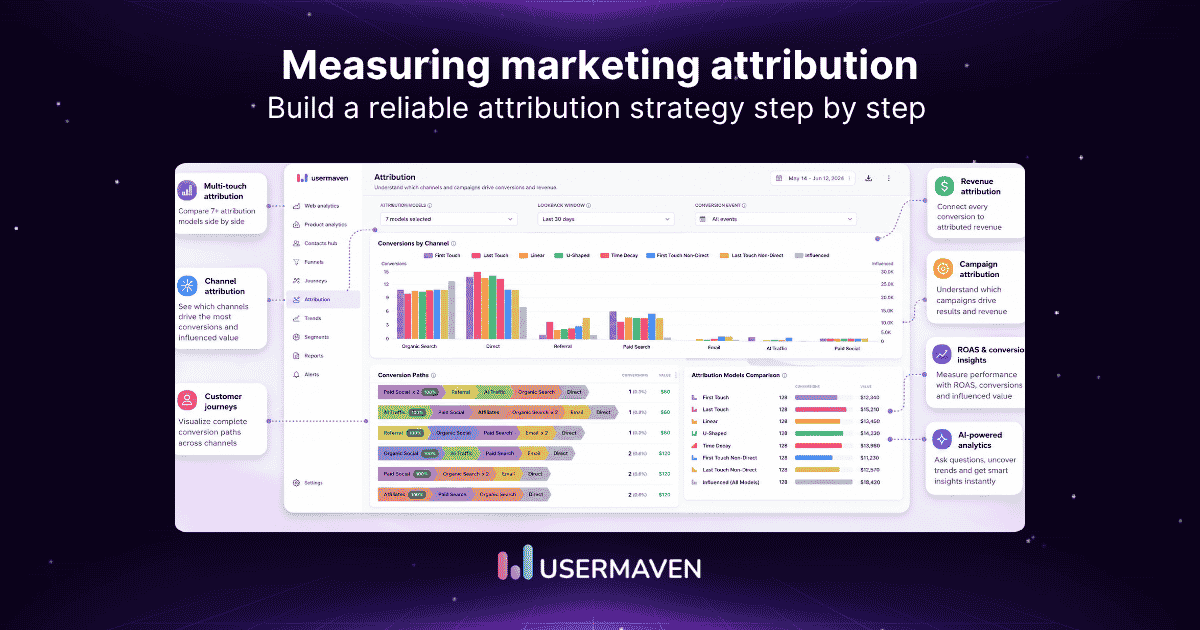
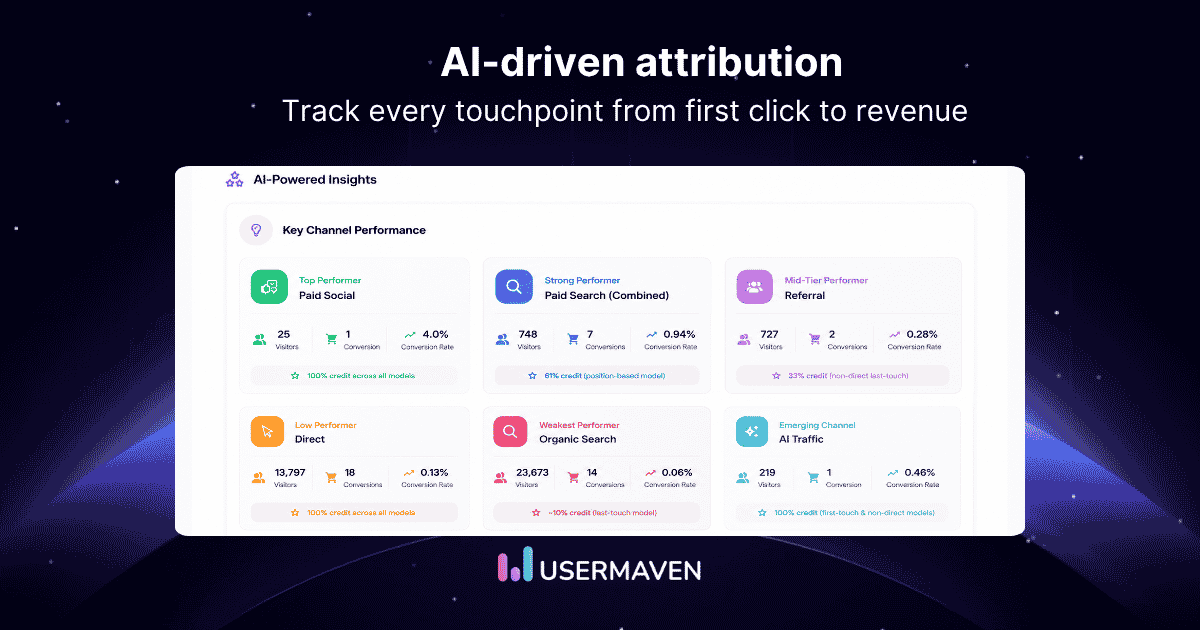
Customers rarely move from discovering a brand to converting on one platform. They may see a Meta advertisement, search on Google, open an email, return directly to the website, explore the product, and complete a purchase or deal through another system.
Reliable cross-platform ad tracking provides the data needed to connect these separate interactions instead of evaluating each channel in isolation.
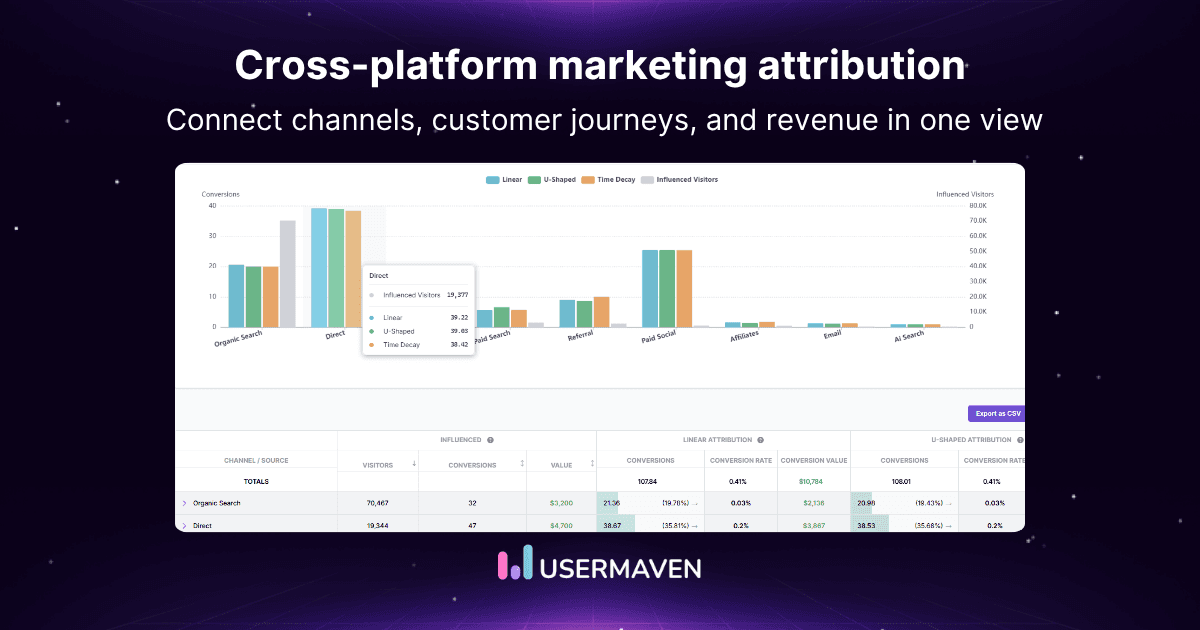
Cross-platform marketing attribution unifies those touchpoints into one journey and applies a consistent method for assigning conversion or revenue credit.
This guide explains how cross-platform marketing attribution works, the main attribution models, its benefits and limitations, implementation steps, and the tools available for measuring performance.
Key takeaways
Cross-platform marketing attribution connects customer interactions across advertising networks, websites, email platforms, product environments, CRM systems, devices, and offline channels.
Accurate attribution depends on consistent campaign naming, first-party tracking, identity resolution, and reliable conversion data because attribution models cannot repair major tracking gaps.
Each attribution model distributes conversion credit differently, so teams should compare several views instead of allowing one platform’s default model to control every budget decision.
The right attribution platform depends on the business model, marketing channels, buying cycle, CRM, data maturity, offline activity, reporting requirements, and available implementation resources.
What is cross-platform marketing attribution?
Cross-platform marketing attribution is the process of connecting customer touchpoints from separate advertising, analytics, CRM, product, and offline systems, then assigning conversion or revenue credit to the interactions that contributed to an outcome.

Instead of reviewing isolated reports from Google Ads, Meta Ads, LinkedIn Ads, email platforms, and website analytics, teams can evaluate these interactions as part of a single journey.
The final outcome may be a:
Form submission
Qualified lead
Product signup
Ecommerce purchase
Subscription
Sales opportunity
Closed deal
Renewal or expansion
Cross-platform attribution provides a consistent framework for understanding how different platforms contributed to that outcome.
Cross-platform attribution example
Consider a prospect who first views a LinkedIn advertisement but does not click it.
Several days later, the prospect searches for the company on Google, reads an article, signs up for a webinar, opens a follow-up email, and eventually books a demonstration.
The deal closes two months later in the CRM.
LinkedIn may claim a view-through conversion, Google may receive credit for the website visit, the email platform may report the demo booking, and the CRM records the final revenue.
Cross-platform attribution connects those interactions and evaluates them under one measurement model instead of accepting every platform’s claim independently.
Attribution reporting vs. platform reporting
Platform reporting shows performance from the perspective of an individual advertising or marketing system.
Each platform uses its own:
Identity signals
Attribution windows
Conversion definitions
Reporting dates
Modeled data
Credit rules
Cross-platform attribution evaluates recorded interactions together using one set of rules.
The goal is not to make every platform report match perfectly. It is to create a consistent measurement view that supports better campaign and budget decisions.
How cross-platform marketing attribution works
Cross-platform attribution requires more than connecting several dashboards. The data must be collected, standardized, matched, and connected with meaningful business outcomes.
1. Collect touchpoint data
The attribution system gathers customer interactions from the platforms involved in acquisition, engagement, conversion, and revenue.
These data sources may include:
Advertising platforms
Website events
Landing pages
Email campaigns
Organic search
Social media
Product activity
Ecommerce platforms
CRM records
Sales calls and meetings
Offline purchases
The result should be a chronological record of the interactions that happened before and after conversion.
2. Standardize campaign information
Campaign data must follow consistent naming rules before it can be combined accurately.
The most important fields commonly include:
Source
Medium
Campaign
Content
Creative
Placement
Keyword
Landing page
Consistent UTM parameters help the attribution system identify the correct source, channel, campaign, and creative across platforms.
Without standard naming, one campaign may appear as several unrelated records. This fragments reporting and reduces confidence in the final attribution results.
3. Resolve customer identities
The same customer may appear as an anonymous visitor, an email subscriber, a product user, a CRM contact, and a paying customer.
Identity resolution attempts to connect those records.
The system may use:
First-party cookies
Login information
Email addresses
User IDs
CRM identifiers
Account or company records
Transaction IDs
Device and browser information
Identity resolution will never capture every journey perfectly. Customers switch devices, reject consent, clear cookies, and use different email addresses.
The goal is to connect as much reliable first-party activity as possible without presenting uncertain matches as confirmed identities.
4. Unify the customer journey
After identities are matched, the platform organizes the available interactions into one timeline.
The unified journey might show:
Meta advertisement viewed
Organic search visit
Blog article viewed
Email subscription
Google Ads click
Product signup
Sales call
Paid conversion
Data can be unified inside an attribution platform, CRM reporting layer, customer data platform, or data warehouse.
The approach matters less than whether the final system preserves the correct interaction order and connects it with the business outcome.
5. Apply an attribution model
The attribution model determines how conversion or revenue credit is divided between recorded interactions.
Some models assign all credit to one click. Others distribute credit across several touchpoints or use historical data to estimate their contribution.
The model should match the question being asked.
For example:
Which channels introduce new customers?
Which interactions help move customers toward conversion?
Which touchpoints appear near the final decision?
Which campaigns contribute to revenue across the complete journey?
No single model answers every question equally well.
6. Connect touchpoints with outcomes
Attribution becomes more valuable when it continues beyond clicks and form submissions.
The reporting system should connect marketing activity with outcomes such as:
Qualified leads
Sales opportunities
Pipeline value
Purchases
Subscription revenue
Closed-won revenue
Repeat purchases
Customer lifetime value
A campaign that generates many leads may still perform poorly when those leads do not become customers.
Cross-platform attribution helps shift reporting from activity volume toward business value.
7. Report and optimize
The final reporting layer should allow teams to compare:
Platforms
Channels
Campaigns
Advertisements
Creatives
Landing pages
Audiences
Customer journeys
Products
Pipeline
Revenue
Teams can then identify where platforms support each other rather than judging every channel only by the conversions it receives directly.
Cross-platform vs. cross-channel vs. multi-channel attribution
These terms are often used interchangeably, but they emphasize different aspects of marketing measurement.
| Term | Main emphasis |
|---|---|
| Cross-platform attribution | Connecting data from separate platforms and technology systems |
| Cross-channel attribution | Measuring contribution across different marketing channels |
| Multi-channel attribution | Distributing credit across several recorded marketing touchpoints |
| Omnichannel attribution | Measuring connected online and offline customer experiences |
Cross-platform attribution focuses on the technology environments that hold the data. These may include advertising platforms, analytics software, CRM systems, ecommerce platforms, and product tools.
Cross-channel attribution focuses more directly on the role of channels such as paid search, organic search, social media, email, referrals, affiliates, and direct traffic.
Multi-channel attribution describes the process of distributing credit across several touchpoints, while omnichannel attribution generally extends measurement across coordinated digital and offline experiences.
In practice, a complete attribution setup may include all four ideas.
Main cross-platform attribution models
Different marketing attribution models can produce very different interpretations of the same customer journey.
A multi-touch attribution approach recognizes several interactions, while single-click models assign the full outcome to one recorded touchpoint.
Google Analytics currently supports data-driven and last-click reporting models. Google removed first-click, linear, time-decay, and position-based models from GA4 in November 2023, although independent attribution platforms may still provide them.
First-click attribution
First-click attribution gives all conversion credit to the first recorded interaction.
If a customer discovers the brand through a Meta advertisement, later returns through email, and finally converts through organic search, Meta receives the entire conversion value.
The first-click attribution model is useful for understanding which campaigns and channels introduce new prospects.
Its main limitation is that it ignores every interaction that happened after discovery.
Last-click attribution
Last-click attribution gives all credit to the final recorded interaction before conversion.
In the previous example, organic search would receive the complete conversion value because it produced the final visit.
The last-click attribution model is simple to understand and can help identify interactions that occur near conversion.
However, it often overvalues branded search, direct traffic, remarketing, and promotional email while undervaluing the channels that created awareness.
Linear attribution
Linear attribution distributes credit equally across every recorded touchpoint.
If a journey contains five interactions, each receives 20 percent of the conversion value.
The linear attribution model recognizes that several channels may contribute to the outcome and provides a balanced view of the full journey.
Its weakness is that equal credit does not necessarily represent equal influence.
Time-decay attribution
Time-decay attribution gives more credit to interactions that occur closer to conversion.
A retargeting advertisement clicked one day before purchase may receive more value than an organic visit that happened three weeks earlier.
The time-decay attribution model can be helpful when recent interactions are more likely to influence the final decision.
However, it may undervalue the channel or campaign that originally created demand.
U-shaped attribution
U-shaped attribution gives greater weight to the first and final recorded interactions while distributing the remaining credit among the middle touchpoints.
A common configuration gives 40 percent to the first interaction, 40 percent to the final interaction, and divides the remaining 20 percent across the middle.
The U-shaped attribution model recognizes the importance of both customer acquisition and conversion.
Its percentages are still predetermined rules and do not prove how influential each touchpoint actually was.
Data-driven attribution
Data-driven attribution uses historical conversion patterns to estimate how much different touchpoints contribute to outcomes.
It may consider:
Channel combinations
Interaction order
Journey length
Converting and non-converting paths
Conversion frequency
Customer segments
Data-driven attribution can reveal patterns that fixed models miss, but it requires enough reliable data to generate stable results.
Its calculations may also be harder for marketers and stakeholders to interpret.
Custom attribution
Custom attribution applies rules designed around a company’s specific buying journey, sales process, or reporting priorities.
A company may give additional credit to product trials, demo requests, qualified opportunities, or interactions from target accounts.
A custom attribution model offers greater flexibility than a standard template.
However, custom rules can reinforce internal assumptions when they are not supported by experiments or historical evidence.
Attribution does not prove causality
Attribution describes how recorded interactions relate to conversions.
It does not prove that a campaign caused the customer to convert or that the conversion would not have happened without it.
Incrementality tests, controlled experiments, geographic holdouts, and audience exclusions provide stronger evidence of causality.
Attribution and experimentation should support each other rather than being treated as competing methods.
Benefits of cross-platform marketing attribution
A unified customer journey
Cross-platform attribution brings activity from separate platforms into one customer journey.
This helps teams understand how advertising, content, email, website behavior, product activity, and sales interactions work together.
Without this view, every department may rely on a different version of the customer journey.
Less duplicate conversion credit
Several platforms can claim the same conversion.
A customer may view a Meta advertisement, click a Google advertisement, and open an email before purchasing. All three platforms may report the sale according to their own rules.
Understanding ad platform discrepancies helps teams identify why reported conversions, revenue, and ROAS often differ between systems.
Independent attribution reduces the risk of adding those platform-reported conversions together and overstating performance.
Better budget allocation
Cross-platform attribution reveals how channels play different roles.
One channel may introduce prospects, another may support research, and another may commonly appear before conversion.
This prevents teams from cutting valuable awareness or nurturing campaigns simply because they rarely receive the final click.
Clearer revenue visibility
Clicks and leads provide only an early view of performance.
Revenue attribution connects campaigns and touchpoints with purchases, subscriptions, pipeline, and closed revenue.
This helps teams compare channels based on the quality and value of the customers they generate.
Stronger marketing and sales alignment
Marketing may focus on campaigns and leads, while sales focuses on opportunities and revenue.
Cross-platform attribution connects those perspectives.
Both teams can examine how marketing interactions contribute to qualified pipeline and how sales activity affects the final journey.
More useful campaign optimization
Individual advertising platforms optimize around the conversions they can observe.
A unified attribution system gives teams an independent view of how those campaigns perform across the complete journey.
This can improve:
Channel allocation
Audience targeting
Creative decisions
Campaign structure
Conversion prioritization
Revenue forecasting
Common cross-platform attribution challenges
Cross-platform attribution becomes difficult because every system collects, defines, and reports customer activity differently. Before teams can trust attribution results, they need to understand the data gaps, privacy limits, and reporting conflicts that affect the full customer journey.

Platform data silos
Advertising, analytics, product, CRM, and payment platforms store data in different formats.
They may use different names for the same campaign, customer, or conversion.
Creating one reliable dataset requires consistent mapping and ongoing maintenance.
Walled gardens
Advertising platforms do not always provide complete user-level or impression-level data.
This can limit independent journey reconstruction, particularly for view-through activity.
The attribution platform may need to combine observable interactions with aggregated or modeled data.
Identity resolution gaps
A customer might research on a phone, return on a work laptop, open an email on another device, and convert after a sales call.
Not every interaction can be connected reliably.
Logged-in user IDs, first-party identifiers, and CRM records improve matching, but gaps will remain.
Cookie and privacy restrictions
Browser restrictions, ad blockers, consent requirements, and reduced access to third-party identifiers limit observable customer activity.
Some platforms use modeled conversions to estimate interactions that cannot be directly measured. Google, for example, uses modeling for cookie-restricted, consent-limited, and cross-device situations.
Cookieless attribution reduces dependence on third-party cookies by using first-party data, server-side collection, CRM information, and privacy-conscious measurement methods.
Conflicting conversion definitions
One platform may report a form submission, while another reports a purchase or qualified opportunity.
Reports cannot be compared reliably when the underlying outcomes are different.
Teams should define the primary conversion events and apply those definitions consistently across connected systems.
Different attribution windows
Platforms may use different periods for connecting an interaction with a conversion.
A seven-day click window, a one-day view window, and a 90-day attribution window will produce different results.
The selected window should reflect the normal customer journey and sales cycle.
Offline customer activity
Phone calls, sales meetings, conferences, retail visits, direct mail, and partner interactions may influence conversion without leaving a standard digital trail.
These interactions must be imported through CRM activity, call-tracking systems, APIs, or manual data processes.
Duplicate conversions
Duplicate records can appear when several tools import the same purchase or lead.
Clear event IDs, transaction IDs, and deduplication rules are necessary before attribution credit is calculated.
Modeled data and uncertainty
Modeled results are estimates based on observed patterns.
They can improve reporting where direct observation is incomplete, but they should not be presented as perfectly measured customer activity.
Teams should understand which results are observed, matched, imported, or modeled.
How to implement cross-platform marketing attribution
1. Define the business outcomes
Begin with the outcomes that influence business performance.
These may include:
Qualified leads
Product signups
Sales opportunities
Purchases
Subscriptions
Pipeline value
Closed revenue
Repeat purchases
Expansion revenue
Avoid building the entire strategy around page views or form submissions when revenue occurs later.
2. Standardize campaign naming
Create one naming system for sources, mediums, campaigns, content, creatives, and placements.
Document the rules and make them available to every person or agency launching campaigns.
Consistent naming prevents the same channel from being divided across several labels.
3. Connect advertising platforms
Import campaign information from the advertising platforms that influence acquisition.
The data may include:
Spend
Clicks
Impressions
Campaigns
Ad groups
Creatives
Conversion events
Confirm whether every platform provides click-level, impression-level, or aggregated data.
4. Track website and product activity
Capture the actions that indicate progression through the customer journey.
Useful events may include:
Landing-page visits
Form submissions
Demo bookings
Account creation
Product activation
Feature adoption
Checkout activity
Purchases
Subscription changes
The event names and properties should remain consistent across the implementation.
5. Connect CRM and revenue data
Marketing attribution should continue into the systems where revenue is recorded.
Connect:
Leads
Contacts
Companies
Opportunities
Deal stages
Purchases
Subscription records
Revenue values
This allows teams to compare channels by pipeline and revenue rather than lead volume alone.
6. Establish identity-resolution rules
Define how the system will connect:
Anonymous sessions
Known website visitors
Product users
CRM contacts
Customer accounts
Purchases
Use deterministic identifiers when possible and document where probabilistic or modeled matching is applied.
7. Select attribution models
Start with a small number of models that stakeholders can understand.
Comparing first-click, last-click, linear, and position-based reporting may initially provide more useful discussion than immediately creating a complex algorithm.
Additional modeling can be introduced once the underlying data is reliable.
8. Validate conversion totals
Compare attribution data with the systems that record the final outcome.
These may include:
CRM records
Payment platforms
Ecommerce orders
Subscription systems
Advertising platforms
Website analytics
Large differences should be investigated before the reports guide budget decisions.
9. Build unified reporting
A marketing attribution dashboard should connect platforms and campaigns with customer journeys, conversions, pipeline, and revenue.
The dashboard should support both executive summaries and deeper investigation.
Teams should be able to move from a channel-level result to the campaigns, customers, or journeys behind it.
10. Review the setup regularly
Attribution is not a one-time implementation.
Regularly audit:
Tracking scripts
Campaign names
UTM parameters
Conversion events
Integrations
CRM fields
Attribution windows
Identity rules
Model assumptions
New channels and campaigns should follow the same measurement standards.
Best cross-platform attribution tools
Cross-platform attribution tools differ in the channels, journeys, and outcomes they measure. The right choice depends on whether the priority is behavioral analytics, ecommerce media measurement, enterprise omnichannel reporting, B2B revenue, paid-media attribution, or offline conversions.
| Tool | Best for | Main cross-platform strength | Pricing approach |
|---|---|---|---|
| Usermaven | Marketing, SaaS, and product-led teams | Connects campaigns, website behavior, product activity, CRM progression, and revenue | Public plans from $84/month |
| Northbeam alternative | Established DTC brands | Ecommerce attribution and advanced paid-media measurement | Starter from $1,500/month; higher tiers custom |
| Rockerbox alternative | Enterprise omnichannel teams | Digital and offline attribution, MMM, and incrementality | Custom |
| Dreamdata alternative | B2B revenue teams | Account journeys, CRM pipeline, and revenue attribution | Free + custom |
| Cometly alternative | Paid-media and performance teams | Server-side tracking, account journeys, CRM, and revenue attribution | Usage based |
| Ruler Analytics alternative | Calls and offline conversions | Connects forms, calls, CRM opportunities, and closed revenue | From $400/month |
Pricing and packaging reflect the vendors’ current official information. Northbeam publishes a $1,500 monthly Starter entry point, Dreamdata offers a free plan with custom advanced pricing, Cometly uses usage-based pricing, and Ruler Analytics starts at $400 per month. Rockerbox remains sales-led, while Usermaven publishes Growth and Scale pricing.
How Usermaven supports cross-platform attribution
Usermaven connects attribution with website activity, product engagement, customer journeys, CRM progression, and revenue.
This broader view helps teams understand what happens before and after a campaign generates a visit or conversion.

Connect paid and organic acquisition
Usermaven brings acquisition data from paid, organic, referral, email, social, and direct channels into one attribution environment.
It also supports advertising integrations including Google Ads, Meta Ads, LinkedIn Ads, and Microsoft Ads.
Teams can compare channels without relying only on the conversion totals reported by each advertising platform.
Follow complete customer journeys
The platform’s user journeys connect acquisition sources with website pages, events, product actions, and conversions.
This helps teams investigate questions such as:
Which channel introduced the customer?
What content supported consideration?
Which product actions appeared before conversion?
How many interactions occurred?
How long did conversion take?
Journey reporting provides context that a channel-level summary cannot show.
Add website and product behavior
Attribution reports explain where customers came from, while behavioral analytics shows what they did afterward.
Usermaven connects acquisition with:
Website activity
Product events
Funnels
Feature adoption
Segments
Cohorts
Retention
User and account profiles
This is particularly useful for SaaS and product-led teams, where signup alone does not indicate customer quality.
Connect CRM progression and revenue
Usermaven’s attribution capabilities can connect campaigns and touchpoints with CRM deals, pipeline stages, and revenue.
Teams can evaluate whether campaigns contribute to:
Qualified leads
Opportunities
Pipeline
Closed revenue
Retained customers
This prevents high-volume but low-quality campaigns from appearing stronger than campaigns that produce fewer, more valuable customers.
Compare attribution models
Usermaven supports several attribution views and adjustable windows for analyzing channel and source performance.
Teams can compare how campaign credit changes depending on whether the focus is discovery, the final conversion click, or the complete journey.
Model comparison encourages better decisions than relying on one default view.
Sync conversion signals with ad platforms
Verified conversion data can be returned to advertising platforms through conversion synchronization.
This helps campaign algorithms optimize toward stronger business outcomes rather than relying only on incomplete browser-side signals.
The process also creates a closer connection between independent attribution and campaign activation.
Investigate performance with Maven AI
Maven AI lets teams ask questions about attribution, campaigns, traffic, journeys, conversions, funnels, product activity, and retention in natural language.
It can help identify top-performing channels, explain changes in conversion activity, and summarize patterns without requiring a new dashboard for every question.
Start without an enterprise implementation
Usermaven provides public pricing, self-serve setup, and a 14-day free trial.
The Growth plan starts at $84 per month, while Scale starts at $199 per month and includes the deeper attribution and revenue capabilities required by growing marketing teams. Annual billing provides a 15 percent discount.
This makes the platform easier to evaluate than enterprise systems that require a sales process, custom contract, and lengthy implementation before teams can test their own data.
Common cross-platform attribution mistakes
Trusting each advertising platform independently
Advertising platforms measure performance using their own data and incentives.
Adding all reported conversions together usually creates duplicate credit.
Use platform reports for campaign management, but maintain an independent attribution view for cross-platform decisions.
Using inconsistent conversion definitions
One platform cannot measure purchases while another measures form submissions and still provide a fair comparison.
Define the primary business outcomes and apply them consistently across systems.
Relying only on last-click attribution
Last click favors interactions that occur close to conversion.
It can undervalue social media, content, video, communities, affiliates, and other channels that create demand earlier.
Compare last click with first click and at least one multi-touch view.
Ignoring offline touchpoints
Sales calls, meetings, conferences, retail activity, and partner referrals may have a major influence on revenue.
Import these interactions through CRM activity, call-tracking systems, APIs, or other data processes.
Using attribution windows that are too short
A 30-day attribution window can exclude the interaction that introduced a customer six months before a deal closed.
The window should reflect the typical sales cycle and time between discovery and revenue.
Failing to connect CRM revenue
Lead volume does not reveal whether campaigns generate valuable customers.
Connect marketing activity with opportunities, purchases, pipeline, and revenue before making major allocation decisions.
Treating attribution as causality
Attributed credit does not prove that a campaign created an additional conversion.
Use experiments and incrementality testing when the decision requires evidence of causal impact.
Buying unnecessary complexity
Advanced MMM, incrementality, and custom modeling require clean data and analytical resources.
A simpler attribution system may provide more value when the organization is still fixing campaign naming, conversion events, and CRM stages.
Final verdict
Cross-platform marketing attribution is necessary when customer journeys move between advertising platforms, websites, email campaigns, product environments, CRM systems, and offline interactions.
The first priority is reliable data collection. Attribution models cannot compensate for missing events, inconsistent campaign names, duplicated conversions, or disconnected revenue records.
The second priority is selecting models that match the question. First-click attribution helps evaluate discovery, last-click attribution focuses on the final interaction, and multi-touch models provide a broader view of the journey.
The right software depends on the organization’s channels, business model, sales cycle, data maturity, and measurement requirements.
Northbeam is designed around advanced ecommerce media measurement, while Rockerbox combines enterprise attribution with MMM and incrementality. Dreamdata focuses on B2B account journeys, Cometly emphasizes paid-media-to-pipeline reporting, and Ruler Analytics is strong for calls and offline revenue.
For teams that want campaigns connected with website behavior, product engagement, customer journeys, CRM progression, pipeline, and revenue, Usermaven provides the strongest all-in-one balance.
Its marketing attribution software combines multi-touch attribution, behavioral analytics, conversion paths, CRM revenue visibility, and Maven AI without requiring a separate enterprise measurement stack.
Ready to see Usermaven in action? Explore the platform or book a demo for a closer look.
FAQs
1. What is cross-platform marketing attribution?
Cross-platform marketing attribution connects customer interactions from separate advertising, analytics, CRM, product, and offline systems.
It then assigns conversion or revenue credit to the recorded touchpoints that contributed to the outcome.
2. How does cross-platform attribution work?
It collects interaction data, standardizes campaign information, resolves customer identities, unifies the journey, applies an attribution model, and connects the result with conversions or revenue. The quality of the final report depends on the accuracy and completeness of the underlying data.
3. What is the difference between cross-platform and cross-channel attribution?
Cross-platform attribution emphasizes connecting separate technology platforms and data systems. Cross-channel attribution focuses on measuring how marketing channels such as paid search, social media, email, organic search, and referrals contribute to conversion.
4. What is the difference between multi-channel and cross-channel attribution?
Multi-channel attribution distributes credit across several interactions or channels. Cross-channel attribution focuses on analyzing how those channels work together across the journey. The terms often overlap in practical marketing use.
5. Which cross-platform attribution tool is best?
The best tool depends on the business model and measurement requirements. Usermaven suits teams that need attribution alongside website and product analytics. Northbeam is designed for DTC media measurement, Rockerbox for enterprise omnichannel analysis, Dreamdata for B2B revenue attribution, Cometly for paid-media-to-pipeline reporting, and Ruler Analytics for calls and offline conversions.
6. How do attribution platforms avoid duplicate conversions?
Updated

Written by
Junaid Ahmed
Content Writer & Digital Marketer
Junaid Ahmed is a content and copywriter with 3+ years of experience creating research-driven content across SaaS, B2B, ecommerce, and digital marketing. He specializes in turning complex topics into clear, practical content that helps marketers better understand their challenges, evaluate solutions, and make informed decisions. His work spans educational content, industry insights, and actionable marketing guides.
All articles by Junaid →