Most marketing funnels stop too early. A B2B SaaS company can generate traffic, leads, demos, or trials and still have a weak funnel if those prospects fail to activate, qualify, become customers, or stay long enough to create durable revenue.
The path also changes by go-to-market motion. Product-led SaaS needs to understand what happens after signup. Sales-led SaaS needs to preserve marketing context through qualification and pipeline. Hybrid SaaS needs both.
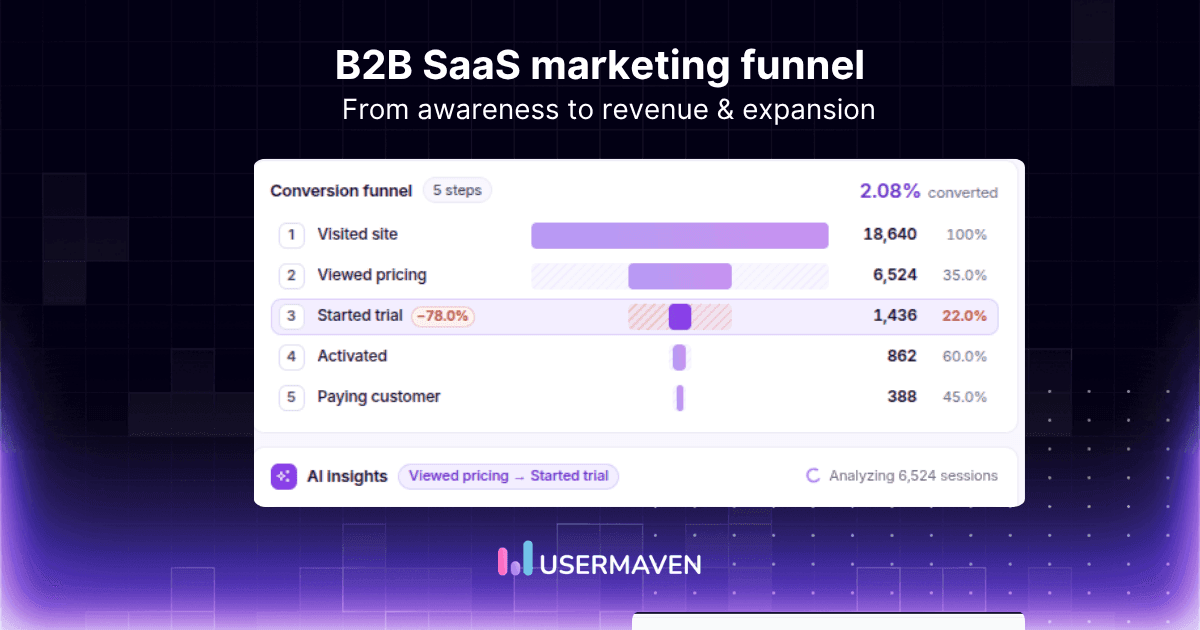
With marketing attribution software, teams can connect acquisition with behavior, product or CRM milestones, and revenue instead of treating the first conversion as the finish line.
This guide shows how to structure a B2B SaaS marketing funnel, what progress looks like at each stage, and how to diagnose the specific leak before changing tactics.
Key takeaways
These principles keep the funnel focused on measurable customer progression rather than traffic or lead volume alone.
B2B SaaS funnels should continue beyond lead or signup into activation or qualification, revenue, retention, and expansion.
PLG, sales-led, and hybrid SaaS require different progression signals even when they share the same broad marketing stages.
Funnel stages, touchpoints, events, conversion goals, CRM stages, and product milestones are related, but they are not the same thing.
Funnel health depends on progression, quality, value, and velocity, not only the number of people entering at the top.
The funnel identifies where progression weakens. Segmentation, journeys, and attribution help explain who is affected, what happened, and which sources create the strongest downstream customers.
B2B SaaS marketing funnel at a glance
A B2B SaaS marketing funnel is a measurement framework for tracking how prospects and accounts move from initial problem awareness through conversion, activation or qualification, revenue, retention, and expansion.
| Stage | Core question | Typical proof of progress |
| Awareness | Has the right audience discovered the problem or category? | Qualified visit or engaged return |
| Consideration | Is the buyer actively evaluating fit? | Pricing, comparison, case study, or use-case engagement |
| Conversion | Has the buyer explicitly raised a hand? | Demo, signup, trial, or contact form |
| Activation / qualification | Is there evidence of real value or fit? | Activation, PQL, MQL, SAL, or SQL |
| Revenue | Did interest become commercial value? | Paid subscription or Closed Won |
| Retention & expansion | Does the customer continue creating value? | Renewal, retention, expansion, or added seats |
| A signup or demo is a funnel milestone, not proof that the funnel created a valuable customer. |
Where B2B SaaS funnels usually leak
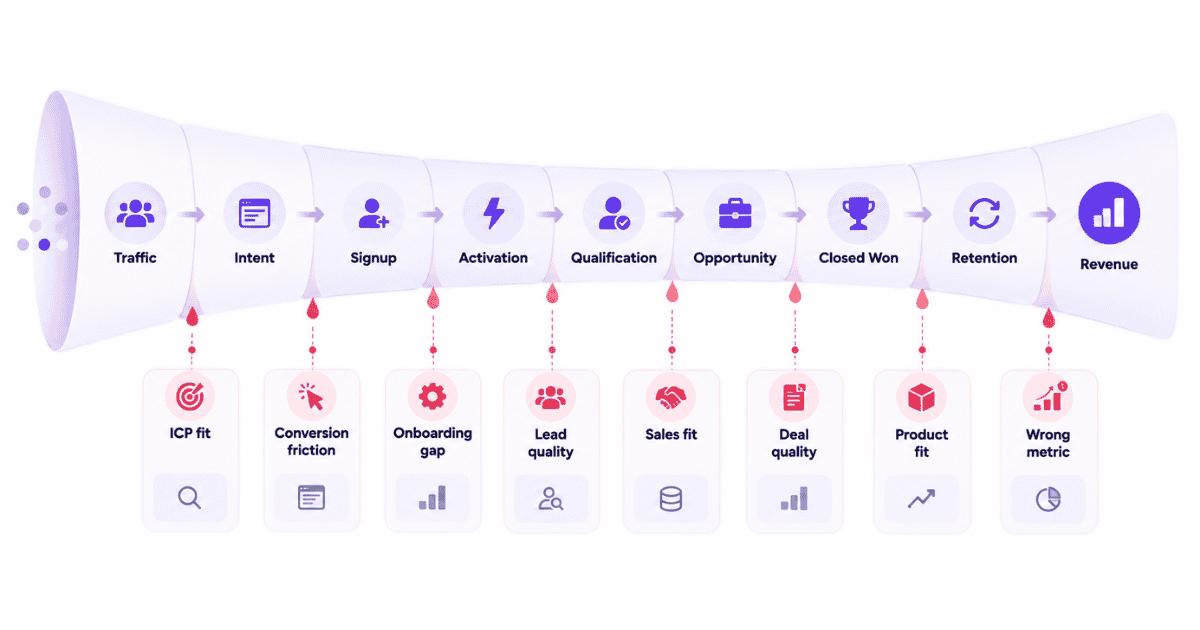
A funnel becomes useful when it helps a team move from a weak business signal to the layer most worth investigating. The largest visual drop-off is not always the most expensive problem.
| Funnel symptom | Likely issue | What to investigate |
| Strong traffic, few high-intent visits | ICP or message mismatch | Source, audience, and landing behavior |
| Many pricing visits, few demos | Offer or conversion friction | Pricing and demo path |
| Many signups, weak activation | Onboarding or product-value gap | Product funnel and time to value |
| Good MQL volume, few SQLs | Targeting or qualification | Lead quality and handoff rules |
| Many SQLs, few opportunities | Sales fit or handoff | CRM progression and account fit |
| Strong pipeline, weak Closed Won | Deal quality or late-stage friction | Opportunity data and objections |
| Many customers, weak retention | Fit or product-value gap | Retention cohorts and adoption |
| Funnel improves but revenue does not | Wrong optimization metric | Pipeline, revenue, CAC, and LTV |
| A funnel leak tells you where progression weakens. It does not automatically tell you why. |
Turn visitors into paying
customers with funnel analysis
Marketing vs. sales vs. product funnels
The SERP for B2B SaaS funnels mixes marketing, sales, product, and customer-lifecycle language. They overlap, but each answers a different operating question.
| View | Starts with | Usually ends with | Main question |
| Marketing funnel | Market or problem awareness | Qualified commercial intent | How does demand progress? |
| Sales funnel | Qualified lead or opportunity | Closed Won | How does a qualified buyer become a customer? |
| Product funnel | Signup or trial | Activation, adoption, or paid | How does a user experience product value? |
| Revenue lifecycle | Acquisition | Retention and expansion | How does acquisition become durable revenue? |
The dedicated b2b sales funnel is where lead qualification and opportunity progression should be explored in depth, while the saas sales funnel focuses more specifically on the SaaS sales and conversion process.
Salesforce makes a similar distinction in its B2B marketing guide, describing the marketing funnel as a progression from awareness through interest, evaluation, purchase, and an ongoing buyer relationship rather than a one-time transaction.
| B2B SaaS growth requires marketing, sales, and product funnels to connect rather than compete as separate reporting systems. |
Stages, touchpoints, events and goals differ
A common measurement mistake is to use a page or tactic as if it were a funnel stage. A stage is the business abstraction. Touchpoints and events are the evidence used to decide whether progression actually happened.
| Concept | Example |
| Funnel stage | Consideration |
| Touchpoint | Comparison page |
| Event | Viewed pricing |
| Conversion goal | Demo booked |
| CRM stage | SQL |
| Product milestone | Activated workspace |
For example, a prospect can view a comparison page without truly entering consideration, while another buyer can move toward a decision through a webinar, an analyst recommendation, or a sales conversation. The stage should represent meaningful business progress, not simply the URL visited.
| Do not build funnel stages around page names. Build stages around meaningful progression and use events as evidence. |
How the funnel changes by GTM motion
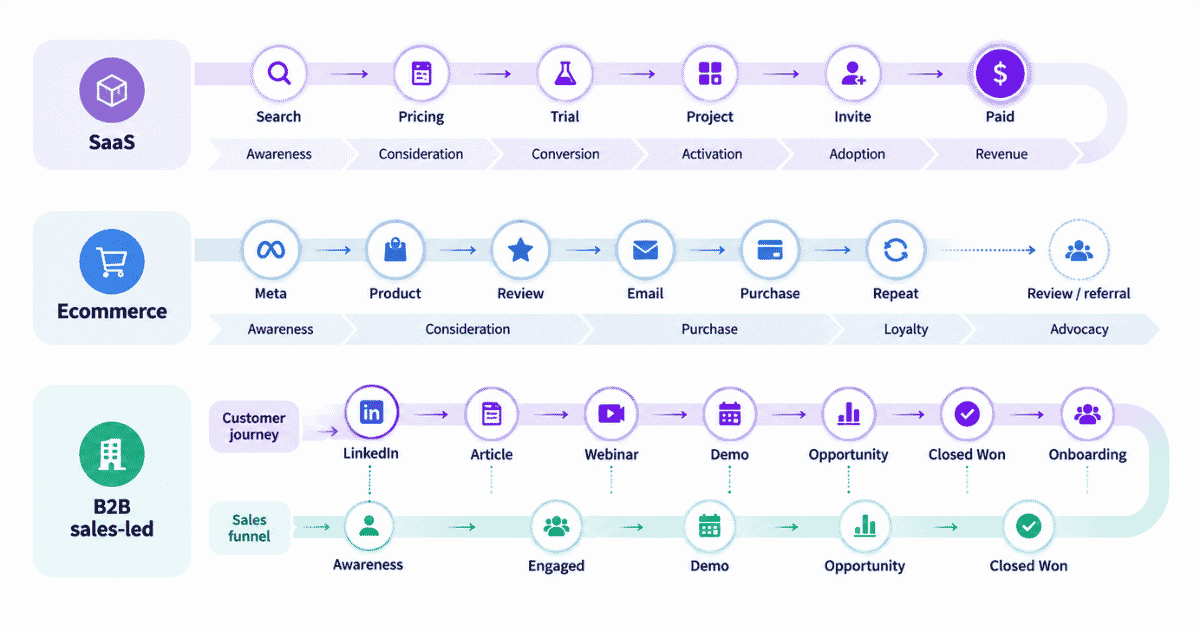
The broad lifecycle may be similar, but the evidence of progress changes substantially between product-led, sales-led, and hybrid SaaS.
Product-led SaaS
A product-led funnel usually needs to continue from acquisition into product behavior: visit -> signup -> activation -> product-qualified user or account -> paid -> retained -> expansion. Signup volume is useful, but activation and retained value reveal whether the acquisition source brought the right users.
Unlock insights that drive growth
Sales-led SaaS
A sales-led funnel shifts into qualification and CRM progression: visit → lead → MQL → SAL → SQL → opportunity → Closed Won → renewal or expansion. The important handoff is not simply marketing to sales; it is the preservation of acquisition context while the account advances.
Hybrid SaaS
A hybrid motion blends product and sales evidence: visit → signup or demo → product activity → qualification → sales engagement → opportunity or upgrade → customer → expansion. A pure web funnel or pure CRM funnel can miss part of this path.
| Funnel layer | PLG | Sales-led | Hybrid |
| First conversion | Signup or trial | Lead or demo | Signup or demo |
| Quality signal | Activation / PQL | MQL / SAL / SQL | Product + sales signal |
| Commercial milestone | Paid upgrade | Opportunity | Upgrade or opportunity |
| Revenue | Subscription | Closed Won | Either or both |
| Post-sale | Retention / LTV | Renewal / expansion | Both |
| Primary data | Product | CRM | Product + CRM |
| The funnel should reflect how the company sells, not a generic SaaS diagram. |
The 6 B2B SaaS marketing funnel stages
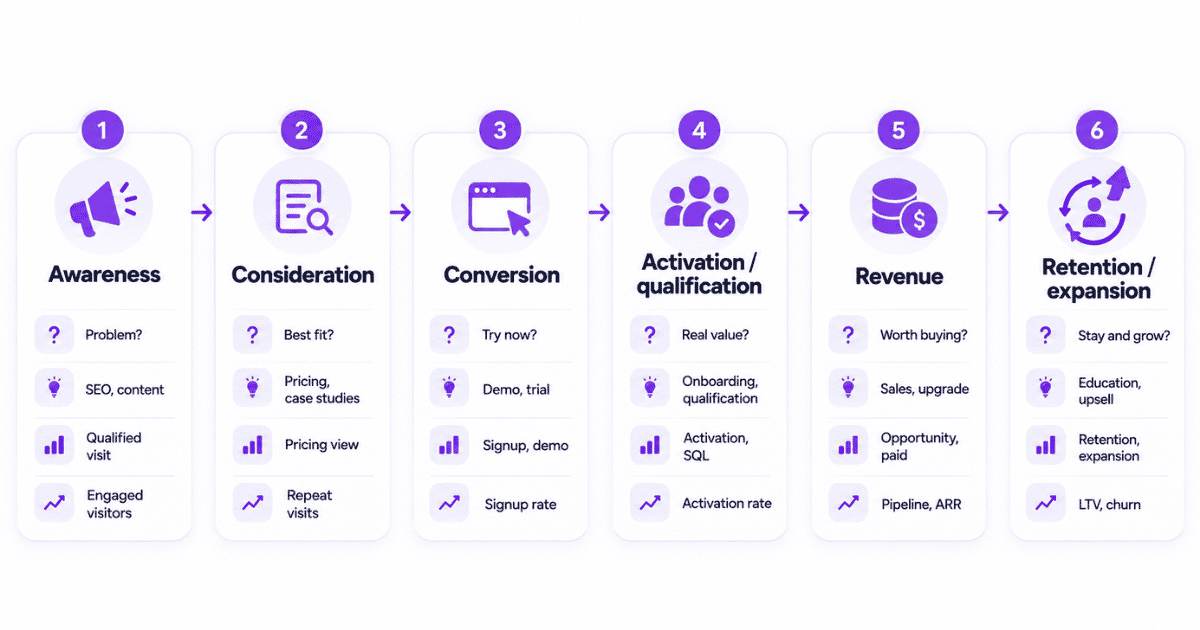
The same six-stage framework can work across B2B SaaS motions if each stage is defined by four things: the buyer question, the marketing job, the observable progression signal, and the metric used to evaluate progress.
1. Awareness
Buyer question: Do I have this problem, and what type of solution exists?
The marketing job is to attract the right market and help prospects recognize the problem, category, and possible approaches. SEO, AI-search visibility, original research, educational content, thought leadership, paid awareness, social distribution, podcasts, and industry events can all contribute.
Useful progression signals include a qualified website visit, meaningful content engagement, a return visit, or movement from educational material into product, use-case, or solution content.
Useful metrics include qualified visits, first-touch source, engaged visitors, return rate, and awareness-to-consideration progression. Raw impressions and traffic can support reach analysis, but they do not prove that the right buyers entered the funnel.
2. Consideration
Buyer question: Which approaches or vendors fit my use case?
At this stage, the job shifts from problem education to fit and evidence. Comparison pages, case studies, webinars, product pages, solution pages, pricing, nurture, and retargeting can help. A dedicated content marketing funnel can go deeper into which formats work at different intent levels without turning this article into a content-format guide.
Progression can show up as pricing views, comparison-page engagement, repeat sessions, case-study consumption, webinar attendance, product-page depth, or a return to high-intent pages.
The best metrics are therefore not only page views. Track consideration-to-conversion rate, repeat visits, high-intent content engagement, and the share of people or accounts that move to signup, trial, or demo.
3. Conversion
Buyer question: Am I ready to experience or evaluate this solution directly?
Conversion here means the first explicit hand-raise or entry into the commercial or product experience. It can be a demo, trial, signup, contact form, consultation, or another defined first conversion. It does not mean final revenue.
High-intent landing pages, pricing clarity, demos, trials, proof, security documentation, and strong message continuity all matter. A lead generation funnel is useful when the specific goal is capturing and nurturing leads, but the B2B SaaS marketing funnel has to continue beyond that point.
Track demo rate, signup rate, trial rate, form completion rate, and the quality of the people or accounts converting. A high form-conversion rate can still be unhealthy if the downstream leads rarely qualify.
4. Activation or qualification
This is the stage where an initial conversion is tested against evidence of real customer potential, whether that evidence comes from product value or sales qualification.
| Acquisition fills the funnel. Activation or qualification shows whether those acquisitions have a realistic path to value. |
This stage changes most dramatically by GTM motion. For PLG, it is usually an activation or product-qualified milestone. For sales-led SaaS, it is a progression from lead toward MQL, SAL, and SQL. Hybrid SaaS may use both product engagement and sales qualification as evidence.
For PLG teams, user activation should be tied to an event that represents first value, not simply account creation. That might be publishing the first campaign, inviting teammates, completing an integration, or reaching another product-specific success milestone.
| Illustrative campaign | Trials | Activated | Paid |
| Campaign A | 500 | 100 | 20 |
| Campaign B | 220 | 150 | 65 |
Campaign A generated more than twice as many trials, but Campaign B produced far more activated and paying customers. Optimizing only for trial volume would have rewarded the weaker funnel.
Useful metrics include activation rate, PQL rate, MQL rate, SAL rate, SQL rate, lead-to-SQL rate, time to activation, and the share of qualified accounts that continue to a commercial milestone.
5. Revenue
Buyer question: Is this solution commercially worth buying?
For PLG, the commercial milestone may be a paid upgrade or subscription. For sales-led SaaS, the funnel moves through opportunity creation and Closed Won. Hybrid teams may reach revenue through a self-serve upgrade, a sales-assisted deal, or both.
Track trial-to-paid rate, opportunity creation, opportunity-to-won rate, paid-media or channel-specific CAC where appropriate, pipeline, attributed revenue, and recurring revenue metrics such as MRR or ARR when they are relevant to the decision.
| A funnel should ultimately be evaluated by the value of the customers it creates, not only the volume of conversions it produces. |
6. Retention and expansion
Buyer question: Does the product continue delivering enough value to stay and expand?
SaaS economics do not end at purchase. Lifecycle communication, customer education, feature adoption, advocacy, account expansion, additional seats, upsell, cross-sell, and renewal support can all influence whether acquisition becomes durable revenue.
That is why Retention analytics belongs in the wider funnel conversation. A channel that creates customers who churn quickly can be less valuable than a smaller source that brings accounts with stronger retention and expansion.
Track retention, churn, expansion MRR or ARR, product adoption, and LTV by source, segment, company size, or acquisition cohort where the data is available.
Measure more than funnel volume
A long KPI list is less useful than a hierarchy that explains what each metric is trying to prove. A disciplined funnel analysis is easier to interpret when metrics are grouped into five layers: volume, progression, quality, value, and velocity.
| Layer | Question | Example metrics |
| Volume | How many entered? | Visits, leads, trials |
| Progression | How many moved forward? | Stage conversion, drop-off |
| Quality | Were they good prospects or users? | Activation, SQL rate, win rate |
| Value | Did the funnel create business value? | Pipeline, revenue, CAC, LTV |
| Velocity | How quickly did they progress? | Time to activation, opportunity, or win |
This hierarchy prevents a common reporting error: treating a larger top of funnel as proof of improvement even when qualification, activation, revenue, or retention gets worse.
B2B SaaS funnel formulas
Simple formulas make funnel definitions consistent across marketing, product, RevOps, and sales. The denominators matter as much as the rates themselves, so document the exact population used for each metric.
Stage conversion rate: Next-stage entrants / Current-stage entrants x 100
Drop-off rate: 1 – Stage conversion rate
End-to-end conversion: Customers / Funnel entrants x 100
Activation rate: Activated accounts / New signups x 100
Lead-to-opportunity rate: Opportunities / Leads x 100
Opportunity win rate: Closed Won deals / Opportunities x 100
For example, if 1,000 signups produce 400 activated accounts and 160 paying customers, signup-to-activation is 40%, activation-to-paid is 40%, and end-to-end signup-to-paid conversion is 16%. The rates make it easier to see which stage is truly constraining customer growth.
Funnel velocity reveals hidden bottlenecks
Conversion rate answers how many people progressed. Funnel velocity asks how long that progression took. B2B SaaS needs both because long sales cycles and delayed product activation can hide operational bottlenecks even when eventual conversion looks acceptable.
| Stage transition | Illustrative time |
| Pricing → Demo | 2 days |
| Demo → Opportunity | 34 days |
| Opportunity → Closed Won | 48 days |
The example does not necessarily show a conversion problem at demo. It may show that qualification, follow-up, stakeholder alignment, or opportunity creation is taking too long.
Useful velocity metrics include time to next stage, time to activation, time to MQL or SQL, time to opportunity, and time to Closed Won. Usermaven Funnels currently includes conversion-time analysis and average time between funnel steps.
| A slow funnel can be unhealthy even when its eventual conversion rate looks acceptable. |
Segment the funnel before fixing it
A single funnel conversion rate can hide several very different funnels. Before changing the page, campaign, or onboarding flow, compare the funnel across the segments most likely to behave differently.
Acquisition source and campaign
Company size or account tier
Persona or role
Geography
Plan or product package
New vs. returning visitors
Enterprise vs. SMB
PLG vs. sales-assisted cohorts
A 25% signup-to-activation rate can be misleading if enterprise accounts activate at 50% while a high-volume paid campaign activates at 8%. The average conceals the segment creating the problem.
| Do not ask only where the funnel leaks. Ask which segment is leaking. |
Measure users or companies depending on the sale
B2B buying often involves several people. One person can discover the product, another can attend a webinar, a third can book a demo, and all of those actions may belong to one account.
| Observed behavior | Account interpretation |
| Person A reads an article | Early research |
| Person B attends a webinar | Consideration |
| Person C books a demo | Commercial intent |
| Company X becomes an opportunity | Account-level progression |
User-level analysis remains useful for behavioral detail. Company-level analysis becomes more useful when multiple contacts contribute to the same commercial progression. Usermaven Funnels currently supports both Users and Companies (B2B) as funnel types.
| For complex B2B deals, the account may be the real conversion unit even when the individual creates the event. |
Pair funnel analysis with customer journeys
The funnel is the company’s progression framework. The customer journey is the path prospects actually take, which is usually nonlinear.
| View | Question | Example |
| Funnel | Where does progression slow? | Signup → Activation = 24% |
| Journey | What did customers actually do around that point? | Pricing → signup → integrations → exit → return → invite team → activation |
The funnel locates the problem. The journey provides behavioral context around it. The dedicated customer journey funnel explains this relationship in more depth without turning the marketing-funnel article into a path-analysis guide.
Connect the marketing funnel to CRM stages
For sales-led and hybrid SaaS, web analytics alone cannot see the full handoff from commercial intent to revenue. Marketing context needs to remain attached as the record advances through qualification and pipeline.
A useful sales-led progression is: Visitor → Lead → MQL → SAL → SQL → Opportunity → Closed Won. The exact definitions should match the company’s operating model rather than a generic benchmark.
In HubSpot-centric teams, the goal is to connect acquisition and behavioral evidence with contact, company, and deal context. The Usermaven guide on why HubSpot users need Usermaven covers that combined workflow in more depth.
For Salesforce teams, Salesforce marketing attribution depends heavily on preserving relationships among leads, contacts, accounts, opportunities, stages, and marketing touchpoints.
HubSpot’s current lifecycle-stage documentation also reflects the same operational idea: lifecycle stages categorize contacts or companies according to where they are in marketing and sales, including Lead, MQL, SQL, Opportunity, and Customer.
Include off-site stages in the funnel
A B2B SaaS funnel often leaves the website before the business outcome happens. Webinar attendance, sales meetings, CRM opportunities, payments, renewals, and offline conversions can all become meaningful funnel milestones.
| Website visit → Webinar → Sales meeting → CRM opportunity → Payment |
Usermaven Event Sources can bring supported CRM, payment, webinar, webhook, CSV, and other off-site events into the same analytics environment so those outcomes can participate in Funnels, Journeys, Attribution, and Conversion Goals.
| The funnel should follow the business outcome, even when that outcome happens outside the website. |
Attribute channels by downstream progression
Once the team knows where customers progress, the next question is which channels put the right customers into the funnel. That is where attribution becomes useful without taking over the entire funnel strategy.
| Channel | Visitors | Trials | Paid customers |
| Channel A | 1,000 | 120 | 20 |
| Channel B | 400 | 80 | 35 |
Channel A creates more volume and more trials. Channel B creates fewer entries but more paying customers. A top-of-funnel report might favor A; a full-funnel view would favor the downstream economics of B.
That is the purpose of b2b marketing attribution: connect observed acquisition touchpoints with deeper outcomes instead of evaluating sources only by the number of people they introduce.
| A channel should not be judged only by how many people it puts into the funnel, but by how far those customers progress. |
How to build a B2B SaaS marketing funnel
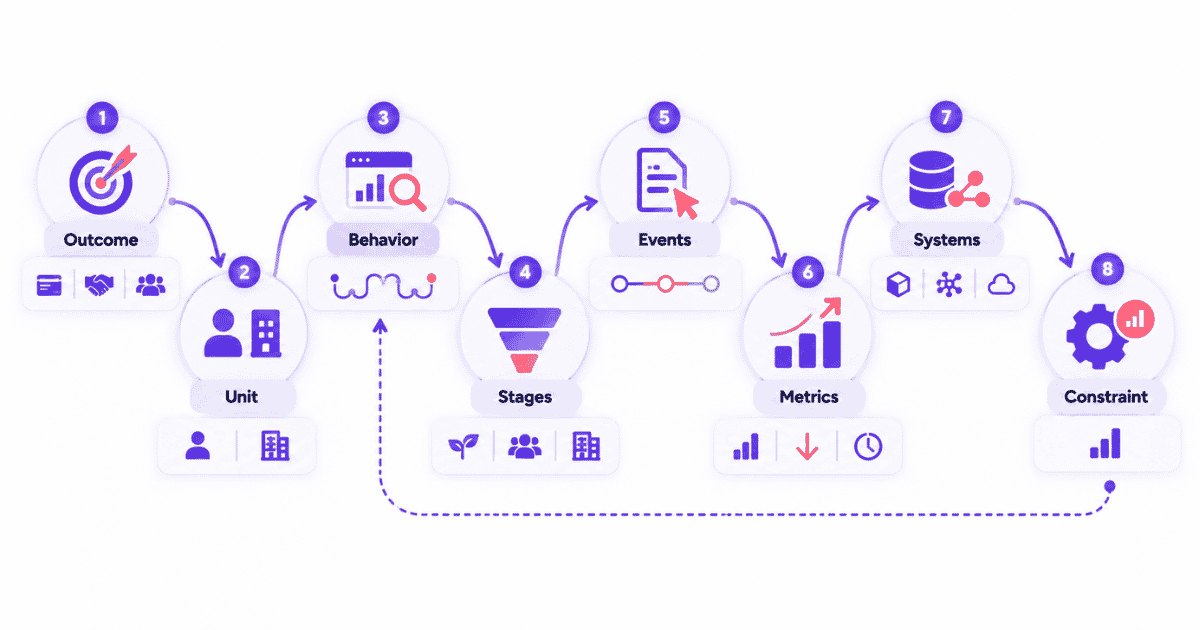
A useful funnel starts with the business outcome and works backward to the signals that prove progress. The steps below keep the model measurable instead of turning it into a theoretical stage diagram.
1. Start with the customer outcome
Define the business outcome first: paid subscription, Closed Won deal, retained customer, expansion event, or another result that matters. Working backward prevents the funnel from being designed around easy-to-count but weak conversions.
2. Choose the correct unit
Decide whether progress should primarily be measured by visitor, user, lead, account, or company. For enterprise and buying-committee motions, company-level progression can be more meaningful than individual conversion.
3. Inspect real behavior
Review actual customer journeys, CRM progression, product usage, and conversion paths before finalizing the stages. Do not draw the funnel first and force customer behavior into it afterward.
4. Define GTM-specific stages
Use PLG, sales-led, or hybrid logic. A self-serve product might need signup → activation → paid, while an enterprise motion may need lead → SQL → opportunity → Closed Won.
5. Choose measurable progression events
Map every stage to observable evidence: event, conversion goal, product milestone, CRM status, payment, or another reliable signal. This is where understanding goal tracking in SaaS becomes practical because each goal should represent a reliable stage transition rather than an easy-to-count action.
6. Set conversion and velocity metrics
Measure both how many move forward and how long it takes. A high-converting step can still be an operational bottleneck if it takes too long.
7. Connect product, CRM, and off-site outcomes
The funnel should not end where the web tracker ends. Connect product activation for PLG, CRM stages for sales-led motions, and off-site revenue events when they determine customer value.
8. Optimize the biggest proven constraint
Prioritize the constraint with the greatest business impact, not automatically the visually largest drop. A small deterioration near revenue can be more expensive than a large top-of-funnel drop with little effect on customer quality.
How Usermaven measures the full SaaS funnel
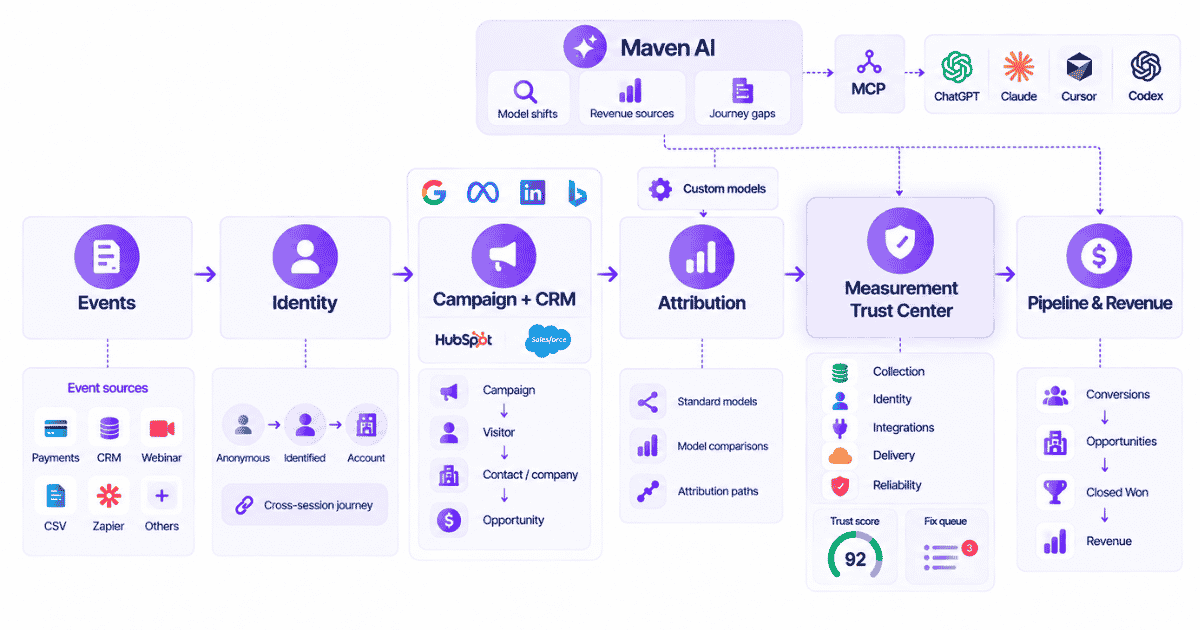
Usermaven is an AI marketing attribution platform that connects marketing, product, CRM, and revenue data so B2B SaaS teams can measure funnel progression from acquisition through customer value. Its B2B SaaS workflow is especially relevant when the funnel crosses product behavior and CRM stages rather than ending at a single web conversion.
When measurement needs to continue past the first conversion, full-funnel revenue attribution connects earlier marketing activity with downstream pipeline and revenue rather than stopping at lead or signup volume.
Measure stage conversion and drop-off
Funnels can model sequential or strict paths, optional steps, completion windows, stage conversion, biggest drop-off, average time between steps, conversion time, breakdowns, comparisons, segments, and both user- and company-level progression.
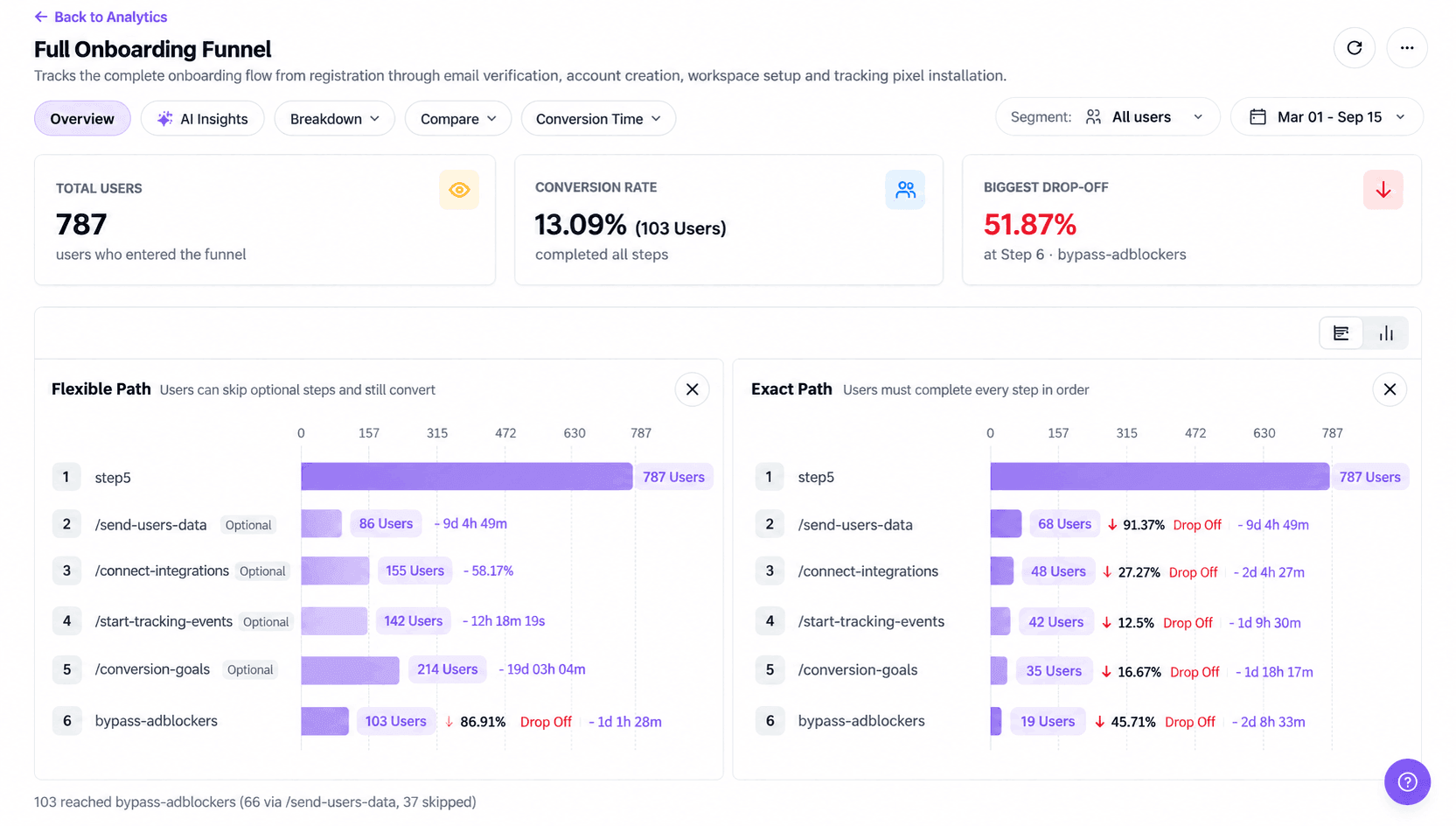
That makes it possible to start with a simple question such as “Where does signup-to-activation break?” and then compare the same funnel by campaign, company segment, date range, or customer type.
Track Lead → MQL → SAL → SQL progression
In its September 25, 2026 product update, Usermaven added a sales-stage funnel that lets teams categorize conversion goals as Lead, MQL, SAL, or SQL and analyze progression through those stages. Attribution can also be filtered by stage, which makes lead quality more visible than a single total-leads number.
For a sales-led team, that creates a practical distinction between channels that generate many leads and channels that keep producing accounts that advance toward SQL and opportunity.
Add product activation for PLG
Product Analytics adds the post-signup evidence a PLG funnel needs: onboarding, activation, feature usage, adoption, and retained behavior. That helps marketing compare acquisition sources by product-qualified outcomes rather than signup count alone.
Use journeys to explain funnel behavior
User Journeys adds path context behind the funnel. When a stage conversion weakens, journeys can show the pages, events, product actions, and return visits that surround the drop-off or eventual conversion.
Connect CRM, pipeline and revenue
For sales-led and hybrid motions, CRM context keeps the funnel moving past the web conversion into opportunity and revenue. Usermaven can bring supported HubSpot and Salesforce context alongside marketing and product behavior, while pipeline attribution helps connect acquisition with opportunities and Closed Won outcomes.
Bring off-site outcomes into the funnel
Event Sources extend the funnel to payments, CRM updates, webinars, webhooks, imports, and other supported events that happen outside the browser. That is useful when the event that proves success is not a website action.
Investigate the funnel with Maven AI
Maven AI can help teams investigate funnel questions without manually rebuilding a separate report for every hypothesis.
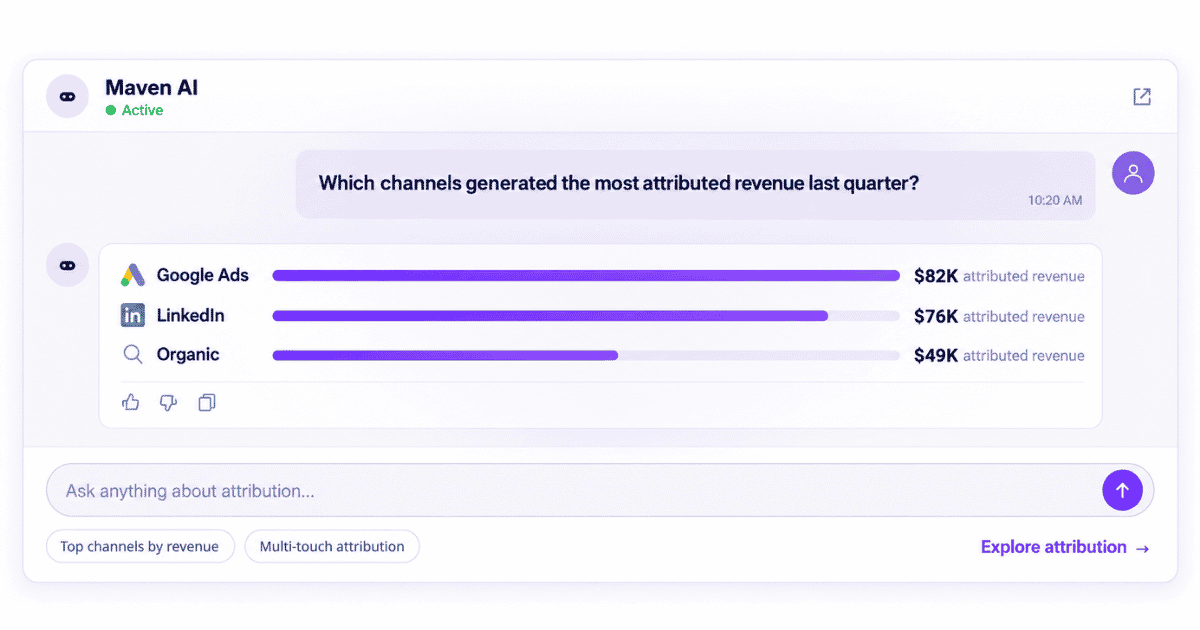
Maven AI can answer questions across funnel, attribution, traffic, and customer behavior data without requiring the team to manually rebuild every report. Useful questions include which stage declined most, which acquisition source creates the highest activation rate, which company segment has the weakest demo-to-SQL progression, and which stage takes longest to complete.
Monitor funnel changes with Maven AI Agents
Maven AI Agents are helpful for recurring analysis and monitoring. In a funnel context, that can support ongoing checks for journey drop-offs, feature adoption changes, accounts showing signs of slipping, or retention shifts instead of waiting for someone to inspect the dashboard manually.
| Maven AI answers the question now. Agents can help monitor the question repeatedly. |
Extend funnel workflows through MCP
Teams that work in compatible AI clients can use Usermaven MCP to query funnel, journey, conversion, and attribution data. With the required permissions and explicit approval, the AI can also create or update supported funnels, conversion goals, segments, journeys, dashboards, reports, and attribution views.
Before optimizing any funnel, the Measurement Trust Center is also useful for checking whether collection, identity, integrations, delivery, and reliability are strong enough to trust the underlying data.
Evidence: Hyperengage prioritized funnel quality
Hyperengage is a useful primary example because it is a B2B SaaS company with long, multi-touch acquisition paths across content, search, podcasts, LinkedIn, email, and partnerships. The team wanted to understand which channels produced qualified signups and pipeline, not merely which sources sent traffic.
In the Hyperengage case study, Usermaven connected channel contribution with customer journeys so the team could re-evaluate where prospects were being introduced and which sources were influencing meaningful conversions.
| Reported attribution outcome | Result |
| Visitor-to-goal conversion | 22.19% |
| Channels attributed | 4 → 6 |
| Organic first-touch conversions | 0 → 8 |
| New sources surfaced | 2 |
The lesson is not that more tracked channels automatically improve performance. The case shows why a B2B SaaS team needs to separate traffic generation from qualified progression and pipeline contribution when deciding where to invest.
| More traffic does not automatically mean a healthier funnel. |
A funnel fix can improve existing traffic
Sometimes the highest-leverage growth move is not acquiring more visitors. It is fixing the stage where already-acquired demand is getting lost.
The ContentStudio case study describes how funnel analysis surfaced a drop-off in the signup and demo-booking flow. After the team changed the experience, ContentStudio reported a 242% increase in demo bookings. The broader implementation also reported 128% growth in signups and 92% more plan upgrades.
Those figures should not be read as proof that one change or one tool caused all growth. The practical lesson is narrower: behavioral evidence can reveal where existing traffic is failing to progress, and fixing that constraint can improve downstream conversion without increasing acquisition volume first.
| Not every growth problem requires more traffic. Sometimes the highest-leverage change is removing friction from traffic already acquired. |
B2B SaaS funnel optimization checklist
Use this checklist before changing channels, landing pages, onboarding, or sales handoffs. It helps separate a measurement problem from a real funnel constraint.
| Check | Question |
| GTM motion | Is the funnel PLG, sales-led, or hybrid? |
| Unit | Should progress be measured by user or company? |
| Stage definition | Does each stage represent a real business transition? |
| Progress signal | Is each stage tied to observable evidence? |
| Conversion | Are stage conversion rates measured? |
| Velocity | Is time between stages measured? |
| Activation | Does signup progress to product value? |
| Qualification | Do leads progress to MQL, SAL, and SQL? |
| CRM | Is acquisition context retained into opportunity and revenue? |
| Product | Is post-signup behavior visible? |
| Off-site events | Are webinars, payments, and CRM outcomes included? |
| Segment | Which cohort or source is actually leaking? |
| Journey | What behavior surrounds the drop-off? |
| Attribution | Which sources create downstream customers? |
| Revenue | Does the funnel create pipeline or revenue? |
| Retention | Do acquired customers stay and expand? |
| Data quality | Can the underlying measurement be trusted? |
Common B2B SaaS funnel mistakes
Most funnel mistakes come from measuring the wrong milestone, using the wrong unit, or optimizing an aggregate number without enough context. These are the problems to rule out before redesigning the funnel.
Stopping at lead or signup
Lead capture and account creation are useful milestones, but they do not prove fit. Continue to activation or qualification and then to revenue.
Measuring traffic instead of progression
A larger audience can make the funnel look healthier while downstream customer quality declines. Evaluate how the entrants progress.
Using one funnel for every GTM motion
PLG, sales-led, and hybrid SaaS need different progression signals. Copying one universal stage model creates reporting that looks tidy but fails to reflect how customers actually buy.
Treating every buyer as one user
For account-based and enterprise sales, company-level analysis may better represent commercial progress than independent user funnels.
Ignoring funnel velocity
Slow movement between stages can constrain growth even when eventual conversion looks acceptable. Time between steps deserves the same attention as drop-off.
Optimizing the average instead of segments
Overall conversion rates can hide a poor campaign, persona, geography, company tier, or acquisition source. Segment before changing the whole funnel.
Treating the funnel as the customer journey
The funnel is a progression model. The journey is the actual sequence of touchpoints and behaviors. Use both, but do not treat them as interchangeable.
Final verdict
A useful B2B SaaS marketing funnel should extend beyond awareness and lead generation. The important question is not only whether people enter, but whether the right prospects continue into activation or qualification, revenue, retention, and expansion.
Its structure should reflect the company’s GTM model and the unit that actually buys. PLG teams need product evidence, sales-led teams need CRM progression, and hybrid teams need both. Conversion, quality, value, velocity, segmentation, and account-level context all matter.
The strongest measurement system combines stage progression with customer journeys, acquisition-source quality, product behavior, CRM outcomes, and revenue. That turns the funnel from a diagram into an operating model for growth.
Book a Usermaven demo to see where B2B SaaS prospects drop off and how acquisition connects with activation, pipeline, customers, and revenue.
FAQs
1. What is a B2B SaaS marketing funnel?
A B2B SaaS marketing funnel is a measurement framework for tracking how prospects and accounts progress from awareness through consideration, conversion, activation or qualification, revenue, retention, and expansion. It is broader than a simple lead-generation or sales funnel because SaaS value continues after the first signup or purchase.
2. What are the stages of a B2B SaaS marketing funnel?
A practical six-stage model is Awareness → Consideration → Conversion → Activation or qualification → Revenue → Retention and expansion. The exact progression signals should change according to whether the company is product-led, sales-led, or hybrid.
3. How is a B2B SaaS marketing funnel different from a sales funnel?
The marketing funnel explains how demand progresses toward qualified commercial intent. The sales funnel focuses on what happens after a lead or account becomes sales-ready, including qualification, opportunity progression, and Closed Won. The two should connect, but they are not the same report.
4. How does a PLG funnel differ from a sales-led SaaS funnel?
A PLG funnel relies heavily on product behavior such as signup, activation, PQL signals, paid upgrade, and retention. A sales-led funnel relies more on lead, MQL, SAL, SQL, opportunity, and Closed Won stages. Hybrid SaaS needs product and CRM signals together.
5. What metrics should B2B SaaS teams track at each funnel stage?
Track five layers: volume, progression, quality, value, and velocity. That can include qualified visits, signup or demo rate, activation rate, MQL-to-SQL progression, opportunity win rate, pipeline, revenue, CAC, retention, LTV, and time between stages.
6. How do you calculate SaaS funnel conversion rate?

Written by
Ryan Mitchell
Marketing Analytics Strategist
Ryan Mitchell is a marketing analytics strategist specializing in campaign measurement, customer journeys, and marketing performance. He writes about analytics, reporting, and data-driven marketing strategies, helping SaaS and B2B teams measure what matters across every stage of the customer journey.
All articles by Ryan →