A B2B SaaS campaign can generate cheap clicks and hundreds of signups while creating almost no pipeline. Another can look expensive at the lead stage but bring activated users, qualified opportunities, and recurring revenue.
That is why paid ads attribution for SaaS has to continue beyond the first form fill or trial. The useful path is ad spend to visitor, signup or lead, activation or qualification, customer, and revenue. The exact milestones depend on whether the business is product-led, sales-led, or hybrid.
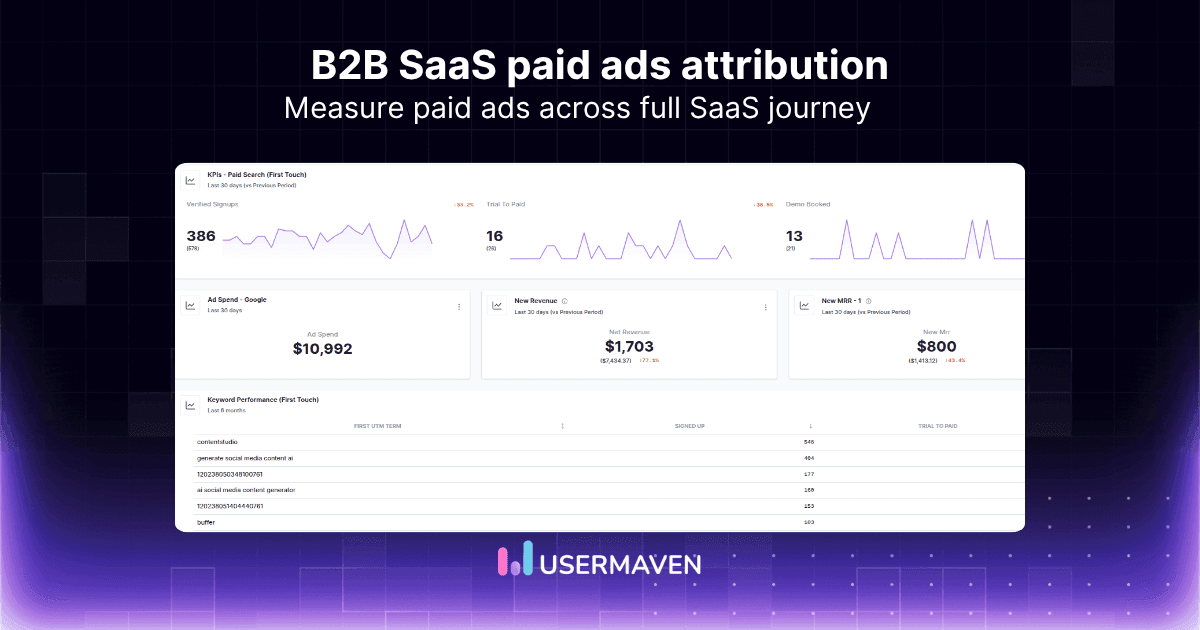
With AI marketing attribution software, teams can connect paid acquisition with website behavior, product activity, CRM outcomes, and revenue. This guide explains B2B SaaS paid ads attribution and how to build that measurement layer without confusing platform attribution with customer value.
B2B SaaS paid ads attribution at a glance
B2B SaaS paid ads attribution is the process of connecting advertising spend and paid campaign interactions with downstream SaaS outcomes such as activation, qualified pipeline, customers, recurring revenue, retention, and LTV.
The goal is not simply to identify which ad generated a form submission. It is to determine which paid acquisition efforts contribute to valuable customers over the full buying journey.
| Question | Short answer |
|---|---|
| What should paid ads attribution connect? | Spend to downstream customer value |
| Is a lead or signup enough? | Usually no |
| Best PLG outcomes | Activation, paid upgrade, retention, LTV |
| Best sales-led outcomes | MQL/SQL, opportunity, Closed Won, revenue |
| Can one ad platform show the full journey? | Usually not |
| Does model choice solve bad tracking? | No |
| Is first touch always best? | No |
| Is last touch always best? | No |
| Should the longest attribution window always be used? | No |
| Best setup | Ad data + website identity + product/CRM outcomes + revenue |
| B2B SaaS attribution should continue until the business outcome that actually determines customer value. |
Why paid ads can look good while revenue does not
Paid media metrics are useful for understanding delivery and acquisition efficiency. They become misleading when they are treated as the final business outcome.
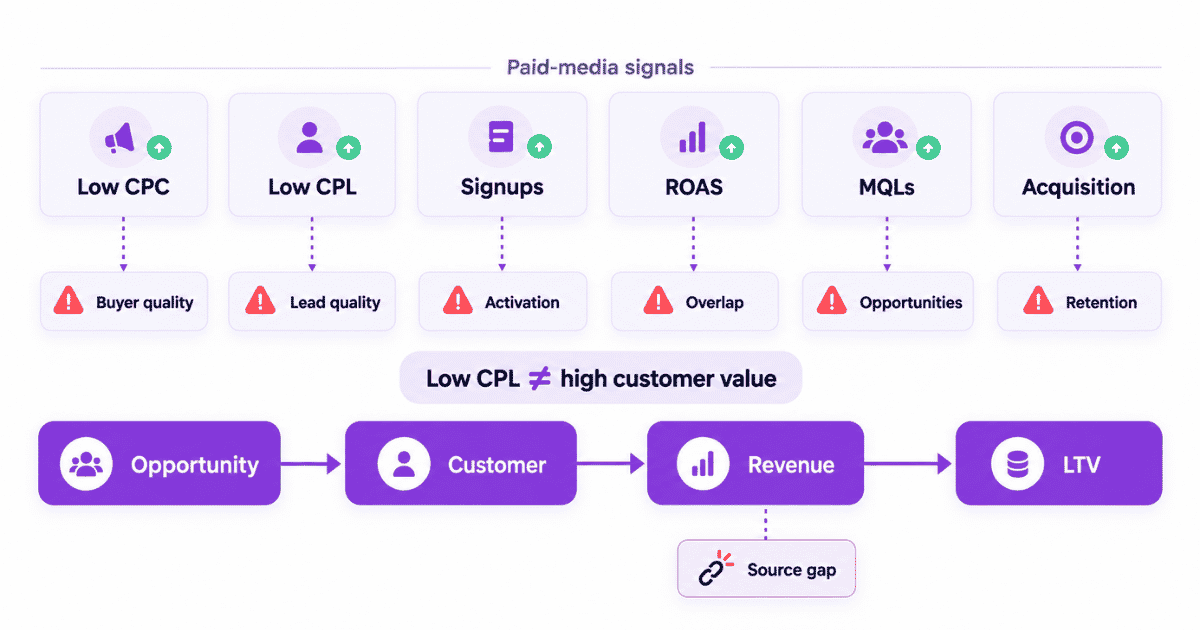
| What the dashboard shows | What may actually be happening |
|---|---|
| Low CPC | Cheap traffic, weak buyers |
| Low CPL | High lead volume, poor qualification |
| High signup volume | Weak activation |
| Strong platform ROAS | Several platforms may be claiming overlapping conversions |
| Weak first-week ROAS | Conversions may mature later |
| Many MQLs | Few opportunities |
| Strong paid acquisition | Weak retention or LTV |
| CRM revenue with no source | Identity or tracking gap |
A campaign can therefore look efficient at the top of the funnel while destroying value later. For B2B SaaS, the useful question is not simply which campaign creates the cheapest conversion. It is which campaign creates the strongest downstream customer economics.
| The cheapest lead is not necessarily the cheapest opportunity or customer. |
Visualize & optimize
user journeys with Usermaven
Where AI helps B2B SaaS attribution
AI can accelerate investigation once the tracking foundation is reliable. It can compare campaigns by downstream value, identify where paid traffic drops out, investigate conversion lag, compare activation by campaign, and surface channels that create cheap leads but weak opportunities.
AI cannot repair missing identifiers, broken CRM syncs, or untracked revenue events. If the customer journey is incomplete in the underlying data, the analysis will inherit that gap.
Map attribution to the SaaS go-to-market motion
The most important design choice is not the attribution model. It is deciding which customer milestones actually define value for the company’s go-to-market motion.
| Layer | PLG SaaS | Sales-led SaaS | Hybrid SaaS |
|---|---|---|---|
| First conversion | Signup / trial | Lead / demo | Signup or demo |
| Quality signal | Activation | MQL / SQL | Product usage + qualification |
| Commercial milestone | Paid upgrade | Opportunity | Opportunity or paid upgrade |
| Revenue | Subscription / MRR | Closed Won | Subscription + deal revenue |
| Customer quality | Retention / LTV | Renewal / expansion | Both |
| Main downstream system | Product analytics | CRM | Product + CRM |
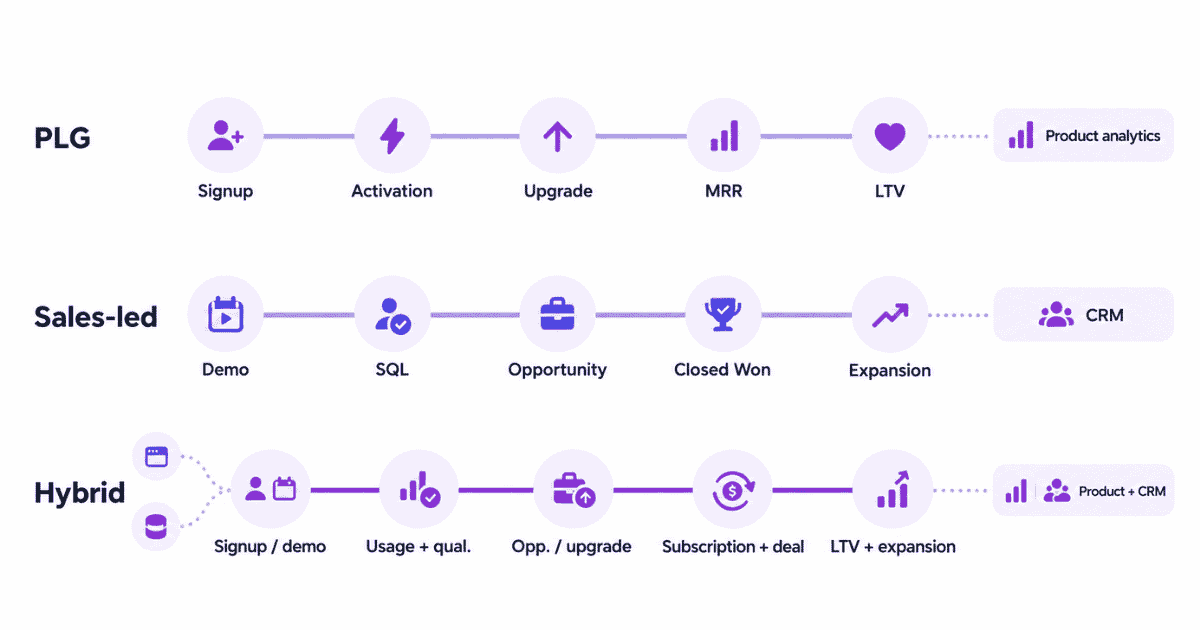
Usermaven’s B2B SaaS analytics connects acquisition with product activity, pipeline, revenue, retention, and LTV, which is why the attribution endpoint can move beyond the first conversion.
| A paid attribution setup should mirror how the company actually acquires and monetizes customers. |
Paid ads attribution for product-led SaaS
Product-led SaaS teams usually need to look past signup volume. The acquisition path should continue into the product because trial quality is often more important than trial quantity.
| Paid ad -> signup -> activation -> key product event -> paid upgrade -> retention / LTV |
Suppose Campaign A creates 500 signups but only 20 users activate and eight become paid customers. Campaign B creates 180 signups, 70 users activate, and 34 become paid. Campaign A wins on acquisition volume, but Campaign B creates much stronger product-qualified growth.
This is where product analytics and funnels add the missing context. They show whether paid users reach activation milestones, adopt the product, and progress toward a paid outcome.
For PLG teams, useful paid attribution goals can include activated trial, subscription started, plan upgraded, retained customer, or another product event that is closer to actual value than a raw signup.
Paid ads attribution for sales-led SaaS
Sales-led SaaS attribution has a different endpoint. The first website conversion is often a lead or demo request, while the commercial outcome appears later in the CRM.
| Paid ad -> lead / demo -> MQL -> SQL -> opportunity -> Closed Won -> revenue |
The gap between lead attribution and revenue attribution is where pipeline attribution becomes important. Campaigns should be compared not only by lead volume, but also by opportunity creation, pipeline value, win rate, Closed Won revenue, and time to close.
HubSpot
For HubSpot-based teams, marketing attribution becomes more useful when website activity and identity can be connected with contacts, companies, deals, pipeline stages, and related engagement data. That allows a paid campaign to be evaluated after the form submission instead of ending the journey at the lead.
Salesforce
For Salesforce teams, the same principle applies across Accounts, Contacts, Leads, Opportunities, stage history, and contact roles. Usermaven’s Salesforce integration is read-only, so the CRM remains the system of record while marketing and behavioral data can be analyzed alongside the opportunity lifecycle.
The difference is practical: a campaign that creates 50 leads and one opportunity can be weaker than a campaign that creates 15 leads and six opportunities, even when the first campaign looks better in the ad dashboard.
Unlock insights that drive growth
Paid ads attribution for hybrid SaaS
Hybrid SaaS combines product-led behavior with sales qualification. A buyer may sign up, use the product, trigger an activation milestone, speak with sales, enter an opportunity, and convert through a contract.
| Paid ad -> signup -> activation -> sales qualification -> demo -> opportunity -> paid account |
That means attribution needs both product and CRM context. Product events reveal whether the acquisition source brings users who experience value. CRM events reveal whether those users become commercially qualified and progress through the sales cycle.
| A hybrid SaaS company cannot evaluate paid acquisition accurately if product usage and sales pipeline live in separate measurement systems. |
Build the paid attribution data architecture
Reliable attribution starts by connecting the data that describes the paid interaction with the events that describe customer value. The model comes later.
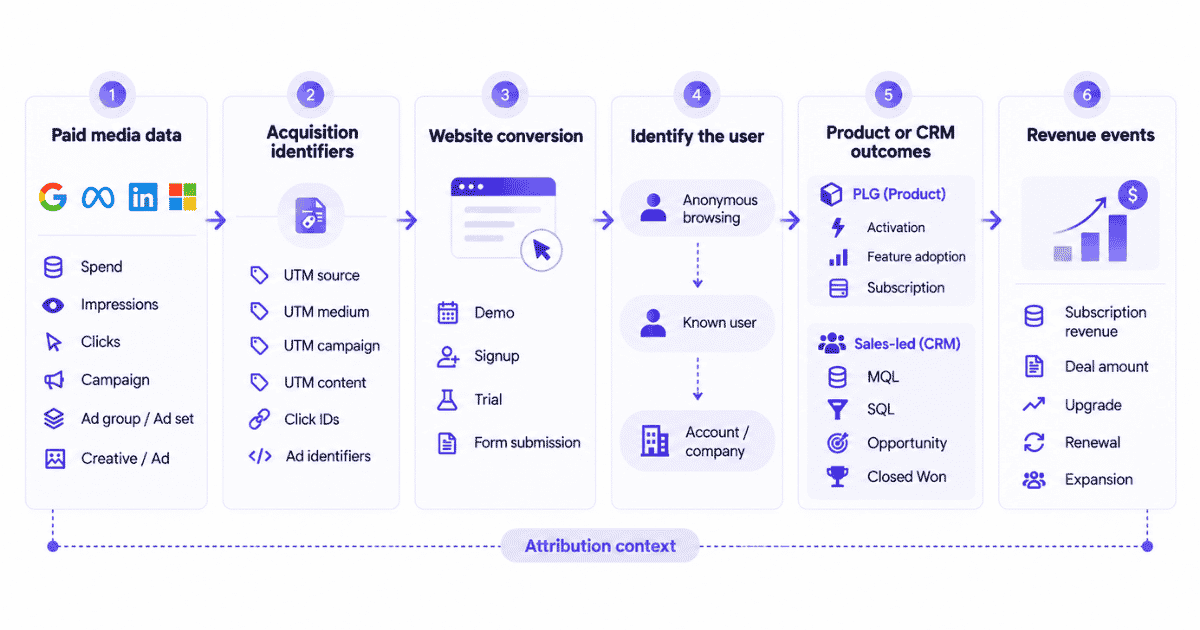
1. Capture paid media data
A connected paid media layer should bring in spend, impressions, clicks, campaign, ad group or ad set, and creative-level context. Usermaven’s paid ads attribution supports Google Ads, Meta Ads, LinkedIn Ads, and Microsoft Ads for this reporting layer.
2. Preserve acquisition identifiers
UTM parameters and platform-specific identifiers preserve the acquisition context after the click. A consistent UTM parameters structure should identify the source, medium, campaign, and creative without creating different naming conventions for every team.
For ad-level attribution, platform identifiers matter as well. Usermaven’s current paid-ad documentation uses ad IDs and click identifiers to tie downstream conversions back to the correct campaign hierarchy.
3. Track the website conversion
The first website conversion should be explicit: demo requested, trial started, account created, form submitted, or another outcome. That event is useful, but it is normally only the first milestone in the SaaS attribution chain.
4. Identify the user
Anonymous acquisition history needs to be stitched to the person when the user signs up, logs in, or otherwise identifies. A stable user ID is the strongest deterministic link because it lets later product, CRM, and off-site events attach to the same person.
If the marketing site and app live on different domains, cross-domain identity handling also matters. Otherwise, the acquisition session can become disconnected from later product behavior.
5. Add product or CRM outcomes
For PLG, send activation, feature adoption, trial conversion, and subscription events. For sales-led SaaS, connect the CRM milestones that matter: qualification, opportunity creation, stage movement, Closed Won, and deal value.
6. Add revenue events
The final layer should include the commercial outcome the business wants to optimize. That may be subscription revenue, deal amount, upgrades, renewals, or expansion revenue.
Identity comes before attribution models
Attribution only works when the paid interaction can be connected with the later conversion. Before debating first touch versus last touch, the measurement system has to resolve the visitor into the same person who later activates, becomes an opportunity, or generates revenue.
Usermaven’s current identity workflow connects anonymous visitor activity with a known profile when the site identifies the user. Event Sources can also carry user ID, anonymous ID, or email. A stable user ID provides the strongest deterministic match.
This is why a sophisticated model cannot compensate for broken stitching. If Campaign A is recorded at the click but the paid upgrade arrives as an unrelated person, no weighting formula can restore the missing connection. Once identity is stable, User Journeys can show how paid acquisition, return visits, product activity, and later conversion events connect across the observed path.
| A sophisticated attribution model cannot rescue a customer journey that was never stitched together correctly. |
Account-level attribution still has limits
B2B SaaS journeys can involve several people from the same company. One person may click an ad, another may research the product, a third may join a webinar, and a procurement contact may appear later in the CRM.
| VP clicks LinkedIn ad -> Marketing Manager visits through Google -> Director attends webinar -> Opportunity enters CRM |
Person-level tracking does not automatically reconstruct every member of that buying committee. Company and CRM enrichment can add useful context, but teams should avoid treating one observed person’s journey as proof of the entire account’s influence.
The safer approach is to distinguish what is observed from what is inferred. Use contact and account relationships when they are available, but do not invent touchpoints that were never captured. For the broader account and channel context beyond paid media, B2B marketing attribution covers how multiple marketing interactions can contribute across a longer buying journey.
Track off-site conversions with Event Sources
Many of the most important B2B SaaS outcomes happen outside the website. Usermaven Event Sources can bring supported CRM, billing, webinar, webhook, CSV, and other off-site events into the same analytics and attribution environment.
| Paid ad -> website demo -> CRM opportunity -> Closed Won -> revenue event |
This is especially useful when the website can observe the initial form submission but the real value appears later in Stripe, Paddle, a CRM, a webinar platform, or an offline sales process.
For identity, send the same stable user ID where possible. An anonymous ID can preserve pre-signup context, while email works as a fallback when a stronger identifier is not available.
Measure the right B2B SaaS paid ads metrics
Paid attribution becomes more useful when metrics are grouped by where they sit in the funnel. The goal is to avoid optimizing a top-funnel metric while ignoring a downstream quality problem. The same principle applies across performance marketing attribution: media efficiency should be read alongside conversion quality and downstream value.
| Layer | Useful metrics |
|---|---|
| Media | Spend, CPM, CPC, CTR |
| Acquisition | CPL, CPA, signup rate, demo-booking rate |
| Quality | Activation rate, MQL rate, SQL rate, trial-to-paid rate |
| Pipeline | Cost per opportunity, attributed pipeline, pipeline per ad dollar, win rate |
| Revenue | Attributed revenue, attributed ROAS, value per conversion, paid-media CAC |
| Customer quality | Retention, expansion revenue, LTV, LTV:CAC |
B2B SaaS paid attribution formulas
Attributed ROAS
| Attributed ROAS = Attributed revenue / Ad spend |
Use this when the conversion value reflects actual revenue rather than a placeholder lead value.
Cost per opportunity
| Cost per opportunity = Paid ad spend / Attributed opportunities |
This is often more decision-ready than CPL for sales-led SaaS because it measures how efficiently paid acquisition creates a real pipeline.
Pipeline per ad dollar
| Pipeline per ad dollar = Attributed pipeline value / Paid ad spend |
This helps compare campaigns that produce different lead volumes but materially different opportunity values.
Value per conversion
| Value per conversion = Attributed conversion value / Attributed conversions |
This is useful when the same conversion type can carry different values, such as plans, contracts, or transaction amounts.
Paid-media CAC
| Paid-media CAC = Paid ad spend / Customers attributed to paid media |
Paid-media CAC is not automatically the same as total CAC. A full CAC calculation may also include salaries, agencies, creative production, software, and other acquisition costs.
Why CPL can mislead B2B SaaS teams
Lead cost is useful, but it can hide large differences in lead quality. A simple worked example shows why:
| Campaign | Spend | Leads | CPL | Opportunities | Customers | Revenue |
|---|---|---|---|---|---|---|
| A | $10K | 200 | $50 | 4 | 1 | $6K |
| B | $10K | 80 | $125 | 18 | 7 | $42K |
Campaign A wins on lead volume and CPL. Campaign B creates fewer leads but far more opportunities, customers, and revenue.
| A cheap lead can be an expensive customer acquisition strategy. |
Platform attribution vs. independent attribution
An ad platform and an independent attribution system can report different conversion numbers without either report being automatically wrong. They may use different identity signals, windows, click or view rules, conversion definitions, and credit models.
| Measurement layer | Best used for |
|---|---|
| Ad platform attribution | Platform bidding, delivery, and optimization |
| Independent attribution | Cross-channel comparison and budget analysis |
| CRM / revenue data | Confirming pipeline, customer, and commercial value |
Google’s current enhanced conversions for leads is one example of an ad platform using first-party lead data to improve measurement and bidding. The underlying idea is useful for B2B SaaS: deeper customer outcomes are more valuable than stopping at the first web event.
LinkedIn also supports server-side conversion data through Conversions API. These platform workflows improve each platform’s own optimization, while an independent attribution layer remains useful for comparing channels under one measurement framework.
The practical rule is to use platform attribution for platform optimization and independent attribution for cross-channel budget decisions, then validate the commercial outcome against product and CRM data. Teams comparing implementation options can use the separate ad attribution software for SaaS guide without turning this measurement framework into a vendor list.
Conversion date vs. spend date
B2B SaaS has a timing problem that many ad dashboards hide. A campaign clicked in January can create a signup in January, an opportunity in February, and Closed Won revenue in April.
Usermaven’s Paid Ads Attribution provides two ways to ask the timing question.
By Conversion Date
This view starts with conversions that happened during the selected reporting period, then looks backward within the lookback window to find eligible ad touchpoints.
| Question answered: Which ads influenced the conversions that happened during this period? |
By Spend Date
This view starts with ad spend and clicks from the selected period, then follows those interactions forward through a look-ahead window to capture later conversions.
| Question answered: What did the money spent during this period eventually produce? |
| View | Starts with | Best question |
|---|---|---|
| Conversion Date | Conversion | What converted this month? |
| Spend Date | Ad spend / click | What did this period’s spend eventually produce? |
Choose the right attribution window
The attribution window defines how far the measurement system looks for eligible touchpoints around a conversion. Usermaven supports long windows for teams with extended journeys, but the maximum available setting is not automatically the correct one.
A short trial-to-paid motion may reach most conversions within a few weeks. Enterprise SaaS may require a much longer window because procurement, legal review, stakeholder alignment, and product evaluation can stretch the journey.
Choose the window from observed time-to-conversion data. If 95% of qualified customers convert inside 60 days, a much longer window may add old interactions that no longer help the decision.
| The correct attribution window is the one that reflects how long real customers take to convert. |
Choose the attribution model by question
B2B SaaS teams do not need a giant attribution-model taxonomy every time they evaluate paid campaigns. They need a model that answers the question being asked.
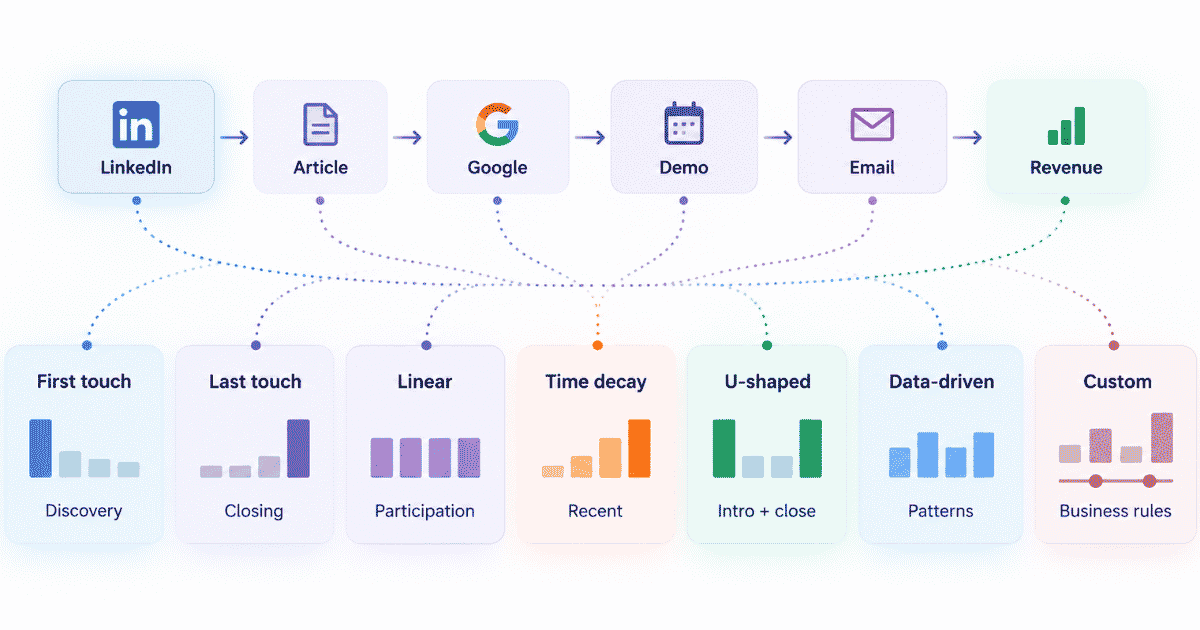
| Business question | Useful lens |
|---|---|
| Which ads introduce valuable customers? | First touch |
| Which touchpoints occur near conversion? | Last touch |
| Which interactions participate across the journey? | Linear |
| Which recent interactions receive more weight? | Time decay |
| Which opening and closing touches matter most? | U-shaped |
| Does the business need custom business-specific weighting? | Custom attribution |
For a deeper model comparison, the multi-touch attribution guide explains how several touchpoints can receive credit across one conversion journey.
Enterprise teams that need business-specific rules can use custom attribution models. Usermaven’s September 2026 release added configurable milestone weights and channel multipliers, with versioned models applied across attribution breakdowns.
| Changing attribution models changes credit distribution. It does not change what customers actually did or how much revenue the business generated. |
Attribution is not incrementality
Attribution and incrementality answer different questions.
| Method | Question |
|---|---|
| Attribution | Which observed marketing interactions receive credit for a conversion? |
| Incrementality | What additional outcome occurred because the advertising ran? |
If LinkedIn receives $100K of attributed revenue, that does not prove the campaign caused $100K of additional revenue. The distinction is covered in more depth in incremental revenue attribution.
Attribution is still valuable for budget analysis, journey understanding, and reporting. It simply should not be presented as causal proof.
Handle the dark funnel carefully
Paid attribution can observe ad clicks, known website visits, product actions, CRM milestones, supported off-site conversions, and revenue events that are actually captured.
It may not independently observe a private recommendation, a Slack discussion, word of mouth, an ad impression that was never clicked, or an offline conversation that was never recorded.
| Paid ads attribution measures observable contribution. It does not automatically reconstruct every influence in a B2B buying process. |
Send better conversion signals back to ad platforms
Measurement is more useful when deeper first-party outcomes can improve optimization as well as reporting.
| Ad platform -> visitor -> qualified outcome -> attribution -> conversion feedback -> ad platform |
For PLG, a stronger signal might be an activated trial, paid upgrade, or subscription purchase rather than every signup. For sales-led SaaS, a qualified lead or another deeper sales milestone may be more useful than every form submission.
Usermaven currently supports conversion sync workflows for Google Ads and Meta. Google click identifiers such as gclid, wbraid, and gbraid, and Meta identifiers such as fbclid, help the destination platform connect the returned event to the original ad interaction.
Do not assume every downstream event can be synced into every ad network. Use the events and destinations currently supported by the platform, and keep the independent attribution report separate from the bidding signal.
Check data quality before changing models
Before arguing over model choice, validate the measurement foundation. Usermaven’s Measurement Trust Center checks data health across campaign tracking, identity, integrations, delivery, and reliability.
Are campaign parameters and required ad identifiers present?
Are conversion events firing once and at the correct stage?
Are anonymous visitors being identified consistently?
Are CRM contacts and opportunities matching the right people?
Are off-site revenue events arriving with usable identity?
Are ad integrations synced and healthy?
| A sophisticated model cannot rescue incomplete conversion data. |
How Usermaven handles B2B SaaS paid ads attribution
Usermaven connects paid advertising data with website behavior, product activity, CRM outcomes, customer journeys, and revenue so B2B SaaS teams can evaluate campaigns beyond clicks and leads.
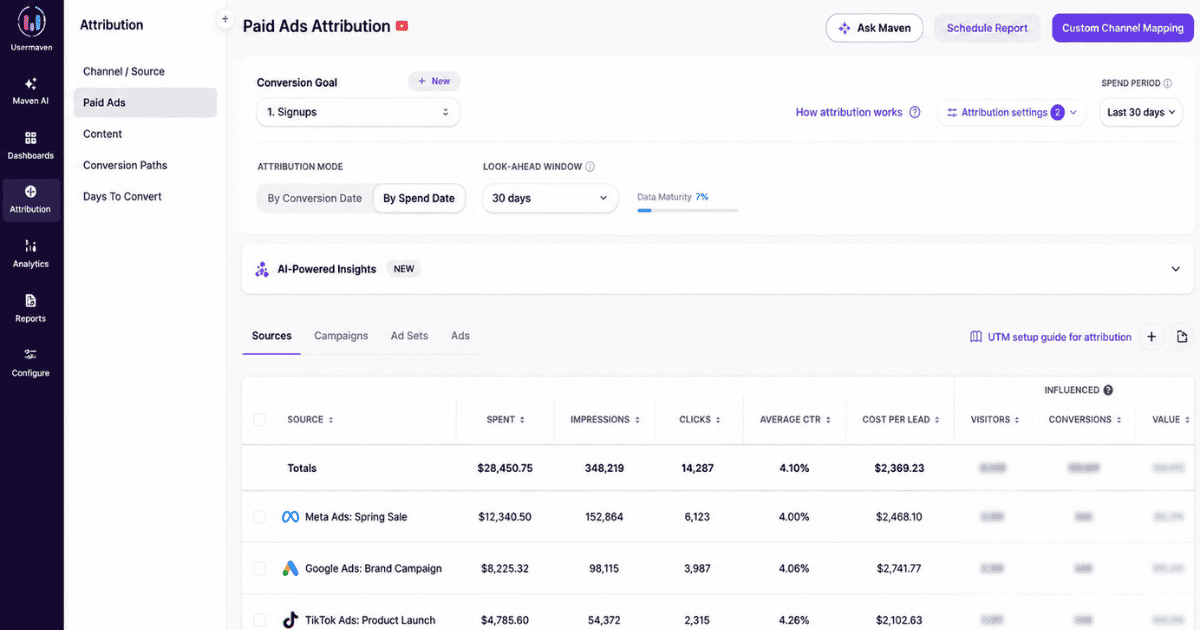
Connect paid ad platforms
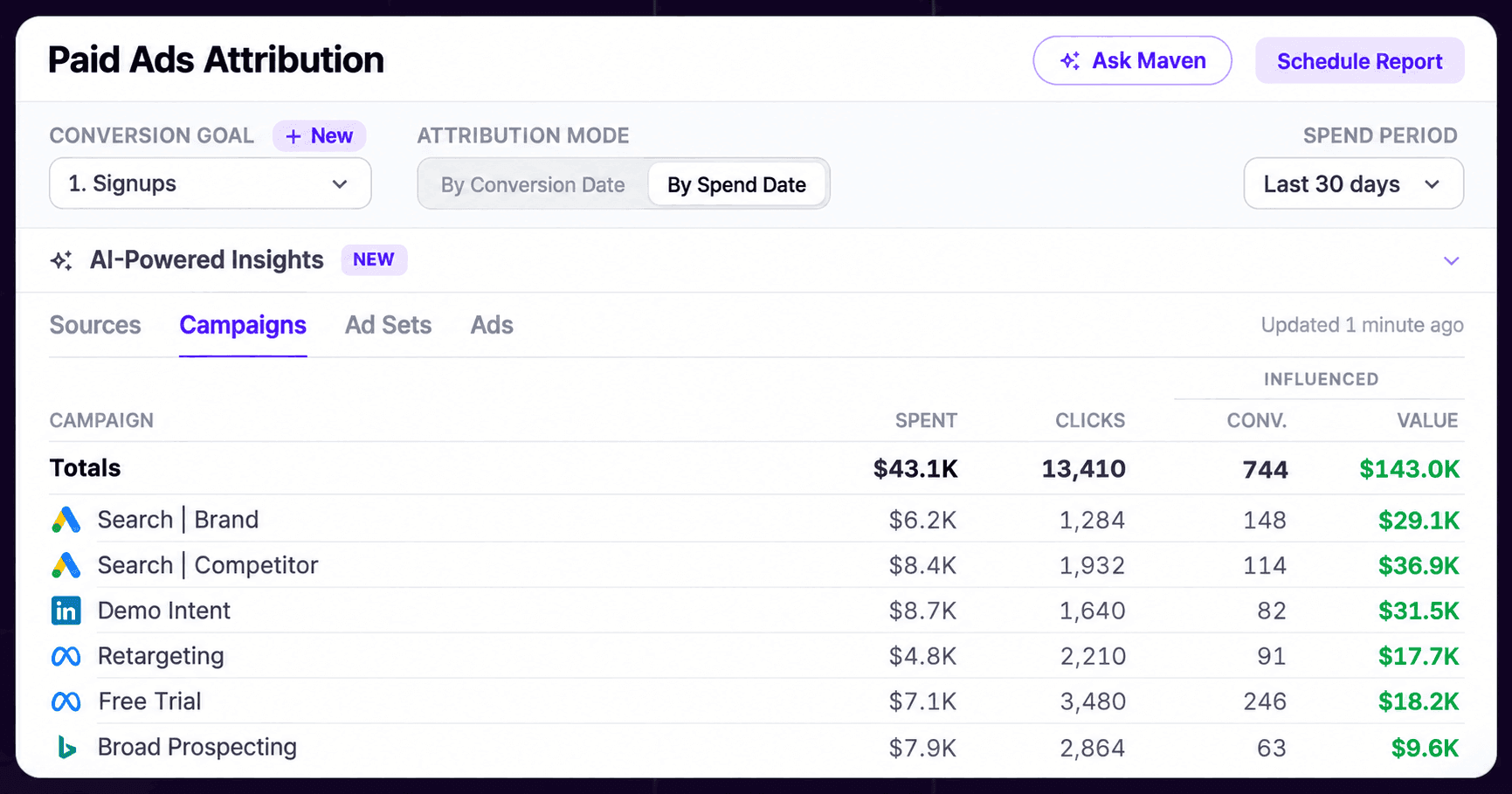
Google Ads, Meta Ads, LinkedIn Ads, and Microsoft Ads can be brought into the Paid Ads Attribution workflow so spend, impressions, clicks, conversions, and attributed revenue can be analyzed under one reporting layer.
Connect product behavior
For PLG and hybrid SaaS, product events can extend the campaign journey through activation, feature adoption, paid conversion, retention, and other meaningful product milestones.
Connect CRM pipeline
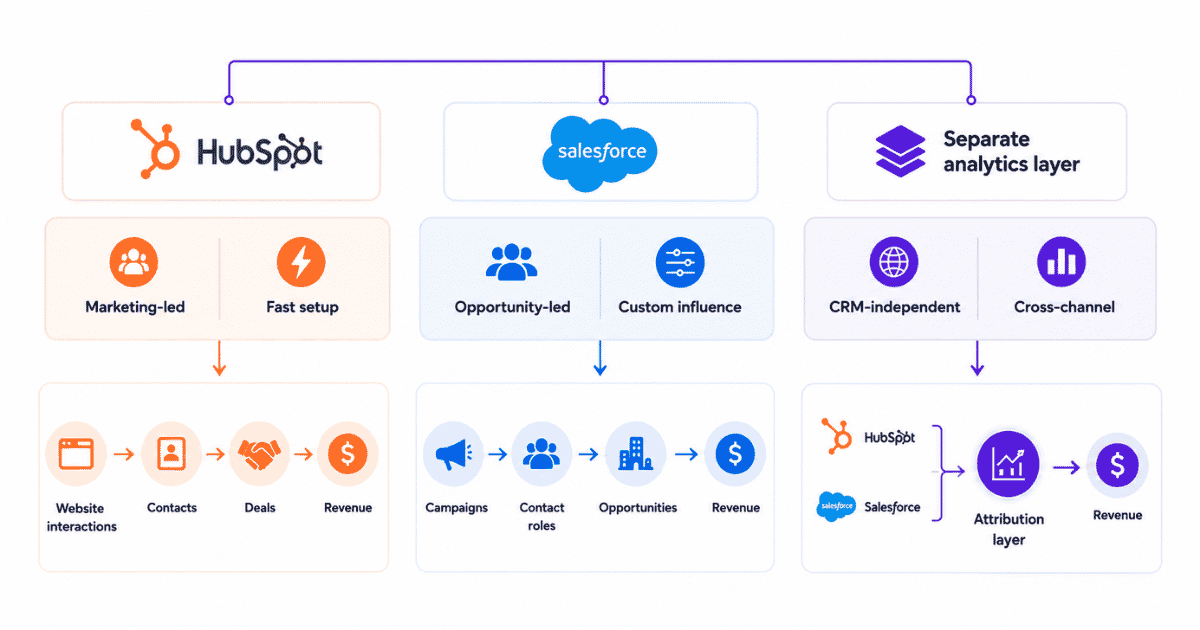
HubSpot and Salesforce data can add the pipeline layer. For full-funnel revenue attribution keeps marketing touchpoints connected with conversions, opportunities, customers, and revenue rather than stopping at the first lead.
Bring in off-site outcomes
Event Sources can add payment, CRM, webinar, webhook, and imported historical events to the same person-level reporting flow when those conversions happen outside the tracked website.
Compare spend and conversion timing
Paid Ads Attribution can switch between Conversion Date and Spend Date views. That helps separate monthly conversion reporting from the question of what an earlier period’s budget eventually produced.
Analyze attribution with Maven AI
Maven AI lets B2B SaaS teams analyze attribution, customer journeys, funnels, campaign performance, and conversion trends by asking questions in plain English. For paid acquisition, teams can investigate which campaigns generate activated accounts, which channels create the highest opportunity value, where paid users drop out, or how long conversions take to mature.
It can also build dashboards and surface attribution or retention analysis from the conversation. The September 2026 update added faster streaming, concurrent conversations, visible execution steps, and interactive funnel results.
Analyze Usermaven data through MCP
Teams that already work inside ChatGPT, Claude, Cursor, Codex, or another compatible AI client can connect their Usermaven workspace through Usermaven MCP. This makes it possible to query paid attribution, revenue, CAC, LTV, funnels, customer journeys, and product analytics from the AI tools the team already uses.
For example, a growth team could ask which paid campaigns generated the most paying customers, compare attributed revenue across channels, investigate a signup-to-activation drop-off, or create an attribution view without manually moving data between tools.
MCP access stays scoped to the workspaces and permissions the user authorizes, and write actions require approval.
Evidence: ContentStudio connected ads with paying customers
ContentStudio is not a controlled experiment proving that one ad channel is universally better than another. It is useful evidence because the SaaS team used downstream attribution to judge its own paid acquisition beyond clicks and lead volume.
In the ContentStudio case study, the company connected paid campaigns with signups, plan upgrades, demo bookings, and revenue while testing Google, Meta, LinkedIn, and X.
| Reported outcome | Result |
|---|---|
| Signups | +128% |
| Plan upgrades | +92% |
| Demo bookings | +242% |
| Traffic | +329% |
| Overall ROAS | +30% |
The case study also found that a meaningful share of paid conversions arrived 7 to 14 days after the initial ad click. That timing view helped the team avoid cutting campaigns simply because the first week looked weak.
Channel-level customer economics then informed budget allocation. LinkedIn and X were deprioritized in ContentStudio’s own tests when cost per paying customer was weaker, while spend was concentrated in channels where the company’s attribution data confirmed stronger revenue.
That does not mean LinkedIn or X are generally weaker channels. It shows why B2B SaaS teams need their own spend-to-customer evidence rather than treating clicks or platform-reported conversions as the final answer.
| The useful attribution question was not which platform produced the most clicks. It was which paid campaigns eventually produced paying customers and revenue. |
B2B SaaS paid ads attribution checklist
| Check | Question |
|---|---|
| Ad integrations | Are spend, clicks, and campaign details available? |
| UTMs | Are naming conventions consistent? |
| Ad IDs | Can conversions be tied to the right creative? |
| Website event | Is signup or demo tracked? |
| Identity | Can anonymous history connect to the known user? |
| Product data | Are activation and paid-upgrade events tracked? |
| CRM data | Are leads, opportunities, and Closed Won available? |
| Revenue | Is conversion value or revenue recorded? |
| Account context | Can known users be associated with companies? |
| Conversion lag | How long do customers take to convert? |
| Attribution window | Does it reflect the observed sales cycle? |
| Model | Does it answer the business question? |
| Spend-date reporting | Can historical spend be evaluated after maturation? |
| Platform comparison | Are paid channels evaluated consistently? |
| Data quality | Is the measurement setup trustworthy? |
| Incrementality | Are attribution and causality kept separate? |
Final verdict
B2B SaaS paid ads attribution should not stop at clicks, leads, or signups. The useful endpoint depends on how the company makes money and where customer quality becomes visible.
For PLG, attribution should continue through activation, paid conversion, retention, and customer value. For sales-led SaaS, it should continue through qualification, opportunity, Closed Won, and revenue.
The strongest setup connects paid media data with identity, website behavior, product events, CRM outcomes, and revenue, then uses attribution models as decision lenses rather than treating any model as absolute truth.
Book a Usermaven demo to see how paid ad spend connects with SaaS customer journeys, pipeline, conversions, and revenue.
FAQs about B2B SaaS paid ads attribution
1. What is B2B SaaS paid ads attribution?
B2B SaaS paid ads attribution connects advertising spend and campaign interactions with downstream outcomes such as signups, activation, qualified pipeline, customers, recurring revenue, retention, and LTV. The useful endpoint depends on how the SaaS business acquires and monetizes customers.
2. How is SaaS paid ads attribution different from normal ad attribution?
Standard ad attribution often stops at a web conversion such as a form submission or signup. SaaS attribution usually needs to continue into product usage, CRM stages, subscription or deal revenue, and customer quality because the first conversion may not represent real commercial value.
3. What should PLG SaaS attribute paid ads to?
Product-led SaaS should evaluate paid acquisition against outcomes such as activation, key product events, trial-to-paid conversion, subscription revenue, retention, and LTV. Signup volume alone can reward campaigns that attract many low-quality users.
4. What should sales-led SaaS attribute paid ads to?
Sales-led SaaS should connect paid campaigns with qualified leads, SQLs, opportunities, pipeline value, Closed Won deals, and revenue. CRM integration is important because the commercial outcome often happens well after the initial website conversion.
5. Which metrics matter most for B2B SaaS paid ads?
Useful metrics include CPC and CPL at the acquisition layer, activation or qualification rates for customer quality, cost per opportunity and pipeline per ad dollar for sales efficiency, and attributed revenue, attributed ROAS, paid-media CAC, retention, and LTV for commercial impact.
6. Which attribution model is best for B2B SaaS?

Written by
Junaid Ahmed
Content Writer & Digital Marketer
Junaid Ahmed is a content and copywriter with 3+ years of experience creating research-driven content across SaaS, B2B, ecommerce, and digital marketing. He specializes in turning complex topics into clear, practical content that helps marketers better understand their challenges, evaluate solutions, and make informed decisions. His work spans educational content, industry insights, and actionable marketing guides.
All articles by Junaid →