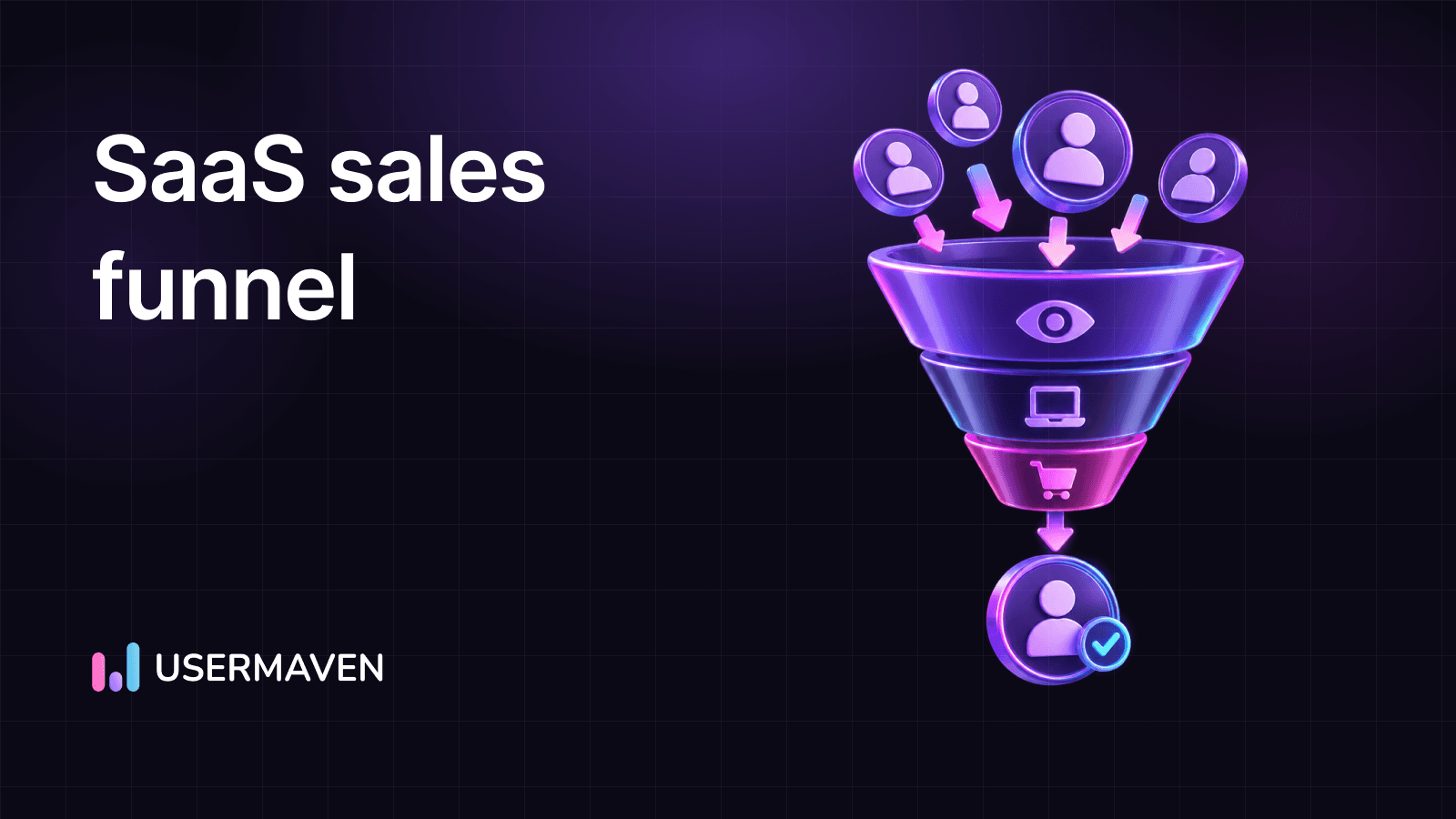
A SaaS sales funnel shows how people move from discovering a software product to becoming paying customers. Unlike a one-time purchase funnel, it must account for free trials, product activation, sales conversations, and the ongoing value that makes a subscription worth renewing.
For a growth team, the challenge is not simply generating more signups. It is understanding which acquisition sources produce users who reach value, which accounts become qualified opportunities, and where the journey breaks before revenue. That is why funnel measurement belongs alongside marketing attribution software, not just in a CRM dashboard.
This guide explains how to design product-led, sales-assisted, and hybrid SaaS funnels; choose meaningful stage definitions; calculate conversion metrics; and connect marketing activity with product and revenue outcomes.
Key takeaways
- Define value before volume: A signup, activated account, qualified opportunity, and paying customer are different outcomes. Measure each separately.
- Choose the right motion: Product-led funnels emphasize activation and trial-to-paid conversion; sales-assisted funnels emphasize qualification, opportunities, and closed revenue.
- Connect the systems: Website, product, CRM, and billing events need consistent definitions and identifiers before teams can analyze the full journey.
- Track cohort-based conversion: Use consistent populations and time windows to avoid misleading stage-to-stage rates.
- Diagnose before optimizing: A large drop-off indicates where to investigate, not why customers left or which change will work.
- Measure customer quality: Compare acquisition channels by activation, paid conversion, pipeline, and post-sale value rather than signup volume alone.
What is a SaaS sales funnel?
A SaaS sales funnel is a measurable sequence of stages through which prospective users or accounts progress toward a paid software subscription. The stages usually begin with awareness and evaluation, then branch into a product-led signup path or a sales-assisted buying process.
For example, someone might discover an analytics platform through organic search, sign up for a trial, connect a data source, create their first report, and upgrade to a paid plan. Another buyer may read the same content, request a demo, complete a security review, and sign an annual contract.
Both are SaaS sales funnels, but the milestones and owners are different. The first relies heavily on product events. The second relies on marketing activity, lead qualification, and CRM opportunity stages. A hybrid model uses both paths.
Sales funnel vs. customer lifecycle: The primary sales funnel culminates in becoming a paying customer. Onboarding, retention, renewal, and expansion follow the sale, although SaaS teams should analyze them to understand whether the funnel acquired valuable customers. The broader what is a sales funnel guide covers the general buying process in more detail.
How is a SaaS sales funnel different from a traditional sales funnel?
A conventional sales funnel often ends at purchase. SaaS businesses earn recurring revenue only while customers continue finding value, so a successful first conversion may still be economically weak if customers never activate or cancel soon afterward.
Activation matters: Someone can register for a free trial without experiencing the product’s core benefit. Define an activation event that represents an early meaningful outcome, such as publishing a project, sending a report, or successfully connecting a critical integration.
The unit of analysis changes: One user may open an account, but several employees can evaluate and purchase it. SaaS businesses need to distinguish visitors, users, companies, and opportunities rather than count every action as a separate potential customer.
What are the stages of a SaaS sales funnel?
There is no mandatory six-stage model. A product-led company might use visitor → signup → activation → paid, while an enterprise business might use visitor → lead → MQL → SQL → opportunity → closed won. Use only stages that represent meaningful changes in status.
1. Awareness and acquisition
Prospects discover the product through organic search, paid campaigns, referrals, partnerships, review sites, or communities. The objective is to attract people whose problem and profile match the product, not to maximize undifferentiated traffic.
Track: Relevant visitors, acquisition source, campaign, and the next meaningful action. A channel that drives fewer visits can still be valuable if its visitors activate or produce qualified pipeline.
2. Evaluation and interest
Prospects assess whether the software solves their problem. They may compare features, view pricing, read case studies, attend a webinar, or examine implementation requirements. A visit to a pricing page indicates interest, but not necessarily readiness to buy.
Track: Demo requests, trial starts, qualified content conversions, and progression into deeper evaluation. Avoid declaring everyone who downloads a guide to be a sales-qualified lead.
3. Signup or lead creation
A self-serve product typically records an account creation or trial start. Sales-led companies often use digital forms to capture demo requests, contact submissions, or inbound inquiries. The event must carry a consistent timestamp and an appropriate person or account identifier.
Track: Visitor-to-signup or visitor-to-lead rate, segmented by source and audience. Keep signups and qualified leads as separate metrics when both motions exist.
4. Activation or sales qualification
For product-led SaaS, activation means the user reaches a defined first-value milestone. For a sales-assisted motion, qualification means marketing and sales agree that the account meets fit and readiness criteria.
Track: Signup-to-activation, time to value, MQL-to-SQL conversion, and acceptance reasons. An activated trial is not automatically an SQL; the two measures answer different questions.
5. Paid conversion or opportunity progression
Self-serve users select a paid plan and complete a successful transaction. Sales-assisted buyers may enter an opportunity, negotiate requirements, complete procurement, and move to closed won. Hybrid buyers can take both routes before purchasing.
Track: Trial-to-paid rate, qualified-opportunity conversion, closed-won rate, deal value, and time to conversion. Use billing or CRM records for definitive commercial outcomes, not an unverified pricing-page click.
6. Retention and expansion as the next measurement layer
After purchase, customers must keep experiencing value. Measure whether they remain active, renew, add users, or expand their subscription, but label these as lifecycle outcomes rather than additional prerequisites for the first sale.
Track: Cohort retention, churn, net revenue retention, and expansion MRR where valid billing data is available. These measures help identify acquisition sources that generate durable value instead of short-lived conversions.
Product-led vs. sales-led SaaS sales funnels
Product-led and sales-led funnels are not rival theories. They are different go-to-market motions, and many SaaS companies combine them. Choosing the right reporting structure depends on how customers evaluate the product and make the purchasing decision.
| Dimension | Product-led funnel | Sales-assisted funnel |
|---|---|---|
| Initial conversion | Signup, free trial, or freemium account | Lead or demo request |
| Core milestone | First meaningful product value | Qualified account or opportunity |
| Primary owner | Product and growth teams | Marketing, sales, and RevOps |
| Main data | Product events and subscription billing | Marketing events and CRM stages |
| Success metrics | Activation, time to value, trial-to-paid | MQL-to-SQL, opportunities, win rate |
| Common friction | Setup or feature adoption | Stakeholder alignment and procurement |
Product-led example
A project-management tool lets users create accounts without speaking to sales. A team leader signs up, invites collaborators, builds the first project, and upgrades when the team needs more capacity or features.
The activation event should reflect actual collaboration value, not just a login. Product teams can use product analytics for SaaS to investigate setup completion, engagement, and which users progress toward payment.
Sales-assisted example
A security platform may require a demonstration, proof of concept, technical validation, and purchase approval. A lead becomes an opportunity only when the defined qualification criteria are met. Several contacts may contribute to one company-level deal.
The b2b sales funnel guide covers that buying process in depth. For this article, the essential distinction is that CRM stage transitions and product evaluation signals must be linked without double-counting accounts.
Hybrid example
An analytics platform might offer a self-serve trial and also accept enterprise demo requests. A trial account that adopts key features can request advanced security or implementation help, at which point sales creates an opportunity.
The funnel should accommodate that transition. A strict requirement that every customer must follow the same step sequence would misclassify legitimate paths. Record whether the outcome was self-serve, assisted, or influenced by both. A broader customer journey funnel helps contextualize these non-linear paths.
How to build a SaaS sales funnel step by step
A sound funnel begins with decisions about customers, outcomes, and data, not with an attractive diagram. This seven-step process creates a measurement framework that growth, product, and sales teams can use together.
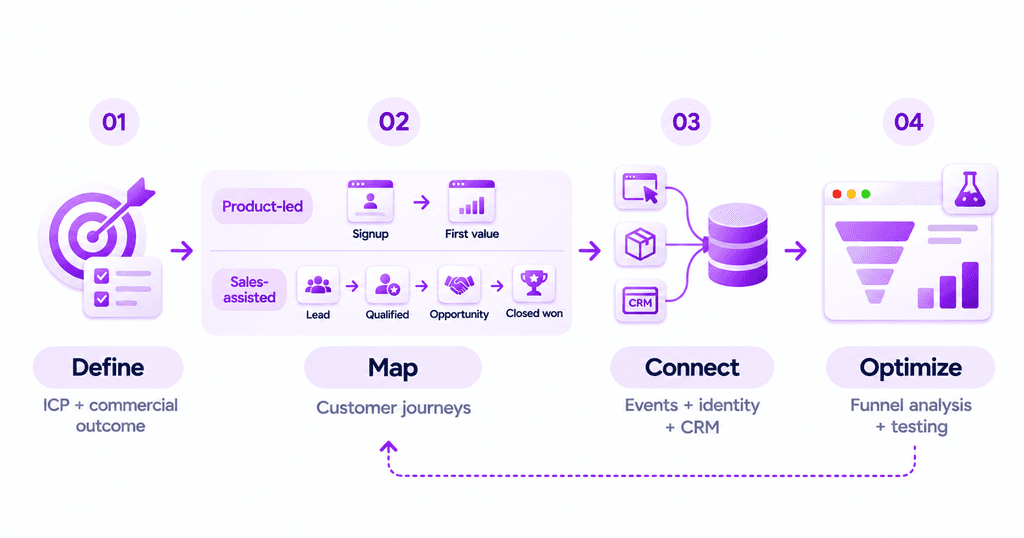
Step 1: Choose the customer and commercial outcome
Define the ideal customer profile, the problem being solved, and what counts as a successful first sale. Specify whether the journey is primarily product-led, sales-assisted, or hybrid. For B2B SaaS, document whether the customer is an individual or a company account.
Output: One primary commercial outcome, an owner, and a list of meaningful intermediate milestones. Resist the temptation to label every engagement event a funnel stage.
Step 2: Map the paths that real customers follow
Review website conversion paths, product onboarding events, customer interviews, CRM records, and lost-deal notes. Map the common progression toward value and purchase. Include likely detours such as a trial user requesting a demo.
Step 3: Define activation and qualification rules
Pick an activation action that indicates initial value. A reporting SaaS might use a successfully generated and viewed report, while an integration platform might require a completed data sync. Test whether the event correlates with longer-term usage before treating it as definitive.
Separately, define MQL, SQL, and opportunity criteria with sales. Record how a lead qualifies, who approves the stage change, and whether qualification is measured at the contact or company level.
Step 4: Instrument website, product, CRM, and billing events
Create a tracking plan listing event name, event properties, actor, timestamp, and source system. Events might include trial_started, integration_connected, first_report_created, demo_booked, opportunity_created, and subscription_paid.
Use reliable identity and deduplication rules. Usermaven’s Events capability is relevant for capturing important interactions, but any platform’s report is only as trustworthy as the underlying event coverage and configuration.
Step 5: Connect people to accounts and downstream outcomes
Website visitors, trial users, contacts, and CRM companies may use different identifiers. Align them where permitted and supported, and establish rules for accounts with multiple contacts. A deal should not multiply simply because three stakeholders visited the website.
Where purchase and opportunity data live outside the website, configure suitable CRM or payment integrations. Confirm the amount, currency, timestamps, deal status, and conversion-goal mapping before comparing revenue across channels.
Step 6: Build separate funnels for each question
Create an onboarding funnel for signup → first value, a sales funnel for lead → opportunity → closed won, and an end-to-end view where the identity chain supports it. Use funnel analytics software to compare stage progression and drop-offs.
Choose a sensible conversion window and whether steps must occur in sequence. Define whether a report counts distinct users, companies, sessions, or opportunities. These choices can change the calculated conversion rate even when the event data is identical.
Step 7: Review performance and test improvements
Compare performance by channel, segment, company profile, and entry cohort. Investigate the largest meaningful losses before proposing changes. Use interviews, recordings, technical checks, or experiments to assess whether the suspected reason is real.
Output: A repeating review routine with a metric owner, a hypothesis, a proposed intervention, and a follow-up measurement. The funnel analysis guide covers the diagnostic methods in greater depth.
SaaS sales funnel examples for different business models
These examples illustrate what teams might instrument. They are not real customer datasets, and the event names are illustrative rather than required Usermaven conventions.
Example 1: Self-serve reporting SaaS
A visitor arrives from organic search, opens a free account, connects a data source, generates a first useful report, and selects a paid plan. Here the key failure could be a complicated integration step, not a lack of demand.
Suggested checkpoints: landing_viewed → trial_started → data_connected → report_used → subscription_paid. Use activation rates and time to value to decide whether onboarding needs attention. Compare paid conversion by original acquisition source.
Example 2: Sales-assisted enterprise SaaS
An operations director discovers an enterprise platform through LinkedIn, reads a guide, books a demo, and brings IT and finance into an evaluation. Sales qualifies the account, creates an opportunity, and eventually closes a contract.
Suggested checkpoints: lead_created → sql_accepted → opportunity_created → proposal_sent → closed_won. Account-level tracking matters because several people may represent a single deal. The B2B SaaS solution illustrates why linking marketing, product, and CRM outcomes is useful.
Example 3: Hybrid SaaS with product-qualified leads
A small company starts on a self-serve trial. As more team members become active and a critical integration is adopted, the account requests a consultation about a higher plan. Sales enters to help close the larger subscription.
Suggested checkpoints: Trial signup → meaningful activation → expansion signal → accepted sales opportunity → closed won. Do not equate a product-qualified signal with a confirmed deal; the CRM still needs a documented qualification and sales outcome.
SaaS sales funnel metrics to track
SaaS funnel reporting needs consistent numerators, denominators, and time windows. A rate calculated from this week’s trial starts and this week’s payments may mix unrelated customer cohorts and produce misleading conclusions.
| Metric | Calculation or definition | Decision supported |
|---|---|---|
| Visitor-to-signup | Signups from an eligible visitor cohort ÷ visitors in that cohort × 100 | Assess entry conversion |
| Signup-to-activation | Activated accounts from a signup cohort ÷ eligible signups × 100 | Diagnose first value |
| Time to value | Time between defined start and first-value events | Reduce onboarding delay |
| Trial-to-paid | Paying customers from a trial cohort ÷ trials in that cohort × 100 | Evaluate monetization |
| MQL-to-SQL | SQLs originating from an MQL cohort ÷ MQLs in that cohort × 100 | Assess lead quality |
| Opportunity win rate | Closed-won deals ÷ all closed deals × 100 | Evaluate sales conversion |
| CAC | Eligible acquisition costs ÷ new customers acquired | Evaluate acquisition efficiency |
| NRR | (Starting recurring revenue + expansion − contraction − churn) ÷ starting recurring revenue × 100 | Evaluate existing-customer revenue |
Use the right unit: A product-led conversion may count individual users or paid accounts. A B2B opportunity rate should generally use opportunities or accounts according to the organization’s CRM rules. Never combine those denominators without explaining the change.
Set the time window: A 14-day trial-to-paid report and a 90-day report answer different questions. Mature each cohort long enough to reach the outcome before making comparisons, and label open or incomplete cohorts clearly.
Avoid false benchmarks: Conversion rates vary by audience, pricing, onboarding complexity, trial type, and qualification policy. Historical industry medians can help frame a question, but internal comparisons with consistent definitions often provide a more actionable baseline.
For a more detailed explanation of recurring-revenue health, link the sales funnel to customer retention metrics rather than treating NRR as a pre-sale stage conversion metric.
How to measure marketing’s contribution to SaaS revenue
Marketing analytics often ends at form submissions, while product teams focus on activation and sales teams report closed-won pipeline. Those views can disagree because they use different identities, reporting windows, and conversion outcomes.
A more useful approach connects the journey from campaign touchpoints through signup, qualification, product engagement, and revenue. saas marketing attribution explains the broader attribution concepts behind this measurement.
Measure quality by acquisition source
Compare channels on more than traffic and lead volume. For a product-led SaaS company, examine activation and paid conversion by first known source or campaign. For sales-assisted SaaS, compare MQLs, SQLs, qualified opportunities, and closed revenue.
Interpret carefully: A channel associated with more closed revenue is not necessarily the sole cause of those deals. Attribution models assign credit according to rules and observed touchpoints; they do not independently establish incrementality.
Connect CRM milestones to the funnel
Where reliable CRM integration is available, use pipeline attribution to investigate how marketing sources relate to lead qualification, opportunities, pipeline value, and closed-won revenue.
For a longer buying cycle, distinguish the conversion date from the original acquisition date and consider the appropriate attribution window. Otherwise, a recent campaign may appear unproductive simply because its leads have not yet matured into opportunities.
Separate funnel analysis from attribution
Funnel analysis asks how many eligible people or accounts reach each step and how long progression takes. Attribution asks how conversion credit is distributed across eligible marketing touches. Both are informative, but neither answers every causal question.
The full-funnel revenue attribution solution is relevant when teams want a connected view of acquisition, CRM outcomes, and revenue. Accurate tracking, identity resolution, and configured conversion goals remain prerequisites.
How to improve SaaS funnel conversion rates
Improving the funnel means solving a measured problem, not optimizing every step simultaneously. Start where there is a significant loss and enough volume to examine the pattern with reasonable confidence.
When signup conversion is weak
Check whether the page matches the intended audience, whether the offer is clear, and whether the signup form creates unnecessary friction. Compare branded and nonbranded traffic, device types, and channel segments before redesigning the page.
Potential test: Simplify a form or clarify pricing expectations. Measure the effect on qualified signups and later activation, not just the number of form completions.
When activation is weak
Review the events between account creation and first value. A missing integration, unclear setup step, or confusing default state may prevent the customer from experiencing the product’s benefit.
Potential test: Improve setup guidance or remove an unnecessary step, then compare time to value and activation for comparable cohorts. Use behavioral customer segmentation software to identify groups with different onboarding needs.
When pipeline conversion is weak
Investigate whether qualified leads fit the target customer profile, whether the handoff to sales is timely, and which objections recur. Examine lost-opportunity reasons and the delay between accepted qualification and first meeting.
Potential test: Refine qualification criteria or improve follow-up coordination. The conversion funnel optimization guide goes further into testing and diagnostics.
When paid conversion is weak
Understand whether trial users reach enough value to justify paying, whether plan limitations are clear, and whether sales-assisted buyers face unresolved security or procurement requirements. The answer may differ between small accounts and enterprise prospects.
Potential test: Improve upgrade communication for activated users, or shorten procurement friction for qualified accounts. Track actual paid conversions and revenue after the change, not clicks on a payment button.
Common SaaS sales funnel mistakes
Counting signups as customers: New accounts are not equivalent to activated users, paying subscribers, or successful B2B deals. Keep their definitions and conversion rates separate.
Using one funnel for every buying motion: Self-serve, sales-assisted, and hybrid customers may take different paths. A mandatory demo stage will incorrectly exclude legitimate self-serve conversions.
Ignoring account identity: Multiple contacts can represent one company, while one user can interact across several devices. Decide whether each metric counts people, accounts, or opportunities, then validate identity rules.
Assuming a drop-off proves its cause: A weak activation rate suggests where to investigate. It does not prove that the interface, lead quality, price, or support experience caused the loss.
Mixing cohorts and currencies: Compare matched acquisition cohorts, use appropriate conversion windows, and normalize financial data before aggregating pipeline or revenue.
Optimizing for lead volume alone: A campaign can produce inexpensive leads without producing activated customers or qualified pipeline. Analyze downstream quality before reallocating budget.
How Usermaven helps measure SaaS sales funnels
Usermaven is primarily a marketing attribution platform with product analytics and funnel-analysis capabilities. It helps teams examine which marketing efforts acquire relevant users and accounts, how those audiences progress, and what can be connected to qualified pipeline and revenue.
Funnels: Configure URL or event-based steps, optional milestones, sequential or strict ordering, conversion windows, and user- or company-level analysis. Reports include drop-offs, time to convert, segment breakdowns, and period comparisons.
Acquisition and product behavior: Explore how sources and campaigns differ in signup, activation, and conversion quality. The platform’s product analytics can help teams inspect behavior after a website visit instead of stopping at lead volume.
CRM and payment outcomes: Supported Event Sources can bring external conversion events into the analytics workspace. Properly mapped CRM and billing data can support pipeline and revenue views where integrations and identifiers are reliable.
Customer journeys: customer journey analytics software helps teams examine interactions around formal funnel steps, including multi-session paths that do not fit one straight line.
Maven AI: Maven AI can assist with analytics questions and recurring monitoring through Agents. Recent product improvements support saving AI-generated reports to dashboards and sharing Agent reports, but the insights still depend on the underlying data.
For a SaaS team, the useful outcome is a more connected view of acquisition quality, activation, qualified pipeline, and revenue. It is not a promise that every conversion occurs within a single tool or that a dashboard automatically establishes marketing causality.
Book a demo: See how Usermaven can connect your SaaS acquisition, product, and CRM journey. Book a demo to review the funnel stages and conversion goals that matter to your team.
Final thoughts
Build your SaaS sales funnel around meaningful activation and commercial milestones, not just signup volume. Keep product-led and sales-assisted paths distinct, connect marketing to reliable CRM and billing outcomes, and improve the steps where consistent cohort evidence reveals genuine friction.
FAQs
1. What is the difference between a SaaS sales funnel and a marketing funnel?
A marketing funnel focuses on how an audience discovers, considers, and engages with an offer. A SaaS sales funnel tracks progression toward a paid software customer, often using product activation, CRM qualification, or both. The two overlap, but their primary outcomes and reporting owners may differ.
2. What are the main stages of a B2B SaaS sales funnel?
A sales-assisted B2B SaaS funnel commonly includes acquisition, lead creation, marketing qualification, sales qualification, opportunity creation, and closed won. Product-led funnels may instead emphasize signup, activation, and trial-to-paid conversion. Define the stages around your actual sales motion rather than an industry template.
3. How do you calculate SaaS sales funnel conversion rates?
Divide the number of eligible users, accounts, or opportunities reaching a later stage by the number entering the earlier stage, then multiply by 100. Keep the same cohort, counting unit, and observation window. Mixing different populations can produce a plausible-looking but misleading rate.
4. What is a good SaaS trial-to-paid conversion rate?
There is no universal rate because free trials, freemium plans, product prices, audiences, and attribution windows vary. First define the trial cohort and whether the numerator counts users or paid accounts. Compare mature cohorts consistently, then use relevant peer benchmarks cautiously if their definitions match yours.
5. Can a SaaS company use both product-led and sales-led funnels?
Yes. A company may let smaller customers convert through self-service while sales supports larger opportunities, security reviews, and complex purchases. A hybrid funnel should allow product usage to inform qualification without forcing every account through identical steps.
6. Which tools and data sources do you need to measure a SaaS sales funnel?
Typical inputs include website and campaign analytics, product events, CRM stages, and subscription or billing records. Some companies combine these in an analytics platform; others join them in a warehouse. Prioritize consistent event definitions, account identifiers, permission controls, and validated commercial outcomes over tool count.

Written by
Adeel Khan
Growth Marketing Expert
Adeel Khan is a full-stack SaaS marketer with 10+ years of experience in content marketing, paid advertising, analytics, and conversion rate optimization. He shares practical insights and strategies drawn from hands-on experience, helping B2B SaaS marketers improve performance and make better marketing decisions.
All articles by Adeel →