A B2B deal rarely starts and closes in one interaction. A buyer might discover a company through organic search, return through LinkedIn, attend a webinar, speak with sales, and become an opportunity weeks later.
If reporting stops at the lead, marketing never reaches the commercial outcome. If it credits only the final interaction, the channels that created and developed demand can disappear from the story.
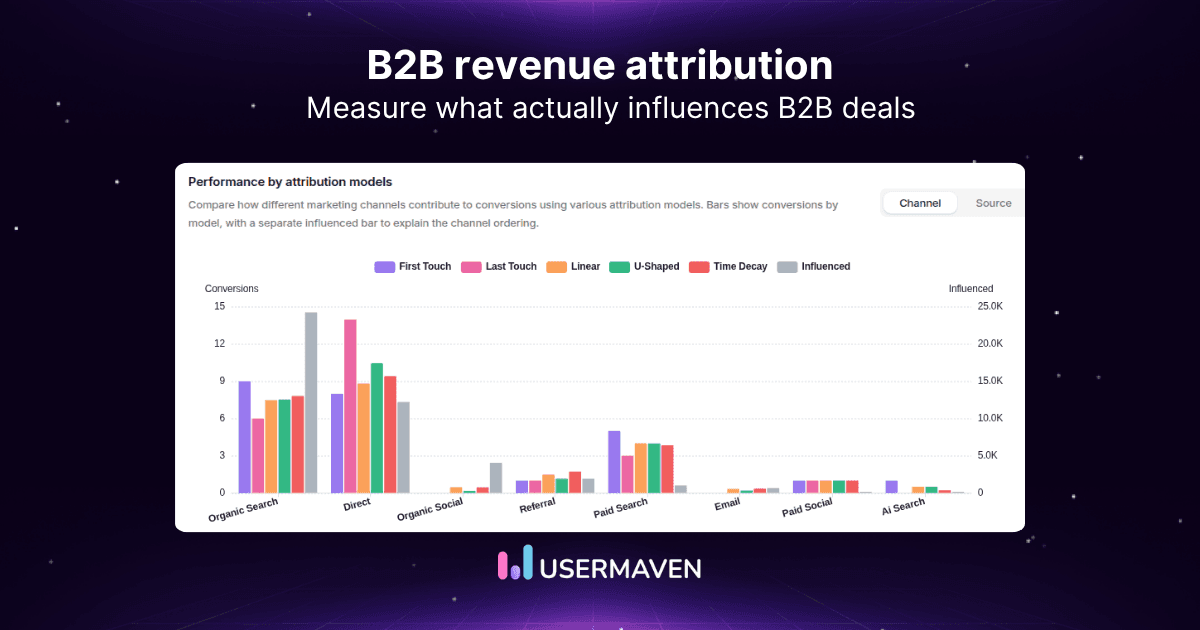
With marketing attribution software, B2B teams can connect observable marketing and sales touchpoints with opportunities, Closed Won deals, and revenue. This guide explains the data, models, CRM connections, and limits needed to make that revenue credit useful rather than merely precise-looking.
Key takeaways
B2B revenue attribution goes beyond leads. It connects observable acquisition and sales activity with opportunities, Closed Won outcomes, and revenue.
Identity and CRM data come before model choice. A sophisticated model cannot repair disconnected contacts, opportunities, or revenue events.
Pipeline and revenue should stay separate. A channel can create more pipeline but less Closed Won revenue than another channel.
Different models redistribute credit. The customer journey and the total deal value do not change when the attribution model changes.
B2B attribution has limits. Private recommendations, unlogged conversations, and other unobserved influence cannot be deterministically credited.
B2B revenue attribution at a glance
B2B revenue attribution is the process of connecting measurable marketing and sales touchpoints with downstream pipeline and Closed Won revenue, then assigning financial credit across those interactions according to an attribution model.
The final report should show more than where a lead came from. It should help explain which observed channels, campaigns, content, and sales interactions appeared before qualified pipeline and realized revenue.
| Question | Short answer |
|---|---|
| What is being attributed? | Pipeline and revenue |
| What can receive credit? | Observable marketing and sales touchpoints |
| Where does revenue usually come from? | CRM, billing, payment, or imported revenue events |
| Why is B2B different? | Long cycles, multiple contacts, and offline interactions |
| Is last touch enough? | Usually not for longer journeys |
| Does attribution prove causality? | No |
| What comes before model selection? | Tracking, identity, CRM, and revenue data |
| What should the final output show? | Contribution to opportunity, Closed Won, and revenue |
| B2B revenue attribution should explain the path to revenue, not merely the path to a lead. |
B2B revenue attribution vs. related methods
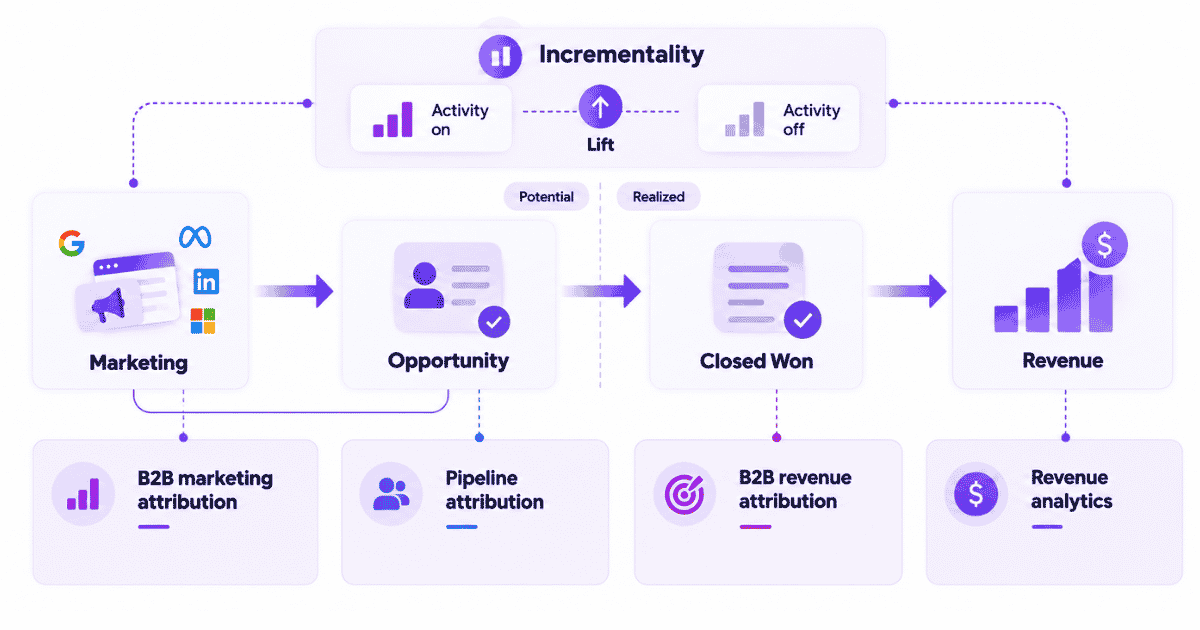
B2B revenue attribution overlaps with several measurement disciplines, but the business question changes depending on the endpoint. Keeping those questions separate prevents one report from being asked to solve everything.
| Method | Main question |
|---|---|
| B2B marketing attribution | Which marketing activities contributed? |
| Pipeline attribution | What influenced qualified opportunities? |
| B2B revenue attribution | What contributed to Closed Won revenue? |
| Revenue analytics | How much revenue did the business generate? |
| Incrementality | What additional revenue occurred because the activity ran? |
The broader B2B marketing attribution problem covers marketing contribution across the funnel. Pipeline attribution goes deeper into opportunity creation and progression, while generic revenue attribution focuses on how financial credit is allocated to observed interactions.
| Pipeline is potential revenue. Closed Won revenue is realized revenue. B2B attribution should keep those outcomes separate. |
Drive business growth
with AI-powered analytics
Why B2B revenue attribution is harder
Consumer funnels can sometimes be measured inside one session. B2B revenue journeys often stretch across people, systems, channels, and months. The measurement architecture has to survive that complexity before a model can distribute credit sensibly.
Long sales cycles
The first measurable interaction may happen weeks or months before a deal closes. A short reporting window can therefore make early demand creation disappear even when the later opportunity would not exist without that initial discovery.
| Organic search -> 21 days -> LinkedIn -> 18 days -> demo -> 42 days -> opportunity -> 35 days -> Closed Won |
Multiple stakeholders
One person may discover the product while another evaluates it, a RevOps leader joins a webinar, and finance appears only during procurement. A single contact rarely describes the entire buying committee.
Marketing and sales share the journey
The interaction immediately before revenue may be a sales call, meeting, demo, or CRM stage transition rather than a marketing click. B2B revenue attribution therefore needs marketing context and commercial context in the same measurement chain.
Revenue often happens off-site
The web form may be the first known conversion, but the actual value can appear later in HubSpot, Salesforce, Stripe, Paddle, another billing system, or an offline sales workflow. If those outcomes never return to the analytics layer, attribution stops too early.
Some influence is unobservable
Peer recommendations, private communities, internal Slack discussions, and unrecorded offline conversations may influence a deal without leaving a deterministic trail. Good attribution should make that limitation visible instead of pretending the full causal story has been captured.
| B2B revenue attribution measures observable contribution, not every influence that may have affected the deal. |
Map the full B2B journey to revenue
A useful B2B attribution design begins with the commercial lifecycle, then asks which interactions should remain eligible at each stage.
| Anonymous visitor -> known lead -> MQL -> SQL -> opportunity -> Closed Won -> revenue |
Overlaying the actual journey makes the model easier to interpret:
| Organic article -> LinkedIn Ad -> email -> webinar -> demo -> sales call -> opportunity -> Closed Won |
| Stage | Example outcome | Attribution question |
|---|---|---|
| Discovery | First visit | What introduced the account or contact? |
| Lead creation | Form or demo | What created identifiable demand? |
| Qualification | MQL or SQL | What contributed to qualified pipeline? |
| Opportunity | CRM opportunity | What influenced pipeline creation? |
| Closing | Sales and demo interactions | What preceded Closed Won? |
| Revenue | Deal amount | Which observed touches receive credit? |
Define the revenue outcome before modeling
B2B revenue attribution becomes unstable when marketing, sales, and finance use different definitions of success. One team may call a demo a conversion, another may optimize for opportunity creation, and leadership may judge the same program only by Closed Won bookings.
Define the commercial outcome first, then work backward into the events and relationships required to explain it. That keeps the attribution report tied to the decision the business actually wants to make.
| Outcome | What it tells you | Main limitation |
|---|---|---|
| Lead or demo | Which activity creates identifiable demand | Still far from revenue |
| MQL / SQL | Which activity creates qualified demand | Qualification rules can change |
| Opportunity | Which activity creates pipeline | Pipeline is not realized revenue |
| Closed Won | Which activity appears before won deals | Does not prove causal lift |
| Revenue amount | How much value receives attribution credit | Depends on CRM and revenue accuracy |
For most B2B revenue attribution reports, Closed Won plus a reliable deal amount is the cleanest commercial endpoint. Earlier stages still matter because they reveal where a channel contributes before the sale, but they should not be presented as realized revenue.
The conversion definition should also specify whether revenue means bookings, recognized revenue, ARR, MRR, first-year contract value, or another business-defined amount.
Mixing those values in one report can make channel comparisons look precise while measuring different economic concepts.
| Start with the business outcome. Then choose the events, CRM fields, and attribution model needed to explain it. |
Unlock insights that drive growth
Build the revenue attribution data architecture
Reliable revenue attribution is a data-connection problem before it is a modeling problem. The goal is to preserve acquisition context, resolve the person, connect the CRM outcome, and attach the actual commercial value.
1. Track acquisition
Capture source, medium, campaign, content, ad identifiers, landing page, and referrer consistently. If a channel or campaign is mislabeled at the beginning, every downstream report inherits the mistake.
2. Resolve identity
Anonymous activity needs to connect to the person when they become known. A stable user ID is the strongest deterministic link because it lets earlier website behavior and later off-site events belong to the same profile.
3. Connect the CRM
For B2B teams, opportunity and revenue context usually lives in the CRM. The integration should preserve enough relationships to connect a known person with companies, deals, stages, opportunity values, and Closed Won outcomes.
HubSpot revenue attribution reports depend on closed-won deals, associated contacts, revenue amount, and date fields. The official HubSpot attribution documentation also lets teams filter revenue attribution by campaigns and interaction sources such as organic search.
Salesforce likewise provides campaign-to-opportunity influence. Its official Campaign Influence documentation supports standard and custom influence relationships so marketing can be analyzed against opportunity pipeline and revenue.
4. Capture off-site revenue events
Usermaven Event Sources can bring supported CRM, payment, webinar, webhook, CSV, and other off-site events into the same analytics environment. Revenue, currency, timestamps, and identity fields can then participate in attribution, goals, funnels, and journeys.
5. Connect revenue to the journey
| Marketing touchpoint -> identity -> CRM opportunity -> Closed Won -> revenue event -> attribution model |
Only after those connections are reliable should the team debate whether first touch, last touch, linear, time decay, U-shaped, or a business-specific model best answers the reporting question.
Validate one deal before trusting the dashboard
Aggregate dashboards are difficult to debug because hundreds of journeys can hide one broken relationship. Before trusting a revenue report, test one known deal from first marketing touch to Closed Won and confirm every handoff.
1. Start with a tagged visit
Use a controlled visit with a known source or campaign. Confirm that the landing page, UTM values, referrer, and any required ad identifiers appear in the visitor record exactly as expected.
2. Identify the same person
Trigger the real signup, form, or login flow that identifies the visitor. The earlier anonymous history should remain attached to the known profile instead of becoming a separate customer story.
3. Create the CRM relationship
Create or update the contact, company, and opportunity in the CRM. Confirm that the person is associated with the correct deal and that the opportunity amount, stage, create date, and other required fields are populated.
4. Move the deal to Closed Won
Close the opportunity using the same process the sales team uses in production. If the reporting workflow depends on a Closed Won event, deal stage, or imported revenue value, verify that the correct amount and timestamp arrive in the analytics layer.
5. Compare the journey with the attribution report
Open the person or deal journey and compare it with the channel, source, campaign, pipeline, and revenue views. The touchpoints eligible under the chosen attribution window and model should reconcile with the known test path.
6. Fix the chain before scaling the report
If the test deal is missing a source, person match, opportunity, or amount, fix that upstream issue before debating model choice. A one-deal validation is slower than opening a dashboard, but it prevents teams from scaling a measurement error across an entire quarter.
| A controlled Closed Won test is the fastest way to prove that acquisition, identity, CRM, and revenue data actually join end to end. |
Identity comes before attribution models
If the first visit belongs to one anonymous profile, the webinar to another contact, and Closed Won arrives as an unmatched CRM event, the attribution model is solving the wrong problem.
Usermaven Event Sources can carry user ID, anonymous ID, and email. A stable user ID provides the strongest deterministic match, while anonymous ID can preserve the pre-signup story and email can act as a fallback when stronger identifiers are unavailable.
Once identity is stable, User Journeys can show how acquisition, return visits, content engagement, CRM milestones, and later conversion events connect across the observed path.
| A sophisticated B2B attribution model cannot rescue disconnected opportunity or revenue data. |
Revenue attribution across multiple stakeholders
Buying committees create a second identity problem: several people can contribute to one commercial outcome. One observed person’s journey cannot automatically stand in for the whole account.
| VP Marketing clicks LinkedIn -> Demand Gen enters via Google -> RevOps attends webinar -> CEO joins demo -> opportunity closes |
Company and CRM context can help connect contacts to the same account or opportunity, but the report should still distinguish observed interactions from inferred influence. Missing committee activity should remain missing rather than being invented to complete the story.
This is also why opportunity-contact relationships matter. If the people who interacted with marketing are not associated with the opportunity in the CRM, legitimate influence can disappear from revenue reporting.
Track pipeline separately from Closed Won
Pipeline and revenue are related but not interchangeable. A channel can generate substantial opportunity value while producing weaker win rates, while another can create less pipeline but convert a larger share into revenue.
| Channel | Attributed pipeline | Closed Won revenue |
|---|---|---|
| $400K | $80K | |
| Organic Search | $280K | $120K |
| Paid Search | $300K | $95K |
In this example, LinkedIn creates the most pipeline, but Organic Search produces the most Closed Won revenue. That distinction changes the budget conversation.
Usermaven full-funnel revenue attribution carries channel analysis into customers and revenue so teams can compare downstream outcomes instead of assuming opportunity value and realized revenue will rank channels the same way.
| Highest pipeline contribution does not necessarily mean highest revenue contribution. |
Measure the right B2B revenue metrics
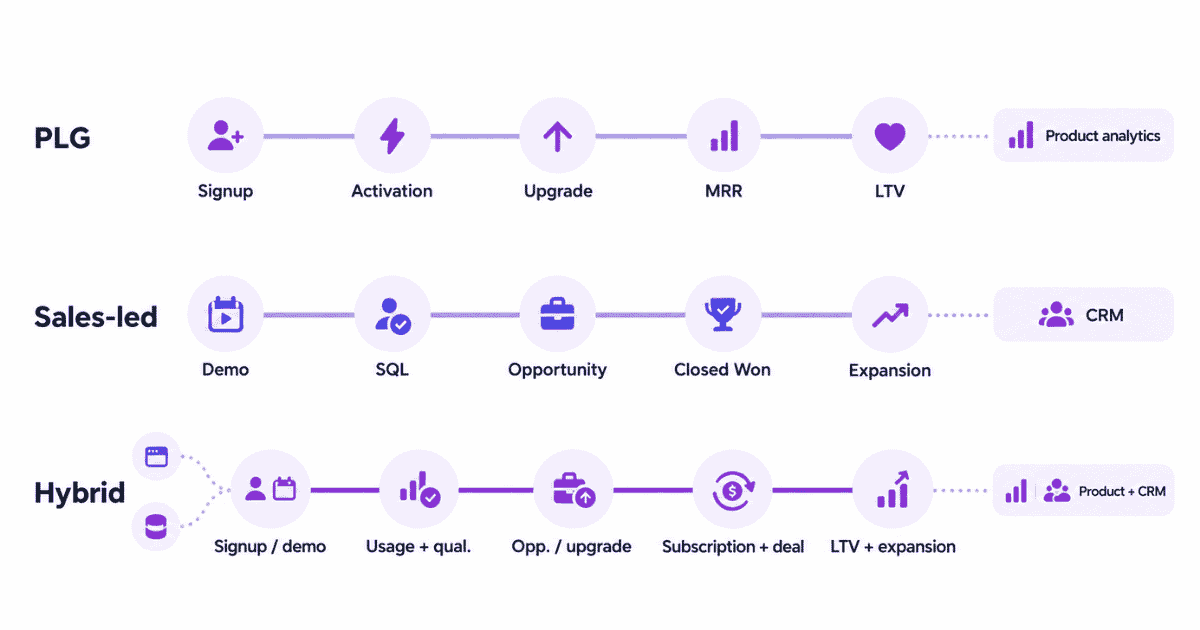
B2B revenue attribution becomes more decision-ready when metrics are grouped by stage. The further down the funnel the metric sits, the closer it usually is to commercial value.
| Layer | Useful metrics |
|---|---|
| Acquisition | Leads, CPL, demos |
| Qualification | MQL rate, SQL rate, cost per SQL |
| Pipeline | Opportunities, cost per opportunity, pipeline value |
| Revenue | Closed Won, attributed revenue, revenue per opportunity |
| Efficiency | Marketing ROI, attributed ROAS, CAC |
| Customer quality | Retention, renewal, expansion, LTV |
A dedicated marketing attribution metrics framework can help teams keep channel, pipeline, revenue, and efficiency metrics aligned instead of optimizing one stage in isolation.
B2B revenue attribution formulas
Formulas make the reporting logic explicit and easier to audit. They should still be interpreted in the context of the attribution model that created the credited values.
Attributed revenue
| Attributed revenue = Deal revenue × attribution credit |
Example: a $50,000 Closed Won deal receiving 40% credit from a channel produces $20,000 of attributed revenue for that channel.
Cost per opportunity
| Cost per opportunity = Marketing spend / attributed opportunities |
This is often more useful than CPL when the business wants to know which channels create sales-ready demand.
Pipeline per marketing dollar
| Pipeline per marketing dollar = Attributed pipeline / marketing spend |
This compares marketing investment with the opportunity value credited to that activity.
Revenue per lead
| Revenue per lead = Attributed revenue / leads |
A channel with fewer leads can outperform if its leads convert into larger or more frequent Closed Won deals.
Marketing ROI
| Marketing ROI = (Attributed revenue – marketing cost) / marketing cost × 100 |
This remains an attribution-derived efficiency measure. It should not be presented as proof that the credited marketing activity caused the same amount of incremental revenue.
How attribution models change revenue credit
Once the measurement foundation is trustworthy, attribution models become useful lenses. They answer different questions by redistributing the same revenue across eligible interactions.
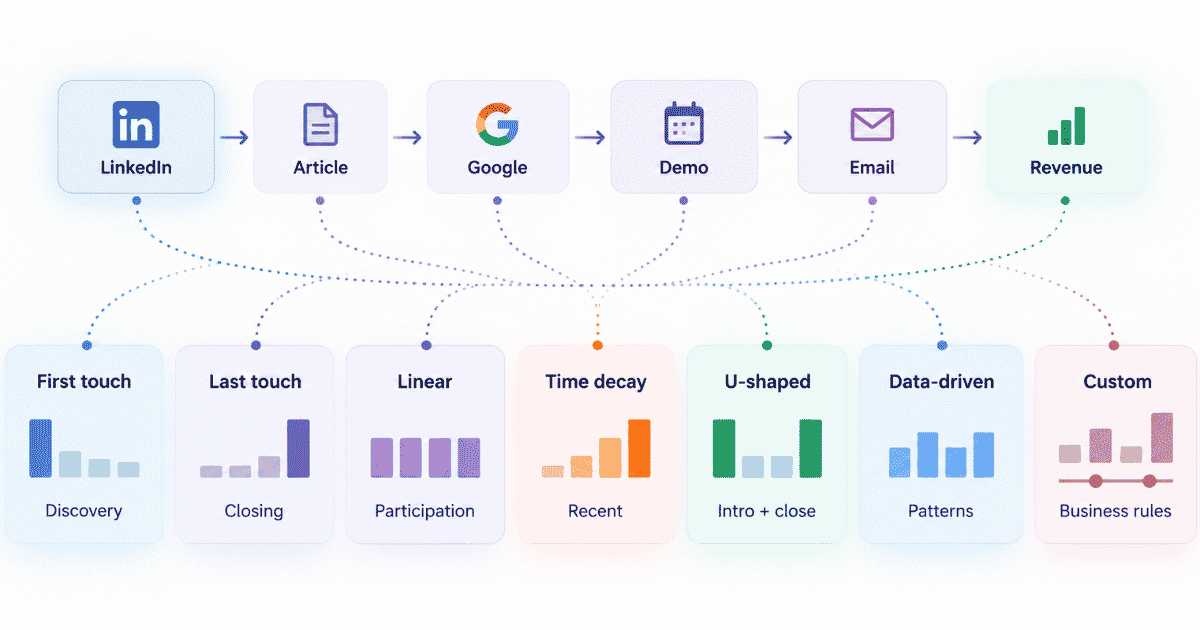
Consider one $30,000 Closed Won journey:
| Organic Search -> LinkedIn -> webinar -> demo -> sales call -> Closed Won = $30,000 |
| Model | Revenue-credit logic |
|---|---|
| First touch | All eligible credit to the opening touch |
| Last touch | All eligible credit to the final touch |
| Linear | Equal credit across eligible touches |
| Time decay | More credit to interactions closer to conversion |
| U-shaped | More credit to opening and lead-creation interactions |
| Stage-weighted / custom | Credit tied to lifecycle milestones and business rules |
For deeper model mechanics, the multi-touch attribution guide compares how credit changes when several touchpoints participate in the same conversion journey.
| The deal remains worth $30,000. The attribution model only changes how that $30,000 of credit is distributed. |
Use lifecycle-stage attribution for B2B
Traditional models focus on touch position. B2B teams may also care about lifecycle milestones because first discovery, lead creation, opportunity creation, and the closing interaction represent different commercial jobs.
A hypothetical stage-weighted model might assign:
| Milestone | Example weight |
|---|---|
| First Touch | 25% |
| Lead Creation | 25% |
| Opportunity Creation | 35% |
| Last Touch | 15% |
These percentages are only an example. The right weights depend on the sales process and should be validated against business goals rather than copied from another company.
Usermaven Enterprise teams can build custom attribution models with configurable weights across First Touch, Lead Creation, Opportunity Creation, and Last Touch, then layer channel multipliers on top. Models are versioned and can be used across Channel, Source, Content, Paid Ads, Conversion Path, and Actor Credit reports.
| A custom model makes business assumptions explicit. It does not make those assumptions causal truth. |
Choose the right B2B attribution window
The attribution window determines how far the model looks for eligible interactions around a conversion. Long B2B cycles need enough lookback to capture early demand creation, but keeping every historical touch eligible forever can introduce weak signals.
| Observed buying cycle | Window implication |
|---|---|
| Most revenue closes within 30 days | A shorter window may be sufficient |
| Opportunities mature over 60-120 days | A longer lookback is likely needed |
| Enterprise cycles span quarters | A long window may be justified |
| Very old touches dominate reports | The window may be too broad |
Usermaven supports long attribution windows for extended journeys, including a 365-day maximum in relevant attribution workflows. That availability should not be treated as a recommendation to use 365 days for every business.
| Choose the attribution window from real time-to-opportunity and time-to-close data, not from the maximum available setting. |
Handle dark-funnel influence carefully
B2B journeys contain both observable and unobservable influence. Attribution is most trustworthy when the report states what it can see and what remains outside deterministic measurement.
| Observable in the measurement stack | Potentially unobservable |
|---|---|
| Paid clicks, organic visits, email, website activity | Peer recommendations |
| Product events and known return sessions | Private buyer-community discussions |
| CRM calls or meetings when imported | Internal buyer conversations |
| Webinar attendance and opportunity stages | Offline interactions that were never logged |
| Payments, Closed Won, and revenue events | Impressions with no identity connection |
| No attribution platform can deterministically assign credit to an influence it never observed. |
For discovery that buyers remember but analytics cannot deterministically connect, self-reported attribution can complement behavioral attribution by capturing what customers say influenced them. It should be treated as additional evidence rather than a replacement for observed journey data.
Attribution is not incrementality
Attribution asks which observed interactions should receive credit. Incrementality asks what would have happened if the marketing activity had not run.
If a model assigns LinkedIn $250,000 of attributed revenue, that does not mean removing LinkedIn would reduce revenue by exactly $250,000. Attribution credit and causal lift are different claims.
The distinction is covered in more depth in incremental revenue attribution, which focuses on measuring additional business outcomes rather than redistributing observed credit.
Common B2B revenue attribution failures
Most attribution disagreements are blamed on the model first. In practice, the bigger failure often happens earlier in tracking, identity, CRM relationships, or revenue definitions.
Starting the journey at the form
If tracking begins only when a contact enters the CRM, early search, content, social, and paid interactions cannot receive credit. The known lead appears complete in the CRM while the demand-creation journey remains missing.
Treating one Lead Source field as the full story
A source field is useful for origin reporting, but one value cannot represent a multi-touch journey. It can answer where the lead was recorded as coming from without explaining the later interactions that contributed to opportunity and revenue progression.
Missing opportunity-contact relationships
Revenue attribution depends on connecting observed people with the commercial opportunity. If a contact attended the webinar or clicked the campaign but is not associated with the deal, the interaction may never become eligible for opportunity or revenue analysis.
Using pipeline as a proxy for revenue
Open pipeline can be valuable, but it contains uncertainty. Channels with large opportunity values can still produce weak win rates. Keep pipeline contribution and Closed Won revenue visible side by side so budget decisions do not assume every opportunity will close.
Changing models without documenting the question
First touch, last touch, linear, time decay, and custom models can all be mathematically valid while producing different channel totals. State the business question and model on the report so a revenue number is not interpreted without knowing the credit rule behind it.
Letting Direct absorb earlier demand
Direct can be a legitimate source, but it can also represent a return visit after earlier measurable discovery. Inspect journeys before concluding that Direct created the demand simply because it appears near the conversion.
Using a window that is too short or too long
A short window drops early demand creation. An excessively long window can keep old, weak interactions eligible long after they stopped being useful. Measure actual conversion lag and document the rule.
Trusting precise revenue with weak data health
A revenue number with two decimal places can still be wrong if campaign parameters are missing, CRM syncs are stale, identities are unresolved, or deal amounts are incomplete. Validate the measurement chain before increasing model sophistication.
What B2B revenue attribution software needs
The related search demand around B2B revenue attribution includes clear software-evaluation intent. A platform should therefore be judged by whether it can connect the revenue journey, not by how many attribution models appear in a menu.
| Requirement | Why it matters |
|---|---|
| Anonymous-to-known identity | Preserve early demand generation |
| CRM integration | Connect marketing to opportunities and revenue |
| Revenue events | Reach Closed Won and actual value |
| Multi-touch models | Handle longer journeys |
| Lifecycle milestones | Reflect B2B funnel stages |
| Long attribution windows | Capture delayed deals |
| Journey inspection | Audit individual customers and deals |
| Pipeline reporting | Separate opportunity value from revenue |
| Custom models | Match business logic |
| Data-health validation | Avoid decisions from broken tracking |
| AI analysis | Investigate complex journeys faster |
Teams actively comparing vendors can use the separate revenue attribution tools guide. This article stays focused on the measurement framework rather than becoming another tools list.
How Usermaven handles B2B revenue attribution
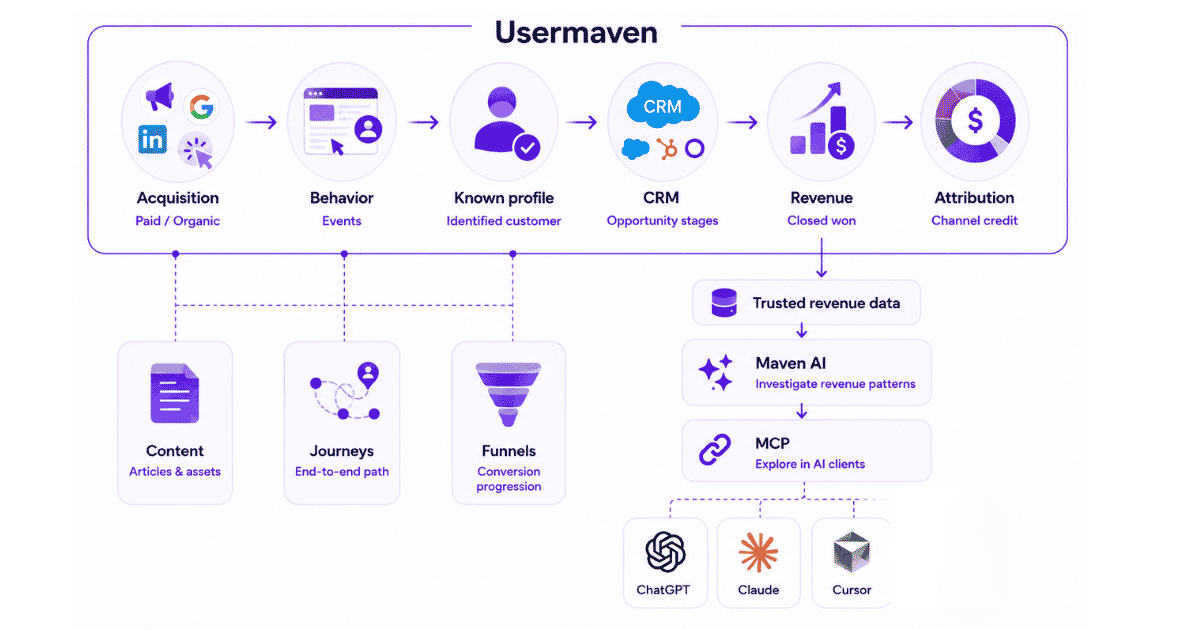
Usermaven connects acquisition, customer journeys, CRM outcomes, pipeline, and revenue so B2B teams can evaluate observed contribution deeper than the lead stage.
Connect the journey to pipeline
Pipeline Attribution follows acquisition through lead qualification, opportunity creation, pipeline value, and time to opportunity. That keeps early marketing performance connected with the commercial stages sales teams actually use.
Continue from pipeline to revenue
Opportunities are potential revenue. Closed Won is realized revenue. Usermaven keeps those outcomes separate so teams can see whether the channels creating the most pipeline are also the channels producing the most attributed revenue.
Inspect customer and deal journeys
User Journeys makes the sequence behind a conversion auditable. A deal can be traced through Google Ads, organic return visits, LinkedIn, a demo, CRM opportunity creation, and Closed Won rather than being reduced to one source field.
Connect HubSpot and Salesforce
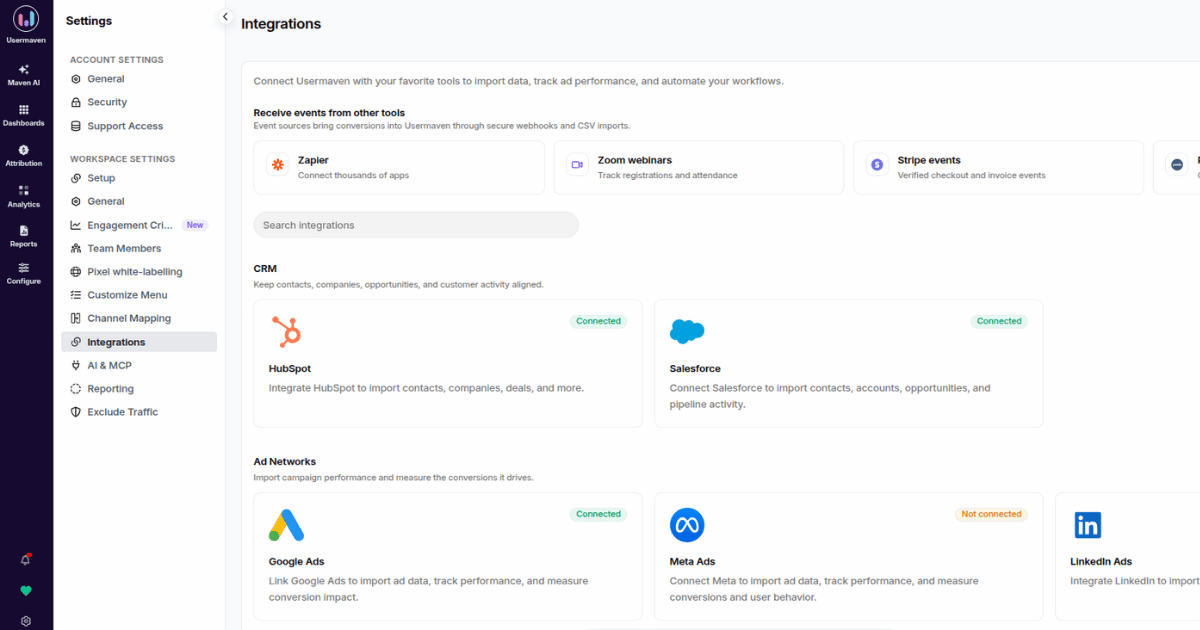
For HubSpot teams, the HubSpot + Usermaven integration can connect contacts, companies, deals, deal stages, calls, meetings, and Closed Won values with the acquisition and behavioral journey that happened before the CRM record existed.
Supported Reverse ETL workflows can also send selected Usermaven attribution and audience data back to HubSpot.
For Salesforce teams, Salesforce marketing attribution connects acquisition and customer behavior with Accounts, Contacts, Leads, Opportunities, stage history, contact roles, pipeline, and Closed Won revenue.
The Salesforce connection is read-only, so Salesforce remains the commercial system of record while Usermaven adds the earlier journey and attribution context.
Bring in off-site revenue events
Event Sources can ingest supported payment, webinar, CRM, webhook, and CSV-based conversions. When the incoming event carries usable identity and revenue, it can become part of attribution, funnels, goals, and journey analysis.
Validate measurement quality
The Measurement Trust Center checks campaign tracking, customer matching, connected platforms, conversion feedback, and data confidence so teams can fix measurement gaps before trusting revenue allocation.
Build business-specific attribution models
Enterprise teams can define lifecycle weights and channel multipliers when standard models do not reflect the way their buying cycle creates and closes opportunities. Versioning prevents later model changes from silently rewriting the historical logic behind saved reports.
Analyze B2B revenue with Maven AI
Maven AI can investigate captured attribution and revenue data in plain English. Teams can ask which channels influenced the most revenue, which campaigns created pipeline but little Closed Won value, or which sources appear before high-value opportunities.
The September 2026 update added faster streaming, concurrent conversations, visible activity steps, and interactive funnel results. AI speeds up investigation, but it still depends on the measurement foundation underneath it.
Query attribution through MCP
With Usermaven MCP, teams can analyze attribution, CAC, LTV, ARR, revenue, channels, campaigns, and journeys from compatible AI clients such as ChatGPT, Claude, Cursor, and Codex. Access respects workspace permissions and approved OAuth scopes, and write actions require approval in interactive clients.
Evidence: Hyperengage uncovered hidden contribution
Hyperengage is useful evidence for B2B attribution because its growth comes through content, organic search, podcast-led distribution, LinkedIn, email, and partnerships. The team previously combined Google Analytics, CRM data, platform dashboards, and manual tracking, leaving the customer journey fragmented.
In the Hyperengage case study, multi-touch attribution expanded measurable channel coverage and showed that some channels were contributing earlier in the journey even when they did not receive last-click credit.
| Reported result | Outcome |
|---|---|
| Channels attributed | 4 -> 6 |
| Visitor-to-goal conversion | 22.19% |
| Primary-goal visitors | 975 |
| Organic first-touch conversions | 0 -> 8 |
| New sources uncovered | 2 |
Direct had previously dominated the attributed picture. With fuller visibility, Email and AI Search emerged as measurable sources, while organic search showed first-touch contribution that last-click reporting had obscured.
The team then used measured contribution to question channels that generated traffic without enough qualified outcomes and put more focus behind channels with stronger connections to qualified pipeline.
| Better attribution did not create the customer journey. It made more of the observed journey visible. |
Create attribution governance across teams
Revenue attribution becomes contentious when different teams trust different systems or definitions. Marketing may use a multi-touch report, sales may trust CRM source fields, and finance may recognize revenue under a different timing rule. The solution is not to force every team into one dashboard, but to document the shared measurement contract behind the report.
| Team | What should be agreed |
|---|---|
| Marketing | Channel taxonomy, campaign naming, eligible touchpoints, attribution model |
| Sales | Lead and opportunity stages, contact roles, Closed Won process |
| RevOps | Identity rules, CRM associations, data syncs, attribution window |
| Finance | Revenue field, currency treatment, bookings vs. recognized revenue |
Document which CRM stage counts as an opportunity, which status counts as Closed Won, which monetary field becomes the attributed value, and which date controls reporting. If a team changes any of those rules, record the effective date so a quarter-over-quarter shift is not mistaken for a marketing performance change.
Governance also means keeping the attribution model visible in dashboards and scheduled reports. Two reports can legitimately show different channel revenue when one uses first touch and another uses a lifecycle-weighted model. The disagreement becomes manageable when the credit rule is explicit.
A quarterly review should therefore audit both the numbers and the measurement assumptions: CRM field changes, new channels, renamed campaigns, identity-resolution gaps, attribution-window changes, and model versions. This keeps the revenue report comparable enough to support real budget decisions.
| The most useful B2B attribution system is not the one with the most models. It is the one whose data definitions and credit rules are understood across marketing, sales, RevOps, and finance. |
Turn attribution into budget decisions
Revenue attribution becomes useful when it changes a decision. The report should help a team decide where to investigate, where to protect investment, and where to reduce spend rather than merely declaring a channel the winner.
| Signal | Possible decision |
|---|---|
| High leads, low opportunity rate | Review targeting, offer, or qualification |
| High pipeline, weak Closed Won | Inspect sales fit, deal quality, and late-stage progression |
| Low lead volume, high revenue per customer | Protect the channel from CPL-only cuts |
| Strong first-touch, weak last-touch | Treat the channel as demand creation rather than closing |
| Weak first-touch, strong closing credit | Investigate whether the channel captures existing demand |
| Revenue appears only under one model | Check how sensitive the conclusion is to attribution assumptions |
A channel does not need to win every attribution model to deserve budget. More useful questions are whether its role is consistent, whether the associated customers progress to revenue, and whether the conclusion survives reasonable changes to the window and credit logic.
Revenue attribution should also trigger qualitative investigation. Open the journeys behind high-value deals, compare the campaigns and pages involved, and check the CRM context before converting an aggregate pattern into a budget rule.
| Use attribution to narrow the decision space, then inspect the journeys and commercial context behind the number. |
B2B revenue attribution checklist
| Check | Question |
|---|---|
| Campaign tracking | Are acquisition parameters consistent? |
| Identity | Can anonymous activity connect to known contacts? |
| Company context | Are contacts associated with the right account? |
| CRM | Are lead, opportunity, and stage events available? |
| Opportunity value | Is pipeline value captured correctly? |
| Closed Won | Can won deals be identified? |
| Revenue | Is actual deal or revenue value available? |
| Off-site events | Are important offline outcomes imported? |
| Journey | Can earlier marketing touches be inspected? |
| Attribution window | Does it fit the real sales cycle? |
| Model | Does it answer the business question? |
| Lifecycle stages | Are lead and opportunity milestones represented? |
| Data health | Is the reporting foundation trustworthy? |
| Incrementality | Is attribution kept separate from causal claims? |
Final verdict
B2B revenue attribution should not stop at lead generation or even opportunity creation. The measurement system needs to connect marketing, identity, CRM stages, Closed Won outcomes, and revenue before deciding how credit should be distributed.
Different models can legitimately produce different channel-credit totals because they answer different questions. The underlying customer journey and actual business revenue do not change when the model changes.
The strongest setup combines reliable identity and CRM data with journey inspection, multiple attribution lenses, explicit limits around unobservable influence, and a clear distinction between attributed revenue and incremental revenue.
Book a Usermaven demo to see how marketing and sales touchpoints connect with opportunities, pipeline, and Closed Won revenue.
FAQs about B2B revenue attribution
1. What is B2B revenue attribution?
B2B revenue attribution connects measurable marketing and sales touchpoints with opportunities, Closed Won deals, and revenue, then applies an attribution model to determine how revenue credit should be distributed across the observed journey.
2. How is B2B revenue attribution different from marketing attribution?
B2B marketing attribution focuses on the contribution of marketing channels, campaigns, and touchpoints. B2B revenue attribution extends the measurement to commercial outcomes such as opportunity value, Closed Won deals, and revenue.
3. Why is revenue attribution difficult in B2B?
B2B journeys often involve long sales cycles, multiple stakeholders, CRM stages, offline interactions, and revenue that appears well after the initial marketing touch. Some influence may also remain unobservable.
4. Which attribution model is best for B2B revenue?
There is no universal best model. First touch is useful for demand creation, last touch emphasizes the closing interaction, linear spreads credit, time decay emphasizes recency, and lifecycle-stage or custom models can reflect specific B2B milestones.
5. What is W-shaped attribution in B2B?
W-shaped attribution typically emphasizes key lifecycle milestones such as first touch, lead creation, and opportunity creation, while distributing remaining credit across other eligible interactions. The exact weights depend on the model definition used by the platform or business.
6. How do CRM systems fit into B2B revenue attribution?
CRM systems hold the commercial records that attribution needs, including contacts, companies, opportunities, stages, Closed Won status, and deal value. Connecting those records with earlier marketing behavior lets revenue be analyzed against the acquisition journey.

Written by
Junaid Ahmed
Content Writer & Digital Marketer
Junaid Ahmed is a content and copywriter with 3+ years of experience creating research-driven content across SaaS, B2B, ecommerce, and digital marketing. He specializes in turning complex topics into clear, practical content that helps marketers better understand their challenges, evaluate solutions, and make informed decisions. His work spans educational content, industry insights, and actionable marketing guides.
All articles by Junaid →