Looking for the best marketing analytics companies? Start by deciding whether you need software to analyze campaigns or experts to design and run your measurement program. Those are different purchases, even when providers use similar language.
This guide compares 15 companies across attribution, product analytics, marketing data infrastructure, and consulting. It explains where each fits, what to verify in a demo, and how to avoid buying another dashboard that cannot answer a revenue question.
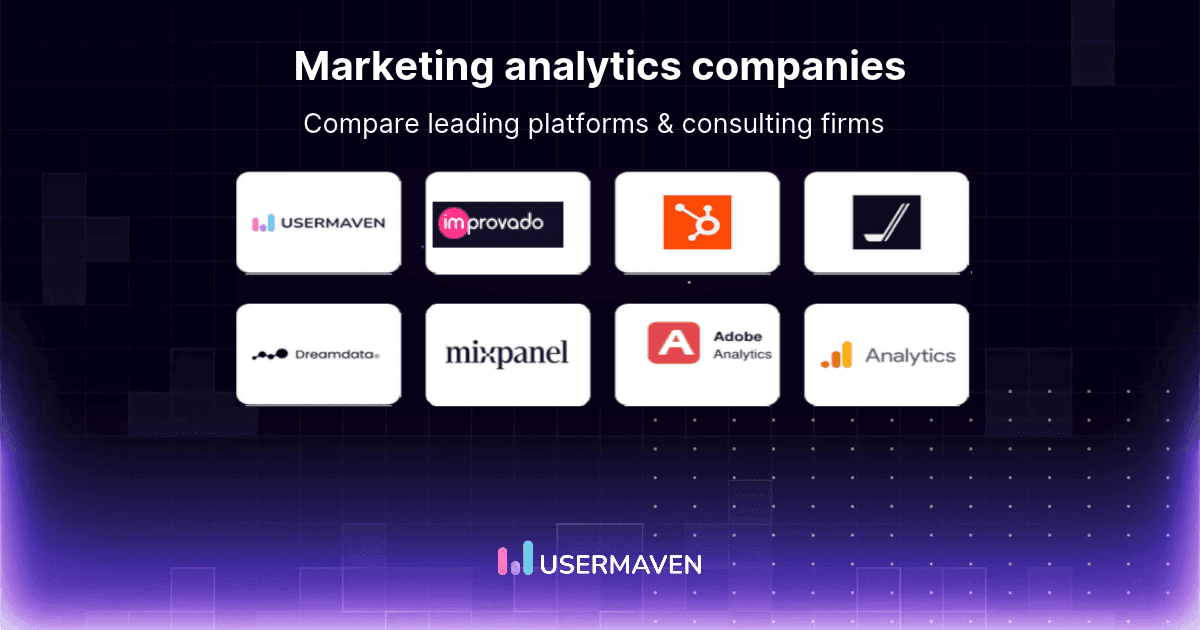
The right marketing analytics approach depends on the KPIs, measurement methods, and business decisions your team needs to support.
Key takeaways
- Choose by problem: Use attribution tools for revenue journeys, product analytics for activation, and data platforms for cross-channel consolidation.
- Software and services are different: An analytics consultancy can build measurement strategy, models, and governance; a software company supplies a recurring platform.
- Do not compare prices without scope: Ask about event volume, connectors, user seats, historical data, implementation, and services.
- Validate measurement: More dashboards do not fix missing conversion events, broken identities, or inconsistent attribution windows.
- Start with a decision: Define the business question and the data needed to answer it before selecting a provider.
Which marketing analytics companies fit each need?
The companies below are grouped by their strongest use cases, not ranked by an unverified universal score. Software vendors and consulting firms are separated because their deliverables differ.
| Need | Companies to evaluate | Primary fit |
|---|---|---|
| Connect campaigns to pipeline and revenue | Usermaven, HockeyStack, Dreamdata, HubSpot | Attribution and CRM outcomes |
| Unify marketing data and reporting | Improvado, Funnel, Supermetrics | Connectors, normalization, reporting |
| Analyze in-product engagement | Amplitude, Mixpanel | Funnels, cohorts, retention, behavior |
| Run web or enterprise experience analytics | Google Analytics, Adobe | Web/app analysis and enterprise CX |
| Commission expert measurement work | Analytic Partners, Ekimetrics, Merkle, Artefact | MMM, experimentation, analytics strategy |
A tool can belong to multiple categories, but its strongest use case is the most useful starting point for a shortlist.
What counts as a marketing analytics company?
A marketing analytics company provides technology or professional services that help businesses collect, interpret, and use marketing data. Its work may span acquisition, customer behavior, conversion tracking, attribution, forecasting, and budget planning.
| Company type | Typical deliverable | Best question it answers |
|---|---|---|
| Attribution platform | Channel, campaign, and revenue reports | Which touchpoints contributed to pipeline or purchases? |
| Marketing data platform | Normalized dataset and dashboards | Can our teams use consistent data across channels? |
| Product analytics platform | Funnel, cohort, retention, and behavior analysis | Where do acquired users activate or drop off? |
| Marketing analytics consultancy | Custom models, measurement plan, interpretation | What changed business outcomes, and how should we invest? |
This distinction matters because marketing attribution describes credited customer touchpoints, while marketing mix modeling and controlled experiments address different questions about marketing contribution and incrementality.
11 marketing analytics software companies
These providers cover different parts of the analytics stack. Pricing and feature access change frequently, so the descriptions emphasize current positioning and important buying considerations rather than unverifiable entry-price claims.
1. Usermaven: Marketing and revenue attribution
Usermaven focuses on connecting acquisition activity with conversion events, customer journeys, pipeline, and revenue. Its platform also includes website and product analytics, funnels, segments, and reporting dashboards.
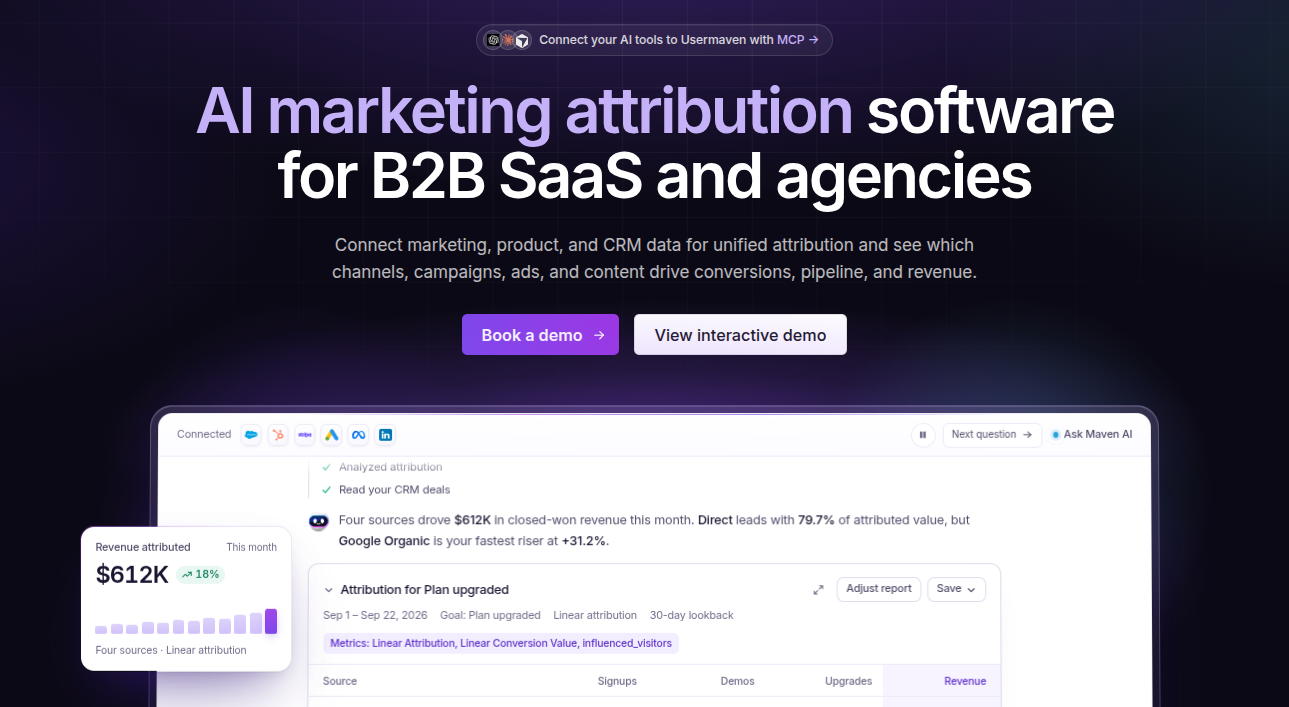
For teams buying marketing attribution software, the useful distinction is visibility beyond the first lead. The platform can connect marketing touchpoints with later CRM and product outcomes when the relevant data and identity mapping are configured.
- Best fit: B2B SaaS, marketing agencies, and ecommerce teams that need to connect campaign activity with business outcomes.
- Core capabilities: Multi-touch attribution, paid ads attribution, funnels, customer journeys, contact profiles, reporting, and supported CRM integrations.
- Consideration: Reliable revenue analysis depends on correctly configured events, conversion goals, platform connections, and user matching.
Built-in analytics dashboards support team reporting, while funnel analytics software helps examine drop-offs between acquisition and conversion.
Maven AI and scheduled AI Agents
Maven AI answers analytics questions in natural language and can build dashboards, trends, funnels, attribution views, and retention analyses from workspace data.
The newer Maven AI Agents run scheduled investigations of campaign performance, acquisition shifts, funnel drop-offs, content results, or retention. Reports can be delivered through supported channels such as Maven, email, and Slack.
Importantly, these Agents use read-only analytics tools while running. They investigate and report; they do not autonomously change media budgets. The Maven AI and Agents documentation explains their objectives, schedules, and permissions.
Measurement Trust Center and connected data
Usermaven also includes a Measurement Trust Center that assigns a workspace Trust Score, checks important data-health signals, and recommends prioritized fixes before teams rely on reports.
The current checks cover campaign tracking, customer matching, connected platforms, conversion feedback, and data confidence. Marketers can run checks again after correcting a problem.
For revenue tracking, Event Sources can bring supported off-site conversion events into goals and attribution, while the Salesforce integration guide explains CRM record ingestion and matching.
Additional options include an MCP connection for supported AI clients and Enterprise custom attribution models. Custom model availability, permissions, and integration scopes should be confirmed during evaluation.
Pricing: The current public pricing page presents Business and Enterprise options with demo-led purchasing. Confirm required capabilities and any additional services rather than relying on obsolete entry-price figures.
2. Improvado: Enterprise marketing data
Improvado specializes in consolidating marketing and revenue data from many platforms. It emphasizes integration, transformation, governance, dashboards, and AI-assisted analytical workflows.
Best fit: Enterprises and agencies with complex channel mixes, large reporting operations, or existing BI and warehouse investments.
Consideration: Evaluate implementation scope, data modeling requirements, governance rules, and total operational cost. It is not simply a replacement for a lightweight website analytics tracker.
3. Funnel: Marketing data and measurement
Funnel combines a marketing data hub with reporting and measurement capabilities. Its positioning now includes governed data, marketing mix modeling, attribution, incrementality, and AI-assisted analysis.
Best fit: Teams that need consistent cross-channel datasets and want to support both reporting and broader marketing measurement.
Consideration: Check which measurement modules are included, how source data is normalized, and what modeling assumptions apply to your business.
4. Supermetrics: Cross-channel data integration
Supermetrics brings marketing data from advertising, analytics, ecommerce, and CRM sources into dashboards, spreadsheets, or warehouses. It also offers marketing intelligence and AI-supported analysis.
Best fit: Marketing teams and agencies with established reporting workflows that need dependable connectors and standardized data.
Consideration: Moving campaign data into one place is not the same as linking anonymous website visitors to CRM revenue. Validate the identity and conversion layer separately.
5. HubSpot: CRM-connected marketing analytics
HubSpot provides campaign, website, contact, and revenue reporting within its broader CRM and marketing system. Its reporting can examine marketing interactions alongside lifecycle and closed-deal records.
Best fit: Teams already using HubSpot for marketing, sales, and customer records.
Consideration: Advanced attribution and reporting depend on subscription, data structure, and implementation. Confirm which reports are available in the proposed plan.
Maximize your ROI
with accurate attribution
6. HockeyStack: B2B GTM intelligence
HockeyStack focuses on B2B buyer journeys, marketing attribution, account intelligence, and go-to-market analysis. Its platform also describes lift reporting and Odin AI analysis.
Best fit: B2B organizations needing account-level visibility across marketing, sales, and pipeline development.
Consideration: Validate identity resolution, CRM coverage, lift methodology, and whether the broader GTM workflow matches your team size and requirements.
7. Dreamdata: B2B account-based attribution
Dreamdata emphasizes B2B revenue attribution across accounts, buying groups, channels, and opportunities. It is particularly relevant where a conversion involves multiple stakeholders over a long sales cycle.
Best fit: B2B teams prioritizing account-based marketing, opportunity creation, and pipeline attribution.
Consideration: Ask how contacts are matched to accounts and opportunities, and how the platform treats multiple open deals within one organization.
8. Amplitude: Product and behavioral analytics
Amplitude analyzes how people move through products and websites. Its capabilities cover event-based analytics, behavioral cohorts, funnels, retention, session replay, and experimentation.

Best fit: Product-led growth teams investigating activation, engagement, retention, and user experience after acquisition.
Consideration: Product behavior analysis may need additional CRM and campaign data when marketing leadership asks for pipeline or closed-won revenue attribution.
9. Mixpanel: Event-based growth analytics
Mixpanel helps teams examine conversion funnels, engagement, retention, and user behavior across web and mobile experiences. Session replay can add context to quantitative funnel findings.

Best fit: Growth and product teams diagnosing onboarding, conversion, and retention problems.
Consideration: Confirm the events, identity fields, and downstream revenue data required before evaluating it as an end-to-end marketing measurement solution.
Power up your SaaS
with perfect product analytics
10. Adobe: Enterprise experience analytics
Adobe offers enterprise analytics across digital behavior, customer journeys, and marketing campaign measurement. Its wider analytics portfolio includes segmentation, attribution, and dedicated campaign modeling capabilities.

Best fit: Large businesses with sophisticated customer-experience programs, governance needs, and dedicated analytical resources.
Consideration: Evaluate the specific Adobe product, data architecture, licensing scope, and specialist support required for implementation.
11. Google Analytics: Web and app measurement
Google Analytics 4 measures website and app activity through an event-based model. It is often the starting point for traffic, engagement, conversion, and Google Ads-related reporting.

Best fit: Organizations needing a general-purpose web and app analytics foundation, particularly within the Google ecosystem.
Consideration: It should not be assumed to reconstruct every cross-device B2B journey or CRM outcome automatically. Configuration, identity, consent, and linked systems affect coverage.
Teams comparing acquisition measurement with deeper journey analysis may find the differences clarified in our guide to marketing analytics vs. attribution.
Website analytics tool for modern marketers & agencies
4 marketing analytics consulting companies
Some organizations need a partner to design the measurement system itself. These firms provide professional services rather than a single, interchangeable self-serve analytics application.
12. Analytic Partners: Commercial analytics
Analytic Partners specializes in marketing measurement and commercial decision-making, including marketing mix modeling and analysis of broader business drivers.
Best fit: Larger advertisers deciding how to distribute budgets across channels, markets, and commercial initiatives.
Consideration: Ask how models are validated, what historical inputs are needed, and how recommendations are connected to business decisions.
13. Ekimetrics: Measurement and MMM strategy
Ekimetrics provides marketing analytics and advanced measurement services, with emphasis on marketing mix modeling, commercial outcomes, and business decision support.
Best fit: Organizations seeking a tailored measurement methodology and expert interpretation rather than an additional dashboard.
Consideration: Clarify the delivery model, internal data requirements, ownership of analytical outputs, and how results will be updated.
14. Merkle: Integrated measurement services
Merkle combines analytics strategy with services for marketing mix modeling, attribution, dashboards, customer insights, and testing.
Best fit: Large brands needing analytics connected to customer experience, media, and broader marketing operations.
Consideration: Define the engagement boundaries so measurement consulting, technology implementation, and media services have clear responsibilities.
15. Artefact: Data science and marketing ROI
Artefact works on marketing performance measurement using approaches such as MMM, attribution, incrementality testing, and data-science-led decision support.
Best fit: Brands that need tailored analysis across online, offline, and broader commercial factors.
Consideration: Ask for the methodology, test design, deliverables, and operational process that will turn a model into better decisions.
Marketing analytics software vs. consulting
| Buying question | Software platform | Analytics consultancy |
|---|---|---|
| Primary deliverable | Recurring access to reports, data tools, and workflows | Measurement framework, models, implementation, and advice |
| Implementation | Tracking, connectors, account setup, governance | Data discovery, modeling, validation, stakeholder workshops |
| Best suited to | Continuous monitoring and repeatable reporting | Strategic questions and custom modeling |
| Typical ownership | Internal marketing and data teams | Shared project team or external specialists |
| What to verify | Coverage, access, integration, reliability, pricing | Scope, methods, data rights, documentation, handover |
Many mature organizations use both. A platform handles repeated reporting; a measurement partner can design experiments, marketing mix models, and decision processes around that data.
How to choose a marketing analytics company
1. Start with the business decision
Write down the question the team needs to answer. For example: Which campaigns generate closed-won pipeline, which users activate after signup, or whether additional media spend creates incremental sales?
A company that excels at dashboards may not support the method needed for your specific question.
2. Map the required data and identity
List ad platforms, website and product events, CRM objects, billing data, and offline outcomes. Determine whether the decision requires event-level tracking, account matching, aggregate data, or a combination.
A practical integration check should cover marketing attribution CRM integration and missing conversion sources, not just whether a vendor lists your CRM logo.
3. Audit data quality before comparing reports
Ask prospective vendors to demonstrate how they detect missing campaign tags, stale integrations, duplicate events, weak customer matching, and inconsistent conversion definitions.
For teams implementing new analytics, the guide to event tracking setup shows why instrumented behavior and properly defined custom events matter.
4. Compare attribution with other evidence
Attribution describes how credit is assigned across recorded touchpoints. It does not, by itself, establish what would have happened without a campaign.
For high-stakes budget decisions, review multi touch attribution vs. marketing mix modeling and consider incrementality experiments where feasible.
5. Calculate the full evaluation cost
Compare subscription fees alongside event or row limits, connectors, data retention, user seats, onboarding, services, warehouse costs, white-label options, and governance needs.
A free entry tier, a low monthly price, and a custom enterprise contract do not offer comparable scope. Request a quote for the same measurement requirements.
6. Run a decision-oriented proof of concept
Choose one real question, one reporting period, and one conversion definition. Ask shortlisted vendors to reconcile sources, explain discrepancies, and show the evidence behind their result.
Use that demonstration to compare trustworthiness, ease of use, and operational ownership instead of counting screenshots or generic features.
Example: Evaluating two different approaches
Consider a B2B SaaS company with a six-week sales cycle. Its paid ads reports show 400 leads, but CRM records show only 35 qualified opportunities.
| Question | Illustrative measurement | Likely approach |
|---|---|---|
| Which campaigns influenced the 35 opportunities? | Campaign touches matched with opportunity records | Revenue attribution platform |
| Where did the other 365 leads drop off? | Lead quality, activation, and funnel stages | Funnel and product analytics |
| Did more spending create more total opportunities? | Experiment with a valid counterfactual | Incrementality study or external specialist |
The figures are illustrative. The same organization may need multiple methods because attribution, funnel analysis, and causal tests answer different questions.
Which company fits each business type?
| Business | Primary requirement | Shortlist direction |
|---|---|---|
| B2B SaaS | Pipeline and long customer journeys | Usermaven, HockeyStack, Dreamdata |
| Marketing agencies | Client reporting, attribution, multiple workspaces | Usermaven, Improvado, Supermetrics |
| Ecommerce brands | Order revenue, ROAS, purchase journeys | Usermaven, Funnel, specialist measurement partner |
| Product-led SaaS | Activation, cohorts, product adoption | Amplitude, Mixpanel, Usermaven |
| Large multichannel advertisers | MMM, lift testing, strategic spend allocation | Analytic Partners, Ekimetrics, Artefact, Merkle |
Organizations tracking post-signup activity can connect acquisition analysis with product analytics software and customer journey analytics software to examine behavior beyond the initial visit.
For B2B businesses with long buying journeys, the B2B SaaS solution explains how Usermaven connects acquisition, product usage, CRM pipeline, and revenue.
Agencies comparing client measurement setups can explore the marketing agencies solution for separate workspaces, revenue analysis, and white-label reporting capabilities.
Ecommerce teams can evaluate the ecommerce brands solution for campaigns tied to orders, revenue, purchase journeys, and repeat customer value.
What about healthcare marketing analytics companies?
Healthcare marketers should evaluate providers against their exact data, privacy, contractual, and regulatory obligations. The requirements can differ substantially between healthcare organizations and ordinary consumer brands.
Assess whether a proposed workflow collects sensitive information, where data is stored, whether applicable agreements are available, and how access controls and consent are managed.
Do not assume a general privacy claim or a vendor logo establishes compliance. Ask for legal and security review of the actual configuration before sending patient-related data.
A first-party example: Hyperengage
In a published Hyperengage customer case study, Usermaven reports that Hyperengage expanded measurable acquisition-channel coverage from four to six channels.
The case also describes eight organic-search first-touch conversions that were previously undercredited, helping the team reassess the role of content and search in its buyer journeys.
These are customer-reported measurement outcomes, not evidence that Usermaven alone caused additional sales. They illustrate how an attribution platform can expose previously obscured acquisition paths.
Final recommendation
There is no single best marketing analytics company for every business. Start with the outcome you must measure, identify the missing data, and choose a provider whose methodology supports the decision.
If your priority is connecting campaign activity with customer journeys, opportunities, and revenue, book a demo to examine how Usermaven would work with your current marketing and CRM setup.
FAQs about marketing analytics companies
1. What are marketing analytics companies?
Marketing analytics companies provide software or professional services that collect, analyze, and interpret marketing data. Some specialize in attribution or data integration, while others deliver consulting, modeling, and measurement strategy.
2. What are the best marketing analytics companies?
The best fit depends on the task. Usermaven, HockeyStack, and Dreamdata focus on attribution use cases; Improvado, Funnel, and Supermetrics emphasize marketing data; and Analytic Partners and Ekimetrics provide specialist measurement services.
3. What is the difference between an analytics company and agency?
A software company supplies a platform for recurring data collection and reporting. An analytics agency or consultancy typically designs measurement approaches, builds models, validates findings, and advises decision-makers.
4. Which marketing analytics companies work for B2B SaaS?
B2B SaaS teams commonly evaluate platforms that connect campaign touches to accounts, CRM opportunities, and revenue, including Usermaven, HockeyStack, and Dreamdata. The right choice depends on the sales process and the data available.
5. Can marketing analytics companies prove ROI?
They can calculate reported or attributed returns using the data and definitions available. Proving an incremental causal effect requires a credible counterfactual, such as a controlled experiment or suitable causal modeling approach.
6. What should small businesses look for?
Start with clear conversion reporting, required integrations, transparent total cost, and a workflow the team can maintain. Avoid buying specialized enterprise modeling before reliable tracking and outcome definitions are in place.

Written by
Adeel Khan
Growth Marketing Expert
Adeel Khan is a full-stack SaaS marketer with 10+ years of experience in content marketing, paid advertising, analytics, and conversion rate optimization. He shares practical insights and strategies drawn from hands-on experience, helping B2B SaaS marketers improve performance and make better marketing decisions.
All articles by Adeel →