A product signal loses value every minute it sits unexplained.
When a funnel starts leaking, a feature underperforms, or churn rate starts to rise, the challenge is not just noticing that something changed. It is figuring out what changed and what to do next while the signal still matters.
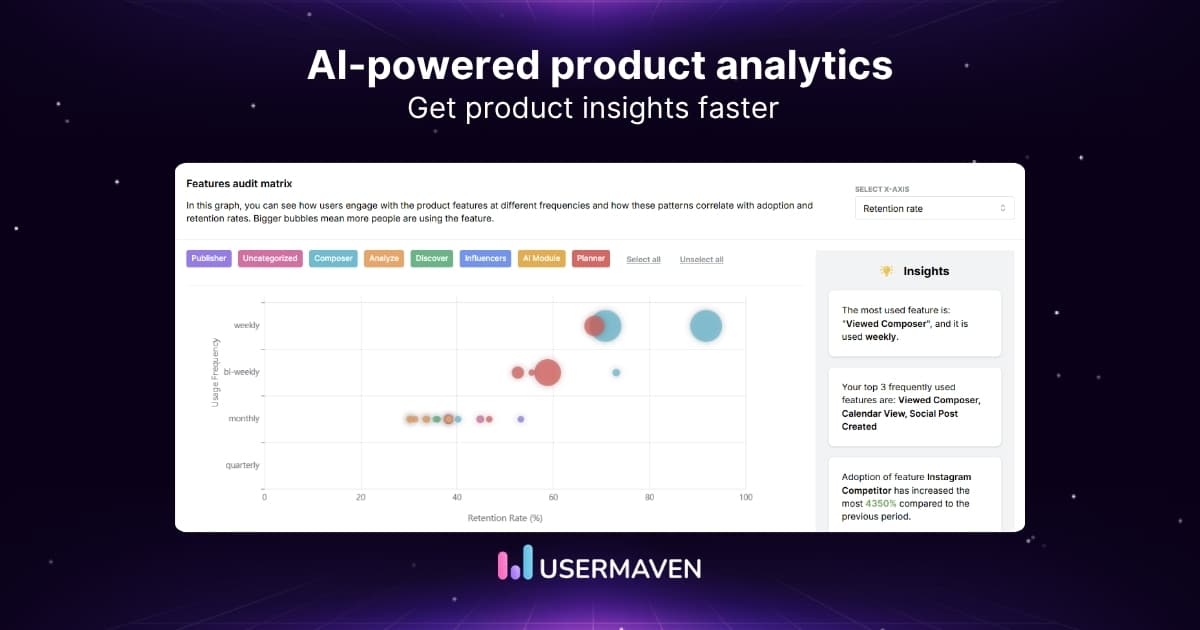
That is where AI-powered product analytics becomes useful. It helps teams work through data faster, reduce manual analysis, and understand what users are doing without the usual reporting delay.
In this blog, we will look at how AI-powered product analytics works in practice to speed up decision-making and surface next steps for product and growth teams.
Why time to insight matters in product analytics
In product analytics, speed matters because insight loses value when it arrives too late.
- If activation drops after a release, the team needs to know while the issue is still easy to fix.
- If a new feature is being ignored, product and growth need that signal before the next sprint is planned.
- If churn starts rising in a high-value segment, waiting until a monthly review means the insight comes after the damage.
That is the real value of AI-powered product analytics. It helps teams get to clear answers sooner and act on them before the opportunity passes.
How AI-powered product analytics speeds up the path from data to decisions
Let’s look at how AI-powered product analytics helps teams move through analysis faster.
Cleaning and preparing data faster
A lot of product analysis slows down before the actual analysis even begins. Events are inconsistent, naming conventions drift, fields go missing, and teams lose time checking whether the data can be trusted.
AI helps reduce that friction by catching issues earlier, flagging broken or unusual patterns, and helping teams standardize messy inputs faster. Instead of manually tracing why a signup event suddenly dropped or why a report no longer matches expectations, teams can spot data problems earlier and fix them with less effort.
That kind of workflow depends on connected systems working together reliably, much like IT services manufacturing, where repeatable processes matter because every downstream step depends on the one before it. In analytics, cleaner data means less time debugging and more time learning from what users are actually doing.
Spotting patterns and anomalies sooner
Once the data is usable, the next delay usually comes from finding what matters inside it.
AI-powered product analytics helps by scanning large volumes of behavioral data faster than a person can. It can surface unusual drops, spikes, changes in conversion, or shifts in user behavior before someone has to dig through dashboards manually. That reduces the time spent hunting for the problem and increases the time spent responding to it.
This matters in everyday product work. A team should not have to wait for a weekly review to realize a release changed onboarding behavior, or that users on one device type are dropping off earlier than expected.
Answering product questions without manual reporting
One of the biggest causes of slow insight is the back-and-forth required to answer simple questions:
- How did activation change this week?
- Which segment adopted the new feature fastest?
- Where are users dropping off in onboarding?
These are not hard questions, but they often require someone to build a report, write SQL, validate the output, and explain the results.
AI-powered product analytics reduces that overhead by helping teams query data in plain language, summarize trends automatically, and surface likely explanations faster. That does not remove the need for analysis, but it removes a lot of repetitive reporting work that slows everyone down.
That is where the value becomes practical. Instead of spending time assembling the first layer of information, teams can move more quickly into interpretation and action.
Turning findings into action faster
Insight only matters if it leads to a next step.
AI-powered product analytics helps teams move from findings to action faster. It highlights what changed, summarizes the key shifts, and makes insights easier to share across product, marketing, and growth. When the insight is already clear, teams do not lose extra time translating data into a recommendation.
Related: The role of AI in website and product analytics
What AI-powered product analytics looks like in practice
The best way to understand AI-powered product analytics is to look at where it actually saves time in day-to-day work.
Funnel analysis with clearer signals
Funnel analysis is one of the clearest examples.
Without AI support, identifying where users are dropping off often means manually comparing steps, filtering segments, checking time windows, and trying to isolate what changed. AI funnel insights can speed that up by surfacing unusual drop-offs, comparing behavior across segments, and pointing teams toward the steps that need attention first.
That makes it easier to answer questions like:
- Which step is creating the biggest drop in conversion?
- Did the latest release affect product onboarding completion?
- Are new users behaving differently from returning users?
The insight arrives faster, so the team can test fixes sooner.
Measuring feature adoption with more clarity
When a new feature launches, teams want to know who is using it, how often, and whether it is changing behavior in a meaningful way.
AI-powered product analytics can speed up that process by summarizing feature adoption patterns and surfacing segments that are engaging more or less than expected. It also helps teams compare usage trends without building every report from scratch.
Instead of waiting for a longer reporting cycle, product teams can see earlier whether a feature is gaining traction or needs changes in positioning, onboarding, or design.
Spotting churn signals earlier
Churn rarely appears all at once. It usually starts with smaller changes in behavior.
Users stop using a key feature. They return less often. They abandon a setup flow or fail to complete an important action.
AI-powered product analytics helps teams detect these patterns earlier and makes churn analysis more useful by identifying behavior changes that often come before churn becomes obvious in topline metrics.
This gives teams more time to respond. They can investigate the segment, improve the experience, or trigger interventions before the problem grows.
Reducing repetitive reporting work across teams
A lot of analytics work is repetitive. Teams ask similar questions every week, but the process of answering them still takes time.
This is where AI can reduce the burden of routine analysis. Early use cases have already shown savings of 20 to 30% on routine and ad hoc tasks, especially where analysts or product teams spend time answering repeated questions, generating summaries, or pulling the same types of reports.
The real advantage is not just efficiency. It is that teams spend less time producing updates and more time working with the insight itself.
Power up your SaaS
with perfect product analytics
What to look for in an AI-powered product analytics platform
Choosing an AI-powered product analytics tool is not really about picking the one with the longest list of AI features. It is about finding one that makes analysis easier to move through, so useful insight is easier to reach and act on.
Look for an AI-powered product analytics platform that helps you:
- Get from question to answer quickly: It should be easy to explore product data, compare behavior, and understand changes without heavy manual work.
- Surface useful insights automatically: Features like automated summaries, anomaly detection, and behavior-based analysis should help bring important changes forward without extra digging.
- Reduce manual reporting: The tool should cut down the work involved in answering recurring questions, preparing stakeholder updates, and pulling the same reports again and again.
- Support real product decisions: Insights should be clear enough to guide what happens next, not just add another layer of charts or vague suggestions.
- Build trust in the data: Reliable event tracking, strong metric definitions, and consistent reporting still matter because fast insight only helps when the data behind it is dependable.
How Usermaven supports AI-powered product analytics
Usermaven is an advanced attribution platform, but it is built as a broader analytics solution. It also includes product-focused analytics alongside website analytics, funnels, and user journeys.
That broader setup matters because product teams rarely work with product data in isolation. Understanding what users do often means connecting acquisition, behavior, conversion, and in-product activity without jumping across multiple tools.
The value here is not just visibility. It’s having a setup that makes behavior easier to track, analysis easier to run, and insights easier to act on without adding more manual work.

Here’s what that looks like in practice:
- Event tracking: Auto-capture helps reduce setup time, while custom events make it easier to track the product actions that matter most.
- Feature adoption: Usage patterns are easier to follow, so it becomes clearer which features are gaining traction and which ones are being ignored.
- Product engagement: Metrics like DAU, WAU, and MAU track active users over time, making it easier to spot engagement drop-offs.
- Funnels: Drop-offs and user flow patterns are easier to read, which helps shorten the time between spotting friction and acting on it.
- User journeys: Behavior can be viewed as a sequence, not just a list of isolated events, which makes analysis more useful.
- Segments: Different user groups can be compared more easily, so changes in behavior are easier to trace back to the right audience.
- Marketing attribution software: Full-journey visibility helps connect product behavior to conversion and revenue.
- Maven AI: Plain-language questions help cut down the back-and-forth of manual analysis and bring answers forward faster.
- Dashboards for shared visibility: Custom dashboards make it easier to organize insights and share them across product, growth, and marketing.
Final thoughts
The gap between seeing a change and knowing what to do about it is where good product teams pull ahead. The faster that gap closes, the easier it becomes to act while the signal still matters.
Usermaven fits naturally into that shift. As a powerful performance attribution software, it helps bring acquisition, conversion, and in-product behavior into the same view, giving teams a clearer picture of what is influencing product outcomes.
Ready to see Usermaven in action? Explore the platform or book a demo for a closer look.
FAQs about AI-powered product analytics
1. Is AI-powered product analytics only relevant for product teams?
No. It can also help growth, marketing, and customer success teams because product behavior often shapes conversion, retention, and expansion.
2. Does AI-powered product analytics only work for large teams?
No. Smaller teams often benefit even more because they have less time for manual reporting. AI can help them get to useful answers without needing a large analytics function.
3. How does AI-powered product analytics help with product decisions?
It helps teams spot meaningful changes faster, understand what is driving them, and act with more confidence. That makes it easier to prioritize fixes, improve journeys, and decide what to test next.
4. Can AI-powered product analytics replace analysts or product teams?
No. It helps teams move faster, but judgment still matters. The real value is in cutting down repetitive analysis so people can focus on decisions and next steps.
5. Do you need a complex setup to get value from AI-powered product analytics?
Not always. The best platforms reduce manual work, so teams can start exploring behavior and getting useful answers without a heavy analytics workflow.
Updated

Written by
Ryan Mitchell
Marketing Analytics Strategist
Ryan Mitchell is a marketing analytics strategist specializing in campaign measurement, customer journeys, and marketing performance. He writes about analytics, reporting, and data-driven marketing strategies, helping SaaS and B2B teams measure what matters across every stage of the customer journey.
All articles by Ryan →