Customer feedback has never been more abundant, or more difficult to interpret. Reviews, surveys, support tickets, in-app comments, social mentions, and community posts generate a constant stream of customer language. While collection has become automated and scalable, interpretation remains the bottleneck.
By 2026, organizations are no longer asking whether they collect enough feedback. The real question is whether they can reliably extract insight from it before decisions need to be made.
Manual tagging does not scale. Sampling introduces bias. Sentiment scoring alone oversimplifies complex customer journeys.
AI-powered customer feedback analysis tools address this gap. They apply semantic modeling, clustering, and pattern detection directly to unstructured feedback, allowing teams to move from raw language to structured understanding with greater speed and consistency.
Core capabilities to look for in a feedback analysis tool
Not all AI-powered feedback tools apply intelligence in the same way. Evaluation should focus on the depth of interpretation rather than the interface design.
Key capabilities include:
- Multi-source ingestion: Ability to combine surveys, tickets, reviews, and digital feedback.
- Semantic clustering: Grouping feedback by meaning, not keywords.
- Driver analysis: Linking themes to satisfaction, churn, or operational metrics.
- Trend and anomaly detection: Identifying emerging issues early.
- Multi-language support: Maintaining consistency across regions.
- Workflow integration: Routing insights to responsible teams.
- Reporting flexibility: Supporting both analysts and operational users.
Top AI-powered customer feedback analysis tools to consider
Here are seven platforms that make customer feedback easier to analyze and act on.
1. Revuze

Revuze stands out as a strong option for teams that want a centralized approach to customer feedback analysis. The platform ingests large volumes of unstructured feedback from surveys, reviews, support channels, and digital sources, applying semantic analysis to surface patterns without requiring predefined taxonomies.
A defining characteristic of Revuze is its ability to let themes emerge from customer language organically. Rather than relying on rigid tagging frameworks, it continuously adapts its modeling as language evolves. This makes it particularly effective in product-driven environments where new features and updates reshape customer expectations frequently.
Organizations typically use Revuze to detect emerging issues, understand satisfaction drivers at a feature level, and monitor perception shifts across markets or competitors.
Key capabilities:
- Advanced semantic clustering without manual tagging
- Driver analysis linking themes to sentiment and outcomes
- Competitive benchmarking based on customer language
- Trend evolution tracking across time and releases
- Multi-language feedback modeling
2. Keatext

Keatext focuses on explainable AI for qualitative feedback analysis. The platform is frequently deployed alongside survey or VoC systems to provide deeper analysis of open-ended responses.
A core differentiator is transparency. Analysts can trace how themes are constructed and how sentiment is assigned, which is critical in research-driven or regulated environments. Rather than functioning purely as an automation engine, Keatext supports structured qualitative analysis at scale.
Keatext is well-suited for organizations that require auditability and analytical rigor while still benefiting from AI-driven efficiency.
Key capabilities:
- Automated theme and intent classification
- Explainable sentiment analysis
- Strong multilingual processing
- Integration with survey and feedback tools
- Analyst-oriented exports and dashboards
3. SentiSum

SentiSum approaches customer feedback analysis from an operational perspective. It is widely used in service-driven environments where feedback is closely tied to support interactions.
The platform excels at identifying root causes behind recurring issues, helping teams reduce repeat contacts and escalation volume. Rather than presenting generic sentiment dashboards, SentiSum surfaces actionable insights connected to operational workflows.
This makes it particularly relevant for organizations where feedback analysis directly impacts cost and service efficiency.
Key capabilities:
- AI-based ticket and feedback categorization
- Root-cause identification
- Sentiment and urgency detection
- Operational dashboards
- Helpdesk integrations
4. Medallia

Medallia is built for large organizations that need to analyze customer feedback across complex experience programs. The platform combines structured and unstructured feedback from surveys, digital channels, contact centers, and service interactions, helping teams interpret customer signals across the full experience landscape.
Its strength lies in enterprise-scale coordination. Rather than focusing only on text analysis, Medallia connects feedback insights with journey measurement, operational workflows, and cross-functional action.
This makes it especially relevant for organizations with mature CX programs. Teams can use it to track themes at scale, link them to business processes, and act on them across departments.
Key capabilities:
- AI-driven text analytics across multiple feedback channels
- Experience signal collection from surveys, digital, and service interactions
- Journey-based analysis and cross-channel visibility
- Role-based dashboards and enterprise reporting
- Workflow automation for closed-loop action
5. Brandwatch

Brandwatch operates at the intersection of social listening and customer feedback analysis. While often associated with brand monitoring, its strength lies in processing high-volume public conversations and extracting structured insight from them.
In industries where public perception shifts quickly, Brandwatch helps organizations monitor sentiment and emerging themes in near real time. This is especially useful in sectors like retail, consumer technology, media, and travel, where conversations spread rapidly across social media, forums, blogs, and review sites.
Unlike purely survey-driven platforms, Brandwatch focuses heavily on unsolicited feedback. This gives teams visibility into customer opinions expressed outside formal channels. AI models cluster conversations, detect shifts in tone, and surface viral or accelerating topics before they become crises.
Key capabilities:
- Real-time social listening across multiple digital platforms
- AI-driven theme and sentiment clustering
- Competitive benchmarking
- Audience segmentation and trend analysis
- Customizable visualization dashboards
6. SupportLogic

SupportLogic focuses on the predictive side of feedback analysis, particularly within B2B and enterprise service environments. The platform analyzes support cases, emails, chats, and account communications to identify risk signals before they escalate.
Rather than concentrating on thematic exploration alone, SupportLogic emphasizes actionable detection. It highlights signals such as frustration, urgency, or dissatisfaction that may not yet be visible in ticket metrics or account health dashboards.
This makes it particularly valuable in complex customer relationships where churn risk builds gradually. AI models analyze historical patterns and ongoing interactions to identify accounts that may require proactive intervention.
Key capabilities:
- AI-based escalation prediction
- Case-level sentiment and risk scoring
- Account health monitoring
- CRM and support platform integrations
- Proactive prioritization workflows
7. CustomerGauge

CustomerGauge is positioned within enterprise customer experience ecosystems, particularly in organizations that rely heavily on NPS and structured feedback measurement. While not exclusively focused on open-text clustering, it incorporates AI to analyze qualitative feedback alongside score-based metrics.
The platform is often deployed in global enterprises with formalized CX programs. It connects feedback data to account hierarchies, revenue information, and operational metrics, enabling teams to link perception directly to business outcomes.
CustomerGauge places strong emphasis on governance and segmentation. Organizations can analyze feedback by region, product line, account tier, or industry segment. This structured approach makes it particularly effective in B2B environments where account-level insight is critical.
Key capabilities:
- Enterprise-grade NPS analytics
- Driver analysis linked to structured metrics
- Account and revenue segmentation
- Executive dashboards
- Long-term benchmarking and governance tools
8. Zonka Feedback

Zonka Feedback is a customer feedback and intelligence platform that combines omnichannel feedback collection with AI-driven analysis in a single system. Unlike tools that focus only on the analytics layer, Zonka handles both sides by collecting responses across email, SMS, WhatsApp, web, in-app, and kiosks, then using AI to interpret what those responses mean.
The platform’s AI performs thematic clustering, sentiment scoring, and entity-level mapping, connecting feedback patterns to specific locations, agents, products, or teams. This allows organizations to move beyond surface-level scores and understand what is driving satisfaction or dissatisfaction at a granular level. AI agents continuously monitor incoming feedback and surface signals, flagging anomalies, emerging themes, and churn risk without waiting for a manual review cycle.
Zonka is particularly relevant for teams that want to consolidate collection and analysis without stitching together separate tools. Feedback from surveys, support tickets, reviews, and chats flows into one intelligence layer, giving CX, product, and operations teams a unified view of customer sentiment.
Key capabilities:
- Multi-source feedback unification across surveys, tickets, reviews, chats, and calls
- AI thematic analysis with sentiment and impact scoring at entity level
- Automated signals for anomalies, trends, and churn risk
- Omnichannel collection across email, SMS, WhatsApp, web, in-app, kiosks, and offline channels
- Centralized inbox with case management and closed-loop workflows
What AI-powered feedback analysis actually solves
Customer feedback management and analysis tools exist to solve structural problems, not cosmetic ones. The difficulty lies in language itself. Customers rarely describe issues using standardized terminology. They reference experiences indirectly, mix praise with criticism, and contextualize complaints with emotion or expectation.
Traditional methods struggle in four recurring ways:
- Feedback volume exceeds human review capacity
- Language varies across channels and regions
- Static taxonomies become outdated quickly
- Insight arrives too late to influence action
AI-powered feedback analysis tools operate below the reporting layer. They interpret meaning rather than matching keywords, allowing patterns to surface even when phrasing differs significantly.
Modern platforms typically provide:
- Semantic clustering of related feedback
- Theme and sub-theme detection
- Driver analysis linking themes to sentiment or outcomes
- Trend monitoring across time
- Anomaly detection for emerging risks
Where customer feedback analysis drives measurable impact
AI-powered feedback analysis tools create the most value when they inform real decisions. Their impact is easier to see in areas like:
- Product and feature optimization: Product teams use feedback analysis to understand not just whether something is underperforming, but why. Customer language can reveal usability issues, unmet expectations, or features that are being misunderstood.
- Service and support efficiency: Support teams use feedback analysis to uncover the root causes behind repeat contacts and escalations. This helps them address recurring issues at the source instead of reacting case by case.
- Customer experience monitoring: CX teams track how customer perception shifts over time by looking beyond score changes alone. Feedback analysis helps explain what is driving satisfaction, frustration, or decline.
- Competitive insight: Reviews and public feedback often include direct or indirect comparisons. AI-powered analysis helps teams see how customers view competing products and where brand perception differs.
- Executive decision support: Leadership teams benefit from structured summaries of customer language rather than scattered anecdotes. This makes it easier to spot patterns, align priorities, and support decisions with clearer evidence.
Gain deeper insights with
360° view of your customers
From customer feedback themes to user behavior insights

AI-powered feedback analysis tools help teams organize what customers are saying. The next step is understanding how those themes show up across the user journey.
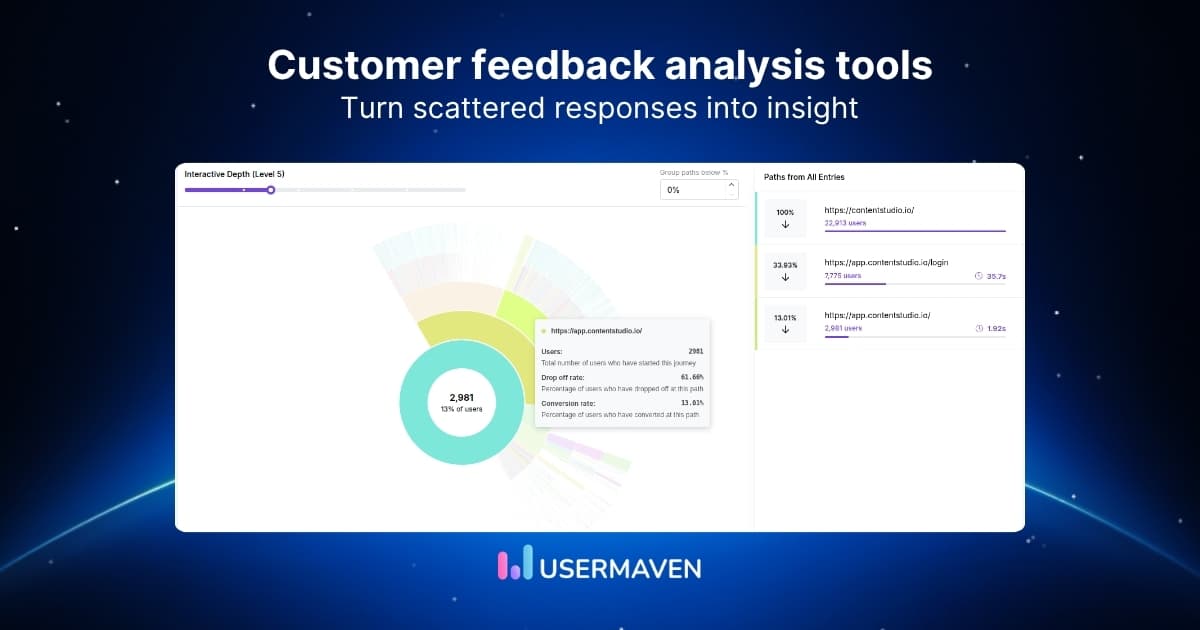
Usermaven helps add that layer of context. It gives teams a clearer view of journeys, friction points, and the actions that shape conversion and retention.
That makes the analysis more useful. Instead of looking at customer language on its own, teams can place it alongside behavioral signals to get a clearer view of what may need attention and where patterns are starting to form.
Usermaven also helps bring AI-assisted analysis closer to action through:
- Maven AI for AI-powered summaries that surface patterns faster
- User journey analysis to understand how users move from entry to outcome
- Funnels that highlight points of friction
- Feature and event tracking for behavior-level visibility
- Ad Attribution software that connects user journeys and campaign activity to revenue
Together, this gives teams a more complete view. Feedback shows what people are saying, while behavior adds the context needed to interpret it more clearly.
Final thoughts
Customer feedback analysis tools have moved well beyond sorting comments into neat categories. They now play a direct role in how teams identify friction, understand shifting expectations, and turn customer language into decisions that carry real operational weight.
The strongest platforms help teams move with more speed and precision. They surface meaningful patterns early and give product, support, and CX teams a clearer basis for action.
In 2026, this capability is moving closer to the operational core. Teams that use it well will respond faster, prioritize smarter, and stay closer to what customers are actually saying.
FAQs about customer feedback analysis tools
1. What qualifies a tool as AI-powered in customer feedback analysis?
A tool is considered AI-powered when it uses machine learning, natural language processing, or semantic modeling to interpret unstructured customer language. It can detect themes, sentiment, and patterns automatically without relying only on manual tagging or keyword rules.
2. How is customer feedback analysis different from traditional reporting tools?
Traditional reporting tools summarize fixed metrics like NPS, CSAT, or ticket volume. Customer feedback analysis goes further by interpreting open-text responses to explain why those numbers are changing.
3. Can these tools effectively analyze multilingual feedback at scale?
Many leading platforms support multilingual analysis using trained language models. The difference lies in how well they preserve meaning and maintain consistent theme detection across regions.
4. Do AI-powered feedback analysis tools replace human analysts?
No. These tools improve speed and consistency, but human analysts are still needed to validate findings, apply business context, and turn insights into action.
5. Are AI-powered feedback analysis tools suitable for mid-sized organizations?
Yes, as long as the platform matches their resources and workflow needs. The best fit is usually a tool that reduces manual effort without adding too much implementation complexity.
6. How quickly can these platforms generate actionable insights?
Some platforms can surface insights in near real time, while others update on scheduled cycles. Speed depends on integration setup, system configuration, and how the platform processes incoming data.
Updated

Written by
Lauren Brooks
Lifecycle Marketing Strategist
Lauren Brooks is a lifecycle marketing strategist with 4+ years of experience helping SaaS businesses create meaningful customer experiences. She specializes in user engagement, retention, and conversion optimization, helping brands build stronger customer relationships beyond acquisition.
All articles by Lauren →