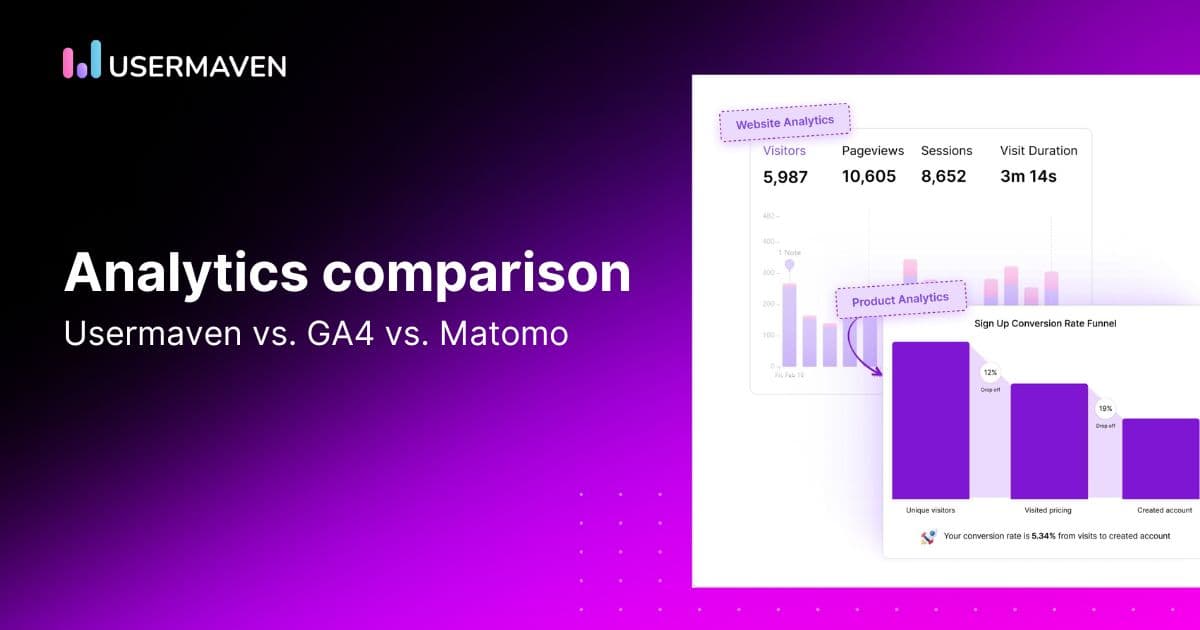
GA4 and Matomo both measure website performance, but their tracking models, hosting options, and attribution workflows differ. marketing attribution software such as Usermaven adds an acquisition-to-revenue perspective.
This comparison examines Usermaven vs. GA4 vs. Matomo across privacy, setup, attribution, funnels, AI, pricing, and support. The goal is to make the trade-offs clear, not claim that one platform wins every category.
Key takeaways
- GA4: A strong choice for Google Ads-connected reporting, event-based web and app analytics, and a free standard product.
- Matomo: A strong choice for data ownership and hosting control, with Cloud and free self-hosted Community options.
- Usermaven: A fit when marketers need paid ads, CRM and revenue attribution alongside website and product analytics.
- Pricing: Compare the full measurement setup and required features, not outdated starting prices or unsupported claims of a cheaper tool.
Usermaven vs. GA4 vs. Matomo at a glance
| Decision factor | Usermaven | GA4 | Matomo |
|---|---|---|---|
| Core strength | Marketing and revenue attribution with web and product analytics | Web/app analytics and Google advertising measurement | Privacy-focused web analytics and deployment control |
| Hosting | Hosted platform; additional Enterprise options | Google-hosted | Cloud in Germany or self-hosted |
| Attribution | Channel, paid ads, content, CRM and conversion-path reporting | Data-driven and last-click key event attribution | Multi-channel attribution in Cloud; premium feature for On-Premise |
| Behavior analysis | Funnels, journeys, cohorts and feature adoption | Explorations, funnels, paths and audiences | Funnels, cohorts, flow and behavior reports; packaging differs |
| AI workflow | Maven AI, scheduled Agents and MCP | Automated insights and predictive metrics when eligible | AI-assistant traffic reports; a different AI use case |
| Published pricing | Business and Enterprise; explore fit through a demo | Standard GA4 free; Analytics 360 enterprise | Free On-Premise Community, paid Cloud and premium bundles |
The right choice depends on what happens after a visit: a Google Ads conversion, an on-site funnel, or a CRM opportunity that eventually becomes revenue.
What each analytics platform is built to do
Google Analytics 4
GA4 combines website and app measurement with acquisition reports, ecommerce events, Explorations, and Google advertising integrations. Its standard version is free, while Analytics 360 serves enterprise needs.
GA4 collects common events automatically and adds more through enhanced measurement. Custom business events, consent configuration, and consistent conversion definitions still require planning.
Matomo
Matomo emphasizes ownership of analytics data and hosting flexibility. Its Cloud service handles maintenance; On-Premise gives organizations infrastructure control and a free open-source Community edition.
Matomo supports goals, ecommerce, funnels, session recordings, cohorts, real-time analytics, and multi-channel attribution. Availability depends on the selected Cloud subscription or On-Premise plugins and bundles.
Usermaven
Usermaven is an attribution-focused analytics platform that connects acquisition sources, on-site behavior, product usage, and CRM outcomes. It is designed for teams investigating which efforts create customers, not just visits.
Its website analytics, product analytics, and attribution views support funnel diagnosis and revenue-focused reporting in one workspace.
Privacy, ownership, and tracking accuracy

Privacy compliance depends on configuration, consent requirements, contracts, and the laws that apply to the organization. No vendor is automatically compliant for every implementation.
GA4 provides privacy controls, including consent configuration and data-retention settings. Matomo offers Cloud hosting in Germany and self-hosting for teams that need control over infrastructure.
Usermaven supports cookieless tracking options and controls intended to reduce measurement gaps. Tracking accuracy still depends on consent, implementation, browser conditions, and data quality.
| Privacy consideration | Usermaven | GA4 | Matomo |
|---|---|---|---|
| Deployment model | Hosted; Enterprise deployment options | Google-managed infrastructure | Cloud or self-hosted |
| Cookieless measurement | Supported options | Consent Mode and modeled behavior depending on configuration | Cookieless configuration available |
| Data residency | Review plan and deployment needs | Review Google data processing and location settings | Cloud hosted in Germany; self-host region chosen by customer |
| Data retention | Depends on contracted plan | Standard GA4 event/user-level retention up to 14 months in UI | Controlled by hosting/plan and retention settings |
| Accuracy claim | Validate against source systems | Validate against source systems | Validate against source systems |
| Best privacy use case | Attribution plus configurable privacy controls | Organizations using Google analytics governance | Teams prioritizing self-hosting and data ownership |
A reported accuracy percentage without a tested measurement method should not drive selection. Compare event completeness, consent impact, and discrepancies against CRM or purchase records.
Implementation and event tracking
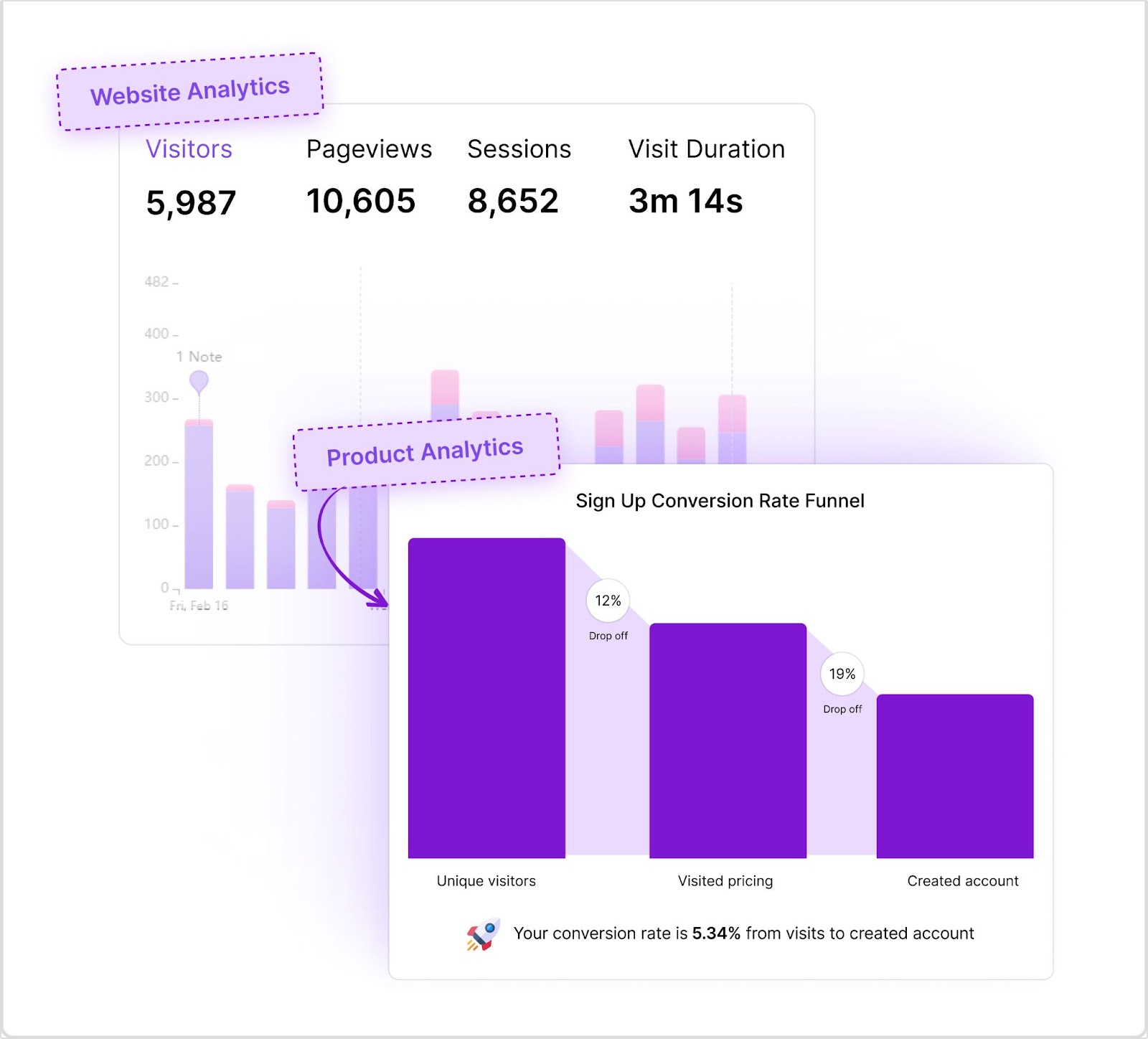
Implementation effort depends more on the tracking plan than a fixed number of minutes. Basic traffic collection is relatively approachable across all three tools; custom funnels and account-level reporting take extra work.
GA4 automatically collects defined events and supports enhanced measurement. Additional recommended or custom events need deliberate instrumentation.
Matomo tracks common page and visit activity with its tracking code. Self-hosting adds server maintenance, while Cloud reduces infrastructure work.
Usermaven supports auto-captured events and explicit custom events. Teams should still validate key conversion goals, identity stitching, and CRM event mapping before relying on attribution.
| Implementation task | Usermaven | GA4 | Matomo |
|---|---|---|---|
| Basic deployment | Workspace and tracking script | Google tag or SDK | Tracking tag; infrastructure for self-hosting |
| Automatic activity capture | Available | Automatic and enhanced measurement events | Core tracking and configured events |
| Custom business events | Available | Recommended and custom events | Custom event configuration |
| CRM and offline outcomes | Connectors and event sources | Imports and integrations require configuration | Import/integration workflow depends on setup |
| Ongoing ownership | Marketing and analytics teams | Analytics and tagging governance | Analytics plus infrastructure for self-hosted |
Marketing attribution and revenue analysis
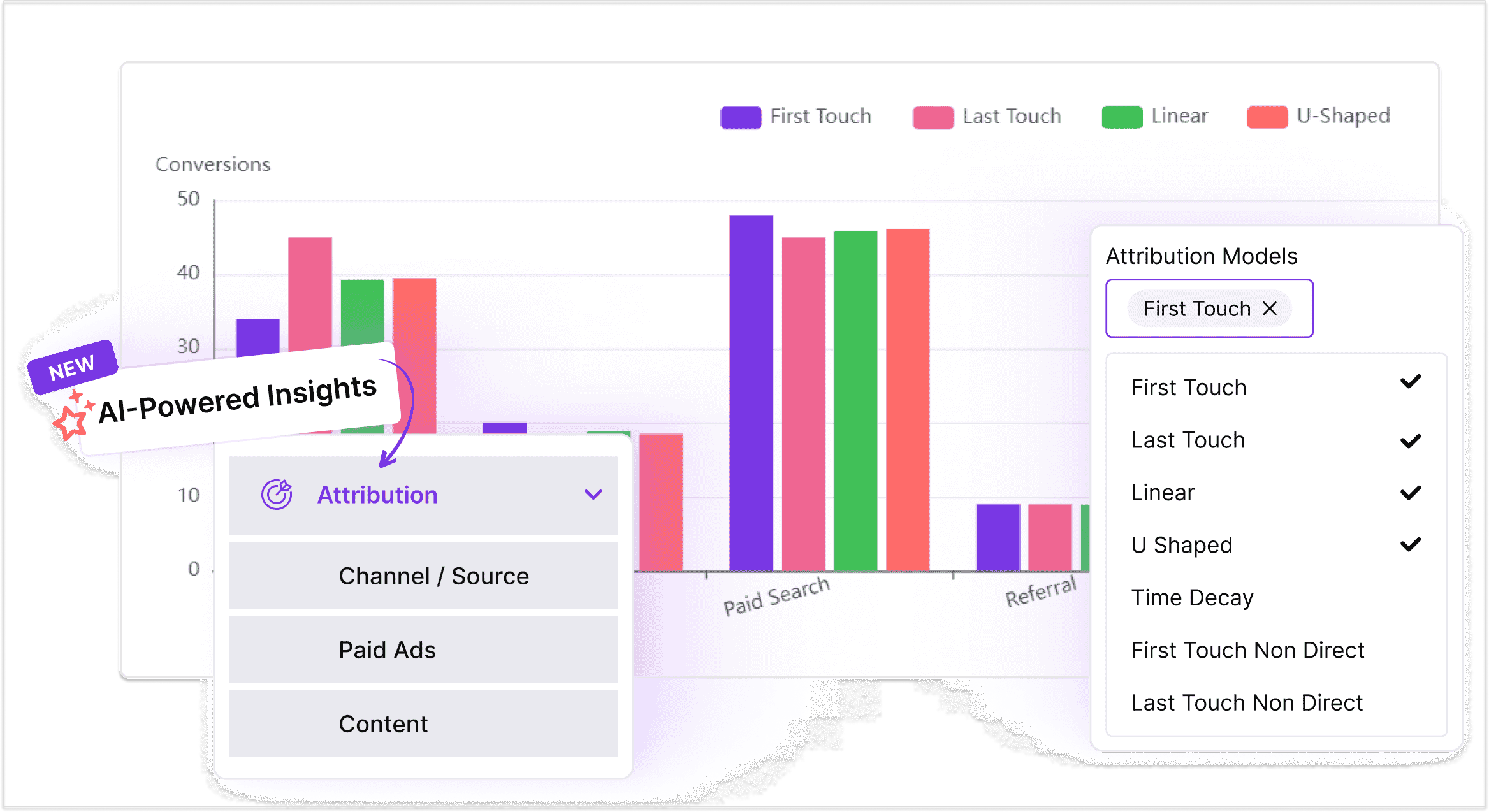
Attribution is where the platforms differ most. The question is whether reporting stops at web conversions or connects campaigns with leads, opportunities, and revenue.
Usermaven reports paid ads, source, channel, content, and CRM-linked revenue attribution. It also supports conversion paths and lookback controls for longer customer journeys.
Enterprise workspaces can configure custom attribution weights and channel multipliers in addition to standard models. Model availability should be checked for the selected workspace.
GA4 supports data-driven attribution and last-click models for key events. Google retired older first-click, linear, time-decay, and position-based reporting models.
Matomo has multi-channel conversion attribution with first, last, linear, position-based, and time-decay options. Its Cloud offering includes the feature; On-Premise uses a premium plugin or suitable bundle.
| Attribution question | Usermaven | GA4 | Matomo |
|---|---|---|---|
| What gets conversion credit? | Marketing and CRM-linked customer outcomes | Tracked key events, including ecommerce when configured | Goals and ecommerce conversions |
| Reporting models | Standard multi-touch; custom weights on Enterprise | Data-driven and current last-click choices | Multiple models with multi-channel feature |
| Paid media spend context | Ad integrations and spend-based reporting | Strong Google Ads integration | Campaign/channel attribution; spend integrations vary |
| Pipeline and closed revenue | CRM and deals attribution workflows | Requires integration and modeling for CRM revenue | Requires integration and modeling for CRM revenue |
| Journey depth | Touchpoints plus behavior and CRM milestones | Events and attribution paths | Tracked visits and multi-visit conversion paths |
| Practical buying test | Can marketing credit be traced to actual revenue? | Do key events match Ads and site events? | Is the needed attribution feature included? |
The most useful attribution comparison is a common test conversion traced from its first campaign interaction through the final outcome in the CRM.
Funnels, journeys, and retention
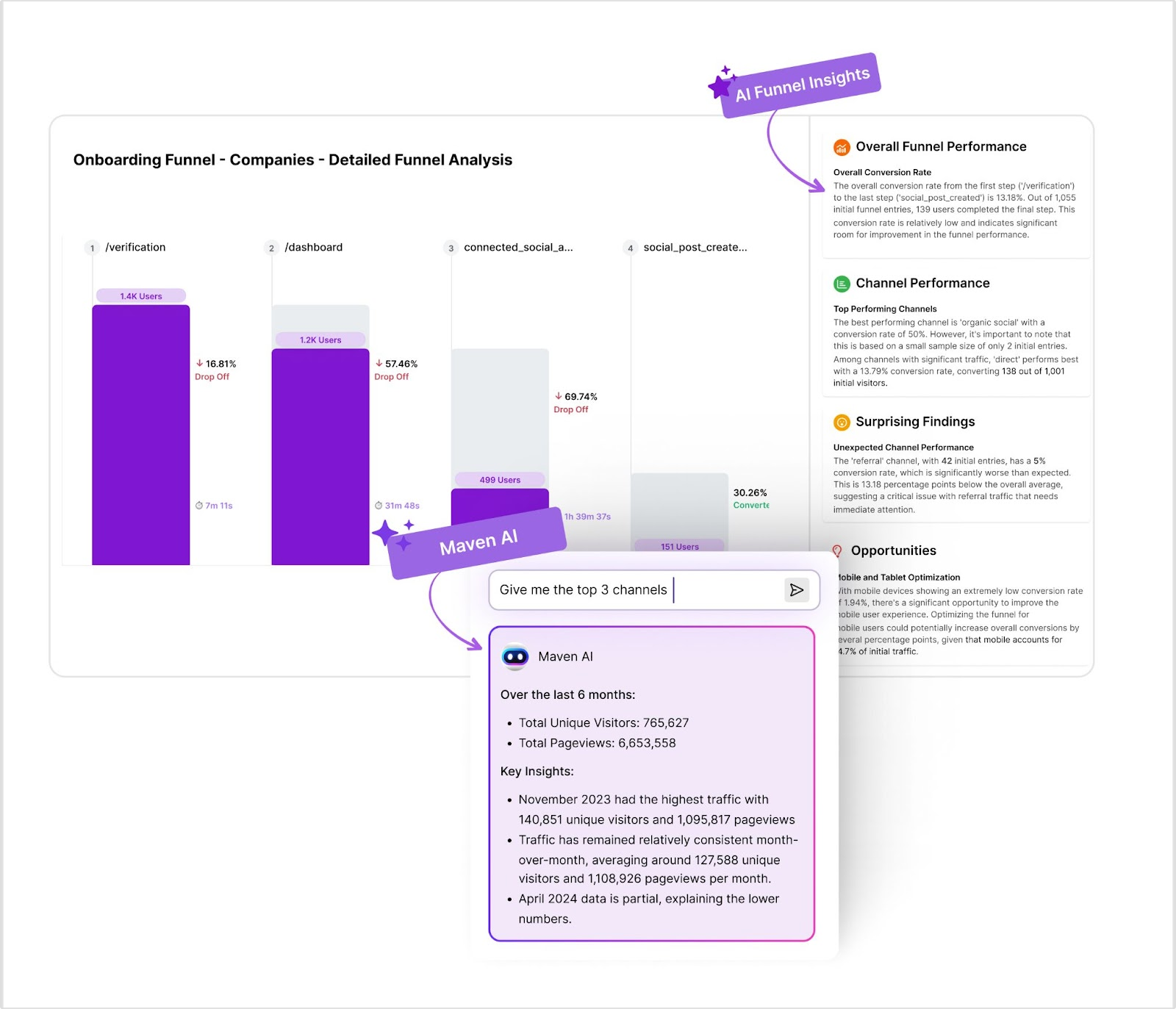
All three platforms can reveal where visitors leave a conversion path. They differ in how reports are built, which data is retained, and how teams connect behavioral findings to customer outcomes.
Usermaven combines funnel analysis, journey reports, segmentation, and retention analysis. These views can help identify whether campaigns attract visitors who later activate and stay.
GA4 Funnel Explorations and Path Explorations support step analysis and route discovery. The setup and usefulness depend on event definitions and selected explorations.
Matomo offers funnel reports and cohort analysis; funnels are included in Cloud plans but are purchased separately or via bundles for some On-Premise setups.
| Behavior capability | Usermaven | GA4 | Matomo |
|---|---|---|---|
| Funnels and drop-offs | Available | Funnel Explorations | Available in Cloud; plugin/bundle for On-Premise |
| User paths | User journeys | Path Explorations | Users Flow and visit reports |
| Retention/cohorts | Product retention and cohort reporting | Retention and user-lifetime analysis | Cohort reports |
| Live activity | Live event/profile views | Realtime report | Real-time visits and visitor log |
| Link to marketing outcomes | Attribution and CRM context alongside behavior | Requires aligned GA4 key events and integrations | Goals/ecommerce and attribution configuration |
AI capabilities and automation

The platforms approach AI differently. Compare which decisions the AI can assist with, what data it can access, and whether it can perform repeatable investigations.
Usermaven includes Maven AI for natural-language questions, charts, dashboards, and funnel or attribution analysis. Its Agents can investigate set objectives on a daily or weekly schedule.
Usermaven also offers MCP access so permitted analytics can be queried from compatible AI tools. Access and available actions depend on workspace permissions and plan.
GA4 uses machine learning for automated insights, anomaly detection, and predictive metrics where a property has eligible data. It is not simply a manual reporting tool.
Matomo has introduced reports for traffic from AI assistants and agents. Those reports measure AI-originated visits and requests; they are not the same as an AI analyst generating dashboards.
| AI use case | Usermaven | GA4 | Matomo |
|---|---|---|---|
| Ask analytics questions | Maven AI conversational analysis | Analytics Intelligence and built-in insights | Standard analytics reports; AI-traffic insights |
| Automated monitoring | Scheduled Maven AI Agents | Automated/custom insights and anomaly detection | Scheduled reporting; AI-agent traffic monitoring |
| Predictive insights | Investigate behavioral and attribution trends | Predictive metrics for eligible properties | Depends on reporting configuration |
| External AI clients | MCP with permissions | Google ecosystem and available APIs | API and integrations; AI traffic reports |
| What to verify | Agent schedules, permissions and plan | Eligibility and feature availability | Distinguish AI traffic analytics from generative AI |
Pricing and total cost of ownership
Pricing comparisons become misleading when event counts, hits, conversions, and hosting expenses are treated as interchangeable. Build estimates using each vendor’s actual billing units.
Usermaven currently offers Business and Enterprise for new customers. Both are evaluated through a demo conversation; the current plans do not have published numerical starting prices.
GA4 has a free standard product. Google Analytics 360 is a separate enterprise offering; implementation, data exports, and analysis workloads can add operational costs.
Matomo On-Premise Community is free software, but organizations pay for their own hosting and maintenance. Cloud Business uses traffic-based pricing, while Enterprise and self-hosted premium bundles add other costs.
| Cost component | Usermaven | GA4 | Matomo |
|---|---|---|---|
| Entry option | Business and Enterprise evaluation | Free standard version | Free On-Premise Community |
| Paid path | Business/Enterprise demo | Analytics 360 enterprise | Cloud traffic tiers; On-Premise bundles |
| Usage unit to check | Plan-specific measurement scope | Collection and report/query limits | Monthly hits for Cloud; plugin/bundle limits On-Premise |
| Additional work | Tracking and CRM setup | Tagging, BigQuery, analytics operations | Hosting/maintenance or Cloud plan; plugins |
| Comparison advice | Test acquisition-to-revenue workflows | Estimate total analytics and operations needs | Price the exact hosting and plugin combination |
Do not use old dollar amounts or compare a free self-hosted package with a managed service as though infrastructure and premium features were included in both.
Support and governance
Support and governance should be matched to the organization’s needs. A team with a dedicated analytics engineer may prefer infrastructure control; a smaller marketing team may favor managed implementation.
Usermaven provides documentation and guided implementation options. Enterprise adds higher-touch onboarding, dedicated success management, and security or deployment controls.
GA4 has extensive Google documentation and a large ecosystem of implementation partners. Support and service terms differ for standard users and Analytics 360 customers.
Matomo has community resources for self-hosting and managed support for Cloud or eligible paid offerings. Confirm onboarding and response expectations for the chosen plan.
| Operational consideration | Usermaven | GA4 | Matomo |
|---|---|---|---|
| Self-hosting | Enterprise deployment options | Not self-hosted | Core On-Premise offering |
| Documentation | Product docs and onboarding guides | Extensive official docs | Official guides and community |
| Managed operations | Hosted platform | Hosted by Google | Cloud hosting option |
| Advanced governance | Enterprise security and controls | GA4/Analytics 360 access controls | Cloud/On-Premise deployment and roles |
| Support evaluation | Confirm plan services in demo | Verify Standard vs. 360 coverage | Verify Community vs. Cloud/paid support |
Product analytics and feature adoption
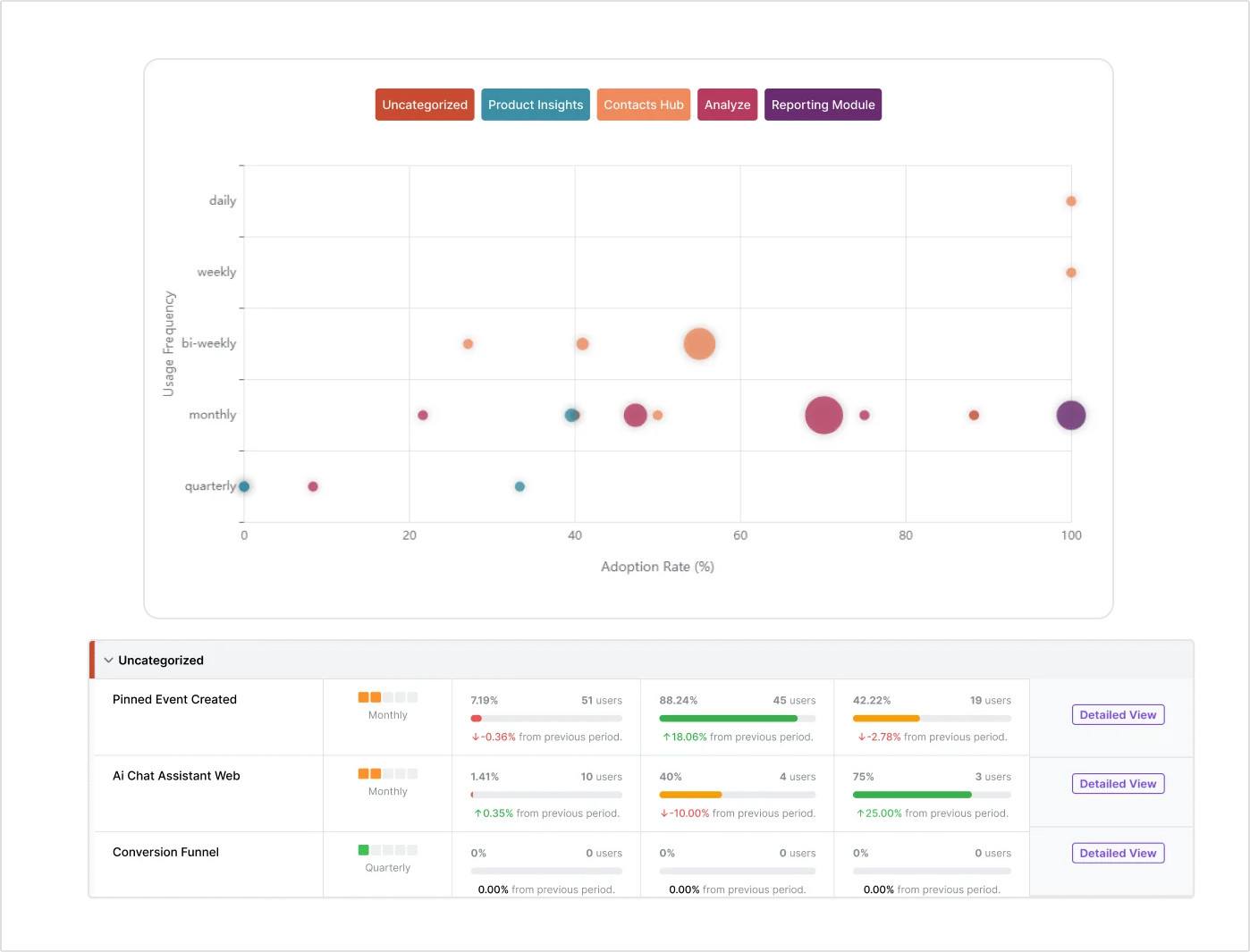
Product teams often need to know what happens after signup, not just which pages were visited. A practical evaluation should compare activation events, retention cohorts, feature usage, and reporting time.
Usermaven tracks product events, accounts, feature adoption, and retention alongside marketing source data. This can help connect acquisition quality with the user behaviors that lead to activation.
GA4 supports event-based app and website analytics, user properties, cohorts, and explorations. Detailed feature adoption analysis needs a thoughtfully designed event taxonomy.
Matomo supports event analytics, cohorts, funnels, and user paths. Its emphasis remains on controllable web analytics; more specialized product-analysis workflows may need configuration.
| Product question | Usermaven | GA4 | Matomo |
|---|---|---|---|
| Feature usage | Tracked events and feature adoption views | Custom/recommended event reporting | Events and custom reports |
| Account context | User and company profiles | User ID and user properties | User IDs and configured dimensions |
| Activation funnels | Funnels with campaign context | Funnel Explorations | Funnels with appropriate package |
| Retention monitoring | Cohorts and retention reporting | Retention and cohort analysis | Cohorts and user behavior |
| Useful differentiator | Connect activation to sources and CRM | Combine app analytics with Google reporting | Self-hosted analytics control |
Real-world example: improving activation
PostNitro originally used GA4 for traffic reporting, but needed clearer insight into onboarding behavior. It adopted Usermaven to examine drop-offs, custom events, and which interactions showed intent.
Its published case study reports that around 70% of visitors who engaged with a new demo flow signed up. This was the observed conversion rate for that flow, not a promised lift for every business.
The takeaway is diagnostic: connect acquisition and onsite interactions to activation, then measure whether a product change improves the outcome.
Which analytics platform should you choose?
- Choose GA4 when the priority is Google ecosystem integration, free standard analytics, and event-driven reporting with internal analytics support.
- Choose Matomo when hosting control, self-managed data, and web analytics privacy architecture are central requirements.
- Consider Usermaven when teams need to connect campaigns, B2B SaaS product behavior, CRM opportunities, and revenue attribution.
- Run the same test in each: Track a visitor from channel to signup, key product action, and customer outcome. Compare reporting, effort, permissions, and full costs.
No platform is universally easiest or most accurate. The better fit is the one that measures the actual decisions your team makes without depending on unsupported feature or pricing comparisons.
Conclusion
GA4 remains a capable general analytics tool, and Matomo offers meaningful flexibility around hosting and data ownership. Their strengths should be part of the buying decision rather than minimized.
Usermaven is worth evaluating when the primary goal is revenue attribution across campaigns, customer journeys, product activity, and CRM outcomes. Those connected views help teams move from traffic reporting to budget and growth decisions.
Want to connect acquisition, activation, and revenue in one reporting workflow? Book a demo to see Usermaven applied to your measurement needs.
Website analytics tool for modern marketers & agencies
FAQs
1. Does Usermaven support automatic event tracking?
Yes. Usermaven supports auto-captured events and custom events. Teams should still validate the events that represent signups, product activation, and revenue before using them in attribution.
2. How do attribution models compare?
Usermaven offers multi-touch and CRM revenue attribution, with custom model weights for Enterprise workspaces. GA4 supports data-driven and last-click key event models. Matomo offers multi-channel models through Cloud or a premium On-Premise feature.
3. What AI capabilities do the platforms offer?
Usermaven has Maven AI, scheduled Agents, and MCP access. GA4 offers automated insights, anomaly detection, and predictive metrics for eligible properties. Matomo includes reports about AI-assistant traffic and requests.
4. Which platform is best for privacy and support?
It depends on requirements. Matomo offers self-hosting and managed Cloud. GA4 has Google-managed hosting and privacy controls. Usermaven combines hosted analytics with attribution and Enterprise governance options. Support varies by plan and contract.
Updated

Written by
Adeel Khan
Growth Marketing Expert
Adeel Khan is a full-stack SaaS marketer with 10+ years of experience in content marketing, paid advertising, analytics, and conversion rate optimization. He shares practical insights and strategies drawn from hands-on experience, helping B2B SaaS marketers improve performance and make better marketing decisions.
All articles by Adeel →