Usermaven and Cometly are both serious AI marketing attribution platforms for teams that need to connect campaigns with pipeline and revenue. Both now support multi-touch measurement, CRM outcomes, AI analysis, and full-funnel reporting, so the comparison goes well beyond basic attribution features.
The real difference is what happens around attribution. Usermaven extends acquisition data into website behavior, product usage, CRM revenue, retention, and LTV. Cometly extends paid acquisition into server-side tracking, pipeline attribution, conversion feedback, audiences, and direct ad execution.
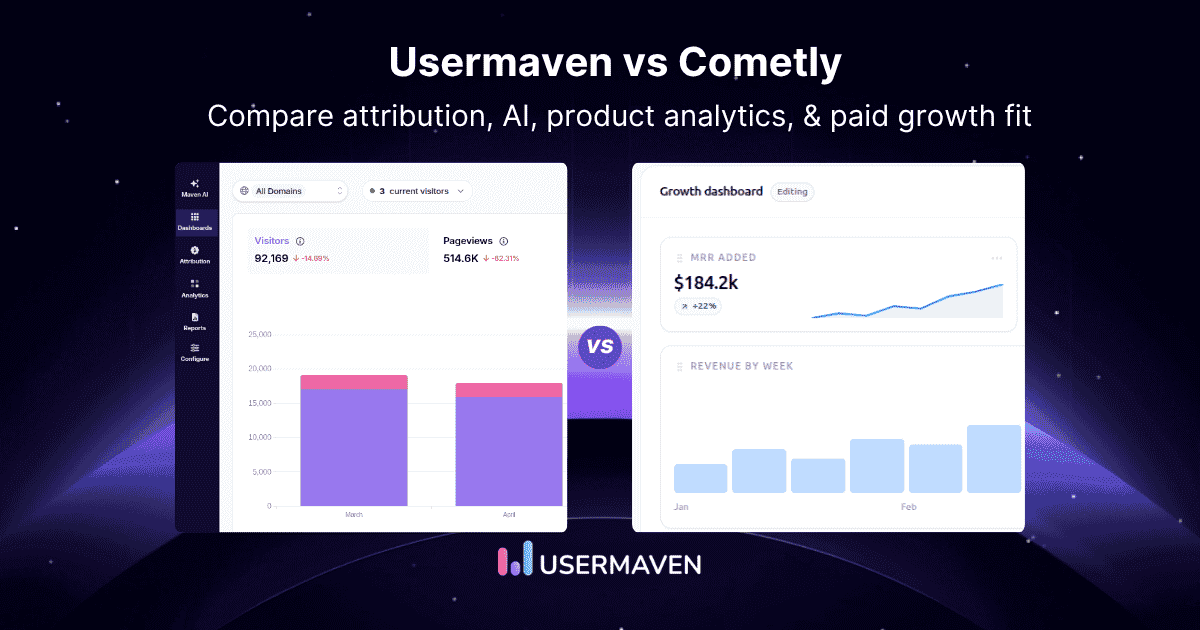
This Usermaven vs. Cometly comparison looks at pricing, attribution depth, tracking, product analytics, AI, MCP, agencies, ecommerce, and real customer outcomes. It also examines how each platform approaches B2B marketing attribution so the final choice reflects the operating model rather than a feature count.
Usermaven vs. Cometly at a glance
Bottom line: Usermaven is generally the stronger fit when attribution needs to connect marketing with website behavior, product usage, CRM revenue, retention, ecommerce, or agency reporting.
Cometly is particularly strong when paid acquisition, server-side tracking, conversion feedback, and direct media-buying execution are the center of the workflow.
Usermaven vs. Cometly comparison
| Area | Usermaven | Cometly | Practical edge |
|---|---|---|---|
| Core positioning | AI attribution for B2B SaaS and agencies | AI attribution for B2B SaaS | Different emphasis |
| B2B attribution | Core strength | Core strength | Both |
| Paid-media attribution | Strong | Very strong | Cometly for paid-heavy teams |
| Product analytics | Native and deep | Product/revenue signals | Usermaven |
| Website analytics | Native workspace | Attribution and journey context | Usermaven |
| CRM pipeline/revenue | Strong | Strong | Different operating loops |
| Measurement health | Dedicated Trust Center | Tracking infrastructure | Usermaven for explicit health checks |
| AI analytics | Maven AI | Agent | Different strengths |
| AI ad execution | No equivalent Ads Manager | AI Ads Manager | Cometly |
| MCP | Read + approval-gated writes | Public beta, read today | Usermaven currently |
| Agencies | Multi-workspace + white label | Strong paid-media agency fit | Usermaven for broader agency use |
| Public numeric pricing | No | No | Neither |
| Free trial | Interactive demo; no self-serve trial listed | No free trial | Usermaven offers an interactive demo |
Buyers who have already decided they are replacing Cometly can use the shorter Cometly alternative comparison. This article focuses on the deeper head-to-head decision between the two platforms, including places where Cometly is the better choice.
Key takeaways
Both are attribution-first: Usermaven and Cometly both treat B2B marketing attribution, pipeline, and revenue measurement as core product jobs.
Usermaven covers more of the customer lifecycle: Attribution sits beside website behavior, product analytics, CRM outcomes, retention, and LTV in the same analytics environment.
Cometly goes deeper into paid acquisition infrastructure: Its Pixel, server-side tracking, Conversion API, audiences, and AI Ads Manager are central to the product workflow.
Product analytics is a major Usermaven advantage: Activation, feature adoption, engagement, and retention are native analysis layers rather than supporting revenue signals.
Both use sales-led pricing: Usermaven lists Business and Enterprise without published numeric prices, while Cometly lists Core and Enterprise without a public numeric quote. Usermaven also offers an interactive demo.
Both now have serious AI: Maven AI spans marketing, product, and lifecycle analytics; Cometly Agent and AI Ads Manager are especially aligned with paid-media revenue decisions.
There is no universal winner: The right platform depends on what needs to happen after attribution, from product and retention analysis to paid-media execution.
Usermaven and Cometly optimize different attribution loops
The cleanest way to compare these products is to look at what happens before and after a conversion is attributed. Both can connect a campaign with revenue, but their operating loops extend in different directions.

Usermaven’s operating loop
Usermaven positions itself as AI marketing attribution software for B2B SaaS and agencies. B2B attribution is central to the product, but the same customer record can continue into website behavior, product activity, CRM pipeline, revenue, retention, and lifetime value.
| Acquisition -> website behavior -> product usage -> CRM pipeline -> revenue -> retention -> LTV |
That structure matters when marketing quality becomes clear only after the initial conversion. A source may generate fewer trials but stronger activation, more upgrades, or better retention, changing the budget conclusion even when lead volume looks weaker.
This is also why B2B SaaS analytics matters in the comparison: acquisition quality can be evaluated against recurring revenue, product behavior, and lifecycle outcomes rather than lead volume alone.
Cometly’s operating loop
Cometly is also built around B2B SaaS attribution, but its public product architecture is especially focused on paid acquisition.
It connects ad clicks and events with people or accounts, CRM stages, pipeline, revenue, and LTV, then pushes those outcomes back into ad platforms and media workflows.
| Ad click -> event -> person/account -> CRM -> pipeline/revenue -> CAPI/audience -> ad action |
This closed loop is valuable when a growth team wants attribution to influence reporting and the next ad decision.
That can mean deciding which campaign to pause, which audience to seed, or which revenue event to send back to the platform.
The practical difference
A useful shorthand: Usermaven extends attribution deeper into customer behavior and lifecycle analytics. Cometly extends attribution deeper into paid-media signal recovery and advertising execution.
Unlock insights that drive growth
Usermaven vs. Cometly pricing
Pricing needs to be compared carefully because neither platform publishes fixed numeric plan prices. Usermaven now lists Business and Enterprise with quote-based pricing and does not publish an event allowance for either plan. Cometly says its plans are tailored to monthly pageviews.
Current pricing and buying experience
| Buying factor | Usermaven | Cometly |
|---|---|---|
| Relevant attribution plan | Business | Core |
| Published numeric price | Not published; request a quote | Not published |
| Usage basis | Not specified publicly; confirm during demo | Pageviews |
| Users | Additional users and workspaces available on request | Not clearly published on live pricing page |
| Free trial | Interactive demo; no self-serve trial listed | No free trial |
| Annual discount | Not publicly stated | 20% |
| Enterprise | Quote-based | Custom |
| Buying motion | Book a demo | Guided / sales-assisted |
Usermaven now lists Business and Enterprise on the Usermaven pricing page. Neither plan has a published monthly price; buyers can request a quote by booking a demo.
Business includes multi-touch attribution, paid ads attribution, custom attribution models, Maven AI, MCP for AI agents, CRM and ad-platform integrations, audience and conversion sync, customer journeys, funnels, dashboards, retention analysis, and reports.
Cometly’s current pricing lists Core and Enterprise but does not publish a numeric Core price. Core includes Pixel, server-side tracking, multi-touch attribution, Events, Account Journeys, dashboards, Agent, Conversion API, AI Ads Manager, Audiences, Analytics, and 70+ integrations.
Cometly says both plans can be billed monthly or annually with a 20% annual discount.
It also states that it does not offer a free trial because attribution requires CRM and ad-platform setup, and that teams normally receive pricing during the sales conversation.
Total cost depends on what the platform replaces
The subscription price is only one part of the decision. Usermaven can consolidate attribution, website analytics, product analytics, funnels, journeys, retention, and AI reporting. That can reduce the need for separate marketing, product, and lifecycle analytics tools.
Cometly can consolidate attribution, paid-media signal collection, server-side conversion delivery, revenue dashboards, audiences, and parts of the media-buying workflow. A paid-acquisition team may value that operational consolidation more than a lower sticker price.
Marketing attribution capabilities
Attribution itself is not where either platform is weak. Both support multi-touch measurement, model comparison, long customer journeys, and CRM or revenue outcomes. The more useful question is what surrounds the attribution result.
Usermaven attribution
Usermaven’s multi-touch attribution software supports seven attribution models across paid, organic, referral, email, and direct journeys. It also includes channel attribution, content attribution, conversion paths, paid spend context, influenced conversions, and a lookback window of up to 365 days.
The key strength is that the attributed visitor or account does not disappear after the conversion. Teams can connect the channel with website behavior, product activity, CRM pipeline, revenue, and retention when those later outcomes matter to the buying decision.
Cometly attribution
Cometly currently exposes eight attribution models in its analytics and AI Ads Manager surfaces, including first touch, last touch, last non-direct, source-specific first and last touch, linear, linear paid, and U-shaped.
Its marketing attribution product is tightly connected to pipeline, MRR, ARR, CAC, LTV, and individual ad performance.
Source-specific attribution is especially useful for teams evaluating one paid channel without letting touches from other sources dominate the report. Cometly also applies the selected attribution lens to downstream reporting, audiences, and AI recommendations.
Which attribution layer is stronger?
Verdict: Cometly is particularly strong when attribution is optimized around paid-channel performance and advertising feedback. Usermaven is stronger when the same attribution result needs to connect with website behavior, product activity, lifecycle analysis, and retention.
Tracking, Events, and server-side measurement
Credit models are only useful when the events feeding them are captured reliably. Both products invest heavily in first-party measurement, but Cometly makes paid-media signal recovery a more visible part of its product identity.
Cometly’s paid-media tracking stack
Cometly combines its Pixel with server-side tracking , Conversion API connections, CRM events, and first-party identity signals. The goal is to preserve conversion evidence that browser-only tracking or ad-platform dashboards may miss.
This is one of Cometly’s clearest strengths. Its pricing page says both plans include unlimited connections to major ad platforms and server-side Conversion API support, making the tracking layer directly relevant to media teams that optimize daily.
Usermaven Events and tracking
Usermaven Events automatically captures website and product interactions and also supports custom, revenue, server-side, webhook, off-site, and imported events. Event Sources can bring Stripe, Paddle, CRM, webinar, and offline outcomes into the same analytics stream.
Usermaven also includes ad-blocker bypassing, a cookieless option, and server-side tracking methods. Its event layer is designed to feed attribution, funnels, product analytics, journeys, and lifecycle reporting together.
The same first-party measurement architecture underpins Usermaven’s approach to ad tracking without third-party cookies, where campaign data, first-party events, customer identity, CRM outcomes, and server-side feedback work together.
Tracking verdict
Cometly has the edge when the main requirement is paid-media signal recovery and conversion feedback. Usermaven is stronger when the same event stream needs to support attribution plus broader behavioral and lifecycle analytics.
Measurement reliability and trust
Collecting more events does not automatically make an attribution report safe to act on. A missing campaign tag, stale CRM connection, broken conversion sync, or weak customer match can still create a confident-looking but misleading channel ranking.

Usermaven Measurement Trust Center
Usermaven has a dedicated Measurement Trust Center that checks five areas: campaign tracking, customer matching, connected platforms, conversion feedback, and data confidence. It combines those checks into a Trust Score and surfaces high-impact fixes.
That creates an explicit workflow for deciding whether the measurement setup is healthy enough for attribution decisions. It is useful when the problem is not choosing a model but understanding why the data should or should not be trusted.
Cometly’s measurement-quality approach
Cometly approaches trust from the collection side. Its Pixel, server-side events, fingerprint and journey visibility, Conversion API, CRM connections, and backend-revenue reconciliation are designed to reduce the gaps between ad-platform claims and business outcomes.
That is a serious measurement-quality stack. The difference is that Cometly makes collection and signal recovery the central mechanism, while Usermaven adds a named diagnostic layer that continuously checks measurement health after the system is connected.
Measurement trust verdict
Cometly is stronger in paid-media collection infrastructure. Usermaven has the distinctive advantage of an explicit measurement-health workflow that tells teams what may be broken before budget moves.
See what's working. Fix what's not. Grow faster.
Product analytics and post-acquisition behavior
For SaaS and PLG teams, the comparison changes after signup. Attribution can explain which campaign created a trial, but the business still needs to know whether those users activated, adopted the product, upgraded, and retained.

Usermaven product analytics
Usermaven has a native product analytics workspace for active-user trends, feature adoption, onboarding, engagement, power users, slipping users, and retention cohorts. Acquisition source can therefore be evaluated against what users actually do inside the product.
That supports questions such as: Which paid campaign produces users who reach activation? Which source creates the strongest D30 retention? Which channels attract customers who adopt the features associated with expansion?
When retention becomes the downstream quality signal, retention analytics adds cohort-level context for comparing which acquired users keep returning and which segments are beginning to slip.
Cometly product signals
Cometly can ingest events such as signups, trials, upgrades, downgrades, MRR, ARR, churn, and LTV. Those signals are valuable for connecting acquisition with revenue quality, but they are primarily used inside an attribution and growth-performance workflow.
Cometly is not positioned as a dedicated feature-adoption or product-behavior workspace. Teams that need native activation analysis, feature usage, or product-retention segmentation will generally find more depth in Usermaven.
Winner for product analytics
Usermaven wins this category. The advantage matters most when acquisition quality cannot be judged until users move through onboarding, feature adoption, and retention.
Website analytics and funnel analysis
A channel can send strong traffic into a weak landing page or funnel. When that happens, attribution alone may blame the acquisition source for a problem that actually occurs after the click.
Usermaven website analytics
Usermaven has a dedicated website analytics layer for traffic, sources, pages, paths, real-time behavior, and conversions. Because this sits beside attribution, teams can separate channel quality from page-level or journey-level friction.
Funnels and conversion paths
Usermaven funnels can compare step-by-step conversion performance across segments and acquisition sources. This is useful for SaaS onboarding, B2B demo paths, ecommerce checkout, and any workflow where the marketing source is only the start of the problem.
Cometly also provides funnel and journey reporting, especially around acquisition, pipeline, and revenue. The practical difference is that website and funnel analysis are native daily analytics workspaces in Usermaven rather than mainly components of a paid-acquisition attribution system.
Customer and account journeys
Both platforms provide journey visibility, but they tend to center different units of analysis. That affects whether the most useful question is about a user, a product journey, or a revenue account.
Usermaven customer journeys
Usermaven customer journey analytics can follow visitors, identified users, and companies across pages, sessions, product actions, and conversion events. The same journey can continue after signup into usage and lifecycle behavior.
Cometly Account Journeys
Cometly is particularly strong when the unit is a B2B revenue account. Its Account Journeys connect first ad clicks, people, CRM stages, pipeline, and Closed Won outcomes, giving growth and RevOps teams a defensible path from paid acquisition to revenue.
Journey fit by question
| Question | Better fit | Why |
|---|---|---|
| What happened after this user signed up? | Usermaven | Product + behavioral journey |
| Which feature did acquired users adopt? | Usermaven | Native product analytics |
| Which account journey created pipeline? | Cometly | Paid acquisition + CRM focus |
| Which ad touches preceded Closed Won? | Cometly | Ad-to-pipeline visibility |
| Which source creates stronger retention? | Usermaven | Lifecycle/cohort analysis |
| Which paid channel creates better LTV ROAS? | Cometly | Revenue-led paid-media analytics |
| Which website/product path leads to upgrade? | Usermaven | Website + product journey depth |
CRM, pipeline, and revenue attribution
B2B attribution is core to both products, so this should not be treated as a category where one platform simply has CRM and the other does not. The more important distinction is what each platform connects to the CRM outcome.

Usermaven B2B revenue attribution
Usermaven connects anonymous and known behavior with contacts, companies, CRM stages, pipeline, and revenue. The broader B2B marketing attribution workflow can preserve pre-CRM marketing touches and then extend the journey into downstream commercial outcomes.
This makes revenue attribution more useful because the question can move from which source created a lead to which source created opportunities, customers, and retained value.
Usermaven’s current Salesforce integration is read-only in v1, which is important when evaluating outbound CRM workflows.
Cometly pipeline and revenue attribution
Cometly’s pipeline attribution is built around connecting ad spend to MQLs, SQLs, demos, opportunities, and Closed Won deals. It can also analyze MRR, ARR, CAC, payback, and LTV by source or ad.
Its Enterprise data-sync layer can push attribution fields into CRM and warehouse environments, which makes the same revenue model available to sales, finance, BI, and AI workflows. That is particularly attractive to revenue teams centered on paid acquisition.
CRM and revenue verdict
Both are strong. Usermaven connects B2B pipeline attribution with pre- and post-conversion behavior. Cometly connects B2B pipeline attribution especially tightly with paid-media performance, conversion feedback, and activation.
AI comparison: Maven AI vs. Cometly Agent
Both vendors now treat AI as an operating layer rather than a small assistant feature. The useful comparison is the data the AI can reason over and what happens after it produces an answer.

Maven AI
Maven AI can answer questions across attribution, traffic, content, product analytics, funnels, journeys, retention, CAC, LTV, and revenue. It can also turn natural-language requests into reusable reports and dashboards.
This breadth matters when the investigation crosses functional boundaries. A growth team can ask why a campaign weakened, then compare the acquired cohort against activation or retention without leaving the same analytics environment.
Cometly Agent
Cometly Agent answers natural-language questions from connected attribution and funnel data and is designed to return the chart, math, and sources behind the answer. Its natural center is pipeline, CAC, LTV, ad performance, revenue, and journey analysis.
Cometly Agent fits especially well when a performance team wants quick answers about campaigns, revenue quality, or funnel movement and then plans to act through Cometly’s paid-media workflows.
AI fit by job
| AI job | Better fit |
|---|---|
| Attribution questions | Both |
| Marketing + product analytics | Usermaven |
| Retention / feature-adoption analysis | Usermaven |
| Pipeline / CAC / LTV investigation | Both |
| Paid-media revenue analysis | Cometly |
| Build reusable analytics dashboards | Usermaven |
| Move directly from insight into ad execution | Cometly |
MCP and external AI workflows
Native AI is only one operating surface. Teams increasingly want the same analytics available inside ChatGPT, Claude, Cursor, or internal agents, which makes MCP permissions a meaningful 2026 buying criterion.
Usermaven MCP
Usermaven MCP exposes authorized website analytics, product analytics, attribution, CAC, LTV, ARR, revenue, funnels, journeys, retention, segments, dashboards, reports, and event taxonomy to compatible AI clients.
The current MCP implementation includes both read and write actions. Writes can create or update objects such as funnels, segments, journeys, reports, dashboards, conversion goals, and attribution views, but they require explicit user approval before execution.
Cometly MCP
Cometly MCP is available as a public beta on Enterprise and lets external agents query live attribution data. Cometly’s current Enterprise page states that read access is live today and write capabilities are on the roadmap.
The data scope is highly relevant to revenue teams, including attribution, pipeline, CAC, LTV, and journey analysis.
The distinction is less about whether MCP exists and more about current write permissions and the breadth of the analytics model behind it.
MCP comparison
| MCP capability | Usermaven | Cometly |
|---|---|---|
| Public MCP | Yes | Yes, public beta |
| Attribution analysis | Yes | Yes |
| Pipeline / LTV | Yes | Yes |
| Journey access | Yes | Yes |
| External AI clients | Yes | Yes |
| Write actions | Approval-gated | Roadmap / read today |
| Analytics object creation | Yes | Not a current public capability |
| Primary scope | Marketing + product + lifecycle | Attribution + pipeline + LTV |
Ad activation and media execution
This is one of the clearest areas where the products diverge. Both can feed better conversion data back into marketing systems, but Cometly also provides an in-platform media execution surface.
Usermaven activation
Usermaven Business includes conversion sync to supported ad platforms, while Reverse ETL can push users, companies, or audiences into downstream tools.
These workflows improve bidding and audience activation without turning the analytics platform into an ad manager.
Cometly AI Ads Manager
Cometly AI Ads Manager lets media buyers manage budgets, pause underperformers, scale winners, compare performance across ad accounts, and use AI recommendations grounded in attribution data.
Current controls cover Meta, TikTok, LinkedIn, Microsoft, Reddit, and Taboola, while Google remains tracking and attribution only for budget changes.
That is a genuine product advantage. It shortens the path from attributed revenue to a media action and is especially valuable for teams that want the attribution system to become part of the day-to-day paid acquisition console.
Winner for direct ad execution
Cometly wins this category. Usermaven remains strong for paid attribution and conversion feedback, but it is designed as a broader measurement and lifecycle analytics system rather than a replacement for the ad-management interface.
Integrations and data architecture
The integration decision should follow the operating model. Both products connect advertising, CRM, and revenue systems, but they organize those connections around different downstream jobs.
Usermaven architecture
Usermaven connects ad platforms, HubSpot, Salesforce, Stripe, website and product events, ecommerce data, conversion sync, and Reverse ETL. Enterprise adds custom integrations and BigQuery or warehouse export, while the analytics layer remains usable without making the warehouse the primary interface.
Cometly architecture
Cometly’s CRM and warehouse sync pushes attributed pipeline, revenue, and journey data into CRM, warehouse, BI, and AI systems. Enterprise supports Snowflake, BigQuery, Redshift, API, MCP, and custom integrations.
This is particularly attractive to organizations that want one attribution model pushed into every downstream revenue system. Usermaven is more attractive when the team wants the marketing, website, product, and lifecycle analysis to remain directly usable inside the same application.
Buying experience and implementation
The products also differ in how buyers evaluate them. This is a more defensible distinction than declaring one product universally easier to use without comparable current review data.
Usermaven buying path
Usermaven lists Business and Enterprise with quote-based pricing. Buyers can explore an interactive product demo or book a demo to discuss requirements and pricing.
Usermaven also offers onboarding and implementation assistance for teams that want help connecting tools, configuring tracking, and validating their setup.
Cometly buying path
Cometly publishes the structure of Core and Enterprise but not a numeric price. It does not offer a free trial and instead pairs customers with professional onboarding because its attribution workflow depends on CRM, ad-platform, event, and conversion configuration.
Which buying model fits?
Usermaven offers an interactive product preview and a demo-led discussion of requirements and pricing. Cometly fits buyers comfortable with a guided, configured attribution deployment.
Usermaven vs. Cometly feature summary
A feature table is useful only after the operating differences are clear. A shared “Yes” does not mean the capability has the same depth or serves the same daily workflow.
Feature comparison
| Capability | Usermaven | Cometly |
|---|---|---|
| B2B marketing attribution | Yes | Yes |
| Paid-media attribution | Yes | Yes |
| Multi-touch attribution | 7 models | 8 models |
| CRM pipeline/revenue | Yes | Yes |
| Product analytics | Native/deep | Product signals |
| Website analytics | Native | Attribution/journey context |
| Funnels | Native | Yes |
| Retention/cohorts | Native | Revenue/cohort analysis |
| Server-side tracking | Yes | Major strength |
| Conversion API | Conversion sync workflows | Major strength |
| Measurement health | Trust Center | Tracking infrastructure |
| Built-in AI | Maven AI | Agent |
| AI Ads Manager | No equivalent | Yes |
| Public MCP | Yes | Yes, beta |
| MCP writes | Approval-gated | Roadmap / read today |
| Ecommerce analytics | Native + attribution | Attribution + integrations |
| Agency white label | Yes | No current white-label dashboards |
| Public numeric pricing | No | No |
| Self-serve trial | No public self-serve trial; interactive demo | No |
Usermaven vs. Cometly by use case
Feature parity does not mean workflow parity. The comparison becomes clearer when each product is tested against the operating question a real team needs to answer.

B2B SaaS
Verdict: depends on the operating model. Both products are built for B2B revenue attribution, but they emphasize different extensions of the same pipeline measurement problem.
Usermaven is especially strong when B2B attribution must connect campaign and account activity with website behavior, product usage, retention, or customer value.
Cometly is especially strong when the B2B growth engine is paid acquisition and the workflow centers on pipeline, LTV ROAS, conversion feedback, and ad action.
SaaS paid acquisition
Cometly is compelling when the media team prioritizes server-side signals, Conversion API, source-specific attribution, revenue audiences, and direct campaign controls. Its product is designed to shorten the loop from ad click to revenue evidence to the next paid-media action.
Usermaven remains strong when the paid-acquisition question continues past signup. It can compare the same campaign against activation, upgrade, retention, and LTV, which matters when cheap trials and valuable customers are not the same thing.
PLG SaaS
Likely fit: Usermaven. The core path is campaign -> signup -> activation -> feature adoption -> upgrade -> retention, and product behavior is native to the same analytics model.
The PostNitro case study illustrates this operating model. PostNitro used behavioral onboarding data to identify friction, introduced a demo flow that converted roughly 70% of engaged users to signup, and cut reporting time by about half.
Agencies
Usermaven should be considered a strong agency platform, not simply a SaaS tool that agencies can also use. Its current white-label add-on supports custom branding, branded dashboard and tracking domains, white-labeled emails, custom themes, and multi-workspace client management.
The broader white label analytics workflow is particularly useful for agencies that want attribution, website analytics, funnels, ecommerce, or product reporting to appear as part of their own service rather than a third-party dashboard.
Salt Marketing Group provides a concrete example. Its Salt Marketing Group case study documents 15+ client accounts, 10,000+ attributed conversions, and a standardized cross-domain tracking workflow across different client technology stacks.
Cometly can still be an excellent fit for paid-media-heavy agencies. Its Enterprise workspaces and client dashboard access are useful for multi-account paid operations, but its current dashboard documentation states that white-labeling is not available today.
Ecommerce
Usermaven has a strong ecommerce case when the workflow needs ecommerce attribution plus website behavior, funnels, checkout analysis, purchase revenue, and repeat-customer quality in one environment.
The Our Taap case study shows this combination in practice, with faster campaign analysis, faster detection of funnel and checkout problems, and less time spent switching among tools.
Cometly also supports ecommerce and DTC customers, especially when measurement is centered on paid ads, server-side purchase tracking, CAPI, attribution, and media optimization.
The distinction is behavioral depth versus paid-media execution, not ecommerce support versus no ecommerce support.
Customer evidence from both platforms
A fair comparison should use customer outcomes from both products and label them correctly. The examples below are vendor-published case-study results, so they show how the platforms were used rather than controlled benchmarks that every customer should expect.
Usermaven evidence: SecurityHive
SecurityHive is a useful Usermaven example because the problem crossed acquisition and product behavior. Its SecurityHive case study describes a SaaS team that previously had website analytics, product analytics, and attribution in disconnected systems.
After unifying website, campaign, and in-product behavior, SecurityHive reported 17% lower wasted ad spend and 50% less time spent on analysis. The team also used the same behavioral context to improve campaign decisions and guide product development.
Cometly evidence: Trainual
Cometly’s Trainual case study is a strong example of the opposite operating loop. Trainual used Cometly to address attribution gaps, inconsistent server-side event tracking, demo quality, and paid-media decision making.
The case reports improved CPA efficiency and demo quality, stronger confidence in conversion-event data, better funnel-drop-off visibility, and faster campaign decisions with Cometly AI. Cometly’s Conversion API and journey visibility were central to the implementation.
What the evidence actually demonstrates
| Platform | Operating problem | Reported outcome | What it demonstrates |
|---|---|---|---|
| Usermaven | Acquisition disconnected from product behavior | 17% lower wasted ad spend; 50% less analysis time | Full-lifecycle attribution and behavior |
| Cometly | Paid attribution and server-side data gaps | Lower CPA; better demo quality; faster decisions | Closed-loop paid acquisition optimization |
When should you choose Usermaven?
Choose Usermaven for B2B attribution plus lifecycle analytics: Connect campaigns with pipeline, product usage, retention, and LTV instead of stopping at the CRM outcome.
Choose Usermaven for PLG SaaS: Evaluate acquisition quality through activation, feature adoption, upgrades, and retention in the same analytics environment.
Choose Usermaven for agencies: Multi-workspace analytics plus a true white-label add-on support broader client reporting and branded delivery.
Choose Usermaven for ecommerce analytics: Combine attribution with website behavior, funnels, checkout paths, purchases, and repeat-customer analysis.
Choose Usermaven for plan flexibility: Business combines attribution, analytics, and AI, while Enterprise adds custom integration, security, deployment, and support options. Pricing is provided through a demo.
Choose Usermaven for broader AI analytics: Maven AI and MCP operate across marketing, product, journey, retention, revenue, and reusable analytics objects.
When should you choose Cometly?
Choose Cometly for paid-media-heavy acquisition: Pixel, server-side tracking, CAPI, and source-specific attribution are central to the product workflow.
Choose Cometly for closed-loop ad optimization: Revenue events can feed audiences, ad-platform algorithms, and day-to-day media decisions.
Choose Cometly for AI ad execution: AI Ads Manager can move from attributed insight to campaign action inside the same operating surface.
Choose Cometly for paid-growth B2B pipeline attribution: CRM pipeline, CAC, payback, LTV, and ad performance fit naturally together.
Choose Cometly when guided implementation is preferred: Its current purchase model is built around onboarding and configured attribution rather than a self-serve free trial.
Choose Cometly when ad execution matters more than native product analytics: This is the clearest product trade-off between the two platforms.
Usermaven vs. Cometly: Final verdict
Usermaven and Cometly are both serious AI marketing attribution platforms with B2B revenue attribution at the core. The decision should not be reduced to which one has more attribution models or which one can connect a CRM.
Cometly is particularly strong when the operating loop is paid acquisition -> server-side tracking -> pipeline/revenue -> CAPI/audiences -> ad execution. Teams that want attribution and media-buying decisions tightly connected should give it serious consideration.
Usermaven is stronger when attribution needs to connect campaigns with website behavior, product usage, CRM revenue, retention, LTV, ecommerce, agency reporting, and measurement health. That broader lifecycle context is especially compelling for B2B SaaS, PLG, and multi-client teams.
Ready to see Usermaven in action? Explore the platform or book a demo for a closer look.
FAQs
1. Is Usermaven better than Cometly?
Usermaven is generally better when attribution needs to connect with website behavior, product analytics, ecommerce, retention, agency reporting, or broader lifecycle analysis. Cometly is particularly strong for paid-acquisition teams that want server-side tracking, CAPI, revenue audiences, and direct ad execution.
2. What is the main difference between Usermaven and Cometly?
Both are AI marketing attribution platforms with B2B revenue attribution. Usermaven extends attribution deeper into customer behavior and lifecycle analytics. Cometly extends attribution deeper into paid-media signal collection, conversion feedback, audiences, and media execution.
3. Is Usermaven cheaper than Cometly?
Neither platform publishes a fixed numeric price on its current official pricing page. Usermaven lists Business and Enterprise with quote-based pricing, while Cometly lists Core and Enterprise without a public numeric Core price. Request comparable quotes before deciding which is cheaper.
4. Which platform is better for B2B marketing attribution?
Both are strong. Usermaven is especially useful when B2B attribution needs website, product, retention, and lifecycle context. Cometly is especially useful when B2B attribution is centered on paid acquisition, pipeline, LTV ROAS, conversion feedback, and ad action.
5. Which is better for SaaS paid acquisition?
Usermaven has an edge when paid acquisition must be evaluated against activation, product usage, upgrades, retention, and LTV. Cometly has an edge when paid-media tracking, CAPI, revenue audiences, and direct campaign controls are the operating center.
6. Which platform is better for product analytics?
Updated

Written by
Junaid Ahmed
Content Writer & Digital Marketer
Junaid Ahmed is a content and copywriter with 3+ years of experience creating research-driven content across SaaS, B2B, ecommerce, and digital marketing. He specializes in turning complex topics into clear, practical content that helps marketers better understand their challenges, evaluate solutions, and make informed decisions. His work spans educational content, industry insights, and actionable marketing guides.
All articles by Junaid →