Not every lead is ready for a sales conversation.
Someone downloading an ebook may be interested in your industry, while another prospect asking about pricing, integrations, and implementation could be actively evaluating your product.
Both count as leads, but they shouldn’t receive the same follow-up.
A sales qualified lead (SQL) helps teams make that distinction. It identifies prospects who have demonstrated enough fit and buying intent to justify direct sales engagement, so marketing can focus on generating valuable opportunities rather than simply increasing lead volume.
Unlock insights that drive growth
Key takeaways
- A sales qualified lead is ready for direct sales engagement. The prospect has demonstrated relevant needs, sufficient customer fit, and credible buying interest.
- SQLs and MQLs represent different qualification stages. MQLs show marketing engagement, while SQLs meet agreed criteria for sales follow-up.
- A demo request doesn’t automatically make someone an SQL. Sales readiness also depends on whether the prospect has a problem your business can solve.
- Qualification works best with consistent criteria. Frameworks such as BANT, CHAMP, and MEDDIC help teams evaluate opportunities systematically.
- SQL performance should be measured beyond lead counts. Opportunity conversion, pipeline value, and closed-won revenue reveal whether your qualification process works.
What is a sales qualified lead (SQL)?
A sales qualified lead (SQL) is a prospective customer who has been evaluated and determined to be ready for direct engagement with a sales representative.
An SQL typically matches the business’s ideal customer profile, has a relevant problem or requirement, and shows meaningful interest in evaluating a solution.
For example, imagine a marketing director at a B2B SaaS company who:
- Requests a product demonstration.
- Explains that their team cannot connect ad spend with sales revenue.
- Confirms they are evaluating marketing attribution platforms.
- Shares a target implementation timeline.
- Has access to the people involved in the purchasing decision.
This prospect has moved beyond general interest. A sales conversation could help determine whether the product meets their requirements.
By contrast, someone who downloads a marketing ebook may still be researching the topic without any intention of purchasing software.
The distinction is sales readiness, not simply engagement.
A sales qualified lead is an important stage in the B2B sales funnel, where prospects move from initial interest toward evaluation, opportunity creation, and purchase.
What does SQL stand for in sales?
SQL stands for sales qualified lead.
It is a lifecycle or qualification status used by sales and marketing teams to identify prospects who meet their agreed requirements for sales engagement.
The exact criteria vary by organization. In some companies, an SQL is a marketing-qualified lead that sales has accepted. In others, the status is assigned after an initial discovery conversation.
A consistent definition matters more than the particular CRM label.
MQL vs. SQL: What’s the difference?
The main difference between a marketing qualified lead (MQL) and a sales qualified lead (SQL) is how ready the prospect is for direct sales engagement.
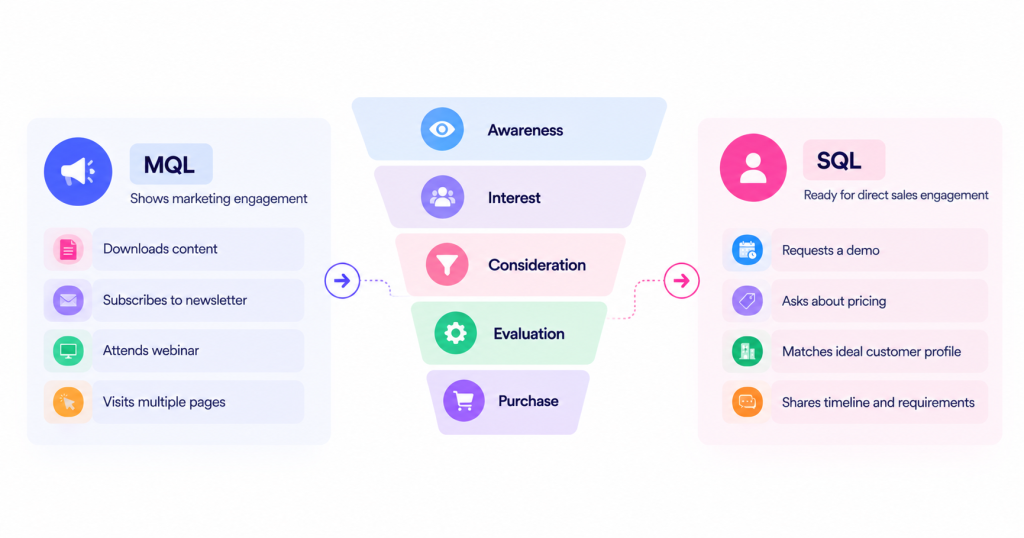
An MQL has demonstrated interest through marketing activity. An SQL has met the organization’s criteria for a meaningful sales conversation.
| Criteria | Marketing qualified lead (MQL) | Sales qualified lead (SQL) |
|---|---|---|
| Main characteristic | Marketing engagement | Sales readiness |
| Typical stage | Awareness or consideration | Active evaluation |
| Common signals | Content downloads, webinars, repeat visits | Demo requests, specific requirements, pricing discussions |
| Customer fit | May be partially assessed | Usually assessed against qualification criteria |
| Primary owner | Marketing | Sales |
| Next action | Nurturing or further qualification | Discovery, consultation, or active sales follow-up |
| Main goal | Develop and assess interest | Determine whether a viable sales opportunity exists |
Example of an MQL
A revenue operations manager downloads a report about marketing measurement.
They subscribe to the newsletter and attend a webinar but haven’t identified a specific software requirement.
Their engagement suggests relevant interest, making them a potential MQL. However, there isn’t enough information to conclude that they need a sales conversation.
Example of an SQL
The same manager returns two weeks later and requests a demonstration.
During the initial exchange, they explain that their company is evaluating software to connect paid campaigns with Salesforce opportunities. They have a target implementation date and are coordinating the evaluation with the marketing director.
They now meet the company’s agreed criteria for sales engagement and can be classified as an SQL.
This progression is part of the broader customer journey funnel. The prospect moves from learning about a problem to evaluating a specific solution.
Can a lead become an SQL without being an MQL?
Yes.
A prospect who arrives through a referral and immediately requests a sales consultation may qualify directly as an SQL.
The same applies to a prospect who contacts sales after receiving a recommendation from an existing customer.
Not every buyer follows a predictable marketing journey. Your CRM process should allow direct qualification when the required evidence exists.
What makes a lead sales qualified?
A sales qualified lead usually demonstrates several characteristics that indicate a credible opportunity.
The exact requirements should reflect your product, target customers, and sales process.
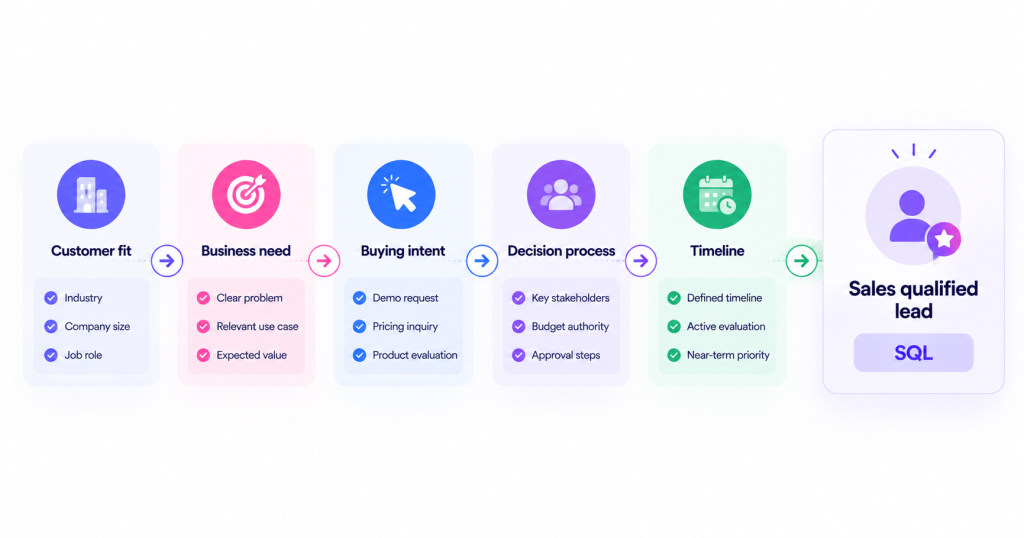
1. Strong customer fit
The prospect should match the type of customer your business can successfully serve.
For B2B companies, this may involve:
- Industry or business model
- Company size
- Geographic market
- Job role
- Technical requirements
- Relevant business use case
For example, a platform designed for B2B SaaS marketing teams may not be suitable for an individual looking for personal website statistics.
A clear B2B customer segmentation strategy helps teams distinguish suitable prospects from audiences that are unlikely to become customers.
2. A clearly identified business need
The prospect should have a problem your product or service can address.
Someone saying, “We’re interested in analytics,” provides limited qualification information.
Someone explaining, “We spend $40,000 a month on paid acquisition but can’t connect campaigns with qualified pipeline,” communicates a specific business challenge.
A defined problem makes it easier for sales to assess potential value.
3. Meaningful buying intent
Buying intent reflects whether a prospect is actively considering a solution.
Potential signals include:
- Requesting a product demo
- Asking about pricing or contracts
- Comparing vendors
- Reviewing integration requirements
- Discussing implementation
- Involving other stakeholders
These actions can be useful, but none should automatically determine qualification in isolation.
Analyzing customer journey touchpoints helps teams understand how these signals relate to the prospect’s broader evaluation process.
4. A realistic purchasing process
Sales should understand how the prospect’s organization makes purchasing decisions.
That doesn’t mean every SQL must personally control the budget.
In B2B sales, a qualified prospect might be a champion who can involve the decision-maker, explain the approval process, and coordinate the evaluation.
The important question is whether there is a credible path toward a purchasing decision.
5. An appropriate timeline
A prospect with a specific business need and an upcoming implementation target may deserve immediate attention.
Someone who is researching possible solutions for the following year may still be valuable but need a different follow-up approach.
Qualification should account for the actual sales cycle. A six-month buying process can be normal for an enterprise purchase.
Unlock insights that drive growth
How does a lead become sales qualified?
A prospect generally becomes sales qualified after the business identifies relevant buying signals, evaluates the prospect against agreed criteria, and confirms that direct sales engagement is appropriate.
The process often follows five stages.
Step 1: Capture the lead
A prospect enters the lead generation funnel through an activity such as a form submission, event registration, product signup, referral, or demo request.
At this stage, the business may know very little about the person.
The objective is to capture useful contact and source information without creating unnecessary friction.
Step 2: Assess customer fit and engagement
Marketing evaluates the prospect’s company characteristics and relevant behavior.
For example, a marketing operations manager at a target SaaS company might receive a stronger fit assessment than a visitor outside the supported market.
A lead scoring system, where available, can help prioritize prospects using fit and engagement signals.
However, a score is only an indicator. It doesn’t replace the information required for qualification.
Step 3: Identify buying intent
Next, the business looks for signs that the prospect is evaluating a purchase.
These may include repeated product exploration, comparison activity, pricing inquiries, or direct requests for sales contact.
Reliable event tracking can help capture these behaviors, although the meaning of an action should always be considered in context.
Step 4: Confirm qualification criteria
Marketing or sales verifies whether the prospect meets the company’s definition of an SQL.
This may involve a form, email exchange, discovery call, or information already available in the CRM.
Common questions include:
- What problem are you trying to solve?
- Why is solving it important now?
- What solutions are you currently considering?
- Who else is involved in the decision?
- What timeline are you working toward?
The goal is to understand the opportunity, not interrogate the prospect.
Step 5: Accept and route the SQL
Once qualified, the lead should be assigned to the appropriate sales representative or team.
The CRM record should include the qualification evidence, lead source, relevant interactions, ownership, and next action.
A consistent handoff prevents prospects from repeating the same information and helps sales respond appropriately.
In a well-managed sales funnel, the SQL stage should have a clear entry definition and a clear next step.
Sales qualified lead example for a B2B SaaS company
Consider a fictional B2B SaaS company selling revenue analytics software.
Its ideal customers are businesses with established marketing teams that need to connect acquisition campaigns with CRM opportunities.
Three prospects enter its pipeline during the same week.
| Qualification factor | Lead A | Lead B | Lead C |
|---|---|---|---|
| Role | Marketing director | Student | Revenue operations lead |
| Company fit | Strong | Poor | Strong |
| Activity | Requests demo | Downloads 4 articles | Visits comparison pages |
| Business need | Clearly defined | None identified | Relevant but exploratory |
| Timeline | Within 60 days | None | Not established |
| Buying process | Evaluation team identified | Not applicable | Unknown |
| Recommended status | SQL | Unqualified | MQL / nurture |
Why Lead A is an SQL
Lead A has a relevant role, matches the target customer profile, explains a specific problem, and has an active evaluation timeline.
The company has enough information to justify direct sales engagement.
Why Lead B is not an SQL
Lead B has engaged with multiple content resources but doesn’t represent a suitable customer.
High activity alone doesn’t establish qualification.
Why Lead C needs further nurturing
Lead C fits the ideal customer profile and appears interested, but the buying need and timeline are not yet clear.
The next step may be a targeted follow-up or additional discovery rather than immediately treating the contact as a qualified opportunity.
The lesson: Qualification should combine customer fit, demonstrated need, and sales readiness instead of relying on a single action.
Sales qualification frameworks you can use
Sales qualification frameworks help teams evaluate prospects consistently.
They are useful when your sales process involves several stakeholders, meaningful contract values, or extended evaluation periods.
| Framework | Main criteria | Suitable use case |
|---|---|---|
| BANT | Budget, authority, need, timeline | Straightforward qualification |
| CHAMP | Challenges, authority, money, prioritization | Problem-led discovery |
| MEDDIC | Metrics, economic buyer, decision criteria, decision process, identify pain, champion | Complex B2B opportunities |
| GPCT | Goals, plans, challenges, timeline | Consultative discovery |
BANT
BANT evaluates four questions:
- Budget: Is there a realistic way to fund the purchase?
- Authority: Who is involved in approving the decision?
- Need: What business problem must be solved?
- Timeline: When does the organization expect to act?
BANT is easy to apply, but it can become restrictive if sales expects prospects to have every detail finalized before an initial conversation.
A strong champion may not know the approved budget yet, especially during early evaluation.
CHAMP
CHAMP begins with the customer’s challenges rather than the available budget.
It evaluates the problem, decision-making authority, financial considerations, and priority.
This approach can work well when prospects understand their operational difficulties but haven’t finalized their purchasing plans.
MEDDIC
MEDDIC provides a more detailed framework for complex B2B deals.
It evaluates measurable business outcomes, economic buyers, decision criteria, decision processes, business pain, and internal champions.
It is particularly useful when several departments participate in purchasing decisions.
However, collecting every MEDDIC detail may be more appropriate during opportunity discovery than at the initial SQL handoff.
GPCT
GPCT focuses on goals, plans, challenges, and timeline.
It helps sales understand what the prospect wants to achieve, what they have already tried, and what is preventing progress.
This can be useful for consultative selling, where the value of the solution depends on understanding the prospect’s broader business objectives.
Which framework should you choose?
Use the simplest framework that provides enough information to decide the next action.
For a straightforward sales process, a few BANT or CHAMP questions may be sufficient.
For enterprise sales, a more detailed framework can help once the opportunity progresses.
Avoid turning SQL qualification into a requirement to complete every field in a complex sales methodology.
How to define SQL criteria for your business
The most useful SQL definition is one that both marketing and sales agree on and apply consistently.
A practical approach is to build a qualification checklist.
Step 1: Analyze customers who became successful deals
Start with your existing CRM records.
Compare closed-won opportunities with rejected leads and closed-lost deals.
Look for patterns in customer characteristics, buying needs, sales conversations, and purchasing timelines.
A well-defined customer acquisition strategy should reflect the types of customers your business can attract and retain successfully.
Step 2: Identify mandatory qualification criteria
Separate essential requirements from supporting signals.
For example:
| Requirement | Type | Example |
|---|---|---|
| Operates in a supported market | Mandatory | Business is in an eligible region |
| Has a relevant use case | Mandatory | Needs campaign-to-revenue reporting |
| Fits target company profile | Supporting | B2B SaaS company |
| Demonstrates buying interest | Mandatory | Requests evaluation or discusses a solution |
| Has a known decision process | Supporting | Can involve a budget owner |
| Has a realistic timeline | Supporting | Plans to evaluate this quarter |
A lead should not automatically qualify because it meets several optional criteria while failing an essential one.
Step 3: Define the handoff agreement
Marketing and sales should agree on:
- Who can assign SQL status
- What evidence is required
- How quickly the lead should be reviewed
- Who owns the next action
- What happens if sales rejects the lead
- How rejected leads return to nurturing
A documented agreement helps reduce disagreements over lead quality.
Step 4: Record the evidence in your CRM
The SQL status should be supported by useful information.
A good CRM record might include:
Qualification reason: Requested demo for marketing-to-revenue reporting.
Business need: Cannot connect Google Ads and LinkedIn campaigns with Salesforce opportunities.
Customer fit: Target B2B SaaS account.
Timeline: Evaluating vendors this quarter.
Next action: Discovery call with marketing director and revenue operations lead.
This makes the status actionable instead of simply adding another label.
Step 5: Validate your criteria against outcomes
Review whether SQLs consistently progress to opportunities and customers.
If sales repeatedly rejects leads that marketing marks as qualified, investigate why.
You may need to refine customer fit criteria, strengthen intent requirements, or improve the handoff process.
Using sales lead tracking alongside CRM outcomes makes these patterns easier to evaluate.
What should happen after a lead becomes an SQL?
Qualification is a transition, not the end of the process.
Once a prospect becomes an SQL, the business needs to move from identifying interest to evaluating a potential purchase.
Assign the right sales owner
Route the lead based on territory, account ownership, product requirements, or another documented rule.
For account-based selling, check whether another representative already owns the company relationship.
Review the prospect’s context
Sales should examine the information collected before the handoff.
This includes the prospect’s business need, relevant interactions, previous conversations, and acquisition history.
Understanding the digital customer journey can help the representative avoid repeating questions the prospect has already answered.
Conduct meaningful discovery
The first conversation should clarify the business problem and determine whether a suitable solution exists.
Useful discovery questions include:
- What prompted your search for a solution?
- What is your current process?
- What isn’t working?
- What would a successful implementation achieve?
- Who will evaluate the solution?
- What could delay the decision?
Decide whether to create an opportunity
Not every SQL should immediately become a sales opportunity.
An SQL may be ready for sales engagement, but discovery could reveal that the prospect lacks a viable project or has requirements the business cannot meet.
Create an opportunity when the company’s opportunity criteria are satisfied.
Return unsuitable or early-stage leads to the right workflow
A prospect may be a good customer fit but not ready to buy.
Rather than permanently rejecting the contact, sales can return the lead to a suitable nurturing sequence with a documented reason.
This keeps the customer journey strategy aligned with the prospect’s actual needs.
How do you calculate SQL conversion rates?
SQL conversion rates help teams evaluate how efficiently leads move through qualification and into the sales pipeline.
However, different businesses use the term SQL conversion rate for different calculations.
Always define the numerator, denominator, and measurement period in your reports.
1. Lead-to-SQL conversion rate
This measures the percentage of leads that become sales qualified.
Lead-to-SQL conversion rate = (Number of SQLs ÷ Total leads) × 100
For example, if a business generates 1,000 leads and 120 become SQLs:
(120 ÷ 1,000) × 100 = 12%
The lead-to-SQL conversion rate is 12%.
This indicates how much of the acquired lead pool meets sales qualification criteria.
It does not establish whether those leads will eventually become customers.
2. MQL-to-SQL conversion rate
This measures the percentage of marketing-qualified leads that progress to SQL status.
MQL-to-SQL conversion rate = (MQLs that became SQLs ÷ MQLs in the cohort) × 100
Suppose 300 MQLs enter the qualification process, and 90 become SQLs.
(90 ÷ 300) × 100 = 30%
The MQL-to-SQL conversion rate is 30%.
For accurate reporting, use a defined cohort and conversion window. Otherwise, leads from different periods can distort the result.
3. SQL-to-opportunity conversion rate
This measures how many SQLs progress into accepted sales opportunities.
SQL-to-opportunity conversion rate = (SQLs that became opportunities ÷ SQLs in the cohort) × 100
If 120 SQLs generate 48 opportunities:
(48 ÷ 120) × 100 = 40%
The SQL-to-opportunity conversion rate is 40%.
This is one of the most useful indicators of qualification quality because it connects SQL status with a meaningful sales outcome.
4. SQL-to-customer conversion rate
This measures how many SQLs eventually become paying customers.
SQL-to-customer conversion rate = (SQLs that became customers ÷ SQLs in the cohort) × 100
If 120 SQLs produce 18 customers:
(18 ÷ 120) × 100 = 15%
The SQL-to-customer conversion rate is 15%.
For businesses with longer sales cycles, measure mature cohorts so recent SQLs aren’t unfairly counted as failures before they have had time to close.
Which SQL metrics should you track?
SQL volume matters, but it doesn’t tell the whole story.
A useful dashboard combines qualification, pipeline, revenue, and efficiency metrics.
| Metric | What it measures | Why it matters |
|---|---|---|
| SQL volume | Number of sales qualified leads | Shows qualified demand |
| Lead-to-SQL rate | Percentage of leads becoming SQLs | Evaluates lead quality |
| MQL-to-SQL rate | Percentage of MQLs progressing | Evaluates marketing-to-sales handoff |
| SQL acceptance rate | Percentage accepted by sales, where acceptance is tracked separately | Reveals qualification alignment |
| SQL-to-opportunity rate | Percentage becoming opportunities | Measures pipeline progression |
| SQL-to-customer rate | Percentage becoming customers | Evaluates downstream quality |
| Cost per SQL | Marketing spend divided by SQLs | Measures acquisition efficiency |
| Pipeline per SQL | Pipeline value divided by SQLs | Shows opportunity value |
| Revenue per SQL | Closed-won revenue divided by SQLs | Connects qualification to revenue |
| Time to first sales response | Delay before initial sales follow-up | Identifies handoff friction |
Cost per SQL
Cost per SQL = Marketing spend ÷ Number of SQLs
If a company spends $24,000 on marketing and generates 80 SQLs:
$24,000 ÷ 80 = $300 per SQL
Cost per SQL helps compare acquisition efficiency, but it shouldn’t be used alone.
A campaign producing SQLs at $400 each may still outperform a campaign producing them at $150 if its leads create more profitable revenue.
Pipeline generated per SQL
Pipeline per SQL = Pipeline value created ÷ Number of SQLs
Suppose 80 SQLs contribute to $400,000 in newly created pipeline.
$400,000 ÷ 80 = $5,000 pipeline per SQL
Pipeline per SQL can help compare qualification outcomes across channels and campaigns.
Keep in mind that pipeline value is potential revenue, not realized revenue.
Revenue per SQL
Revenue per SQL = Closed-won revenue ÷ Number of SQLs
This metric connects SQL acquisition with actual sales results.
Use consistent cohorts and sufficiently long measurement windows to account for your sales cycle.
For a broader view, revenue analytics can help evaluate whether improvements in qualification translate into financial outcomes.
What is a good SQL conversion rate?
There is no universal SQL conversion rate that every business should target.
Conversion rates vary with the industry, target audience, lead source, qualification standards, sales cycle, and definition of an SQL.
For example, a company with strict qualification criteria may generate fewer SQLs but achieve a higher SQL-to-opportunity conversion rate.
Another business may classify prospects as SQLs earlier, producing more SQLs with lower downstream conversion.
Neither approach is necessarily wrong.
A more useful approach is to compare performance against:
- Your own historical conversion rates
- Similar customer segments
- Acquisition channels
- Sales teams or territories
- Lead cohorts with comparable sales cycles
When reviewing B2B sales funnel conversion rates, ensure the stages are defined consistently before comparing results.
How to improve sales qualified lead quality
Generating more SQLs isn’t always the right goal.
The better objective is to generate prospects who progress into valuable opportunities and customers.
1. Improve your ideal customer profile
Look at the customers who close, retain, and generate meaningful revenue.
Identify the characteristics associated with successful relationships and adjust your targeting accordingly.
A more focused customer segmentation strategy can reduce time spent qualifying unsuitable prospects.
2. Strengthen qualification questions
A demo form should capture enough information to help sales prepare, without becoming an obstacle to conversion.
Ask for essential details and collect deeper context during discovery.
For example, asking about the prospect’s main challenge may be more useful than requiring a precise budget figure before the first conversation.
3. Align marketing campaigns with qualified demand
Evaluate campaigns using the quality of the opportunities they generate, not just clicks and form submissions.
A lead source tracking process helps identify where prospects originate, while downstream CRM data shows whether they become qualified.
This can reveal channels that generate fewer leads but more valuable opportunities.
4. Improve nurturing for early-stage prospects
Some prospects have a strong customer fit but aren’t ready for direct sales engagement.
Segment these contacts by their needs and stage of evaluation.
A relevant email marketing funnel can help maintain interest until the prospect has a clearer reason to speak with sales.
5. Reduce friction between qualification stages
Look for delays, unclear ownership, missing CRM information, and repeated qualification questions.
Use funnel analysis to identify where prospects stop progressing and investigate the underlying causes.
6. Use sales feedback to refine qualification
Track why sales rejects leads.
Common reasons might include:
- Poor customer fit
- No active project
- Unsupported requirements
- No purchasing path
- Duplicate records
- Incorrect contact information
Review these reasons with marketing and update qualification criteria when consistent patterns appear.
7. Optimize for pipeline, not just SQL volume
The ultimate measure of SQL quality is whether qualified prospects contribute to valuable sales outcomes.
Connect your qualification reporting with opportunity creation and revenue so you can identify which campaigns deserve continued investment.
Common mistakes in SQL qualification
Several mistakes can make SQL reporting misleading or create unnecessary work for sales.
Treating every demo request as sales qualified
A demo request is a strong intent signal, but it doesn’t guarantee that the prospect is a suitable customer.
Some requests come from students, competitors, job seekers, or businesses with unsupported requirements.
What helps: Combine buying intent with basic customer-fit checks.
Using lead scores without qualification evidence
A high lead score can result from repeated activity rather than meaningful purchase intent.
What helps: Require clear business needs and agreed sales-readiness criteria before assigning SQL status.
Having different definitions across teams
If marketing counts demo requests as SQLs but sales only counts accepted leads, the teams will report different numbers.
What helps: Define the status, ownership, and reporting rules in a shared document.
Ignoring rejected SQLs
A rejected SQL is useful feedback.
Without tracking rejection reasons, teams may continue generating the same unsuitable leads.
What helps: Record rejection reasons and review them regularly.
Comparing SQLs from different sales cycles
A recently qualified enterprise prospect may need months to progress, while a smaller purchase could close much faster.
What helps: Use comparable cohorts and allow enough time for downstream outcomes.
Measuring qualification without revenue
An increasing SQL count can look impressive even when pipeline and closed-won revenue remain unchanged.
What helps: Connect qualification metrics with CRM opportunities, deal values, and customer outcomes.
How Usermaven helps connect SQLs with pipeline and revenue
Knowing how many SQLs your team generates is useful. Understanding which marketing efforts produce those SQLs and whether they become revenue is more valuable.
That’s where Usermaven comes in.
Usermaven is an AI-powered marketing attribution platform that connects marketing spend and customer journeys with conversions, CRM outcomes, pipeline, and revenue.
Rather than replacing your CRM’s qualification process, it helps marketing teams evaluate the performance behind qualified demand.
Identify which channels generate qualified leads
Consider two acquisition campaigns.
| Metric | Campaign A | Campaign B |
|---|---|---|
| Marketing spend | $6,000 | $6,000 |
| Leads generated | 300 | 120 |
| SQLs generated | 15 | 24 |
| Cost per lead | $20 | $50 |
| Cost per SQL | $400 | $250 |
These figures are illustrative.
Campaign A looks better when judged by cost per lead.
But Campaign B generates more SQLs at a lower cost per SQL.
With Usermaven’s pipeline attribution, teams can connect marketing sources with downstream CRM outcomes and examine which campaigns contribute to qualified pipeline.
This helps identify campaigns that deserve investment even when their initial lead costs appear higher.
Connect marketing touchpoints with SQL and opportunity progression
B2B prospects rarely make decisions after one interaction.
A buyer might discover a company through organic search, return through LinkedIn, explore product pages, and request a demo after receiving an email.
With Usermaven’s multi-touch attribution, marketing teams can examine how different interactions contribute across the buying journey.
Connecting those interactions with CRM outcomes provides context for understanding which channels are associated with qualified leads, opportunities, and revenue.
Understand why prospects stop progressing
Not every interested lead becomes sales qualified.
Some visitors explore several pages but never submit a form. Others request a demo and don’t continue.
Usermaven’s funnels and user journeys help teams investigate these paths and identify where prospects drop off.
That information can guide improvements to messaging, conversion paths, and follow-up processes.
Measure marketing beyond lead generation
A campaign that generates SQLs isn’t necessarily the campaign that produces the most revenue.
Some SQLs never become opportunities. Others create pipeline but don’t close.
Usermaven’s full-funnel revenue attribution connects marketing activity with later CRM outcomes, helping teams evaluate campaigns across the complete acquisition-to-revenue journey.
This supports a more useful question than “Which campaign generated the most leads?”
Which marketing investments contribute to qualified pipeline and customers?
See Usermaven in action
Book a free demo and discover how powerful analytics can grow your business.
Final thoughts
A sales qualified lead is more than someone who fills out a form or visits a pricing page.
It’s a prospect who meets your qualification criteria and is ready for a meaningful sales conversation.
Define those criteria with your sales team, document the evidence behind each SQL, and evaluate performance using opportunities and closed-won revenue.
That approach helps marketing focus on attracting the right prospects while giving sales the context needed to move promising conversations forward.
Usermaven helps connect marketing performance with qualified pipeline and revenue. If you want to understand which campaigns contribute to valuable sales outcomes, book a demo.
FAQs
What is a sales qualified lead?
A sales qualified lead is a prospect who meets a company’s agreed criteria for direct sales engagement. Typically, the prospect has a relevant business need, matches the target customer profile, and shows credible buying interest. The precise criteria depend on the organization’s sales process.
What is the difference between an MQL and an SQL?
An MQL has shown enough marketing engagement to warrant further nurturing or assessment. An SQL has met the requirements for direct sales follow-up. The distinction is primarily sales readiness, although companies may define the handoff differently.
How do you identify a sales qualified lead?
Identify an SQL by evaluating customer fit, business need, buying intent, decision-making process, and timeline. Use agreed qualification criteria and record supporting evidence in the CRM. A single action, such as a demo request, may indicate intent but doesn’t necessarily establish qualification.
Is a demo request considered an SQL?
A demo request can be a strong buying signal, but it doesn’t automatically make the prospect an SQL. The lead should still meet your company’s minimum qualification criteria. Some businesses classify suitable demo requests immediately, while others require a brief review.
What comes after an SQL in the sales funnel?
An SQL typically progresses into discovery, active evaluation, or an opportunity stage, depending on the company’s CRM process. Not every SQL becomes an opportunity. Sales may discover that the prospect isn’t ready or that the solution isn’t suitable.
How do you calculate the SQL conversion rate?
Divide the number of leads that became SQLs by the number of leads in the relevant cohort, then multiply by 100. For example, 50 SQLs from 500 leads produce a 10% lead-to-SQL conversion rate. Always specify which funnel stages and measurement period the calculation uses.

Written by
Imrana Essa
SaaS Marketing Lead
Imrana Essa is a marketing lead and content strategist with 8+ years of experience creating and leading content for B2B and SaaS brands. She specializes in marketing analytics, attribution, content strategy, and organic growth, translating complex marketing concepts into clear, actionable insights. Her work focuses on helping marketers understand performance, make data-informed decisions, and build strategies that contribute to sustainable growth.
All articles by Imrana →