Getting more leads doesn’t always mean getting more customers.
A campaign might generate hundreds of signups, but only a handful may be a good fit for your product. Meanwhile, someone who visits your pricing page twice and requests a demo could be much closer to buying.
Treating both leads equally wastes time and makes it harder for sales to focus on real opportunities.
That’s where lead scoring helps. It gives marketing and sales a consistent way to evaluate leads based on who they are, what they need, and how they interact with your business.
Drive business growth
with AI-powered analytics
Key takeaways
- Lead scoring ranks prospects by their potential value and buying readiness. It helps teams decide who needs immediate attention and who should receive more nurturing.
- A useful score combines fit and behavior. Job title or company size alone cannot tell you whether someone is ready to buy.
- Rule-based scoring is often the best starting point. Predictive models become more useful when you have enough reliable historical data.
- Scores should influence actions. A high score should trigger an appropriate sales or marketing response, not just change a number in your CRM.
- Lead scoring needs regular validation. Opportunity creation, closed-won revenue, and conversion rates reveal whether your scoring model identifies valuable prospects.
What is lead scoring?
Lead scoring is a method of assigning numerical values to prospects based on how closely they match your ideal customer profile and how likely they are to become customers.
A lead earns or loses points based on signals such as company size, job role, product interest, website activity, and interactions with marketing campaigns.
For example, a B2B software company might assign:
- +15 points when a lead matches its target industry.
- +10 points when the lead holds a decision-making role.
- +20 points for requesting a product demo.
- +10 points for visiting a pricing page.
- -20 points when the lead is a student researching a topic.
A prospect with 55 points might qualify for sales outreach, while someone with 15 points may remain in a nurturing sequence.
The actual values depend on your business. The goal isn’t to create a perfect mathematical formula. It’s to make lead prioritization more consistent and useful.
Lead scoring typically sits between lead generation and sales qualification. Once prospects enter your lead generation funnel, scoring helps determine what should happen next.
How does lead scoring work?
Lead scoring works by collecting information about a prospect, assigning points to meaningful signals, and using the total or combined scores to determine the next action.
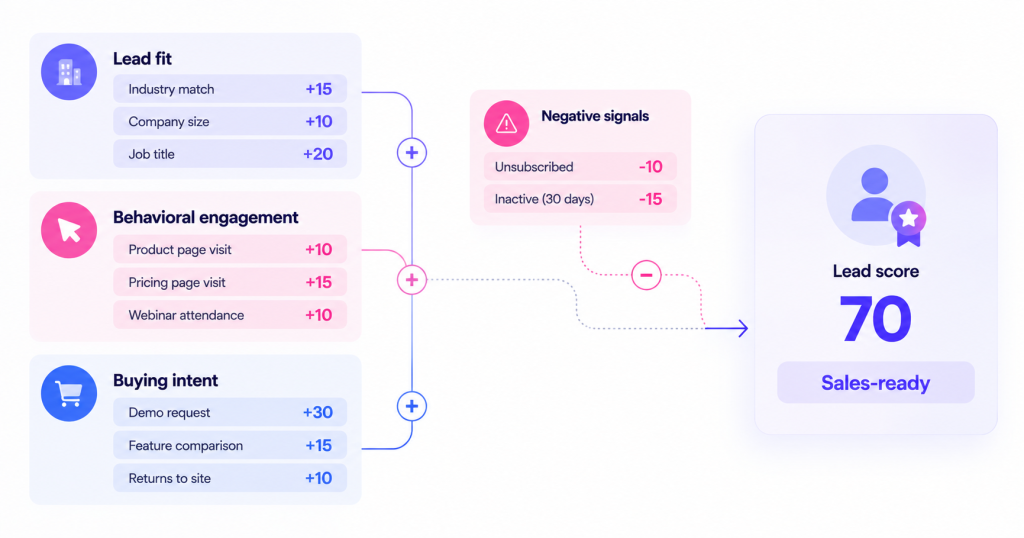
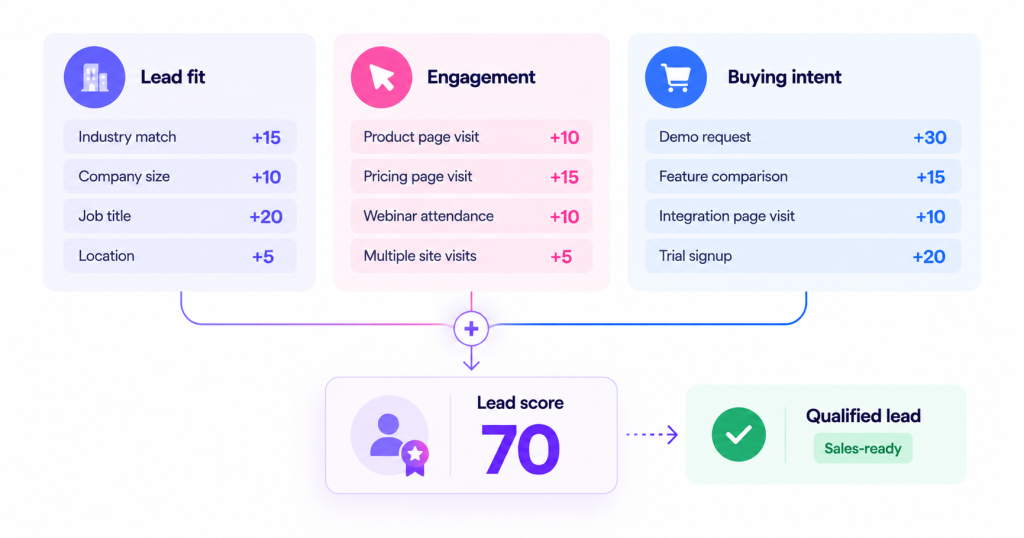
Most scoring systems evaluate three dimensions.
1. Lead fit
Lead fit measures how closely a prospect matches the customers your business wants to attract.
For B2B companies, fit signals often include:
- Industry
- Company size
- Annual revenue
- Job title
- Department
- Geographic market
- Technology requirements
Suppose your product is designed for SaaS marketing teams. A marketing director at a SaaS company with 100 employees may be a stronger fit than a student researching marketing analytics.
This is where B2B customer segmentation becomes useful. Instead of treating every contact as a potential buyer, you can define the characteristics of accounts that are most likely to benefit from your product.
Important: A strong fit does not automatically mean strong buying intent. Someone can match your ideal customer profile without having an immediate need.
2. Behavioral engagement
Behavioral scoring looks at what a prospect does after discovering your business.
Common signals include:
| Lead activity | Example score | What it might indicate |
|---|---|---|
| Visits a product page | +5 | Initial product interest |
| Returns to the website | +5 | Continued evaluation |
| Attends a webinar | +10 | Interest in the problem |
| Views a comparison page | +12 | Vendor evaluation |
| Visits the pricing page | +15 | Commercial interest |
| Requests a demo | +25 | Direct purchase consideration |
| Unsubscribes from emails | -10 | Reduced marketing engagement |
These are illustrative values, not universal benchmarks.
A strong behavioral model distinguishes between actions that suggest curiosity and actions that suggest a buying decision.
For example, reading an educational blog post should generally carry less weight than requesting a product demonstration.
Understanding customer behavior across multiple visits is often more useful than evaluating one isolated event.
3. Buying intent
Intent scoring evaluates signals that suggest a prospect is actively considering a purchase.
Examples include:
- Requesting pricing information
- Comparing vendors
- Asking about integrations
- Returning to implementation or security pages
- Inviting colleagues to a product demonstration
- Starting a trial and completing meaningful setup steps
Intent is closely connected to the customer journey touchpoints a buyer interacts with before making a decision.
A visitor who reads several educational articles may still be exploring the problem. Someone comparing pricing, integrations, and implementation requirements is likely further along.
However, intent signals are not proof that a deal will close. They should help prioritize investigation and follow-up.
Drive business growth
with AI-powered analytics
Why is lead scoring important?
Lead scoring makes it easier to connect marketing activity with sales priorities.
Without a scoring system, teams often rely on lead volume, form submissions, or individual judgment to decide which prospects deserve attention.
That creates several problems.
Sales spends less time on low-priority leads
Sales representatives have limited time. Calling every new contact in the order they arrive rarely produces the best outcome.
Scoring helps identify prospects with a stronger combination of fit and intent, so sales can prioritize them.
This is particularly useful in a B2B sales funnel, where the buying process may involve multiple stakeholders and several conversations.
Marketing can improve lead quality
A campaign generating 500 leads may look successful until the team discovers that very few become opportunities.
Lead scoring adds another layer to campaign evaluation. Marketing can compare not only how many leads each channel generates but also how those leads progress toward sales.
That makes lead source tracking more useful because the source can be evaluated alongside qualification outcomes.
Lead nurturing becomes more relevant
Not every prospect needs a sales call.
A lead with a strong company fit but limited buying activity may benefit from educational emails, product examples, or invitations to webinars.
Someone showing strong buying intent may need a direct conversation.
This is where lifecycle marketing and lead scoring work together. The score helps determine the next appropriate interaction.
Marketing and sales work from shared criteria
Disagreements often happen when marketing considers a lead qualified but sales sees little potential.
A documented scoring model makes the criteria visible to both teams.
Instead of debating whether a lead looks promising, teams can examine which signals contributed to the score and whether those signals actually predict sales outcomes.
What are the different types of lead scoring models?
There is no single lead scoring model that works for every business. The right approach depends on your customers, sales process, and available data.
| Model | What it evaluates | Best suited for |
|---|---|---|
| Demographic | Personal characteristics | B2C and individual buyers |
| Firmographic | Company characteristics | B2B qualification |
| Behavioral | Website and product actions | Engagement-based prioritization |
| Intent-based | Purchase consideration signals | Identifying sales-ready prospects |
| Predictive | Historical conversion patterns | Teams with sufficient reliable data |
| Account-based | Combined activity across an account | Complex B2B buying groups |
| Negative scoring | Poor-fit or disengagement signals | Improving scoring accuracy |
Demographic lead scoring
Demographic scoring evaluates characteristics such as age, location, occupation, or other relevant personal attributes.
For example, an education provider may score prospects based on their professional experience and stated learning goals.
Only collect and use personal information when it is relevant, appropriate, and consistent with applicable privacy requirements.
Firmographic lead scoring
Firmographic scoring evaluates the company rather than the individual.
Typical signals include company size, industry, revenue range, business model, and operating region.
For a SaaS business selling to mid-market marketing teams, a prospect from a suitable company may receive a higher fit score.
Firmographic scoring works particularly well alongside a defined customer segmentation strategy.
Behavioral lead scoring
Behavioral scoring evaluates actions such as page visits, downloads, email interactions, trial activity, and demo requests.
A prospect who repeatedly visits high-intent pages may receive more points than someone who only views the homepage.
Reliable event tracking is important here because the model depends on correctly capturing meaningful actions.
Not every action should earn points. Repeated low-value activity can otherwise inflate scores.
Intent-based lead scoring
Intent scoring emphasizes actions that indicate a potential purchase decision.
For example, visiting an integration page after a product demo may be more meaningful than opening several newsletters.
The challenge is interpreting those signals in context. A pricing-page visit could come from a prospective buyer, an existing customer, or a competitor.
Predictive lead scoring
Predictive scoring uses statistical or machine-learning models to estimate which leads are most likely to convert.
Instead of manually assigning every point, the model analyzes historical patterns among leads that became customers and those that did not.
It may identify combinations of behaviors and company attributes associated with higher conversion probability.
Predictive scoring can be useful, but its reliability depends on data quality, representative training examples, and ongoing monitoring.
Related predictive customer analytics techniques can help teams understand patterns in customer behavior, although a prediction should never be treated as a guaranteed outcome.
Account-based lead scoring
In B2B purchasing, multiple people from the same company may research a product before anyone contacts sales.
Account-based scoring combines signals from several contacts within an organization.
For example:
- A marketing manager attends a webinar.
- A revenue operations lead reviews integrations.
- A VP of marketing requests pricing.
- A technical stakeholder reads security documentation.
Together, these actions may suggest stronger account-level interest than any single contact’s activity.
Negative lead scoring
Negative scoring deducts points when signals suggest a lead is less likely to become a customer.
Examples include:
- A company outside your supported market
- A personal email address when business accounts are required
- A job-seeker inquiry
- Repeated irrelevant form submissions
- Prolonged inactivity
- An explicit statement that the prospect has no purchase plans
Negative scoring prevents the model from overvaluing activity that does not represent commercial potential.
How do you calculate a lead score?
A basic rule-based lead score is calculated by adding positive points and subtracting negative points.
Lead score = Fit points + Engagement points + Intent points – Negative points
Consider a prospect evaluating a B2B analytics platform.
| Scoring signal | Points |
|---|---|
| Works at a target SaaS company | +15 |
| Holds a marketing leadership role | +15 |
| Company falls within target size | +10 |
| Visits product pages | +5 |
| Returns to the pricing page | +15 |
| Requests a demo | +25 |
| Uses an unsupported business requirement | -15 |
| Total lead score | 70 |
The calculation is:
15 + 15 + 10 + 5 + 15 + 25 – 15 = 70 points
If the company considers leads above 65 points sales-ready, this prospect would qualify for review.
However, a single total score can hide an important distinction.
A lead with 70 points from website activity is not necessarily equivalent to a lead with 70 points from strong company fit and a demo request.
That’s why separating fit and intent can improve qualification.
Lead scoring example for a B2B SaaS company
Imagine a SaaS company selling marketing software to B2B businesses.
Its ideal customers have established marketing teams, use a supported CRM, and need to connect campaigns with pipeline and revenue.
The company creates two independent scores:
- Fit score: How closely the prospect matches its target customer.
- Intent score: How strongly the prospect’s actions suggest purchase consideration.
Both scores range from 0 to 100.
Example fit scoring model
| Attribute | Maximum points |
|---|---|
| Target industry | 25 |
| Company size | 25 |
| Relevant job role | 20 |
| Supported region | 10 |
| Suitable technology environment | 20 |
| Maximum | 100 |
Example intent scoring model
| Activity | Points |
|---|---|
| Visits a feature page | +5 |
| Returns within seven days | +10 |
| Views a comparison page | +15 |
| Visits pricing or demo information | +20 |
| Requests a demo | +40 |
| No meaningful activity for 30 days | -15 |
The company then defines its qualification matrix.
| Low intent: 0–49 | High intent: 50–100 | |
|---|---|---|
| High fit: 70–100 | Nurture and monitor | Prioritize sales outreach |
| Low fit: 0–69 | Low priority | Review manually before outreach |
This prevents a highly engaged but unsuitable prospect from automatically receiving the same priority as a strong-fit buyer.
Compare three example leads
| Lead | Fit score | Intent score | Recommended action |
|---|---|---|---|
| Marketing director at a target SaaS company | 90 | 85 | Immediate sales review |
| Revenue operations manager researching solutions | 85 | 35 | Targeted nurturing |
| Student repeatedly visiting product pages | 15 | 70 | Exclude from sales priority |
The first lead matches the target customer and shows buying intent.
The second looks promising but may not be ready for a sales conversation.
The third is active but unlikely to represent a suitable commercial opportunity.
This distinction becomes especially useful when a business has a longer SaaS customer journey, where prospects may spend weeks researching before speaking to sales.
How to build a lead scoring model in 7 steps
A good lead scoring model starts with your sales process, not a spreadsheet full of arbitrary numbers.
The seven steps are:
- Define your ideal customer.
- Identify meaningful buying signals.
- Assign and weight scoring values.
- Set qualification thresholds.
- Connect scores to workflows.
- Validate against sales outcomes.
- Review and refine the model.
Step 1: Define your ideal customer profile
Start by looking at the customers who generate meaningful revenue and are a good fit for your product.
Examine their industries, company sizes, roles, buying needs, and sales cycles.
Look for patterns among successful customers rather than relying only on the characteristics of your newest leads.
Your SaaS customer segmentation should help distinguish valuable customer groups from audiences that generate interest but rarely buy.
Document the attributes that matter most.
For example, if companies with an established revenue operations function consistently become successful customers, that may be a useful fit signal.
Step 2: Identify meaningful buying signals
Next, identify behaviors that occur before qualified opportunities and purchases.
Look at the actions your existing customers completed before conversion.
These may include:
- Viewing product comparison pages
- Returning to specific feature pages
- Starting a trial
- Completing a meaningful onboarding action
- Requesting pricing
- Scheduling a demo
Use customer journey analytics to understand how those interactions fit into the broader evaluation process.
Avoid assigning high points simply because an action is easy to track.
For example, an email open may be measurable but less meaningful than a direct pricing inquiry.
Step 3: Assign points and weight the signals
Once you have your signals, decide how much each should contribute.
Start with a simple model. Give stronger signals more weight and keep the logic easy to explain.
A useful approach is to distinguish between:
- Low-intent actions: Educational content consumption
- Medium-intent actions: Feature exploration and repeat visits
- High-intent actions: Demo requests and direct sales inquiries
Use behavioral segmentation to group prospects based on what they actually do, rather than treating every interaction equally.
Avoid giving unlimited points for repeated actions. A prospect refreshing the same page 20 times should not automatically become your highest-priority lead.
Step 4: Define your qualification thresholds
Your thresholds determine when a lead moves into a different workflow.
For example:
| Score range | Lead status | Action |
|---|---|---|
| 0–24 | Low priority | Continue general nurturing |
| 25–49 | Engaged | Send relevant educational content |
| 50–69 | Marketing-qualified candidate | Review fit and buying signals |
| 70–100 | Sales-ready candidate | Trigger sales qualification |
These thresholds are starting assumptions.
Your team should adjust them using actual conversion and opportunity data.
Also define what happens when a lead’s score decreases. Qualification should reflect current information rather than permanently labeling someone as sales-ready.
Step 5: Connect scores to sales and marketing workflows
A score becomes useful when it changes what happens next.
For example:
- A high-fit, high-intent lead enters a sales review queue.
- A high-fit, low-intent lead receives relevant educational emails.
- A low-fit lead is excluded from sales-priority notifications.
- An inactive lead enters a re-engagement sequence.
This should align with your existing automated sales funnel and CRM processes.
Keep ownership clear. Marketing may manage the scoring rules, but sales should help define the conditions for accepting or rejecting qualified leads.
Step 6: Validate scores against real sales outcomes
This is the step that separates a useful scoring model from a collection of assumptions.
Compare lead scores with actual outcomes:
- Which scores are associated with sales-qualified leads?
- Which score ranges generate opportunities?
- Which leads become paying customers?
- Which high-scoring leads are repeatedly rejected by sales?
- Which lower-scoring leads unexpectedly close?
Your conversion analysis should examine whether higher-scoring groups consistently perform better.
If low-scoring leads convert more often than high-scoring leads, the model needs attention.
Step 7: Review and improve the model
Lead scoring should evolve as your product, audience, and sales process change.
Review the model when you launch a new product, enter a new market, change your qualification criteria, or notice a decline in lead-to-opportunity conversion.
Look at score distributions and downstream performance rather than changing weights based on individual anecdotes.
What data do you need for lead scoring?
Lead scoring combines information from several systems.
| Data category | Examples | Common source |
|---|---|---|
| Contact information | Role, department, location | Forms and CRM |
| Company information | Industry, employee count, revenue range | CRM and enrichment |
| Website behavior | Page visits, repeat sessions, conversions | Website analytics |
| Product behavior | Activation, feature use, trial activity | Product analytics |
| Marketing engagement | Webinar attendance, campaign interactions | Marketing automation |
| Sales outcomes | SQLs, opportunities, closed-won deals | CRM |
The biggest challenge is not necessarily collecting more information. It’s connecting the information you already have.
For example, website engagement may sit in an analytics platform while opportunity creation happens in Salesforce or HubSpot.
A reliable marketing attribution CRM integration can help connect acquisition activity with downstream sales outcomes, which is useful when validating lead quality.
You also need consistent identity matching, accurate event definitions, and a documented approach to missing data.
When the underlying data is incomplete, the scoring model may look precise while producing misleading recommendations.
Lead scoring vs. lead grading vs. lead qualification
These terms are related, but they describe different activities.
| Concept | Main question | Typical output |
|---|---|---|
| Lead scoring | How promising or engaged is this lead? | Numerical score |
| Lead grading | How closely does this lead match our ideal customer? | Grade or fit category |
| Lead qualification | Should sales actively pursue this opportunity? | Accepted, rejected, or needs review |
Lead scoring combines selected signals into a measurable priority.
Lead grading usually focuses on customer fit, such as company size, industry, and role.
Lead qualification is the broader decision-making process. It may include score and grade, but also budget, authority, business need, timing, and information gathered in conversations.
A lead with a high score may still fail qualification because the prospect lacks budget or needs a feature your product does not offer.
Scoring supports qualification. It should not replace it.
Traditional vs. predictive lead scoring
The main difference is how scoring values are determined.
| Factor | Traditional scoring | Predictive scoring |
|---|---|---|
| How points are assigned | Manually defined rules | Statistical or machine-learning model |
| Data requirements | Relatively modest | Reliable historical conversion data |
| Transparency | Usually easy to explain | Depends on model design |
| Maintenance | Manual rule adjustments | Retraining and monitoring |
| Best starting point | New or developing scoring programs | Established programs with enough data |
Traditional scoring gives teams more direct control over the criteria.
Predictive scoring may discover patterns that are difficult to identify manually, but it can also reproduce biases and problems in historical data.
For example, if past sales teams focused almost entirely on one customer segment, a predictive model may undervalue other segments simply because they received less attention.
Teams exploring predictive behavioral analytics should validate predictions against outcomes and check whether the model performs consistently across different customer groups.
Which should you choose? Start with a transparent rule-based model unless you already have enough trustworthy data and the resources to maintain a predictive system.
How do you measure lead scoring effectiveness?
A lead scoring system should be evaluated by what happens after qualification, not just how many leads receive high scores.
Marketing-qualified to sales-qualified conversion rate
This measures how many marketing-qualified leads are accepted as sales-qualified.
MQL-to-SQL conversion rate = (SQLs ÷ MQLs) × 100
If marketing generates 200 MQLs and sales accepts 80:
(80 ÷ 200) × 100 = 40%
A low rate may indicate weak qualification rules, disagreement between teams, or inconsistent sales review practices.
Lead-to-opportunity conversion rate
This measures how many leads become sales opportunities.
Lead-to-opportunity conversion rate = (Opportunities ÷ Leads) × 100
Suppose 500 leads generate 45 opportunities.
The conversion rate is 9%.
Compare this rate across score ranges to determine whether higher scores are associated with stronger outcomes.
Opportunity-to-customer conversion rate
This measures the percentage of opportunities that close as customers.
It helps determine whether high-scoring leads create genuine sales potential or merely progress to an early pipeline stage.
Revenue per lead
Revenue per lead = Closed-won revenue ÷ Number of leads
For example, if 400 leads generate $80,000 in closed-won revenue, revenue per lead is $200.
This is especially useful when comparing marketing sources with different lead volumes and costs.
Time to qualification
Measure how long it takes a lead to become qualified and receive an appropriate response.
A scoring model should help teams act on promising opportunities, not create extra approval steps.
You can also evaluate B2B sales funnel conversion rates to identify whether qualification improvements translate into better downstream performance.
Common lead scoring mistakes to avoid
Even well-designed scoring systems can become unreliable when teams overlook a few basic problems.
- Giving too much weight to engagement
A lead who downloads ten resources may not be closer to buying than someone who requests a demo.
Activity volume and purchase intent are different things.
- Ignoring negative signals
Without negative scoring, irrelevant or inactive leads may accumulate enough points to appear sales-ready.
- Using one model for every audience
A founder evaluating software may behave differently from a marketing operations manager.
If those audiences have different buying processes, their scores may need different weights.
- Never updating the scoring rules
Signals that predicted purchases a year ago may be less useful today.
Your scoring criteria should reflect current customer behavior and sales outcomes.
- Confusing scoring with revenue impact
A campaign can generate many high-scoring leads without generating meaningful revenue.
Lead scores should be checked against opportunities and closed-won outcomes.
- Relying on inaccurate tracking
Missing events, duplicate conversions, and inconsistent identities can distort behavioral scores.
Before adjusting your model, review the underlying conversion tracking and CRM data.
Lead scoring best practices
The most useful lead scoring models tend to share a few characteristics.
- Keep the model understandable. Sales and marketing should be able to explain why a lead received its score.
- Separate fit from intent. This prevents engagement from hiding poor customer fit.
- Use meaningful actions. Give more weight to behaviors associated with genuine purchase consideration.
- Cap repetitive signals. Repeated visits or email interactions should not inflate scores indefinitely.
- Define the next action. Every qualification threshold should connect to a practical workflow.
- Review sales feedback. Rejected leads and unexpected wins reveal weaknesses in the model.
- Measure business outcomes. Use opportunities and revenue to determine whether the model is working.
Lead scoring also works better when marketing understands the full path to purchase, rather than judging prospects only by their most recent interaction.
How Usermaven helps you understand which leads create revenue
A lead scoring model can tell you which prospects deserve attention. But it doesn’t automatically explain which marketing campaigns attract those prospects or whether they eventually become customers.
That’s where Usermaven becomes relevant.
Usermaven is an AI-powered marketing attribution platform that connects marketing interactions with conversions, CRM outcomes, pipeline, and revenue.
It complements a CRM-based lead scoring process by helping marketing teams evaluate the business outcomes behind their lead generation efforts.
Identify the marketing sources behind qualified leads
Imagine two campaigns:
- Campaign A generates 300 leads, but only 12 become opportunities.
- Campaign B generates 120 leads, and 24 become opportunities.
Looking only at lead volume, Campaign A appears stronger.
Looking at opportunity creation, Campaign B performs better.
With Usermaven’s multi-touch attribution capabilities, teams can examine how different channels and touchpoints contribute to conversions and downstream outcomes.
That provides context for evaluating lead quality by source, rather than assuming every new contact has equal value.
Connect lead activity with CRM outcomes
Lead scoring usually happens inside a CRM or marketing automation system. But acquisition activity may happen across ads, organic search, content, and other channels before a lead reaches the CRM.
Usermaven’s pipeline attribution capabilities connect marketing touchpoints with HubSpot or Salesforce outcomes.
This helps teams answer questions such as:
- Which campaigns contribute to qualified opportunities?
- Which sources generate leads that rarely progress?
- Which marketing interactions appear in successful customer journeys?
- How much pipeline and closed-won revenue is associated with each source?
These insights can inform the signals and weights used in a separate lead scoring system.
Understand where promising prospects drop off
A lead might be highly engaged but never request a demo.
Another might start a trial and leave before completing setup.
Usermaven’s funnels and user journeys help teams investigate where people stop progressing and which interactions happen before conversion.
This matters because a lead score cannot explain every obstacle in the buying process.
Sometimes the problem isn’t lead quality. It may be a confusing signup experience, unclear product information, or friction in the conversion process.
Evaluate marketing by pipeline and revenue
A strong scoring program should ultimately support better sales outcomes.
Usermaven’s full-funnel revenue attribution helps teams connect marketing activity with later pipeline and revenue results.
Instead of optimizing campaigns solely for low cost per lead, marketing can examine which sources contribute to valuable opportunities and customers.
This also makes revenue attribution useful when reviewing lead scoring performance across different acquisition channels.
See Usermaven in action
Book a free demo and discover how powerful analytics can grow your business.
Final thoughts
Lead scoring helps marketing and sales focus on the prospects most likely to become valuable customers.
Start with a clear ideal customer profile, identify meaningful buying signals, and build a scoring model your team can explain. Then validate it against actual opportunities and revenue.
The goal isn’t to create more high-scoring leads. It’s to identify the right prospects and understand what helps them become customers.
If you want to connect lead generation with qualified pipeline and revenue, book a demo to see how Usermaven can help.
FAQs
1. What is lead scoring in marketing?
Lead scoring is the process of ranking prospects based on characteristics and behaviors that indicate customer fit and purchase potential. Marketing and sales teams use these scores to prioritize outreach, personalize nurturing, and improve qualification.
2. What is a good lead score?
A good lead score depends on the scoring model and your historical conversion data. A score of 70 may indicate a sales-ready lead in one company and an early-stage prospect in another. The most useful thresholds are those that consistently separate leads with stronger opportunity and customer conversion rates.
3. What is the difference between lead scoring and lead qualification?
Lead scoring assigns values to signals that indicate fit and buying readiness. Lead qualification determines whether a prospect should be pursued by sales. Qualification may use the score alongside budget, authority, needs, timing, and information gathered directly from the prospect.
4. How many points should a demo request receive?
A demo request should generally carry more weight than low-intent actions such as reading a blog post. However, the exact number of points depends on your model. Use historical sales outcomes to determine how strongly demo requests predict qualified opportunities and customers.
5. Can small businesses use lead scoring?
Yes. Small businesses can start with a simple rule-based model using a handful of signals, such as customer fit, pricing inquiries, and demo requests. A complex predictive system isn’t necessary to benefit from consistent lead prioritization.
7. Does lead scoring improve conversion rates?
Lead scoring can help improve conversion performance by making follow-up more timely and relevant. However, assigning scores does not automatically increase conversions. The benefits depend on data quality, appropriate thresholds, sales execution, and whether the model correctly identifies valuable prospects.

Written by
Imrana Essa
SaaS Marketing Lead
Imrana Essa is a marketing lead and content strategist with 8+ years of experience creating and leading content for B2B and SaaS brands. She specializes in marketing analytics, attribution, content strategy, and organic growth, translating complex marketing concepts into clear, actionable insights. Her work focuses on helping marketers understand performance, make data-informed decisions, and build strategies that contribute to sustainable growth.
All articles by Imrana →