Getting more leads is easy to celebrate. Knowing which ones deserve attention is harder.
A prospect might download an ebook, join a webinar, and visit your product pages without being ready for a sales call. Yet those actions can indicate genuine interest, especially when the person matches your target customer. A marketing qualified lead (MQL) helps you separate promising prospects from casual visitors within your lead generation funnel.

The goal isn’t to send every engaged contact to sales. It’s to recognize useful buying signals, nurture people at the right pace, and identify when a meaningful sales conversation makes sense.
Drive business growth
with AI-powered analytics
Key takeaways
- An MQL is a lead that meets marketing’s agreed qualification criteria. It generally combines customer fit with relevant engagement, but isn’t necessarily ready to buy.
- MQLs and SQLs are different stages. An SQL meets the criteria for direct sales engagement, while an MQL often needs further nurturing or assessment.
- Engagement alone is insufficient. Repeated visits or downloads should be evaluated alongside company fit, intent, and negative signals.
- A practical scoring model can make qualification consistent. Start with transparent rules, then validate them against opportunities and customers.
- The best MQL programs measure downstream outcomes. Track MQL-to-SQL conversion, opportunities, revenue, and cost, not just MQL volume.
What is a marketing qualified lead?
A marketing qualified lead (MQL) is a prospect that marketing has identified as more promising than an ordinary lead based on predefined characteristics and behaviors.
An MQL might fit your ideal customer profile and show interest through actions such as attending a webinar, comparing features, revisiting a product page, or requesting educational resources. These signals suggest that the prospect deserves more focused nurturing or qualification.
MQL does not mean ready to purchase. It means there is enough evidence to treat the lead differently from a newly captured or unengaged contact. Definitions vary by company and should be agreed with sales.
For example, a revenue operations manager at a target B2B SaaS company downloads a report on marketing measurement, returns to read a comparison article, and subscribes to a product webinar. The person has relevant fit and interest, but has not expressed a clear buying need or timeline. They may be an MQL rather than a sales-ready prospect.
This is an intermediate stage in the customer journey funnel, between initial lead capture and more active sales qualification.
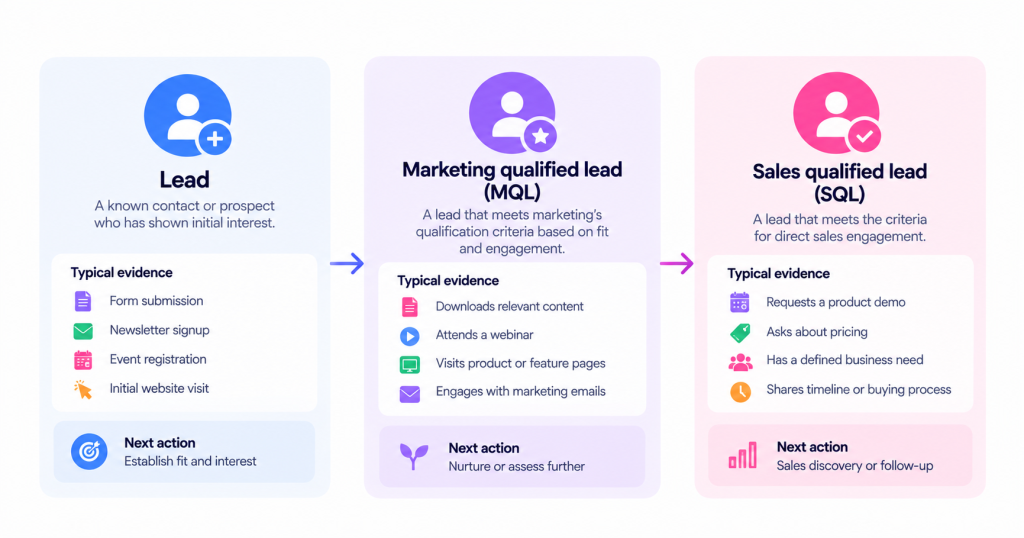
MQL vs. SQL vs. lead
These terms describe different levels of evidence, not three universally fixed CRM statuses.
| Stage | What it means | Typical evidence | Next action |
|---|---|---|---|
| Lead | A known contact or prospect | Signup, form submission, event registration | Establish fit and interest |
| Marketing qualified lead | Meets marketing’s qualification criteria | Relevant profile plus meaningful engagement | Nurture or assess further |
| Sales qualified lead | Meets criteria for direct sales engagement | Defined need, suitable fit, credible buying process | Sales discovery or follow-up |
A lead can become an MQL after showing relevant interest. An MQL can progress to an SQL after demonstrating stronger buying intent and meeting the agreed sales criteria. But a referred buyer who requests a demo may qualify directly for sales without passing through every stage.
The key difference: MQL qualification asks whether a prospect deserves focused marketing attention. SQL qualification asks whether direct sales engagement is justified.
Understanding the B2B sales funnel helps teams align these stages with the actual buying process rather than forcing every buyer into the same sequence.
What makes someone a marketing qualified lead?
There is no universal MQL checklist. A useful definition combines characteristics that indicate potential fit with actions that show meaningful interest.
1. Fit with your ideal customer profile
For B2B marketing, fit can include industry, company size, role, geography, and whether the prospect’s organization has a problem your product solves.
A marketing director at a target SaaS business may be a better fit than a student researching the same topic. Clear B2B customer segmentation helps identify these differences.
Fit should not depend on collecting unnecessary personal information. Use only relevant, appropriate data and apply privacy safeguards.
2. Relevant content engagement
Content downloads, webinars, repeat visits, and email interactions can suggest growing interest. However, not all engagement has the same meaning.
Someone reading a beginner-level article may be learning a concept. Someone repeatedly exploring integration and product-comparison pages may be evaluating options. Consider where each interaction sits among the prospect’s customer journey touchpoints.
3. Product or solution interest
Visiting feature pages, exploring an interactive demo, or starting a trial may indicate that a prospect is moving beyond general education.
These actions can be stronger signals when they happen together, but they should still be interpreted alongside fit and context. Use customer journey analytics to examine sequences rather than isolated clicks.
4. Consistent engagement over time
A return visit after a webinar may matter more than several page refreshes in one session. Recent, varied, and relevant activity often provides a clearer signal than raw event counts.
Behavioral segmentation can help distinguish prospects who repeatedly investigate a solution from those who only consume general content.
5. Absence of disqualifying signals
An active contact may still be a poor fit. Negative indicators can include an unsupported region, irrelevant use case, student inquiry, duplicate record, or an explicit statement that there is no business need.
An MQL definition should explain what disqualifies a lead as clearly as what qualifies one.
Examples of marketing qualified leads
Consider a fictional B2B SaaS company that sells marketing attribution software. It targets established marketing teams that need to connect acquisition channels with CRM outcomes.
| Prospect | Fit | Activity | Classification | Reason |
|---|---|---|---|---|
| Marketing manager at a target SaaS company | Strong | Attends webinar and revisits features | MQL | Relevant profile and repeated interest |
| Student researching attribution models | Poor | Downloads four guides | Not MQL | Engagement without customer fit |
| Revenue operations director | Strong | Requests a demo and shares active evaluation need | Sales review / possible SQL | Direct buying signal |
| Agency owner in a supported market | Strong | Subscribes to newsletter only | Lead / nurture | Insufficient evidence yet |
These are illustrative classifications. Your company may use different thresholds based on its product and sales process.
What this example reveals
A high volume of activity doesn’t guarantee quality. The student is engaged but unsuitable, while the agency owner is potentially valuable but hasn’t demonstrated enough interest. The marketing manager is a promising MQL, and the director may already be ready for sales.
This distinction matters when reviewing lead source tracking: a channel that generates many downloads isn’t necessarily the channel generating the most promising customers.
Drive business growth
with AI-powered analytics
How to identify and qualify MQLs in six steps
A good qualification process is understandable, measurable, and connected to a clear next action.
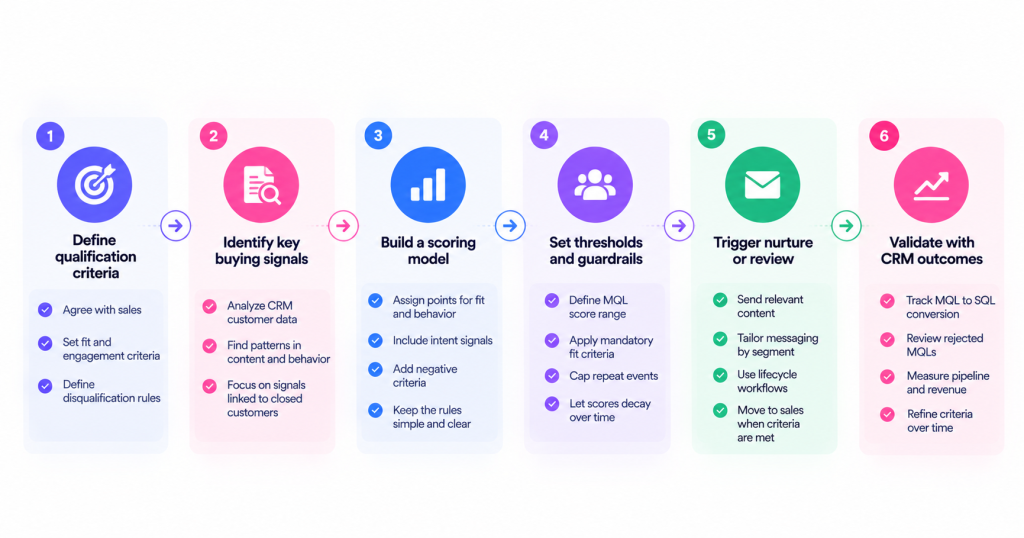
Step 1. Agree on the MQL definition with sales
Write down the minimum criteria a lead must meet, who assigns MQL status, and what happens afterward. Include disqualification rules and a process for reviewing disagreements.
A practical definition might be: A contact from a supported B2B SaaS or agency account, with a relevant role and at least two meaningful engagement signals within 30 days.
That is an example, not a recommended universal threshold. Sales should confirm that the definition reflects the types of prospects it can realistically convert.
Step 2. Identify the signals associated with successful customers
Review CRM history to see what closed-won customers did before qualification. Examine channels, content interactions, product exploration, and the timing of key events.
Don’t assume a popular page is a strong buying signal. Use conversion path analysis to understand which activities tend to appear before meaningful outcomes, while remembering that correlation is not causation.
Step 3. Build a simple scoring model
Assign points for customer fit and behavior, then subtract points for disqualifying or stale signals. Keep the rules explainable.
| Signal | Example points |
|---|---|
| Target industry | +20 |
| Relevant marketing or revenue role | +15 |
| Suitable company size | +10 |
| Attends a product webinar | +10 |
| Revisits feature pages | +10 |
| Views integration information | +15 |
| Requests a demo | +30 |
| Unsupported use case | -30 |
| No meaningful activity for 45 days | -10 |
All point values are illustrative. A simple total can help prioritize leads, but consider tracking fit and intent separately so repeated engagement cannot hide a poor match.
Step 4. Set thresholds and guardrails
A hypothetical process could classify leads below 35 points as unqualified or early-stage, 35–59 as engaged, and 60 or above as MQL candidates.
The threshold should not override mandatory fit requirements. A student who earns points through repeated downloads should not qualify merely by crossing a numerical cutoff.
Also cap repeatable events, define how scores decay over time, and review whether the same person appears in multiple records.
Step 5. Trigger an appropriate nurture or review workflow
An MQL doesn’t always need an immediate sales call. It may need a case study, webinar follow-up, comparison resource, or a request to clarify its needs.
Connect the MQL status with lifecycle marketing so the next message reflects what the prospect already knows. An email marketing funnel can support education and timely follow-up without treating every contact as purchase-ready.
Step 6. Validate the definition against CRM outcomes
Compare MQLs with sales acceptance, opportunity creation, and closed-won revenue. Review rejected MQLs and ask what the scoring process missed.
A useful marketing attribution CRM integration can help connect earlier acquisition activity with later sales outcomes. Revisit qualification rules when your audience, product, or sales motion changes.
How to calculate an MQL score
A basic rule-based score combines positive and negative criteria:
MQL score = Fit points + Engagement points + Intent points − Negative points
Suppose a prospect matches your target industry (+20), holds a relevant role (+15), attends a webinar (+10), revisits a feature page (+10), and has been inactive for a defined period (-10).
20 + 15 + 10 + 10 − 10 = 45 points
If your MQL candidate threshold is 40, this lead qualifies for further marketing review, provided it also meets your mandatory fit requirements.
A score is a prioritization aid, not a prediction of revenue. Treat thresholds as hypotheses to test against real outcomes.
How to nurture MQLs until they’re sales ready
Once someone becomes an MQL, the next step should reflect the prospect’s needs and buying stage.
Match content to the question they’re trying to answer
A prospect researching the problem may benefit from educational examples. Someone comparing solutions may need implementation information, feature comparisons, or proof relevant to their use case.
Use the stages of the customer journey to avoid sending sales-heavy messages too early.
Segment by fit, interest, and behavior
Different MQLs should not receive identical follow-ups. A high-fit lead interested in CRM integration needs different content from someone investigating campaign measurement.
An audience segmentation approach can organize those groups without relying on a single score to describe every need.
Watch for a shift from learning to evaluation
Demo requests, pricing questions, implementation inquiries, and stakeholder involvement can indicate readiness for sales. Review the context and verify the relevant need rather than treating one click as conclusive.
Create a clear marketing-to-sales handoff
When a lead meets the agreed SQL criteria, pass along the relevant context: company fit, stated problem, key interactions, acquisition source, and known next step.
If sales rejects the lead, record the reason and return suitable contacts to nurturing. This creates a feedback loop instead of losing promising prospects.
Which MQL metrics should you track?
MQL volume alone can make a campaign look successful while hiding weak pipeline results. Track the full path from qualification to revenue.
| Metric | Formula or definition | What it tells you |
|---|---|---|
| MQL volume | Count of newly qualified contacts | Qualified demand created |
| Lead-to-MQL rate | MQLs ÷ leads × 100 | How often acquired leads qualify |
| MQL-to-SQL rate | MQLs progressing to SQL ÷ MQL cohort × 100 | Qualification and nurturing effectiveness |
| MQL-to-opportunity rate | MQLs creating opportunities ÷ MQL cohort × 100 | Downstream pipeline quality |
| Cost per MQL | Marketing spend ÷ MQLs | Acquisition efficiency |
| Revenue per MQL | Closed-won revenue ÷ MQL cohort | Financial outcome of qualified demand |
| Time to SQL | Time between MQL and SQL milestones | Qualification speed |
Lead-to-MQL conversion rate
Lead-to-MQL conversion rate = (New MQLs ÷ New leads in the cohort) × 100
If 1,000 leads enter a cohort and 160 qualify as MQLs within the measurement window, the rate is 16%.
MQL-to-SQL conversion rate
MQL-to-SQL conversion rate = (MQLs that become SQLs ÷ MQLs in the cohort) × 100
If 160 MQLs produce 48 SQLs, the rate is 30%. For a meaningful result, define the cohort and allow enough time for leads to progress.
Cost per MQL
Cost per MQL = Attributed marketing spend ÷ MQLs generated
If a campaign costs $12,000 and produces 80 MQLs, the cost per MQL is $150. This can help compare campaigns, but a lower cost isn’t necessarily better if those MQLs rarely become customers.
What is a good MQL conversion rate?
There is no universal benchmark. A strict MQL definition may produce fewer MQLs but stronger progression to sales. A looser definition may inflate volume while reducing acceptance and opportunity rates.
Compare like-for-like cohorts, acquisition channels, and customer segments. Review B2B sales funnel conversion rates with consistent stage definitions, and use downstream outcomes as the deciding measure.
Why MQLs sometimes fail to become SQLs
Several issues can make a healthy-looking MQL count misleading.
- Engagement is mistaken for purchase intent
A lead who reads ten articles may still be researching.
What helps: require relevant fit and distinguish educational behavior from active evaluation.
- The scoring model rewards repeated low-value actions
Unlimited points for visits or opens can push the wrong people above the threshold.
What helps: cap repeat events, use negative criteria, and test score bands against real sales outcomes.
- Marketing and sales use different definitions
Marketing may classify webinar attendees as MQLs while sales expects a confirmed project.
What helps: agree on criteria and review rejection reasons together.
- Poor tracking creates misleading signals
Duplicate contacts, missed events, or inconsistent identities can distort qualification.
What helps: audit conversion tracking and data quality before adjusting the model.
- Nurturing doesn’t match the prospect’s needs
Generic email sequences can ignore the reason a prospect became interested.
What helps: use relevant content and review where people stop progressing through the conversion funnel.
- Campaigns are optimized only for cheap leads
Low cost per lead can hide poor-fit audiences.
What helps: compare cost per MQL with opportunities, pipeline, and revenue rather than treating initial acquisition cost as the final measure.
How Usermaven helps connect MQLs with pipeline and revenue
Generating MQLs is useful, but marketing still needs to know which channels attract promising prospects and which of those prospects eventually create pipeline.
Usermaven is an AI-powered marketing attribution platform that connects marketing spend and customer journeys with conversions, CRM outcomes, pipeline, and revenue. It complements MQL scoring and lifecycle management in your CRM rather than replacing them.
See which acquisition channels contribute to qualified demand
Consider two fictional campaigns with the same spend:
| Metric | Campaign A | Campaign B |
|---|---|---|
| Spend | $5,000 | $5,000 |
| Leads | 250 | 100 |
| MQLs | 50 | 35 |
| SQLs | 8 | 14 |
| Cost per MQL | $100 | $143 |
Campaign A produces cheaper MQLs. Campaign B produces more SQLs. Looking only at MQL cost would miss that distinction.
Usermaven’s pipeline attribution helps teams connect marketing activity with CRM outcomes and evaluate which sources contribute to valuable pipeline.
Understand the journey before qualification
A prospect might discover your brand through organic search, return through a paid campaign, and request a demo after viewing several product pages. With user journeys and funnels, teams can investigate the interactions and drop-offs that precede conversion.
These insights can help marketing improve the paths that produce promising leads, although they do not by themselves prove why someone converted.
Connect marketing touchpoints to later revenue
Usermaven’s full-funnel revenue attribution connects acquisition activity with downstream CRM results, so marketers can look beyond form fills and MQL totals.
With multi-touch attribution, teams can examine how different marketing interactions contribute along a buying journey rather than assigning all credit to one visit.
Drive business growth
with AI-powered analytics
Final thoughts
A marketing qualified lead is not simply someone who engaged with your content. It’s a prospect whose fit and behavior meet a documented standard for focused marketing attention.
Start with a clear definition, score only meaningful signals, and agree with sales on what happens next. Then judge your MQL program by opportunity creation and revenue, not by the number of contacts crossing a threshold.
Usermaven helps teams connect marketing activity with the CRM outcomes that matter. To see how your campaigns contribute to qualified pipeline and revenue, book a demo.
FAQs
What is a marketing qualified lead?
A marketing qualified lead (MQL) is a prospect that meets marketing’s agreed criteria for customer fit and meaningful interest. MQLs are typically more promising than ordinary leads but may still need nurturing or additional qualification before sales outreach.
What is the difference between an MQL and an SQL?
An MQL meets marketing qualification criteria, usually based on fit and engagement. An SQL meets the requirements for direct sales engagement. The precise handoff depends on how the organization defines and manages its sales process.
Is downloading an ebook enough to become an MQL?
Not necessarily. A download is an engagement signal, but the contact may be a poor customer fit or only conducting general research. Most useful definitions combine behavior with relevant profile information and other qualifying evidence.
How do you calculate MQL conversion rate?
Divide the number of leads that became MQLs by the total leads in the same cohort, then multiply by 100. If 80 of 500 leads qualify, the lead-to-MQL conversion rate is 16%. Specify the qualification window so comparisons remain consistent.
How many points should an MQL have?
There is no standard point threshold. A business might set a threshold of 40, 60, or another value depending on its scoring rules. Validate the threshold against sales acceptance, opportunity creation, and closed-won outcomes rather than choosing a number arbitrarily.
Can an MQL skip the SQL stage?
A lead may move directly to sales review without first being labeled an MQL, especially after a referral or explicit demo request. Whether it receives SQL status depends on the company’s criteria. Lifecycle stages should describe the real buying process, not force every prospect through identical steps.

Written by
Imrana Essa
SaaS Marketing Lead
Imrana Essa is a marketing lead and content strategist with 8+ years of experience creating and leading content for B2B and SaaS brands. She specializes in marketing analytics, attribution, content strategy, and organic growth, translating complex marketing concepts into clear, actionable insights. Her work focuses on helping marketers understand performance, make data-informed decisions, and build strategies that contribute to sustainable growth.
All articles by Imrana →