A sales funnel shows how potential customers move from discovering a business to making a purchase. It gives marketing and sales teams a shared way to understand buyer progress, recognize where qualified prospects stop moving forward, and decide what to improve.
For a SaaS company, that journey might begin with a search result, continue through a guide and demo, and end with a signed subscription. An ecommerce business may have a much shorter path from product discovery to checkout. The stages differ, but the question is the same: what helps interested people become customers?
This guide explains the stages of a sales funnel, how to build one, and the metrics that show whether it works. It also distinguishes the sales funnel from a marketing funnel and a CRM pipeline, so each team measures the right thing.
Key takeaways
- Purpose: A sales funnel makes the path from initial awareness to purchase measurable, without assuming every buyer follows the same route.
- Stages: A practical B2B model moves through awareness, interest, consideration, qualification, opportunity, and purchase. Your CRM may use fewer or different stages.
- Execution: Define your audience and stage criteria, create relevant content and conversion points, and set clear handoff responsibilities.
- Measurement: Track stage conversion, qualified pipeline, win rate, sales cycle length, and revenue rather than celebrating lead volume alone.
- Diagnosis: A drop-off identifies where to investigate. It does not, by itself, explain why prospects stop or prove that one change will fix it.
- Attribution: Funnel analysis tracks stage progression; marketing attribution evaluates how touchpoints contribute to selected conversion outcomes.
What is a sales funnel?
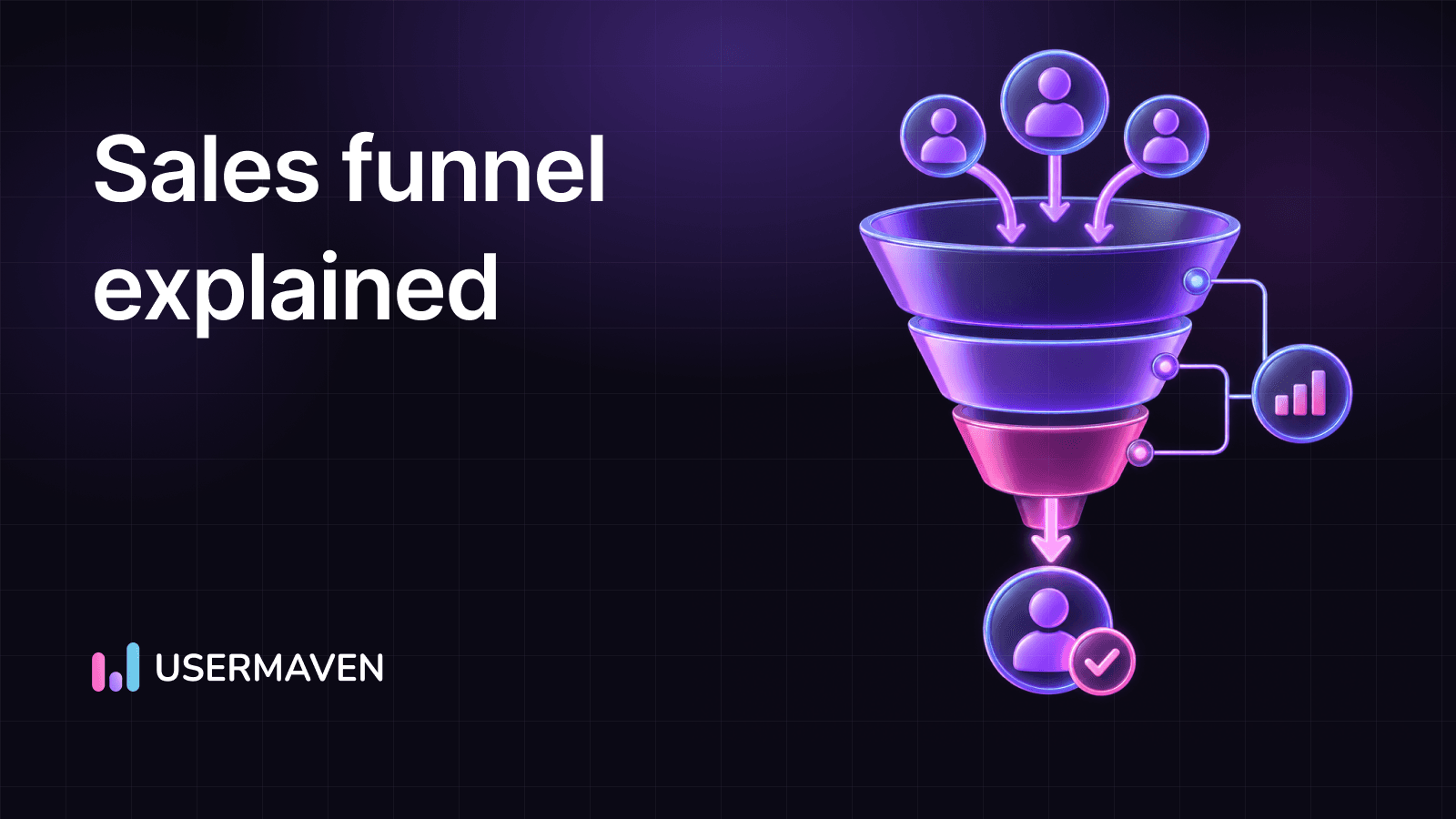
A sales funnel is a model of the steps people take before they become customers. It usually starts with a large audience of people who are aware of a problem or solution and narrows as fewer prospects express interest, qualify, evaluate an offer, and purchase.
The funnel shape is a useful illustration, not a promise that every buying journey is linear. People compare options, return through different channels, involve colleagues, or skip steps. A good funnel makes those patterns measurable rather than forcing everyone into one idealized path.
Consider a reporting-software company. A potential buyer reads a blog post, later visits the pricing page, books a demo, involves a finance colleague, and eventually signs a contract. The company can observe relevant actions and CRM milestones to evaluate how the opportunity progressed.
Why it matters: Teams use the funnel to identify useful conversion points, coordinate marketing and sales activities, estimate pipeline movement, and prioritize improvements. The model is most useful when each stage has an objective entry rule rather than a vague label such as “warm lead.”
How does a sales funnel work?
A sales funnel works by defining meaningful milestones and measuring how many eligible prospects reach the next one. At an early stage, the business earns attention. Later, prospects seek evidence, evaluate fit, engage with sales, and decide whether the offer solves their problem.
For marketing-led journeys, those milestones might be a relevant landing-page visit, an ebook request, and a trial signup. For a sales-assisted B2B company, the milestones may include lead creation, accepted qualification, opportunity creation, proposal, and closed-won status.
Funnels are not the entire customer journey: They intentionally simplify a complex series of interactions into a set of checkpoints. A broader customer journey funnel can include onboarding, product adoption, renewal, and advocacy after the sale.
Stage ownership matters: Marketing commonly owns audience development and early lead generation. Sales or revenue operations may own qualification, opportunities, and close. The handoff should be explicit so a lead is not counted as sales-ready simply because someone downloaded a guide.
Data needs context: A person viewing a pricing page may be a serious prospect, an existing customer, a competitor, or a researcher. Combine behavioral signals with appropriate fit criteria and CRM context before treating activity as purchase intent.
What are the main stages of a sales funnel?
There is no single mandatory number of sales funnel stages. The familiar AIDA framework describes awareness, interest, desire, and action. Businesses with consultative sales often add qualification and opportunity milestones, while ecommerce teams may use product view, cart, checkout, and purchase.
The following six-stage model is a practical example for a business that needs both marketing and sales involvement. For a deeper comparison of different models, see the guide to types of sales funnels.
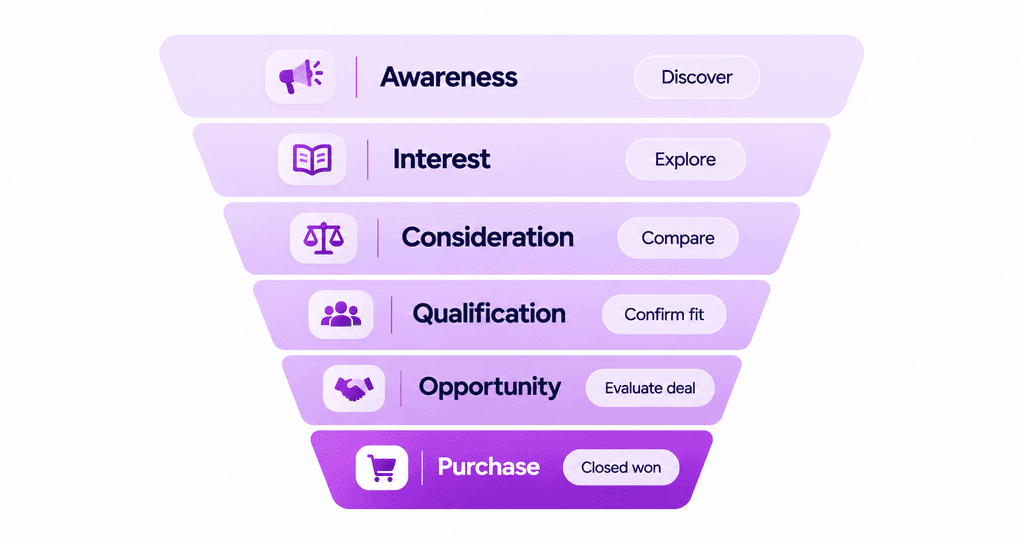
1. Awareness: The prospect discovers a problem or solution
People first encounter the company through search, advertisements, social posts, referrals, communities, or events. They may not know the product category or be ready to discuss purchasing anything.
Useful actions: Publish educational content, explain the problem clearly, and make it easy for relevant visitors to discover the solution. Measure qualified visibility and engagement without assuming that every visit represents a lead.
2. Interest: The prospect explores possible approaches
Interested prospects read more content, attend webinars, subscribe to updates, or explore the product website. They begin connecting the offer to a problem they recognize, but they may still be researching alternatives.
Useful actions: Provide practical guides, product explanations, and examples. Track meaningful content engagement and voluntary lead conversions instead of treating every pageview as equivalent interest.
3. Consideration: The prospect evaluates options
Buyers compare features, implementation effort, pricing, security requirements, support, and expected business value. A relevant case study or transparent comparison may answer questions that general awareness content cannot.
Useful actions: Make capabilities, constraints, and commercial terms easy to assess. Demo requests and trial starts may signal deeper intent, but they are not automatically qualified opportunities.
4. Qualification: The team establishes fit and readiness
A lead becomes meaningful to the sales process when it meets agreed criteria. Those criteria may involve company profile, use case, authority, need, implementation timing, or readiness to discuss a purchase.
Useful actions: Define MQL and SQL criteria jointly with sales. Record the qualification decision and its date in the CRM. Different organizations use MQL, SAL, and SQL differently, so document the exact definitions rather than assuming universal labels.
5. Opportunity: A commercial evaluation is underway
A qualified prospect enters a defined deal process. In B2B, this may involve several people, an implementation review, procurement, a proposal, or legal and security approval. The opportunity can stall, reopen, or close without a purchase.
Useful actions: Track opportunity creation, stage movement, deal value, and reasons for loss. In account-based sales, distinguish an individual contact from the company-level opportunity to prevent counting one account as several separate deals.
6. Purchase: The prospect becomes a customer
The final commercial milestone is a completed transaction, signed agreement, or recorded closed-won deal. The definition should match the business model: a paid subscription, a confirmed order, or a contract meeting the organization’s revenue rules.
Useful actions: Measure closed-won conversion and actual revenue, then hand the customer to onboarding. Retention and expansion follow the sale and belong to the wider customer lifecycle, even when a business reports them alongside the funnel.
How to build a sales funnel step by step
A useful funnel begins with clearly defined buyer actions and measurable outcomes, not with an attractive diagram. The process below works for both self-serve products and sales-assisted businesses, but the stage rules should reflect the actual purchasing process.
Step 1: Define the customer and the purchase outcome
Specify who the product is designed for, the problem they are trying to solve, and what counts as a completed sale. A B2B analytics product might target growth teams and count a signed contract as the primary outcome. A store might count a paid order.
Document: Ideal customer profile, offer, major purchase objections, primary conversion, and the owner accountable for the outcome. Keep the initial definition narrow enough that different teams interpret it consistently.
Step 2: Map the journey using actual evidence
Review sales conversations, website behavior, support questions, CRM histories, and existing conversion reports. Identify the actions customers typically take before buying, then group them into a small number of useful stages.
Do not assume that an ideal path is the most common path. Buyers may read educational content and then contact sales directly, or enter through a recommendation and skip early discovery pages.
Step 3: Create stage-specific content and conversion points
Match each stage to its questions. Early prospects need useful education. Evaluating buyers may need product tours, comparisons, security details, case studies, pricing explanations, or a demo.
Where capturing details is appropriate, digital forms can collect contact and qualification information for demo requests or sales inquiries. Keep fields proportionate to the decision and explain how submissions will be used.
Avoid unnecessary friction: A prospect viewing a basic checklist should not have to complete an enterprise procurement questionnaire. More detailed forms can be appropriate later, when there is a clear sales-related reason to ask for additional information.
Step 4: Set measurable milestones and CRM definitions
Decide exactly which events or CRM changes mean a prospect has entered or completed each stage. For example, a demo booking may be a website event, while SQL acceptance or opportunity creation is usually a CRM milestone.
Create a shared definition sheet containing stage name, eligibility rule, owner, data source, timestamp, and next expected action. This prevents marketing reports from using a different definition of “qualified lead” than the sales pipeline.
For a deeper tracking implementation, the sales lead tracking guide explains why clear lead records matter once inquiries begin moving between teams.
Step 5: Connect the systems that hold the journey
A modern sales funnel may span website analytics, product events, forms, email systems, the CRM, and billing. Connect only the data needed to answer your business questions, with suitable permissions and reliable identifiers.
Pay particular attention to deduplication. A person may submit two forms or use several devices, while multiple employees may participate in one account’s purchase. Choose whether a metric is counting visitors, leads, contacts, accounts, or opportunities.
Step 6: Assign handoffs and follow-up responsibilities
A funnel is incomplete if a qualified inquiry arrives but nobody owns the next action. Agree when marketing hands a prospect to sales, how quickly the team should respond, and which event records acceptance or rejection.
Use your CRM or engagement system for follow-up workflows. Analytics may identify eligible audiences and performance patterns, but reporting software is not automatically the tool that sends sequences or manages seller tasks.
Step 7: Review performance and improve one bottleneck at a time
Start with stage-level progression, conversion timing, lead quality, and closed-won outcomes. If many qualified leads fail to become opportunities, review handoff and sales notes before changing an unrelated landing page.
Run a testable improvement: State the suspected issue, collect supporting evidence, choose a change, and evaluate a defined outcome. Review enough comparable time and volume to avoid reacting to normal fluctuations.
Sales funnel examples for different businesses
The same funnel concept can describe different buying processes. These two examples are illustrative workflows, not customer case studies or claims about real performance.
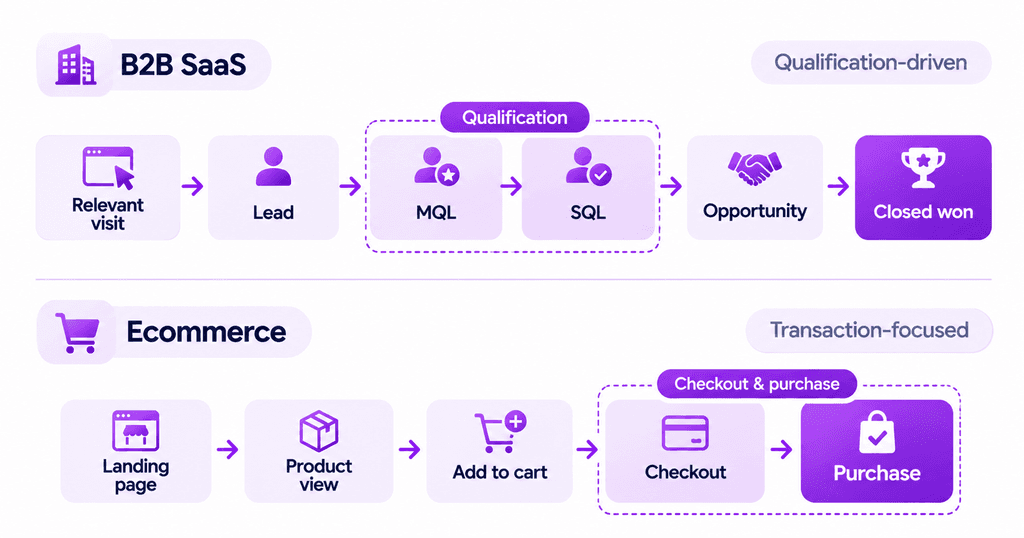
Example 1: A B2B SaaS sales funnel
Imagine a reporting platform selling to mid-market finance teams. Someone discovers the product through organic search, reads an implementation guide, and registers for a webinar. A sales development representative qualifies the account before a demo and opportunity are created.
The stages could be relevant visit → lead → MQL → SQL → opportunity → closed won. A single account might involve a technical evaluator, budget owner, and executive sponsor. Reporting must avoid treating those people as three separate opportunities.
This example is especially useful for b2b sales funnel planning, because qualification and deal progression may take weeks or months after the original website visit.
Example 2: An ecommerce purchase funnel
An online shopper clicks an advertisement, views a product, adds it to the cart, begins checkout, and purchases. The journey is generally more transaction-focused, so tracking often centers on product views, cart creation, checkout starts, payments, and completed orders.
The stages could be landing page → product view → add to cart → checkout → purchase. A purchase may happen on the first visit, while another buyer leaves and returns through email or search. Both journeys need sensible conversion windows.
The dedicated ecommerce conversion funnel guide covers this shorter, behavior-led model in more detail. For a broad sales-funnel explainer, it is enough to show how the stages adapt to a different business.
Sales funnel vs. marketing funnel vs. sales pipeline
These terms overlap in everyday conversation, but they answer different questions. Defining them clearly is especially important when a team connects marketing analytics with CRM reporting.
| Framework | Main purpose | Typical measurement |
|---|---|---|
| Marketing funnel | Move an audience from awareness toward lead or purchase intent | Reach, engagement, campaign conversions, leads |
| Sales funnel | Describe prospect progression toward a purchase | Stage conversion, qualification, win rate, revenue |
| Sales pipeline | Organize open opportunities and sales activities | Opportunity count, value, stage aging, forecast |
| Customer journey funnel | Examine progression across a wider customer lifecycle | Acquisition, activation, retention, expansion |
Sales funnel vs. pipeline: A funnel measures conversion between stages for a defined group. A pipeline is usually a working CRM view of current deals, their values, owners, and actions needed to close them. You can use both on the same deals without treating them as identical reports.
Marketing funnel vs. sales funnel: Marketing often influences awareness and qualification, while sales handles later conversations and opportunities. The handoff depends on the business model. A self-service SaaS purchase may happen without direct sales involvement at all.
For more context on how acquisition touchpoints fit into the wider lifecycle, see marketing funnel vs customer journey.
How to measure sales funnel performance
The value of a funnel comes from comparing clearly defined groups over time. Before calculating performance, specify the population, time window, stage ordering, and whether the unit is a visitor, person, account, or opportunity.
| Metric | Calculation or interpretation | Why it matters |
|---|---|---|
| Visitor-to-lead rate | Leads generated ÷ eligible visitors × 100 | Indicates early conversion effectiveness |
| MQL-to-SQL rate | MQLs that become SQLs ÷ eligible MQL cohort × 100 | Indicates qualification and handoff quality |
| Stage conversion rate | Entities reaching next stage ÷ entities entering previous stage × 100 | Identifies progression bottlenecks |
| Opportunity win rate | Closed-won opportunities ÷ all closed opportunities × 100 | Measures completed deal outcomes |
| Sales cycle length | Time from defined starting milestone to closing | Indicates velocity and sales-process delays |
| Customer acquisition cost | Eligible sales and marketing acquisition cost ÷ new customers | Provides commercial efficiency context |
Compare like with like: If an MQL enters a 90-day sales cycle, a weekly dashboard may mark it as unconverted long before the opportunity has had a fair chance to close. Use sufficiently mature cohorts or a consistent observation window.
Watch the denominator: An opportunity win rate based only on closed deals differs from a conversion rate based on all newly created opportunities. Both can be useful, but mixing them will create misleading comparisons.
Look beyond lead quantity: A campaign that produces fewer inquiries can still create more qualified opportunities. For a detailed treatment of stage-level calculations, see b2b sales funnel conversion rates and the funnel analysis guide.
Funnel analysis and attribution answer different questions
Funnel analysis shows how people or accounts progress through defined checkpoints. Marketing attribution evaluates which recorded acquisition and marketing touchpoints receive credit for selected conversion outcomes, according to a chosen model.
Neither view automatically proves that a campaign caused a sale. Deal reviews, user research, tracking checks, and sometimes controlled experiments are needed to assess alternative explanations or incremental impact.
How to improve a sales funnel
Start by finding the biggest meaningful gap, then investigate its likely causes. A large drop-off is a prompt to examine behavior and operations, not immediate proof that the page, offer, or salesperson at that stage is responsible.
Attract relevant prospects: If traffic grows but qualified lead volume is flat, review the audience and message, not just the page headline. Compare channels using lead quality and downstream pipeline instead of clicks alone.
Reduce friction at high-intent steps: If demo-booking visitors abandon the form, investigate technical errors, unclear expectations, and unnecessary fields. Validate the actual problem before removing information needed for qualification.
Strengthen the sales handoff: When MQLs rarely become SQLs, inspect acceptance rules, response times, duplicate records, and whether sales can see the prospect’s previous activity. The issue may be operational rather than marketing-related.
Make evaluation easier: If qualified opportunities stall, collect reasons from lost and inactive deals. Buyers may need an ROI explanation, implementation scope, security answers, or clearer pricing rather than a new advertising campaign.
Test and revisit: Choose one hypothesis, establish the success metric, run an appropriate test, and monitor downstream effects. Better form completion is not automatically better revenue if the added leads are poorly qualified.
For step-specific optimization methods, the conversion funnel optimization guide goes deeper into diagnosis and testing.
Common sales funnel mistakes
Treating every visitor as a lead: Pageviews reveal interest in content, not necessarily commercial readiness. Reserve lead and qualification stages for observable events and agreed definitions.
Changing stage definitions mid-report: If SQL criteria change, week-to-week comparisons become unreliable. Record effective dates and evaluate whether historical results are still comparable.
Counting individuals and accounts interchangeably: B2B purchases often involve several contacts. Decide when to use person-level funnels and when the company or opportunity is the correct unit.
Ignoring untracked steps: Offline conversations, CRM changes, and contracts may happen outside the website. Incomplete instrumentation can make an otherwise healthy funnel appear broken.
Assuming all drop-offs are failures: Some prospects are not a fit, and qualification should filter them out. High early-stage conversion is less valuable if it overwhelms sales with unsuitable inquiries.
Confusing attribution with causality: A channel receiving model-based credit does not necessarily mean the purchase would not have happened without it. Explain model assumptions when using attributed pipeline or revenue.
How Usermaven connects marketing to the sales funnel
Usermaven is marketing attribution software that combines acquisition measurement with customer journeys, conversion goals, funnels, and CRM-connected pipeline analysis. Its role is to help teams observe and interpret progression, not to replace a CRM or run every sales follow-up.
Measure progression: Usermaven’s funnel analytics software supports page and event steps, optional steps, sequential or strict order, conversion windows, and user- or company-level analysis. These definitions matter when a B2B deal includes multiple contacts.
Connect downstream outcomes: With appropriately configured event sources and CRM connections, teams can include qualifying activities and opportunity milestones alongside website interactions. Usermaven’s pipeline attribution view helps assess which recorded marketing channels contribute to opportunities and closed revenue.
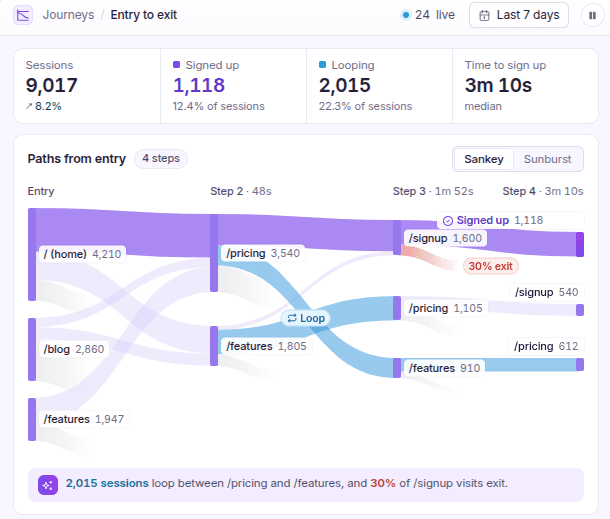
Investigate journeys: The platform’s customer journey analytics software can provide additional context around recorded touchpoints before a conversion. That can help teams assess whether campaigns produce traffic, qualified inquiries, or stronger pipeline outcomes.
Analyze changes with Maven AI: Maven AI supports analytics investigation and reports. Usermaven’s 2026 releases also added recurring Agents and options to save AI-generated charts and reports to dashboards, making findings easier to review with stakeholders.
These capabilities still depend on accurate tracking, identity configuration, CRM event mapping, and consistent stage definitions. Funnel reports show observed progression, while attribution reports apply a model to the recorded touchpoints.
If the goal is to connect campaigns to qualified pipeline rather than count leads alone, Book a demo to discuss the relevant funnel and attribution setup.
Build a funnel that measures what matters
A sales funnel is most useful when it reflects real buyer milestones and produces decisions. Define each stage clearly, connect the systems that record it, and measure qualified progression rather than treating traffic or form submissions as the final goal.
Review drop-offs alongside CRM context, customer feedback, and actual revenue. That combination makes the funnel a practical framework for improving how prospects become customers, instead of just a diagram of an ideal purchase path.
FAQs about sales funnels
1. What is a sales funnel in simple terms?
A sales funnel is a model showing how people move from discovering a business toward purchasing from it. Each stage describes a meaningful level of interest, qualification, or commercial progress, and the business measures how many prospects advance.
2. What are the four stages of a sales funnel?
The four-stage AIDA model uses awareness, interest, desire, and action. Many modern businesses add stages for consideration, qualification, opportunities, or purchase because their buying processes need more detailed measurement.
3. How do I create a sales funnel for a small business?
Start with one clear customer type and purchase outcome. Identify how buyers discover you, what information they need, how they contact you, and what constitutes a sale. Track a few meaningful stage conversions before adding complexity.
4. What is the difference between a sales funnel and a sales pipeline?
A funnel examines how a population converts between stages. A pipeline organizes current deals, their values, owners, and next actions. Both describe the sales process, but they are designed for different reporting and operational questions.
5. Can a sales funnel work for B2B and ecommerce?
Yes. B2B funnels often involve qualification, demos, multiple stakeholders, and CRM opportunity stages. Ecommerce funnels typically focus on product discovery, cart, checkout, and purchase events. Use stage definitions suited to the buying model.
6. What is a good sales funnel conversion rate?
There is no universal rate. Results depend on the stage, customer type, offer, acquisition source, buying cycle, and how conversions are counted. Compare consistent cohorts over time and evaluate lead quality and closed revenue alongside percentages.
7. Which tools are needed to track a sales funnel?
Most teams need reliable website or product event tracking, conversion goals, and a CRM for sales-assisted deals. Depending on the journey, marketing attribution and funnel analytics can connect earlier interactions to later outcomes. See funnel analysis tools for a software comparison.
Updated

Written by
Adeel Khan
Growth Marketing Expert
Adeel Khan is a full-stack SaaS marketer with 10+ years of experience in content marketing, paid advertising, analytics, and conversion rate optimization. He shares practical insights and strategies drawn from hands-on experience, helping B2B SaaS marketers improve performance and make better marketing decisions.
All articles by Adeel →