The gap between signing up and getting value is where onboarding starts to matter.
The goal is not to give users more steps, but to lead them through the right ones without losing momentum.
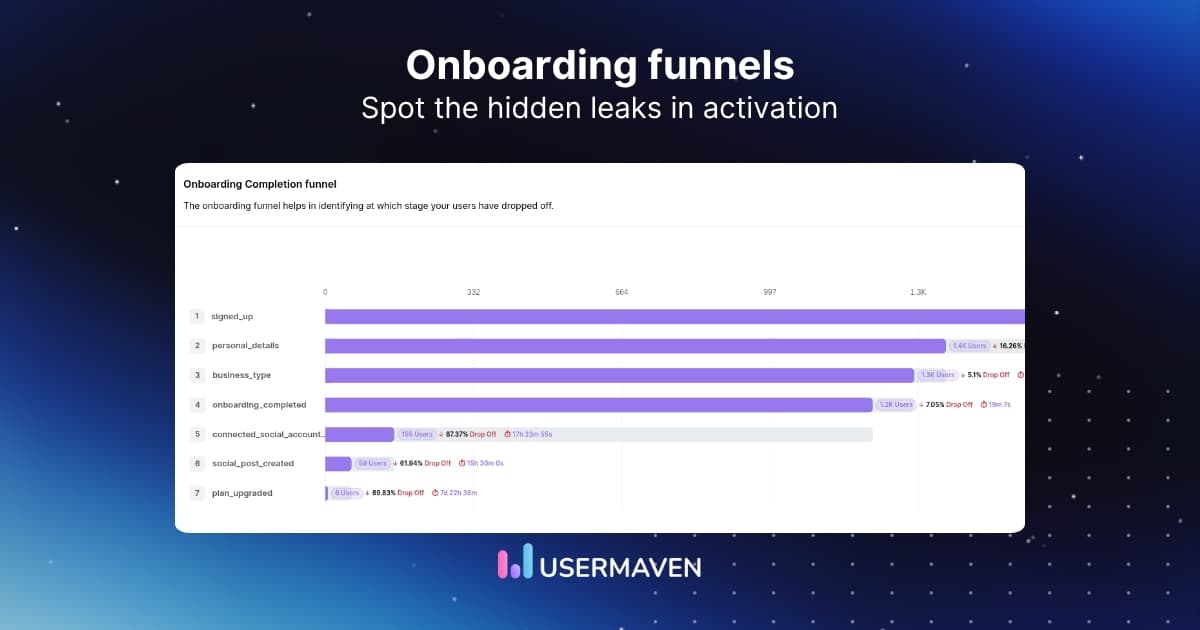
An onboarding funnel helps you see that sequence more clearly. It shows how users move through the key steps that lead to user activation.
In this blog, we will cover what onboarding funnels are, how to create one, and a few examples you can learn from.
What is an onboarding funnel?
An onboarding funnel is the sequence of steps users move through after signing up as they get closer to experiencing value. It turns early product activity into a path you can actually follow.
Instead of looking at onboarding as one broad phase, the funnel breaks it into key actions. That might include creating an account, completing setup, inviting a teammate, or reaching a first meaningful outcome.
The goal is not to count every click. It is to understand how users move through onboarding and how that movement brings them closer to value.
That is what makes funnel analysis useful. When the steps are clearly defined, you can see where users are progressing, where momentum starts to fade, and how the path through onboarding is actually unfolding.
Why an onboarding funnel is worth building
Once onboarding is mapped as a real sequence, a few things become much easier to see:
- Clearer visibility into user behaviour: Shows how users actually move through the early product experience step by step.
- Stronger conversion analysis: Reveals where users keep moving, where they hesitate, and which steps are shaping progress.
- A better read on product onboarding: Helps you view onboarding as a connected flow rather than a scattered set of actions.
- Higher conversions: Removes friction from the steps that matter most, helping more users reach activation.
- Easier identification of drop-offs: Highlights where users leave the flow, so improvement areas are easier to pinpoint.
- Better personalization opportunities: Helps you adapt onboarding around the actions, needs, and behaviour of different users.
Onboarding funnel metrics to track
To understand whether your user onboarding funnel is actually guiding users forward, you need to track user onboarding KPIs that show where progress is happening and where it starts to slow.
- Signup-to-activation rate: Shows how many users make it from account creation to the point where they reach meaningful value.
- Step-by-step conversion rate: Measures how many users move from one onboarding stage to the next, which makes progression easier to evaluate.
- Drop-off rate: Highlights the stages where users are leaving the funnel before completing the next key action.
- Time to value: Tracks how long it takes users to reach their first meaningful outcome after signing up.
- Onboarding completion rate: Shows how many users finish the core onboarding flow you have defined.
- Feature adoption: Measures how many users engage with the features that matter most during early product onboarding.
- User activation rate: Tracks the percentage of users who complete the actions tied to activation in your product.
- Session frequency during onboarding: Helps you understand how often users return while moving through the onboarding process.
- Support or assistance usage: Reveals where users may need extra help through chat, docs, walkthroughs, or support tickets during onboarding.
How to build an onboarding funnel that is actually useful
If you want your onboarding funnel to be useful, start with a structure you can actually learn from.
Using Usermaven as an example, here is a simple way to build that funnel step by step.
Step 1: Define the stages that signal real progress

Start by choosing the steps that represent real movement through onboarding. These should be actions that show progress, not just activity.
That usually means moving from signup into setup, early product use, onboarding completion, and the first meaningful outcome.
If the stages are too broad, the funnel stays vague. If they are too granular, it becomes harder to read.
Step 2: Build the funnel around a clear progression

Next, set up the funnel around the actual onboarding flow. That includes adding the key steps, choosing the right order, and setting the funnel window.
This part shapes how the funnel will be read. A clearer setup gives you a more useful view of completion.
From there, arrange the steps in the same order users are expected to move through them. That way, the funnel reflects the real onboarding flow instead of a simplified version of it.
Step 3: Look closely at where users start dropping off

Once the funnel is live, the first thing to look for is the step where progress breaks. That point usually tells you more than the overall completion rate.
A large drop-off around setup, or account connection, often signals friction, hesitation, or a step that is asking for too much too early. This is where onboarding funnel analysis starts becoming actionable.
Step 4: Measure time to convert between key steps

Conversion timing adds another layer to funnel analysis. It shows how much time users spend moving from one step to the next across the funnel.
That gives you a better read on the pace of the funnel. When one stage takes longer than expected, it usually points to friction, uncertainty, or a flow that is no longer feeling as clear as it should.
Step 5: Use AI funnel analysis to speed up the read

Once the funnel has enough data, AI funnel insights can help surface patterns that are easy to miss in manual review. That might include the biggest drop-off step, unusually weak conversion rates, or channels that are bringing in lower-quality progression.
This is useful because it shortens the time between seeing the numbers and understanding what they mean. Instead of just reporting the funnel, you start getting clearer direction on where to investigate first.
💡Quick note: In more advanced setups, modern data architecture services can support the data flow that makes this kind of analysis more reliable.
Turn visitors into paying
customers with funnel analysis
Onboarding funnel examples and templates
There is no single version of a good onboarding funnel. The right one depends on what users need to do early, how quickly they can reach value, and what kind of product you are guiding them into.
What matters is having a funnel that reflects real progress. The examples below give you a few practical starting points, along with simple onboarding funnel templates you can adapt to your own onboarding flow.
Self-serve SaaS onboarding funnel
This is the classic product-led setup. A user signs up, moves through setup, tries a core feature, and reaches a first meaningful outcome without needing much human help.
It works best when the product is easy to start using, and the path to value can be made clear inside the interface.
Template:
Signup → Email verification → Workspace or account setup → First core action → Activation milestone
Freemium onboarding funnel
Freemium onboarding has a slightly different job. It needs to help users get value with the free version while also creating a natural path toward paid expansion.
That makes the funnel more layered.
You are not just guiding usage. You are also watching for the moments that signal readiness for an upgrade.
Template:
Signup → Basic setup → First feature use → Repeat usage → Limit reached or premium need identified → Upgrade
Related: Paid vs. free user behavior
B2B team onboarding funnel
A B2B onboarding funnel usually involves more than one person and more than one step of setup. There may be an admin, invited teammates, permissions, or workflows that need to be configured before the product starts feeling useful.
That is why this kind of funnel needs to reflect group progress, not just individual activity.
Template:
Signup → Account setup → Team invite → Integration or data connection → Shared usage begins → Activation milestone
In-app onboarding funnel
An in-app onboarding funnel focuses on what happens inside the product after a user gets access. For teams that also need reusable step-by-step tutorials outside the product, iorad alternatives can extend that guidance into shareable training and support content.
The goal is to help users build momentum without making the experience feel heavy. A good in-app funnel should move them toward action, not just exposure.
Template:
Signup or login → Welcome flow → Guided setup → First in-app action → Key feature use → Activation milestone
Mobile app onboarding funnel
Mobile app onboarding usually has less room for error. The screen is smaller, attention is shorter, and users will leave quickly if the first few steps feel unclear or too demanding.
That makes simplicity even more important. A strong mobile funnel should reduce effort, shorten the path, and help users reach value without too much friction upfront.
Template:
App install → Account creation → Permissions or preferences → First core action → Repeat session → Activation milestone
Ecommerce onboarding funnel
In ecommerce, onboarding often means helping a user move from first visit or sign-up into a purchase-ready state. That could involve account creation, browsing, wishlisting, personalization, or adding a first item to the cart.
The exact flow depends on the store, but the principle stays the same. The funnel should reflect the steps that move a shopper closer to buying with confidence.
Template:
Signup or first session → Category or product view → Product saved or added to cart → Checkout started → Purchase completed
How Usermaven helps you track and improve onboarding funnels
Usermaven is an advanced marketing attribution tool with a broader analytics layer that helps you understand how users arrive, how they behave, and how they move toward conversion. That makes it especially useful for onboarding funnels, where progress is shaped by more than just what happens inside the flow.

With Usermaven, onboarding funnel data becomes easier to read in context. You can use it to answer questions like:
- Where are users dropping off? Funnel analysis helps you see which onboarding steps users complete and where the flow starts losing momentum.
- How are users actually moving through onboarding? User journeys and path analysis help you understand the routes users take instead of relying on the ideal path.
- Which actions signal real progress? Event tracking helps you define the onboarding steps that matter and measure them more clearly.
- Which channels are bringing users into the funnel? Ad Attribution software gives you a better view of the campaigns and sources contributing to new signups.
- How does website behaviour connect to product onboarding? Combined website and product analytics help you see how pre-signup activity and in-product actions fit into one path.
- How are different user segments moving through the funnel? Segments help you compare onboarding performance across user types, traffic sources, plans, or behaviours.
- What should you investigate first? AI funnel analysis helps surface patterns, weak points, and shifts in funnel performance faster.
That gives you a clearer way to evaluate onboarding funnels as a whole. You can read the funnel more clearly, understand what is influencing it, and make better decisions about where to focus next.
Final thoughts
The strongest onboarding funnels create direction early. They make the next step feel obvious, the experience feel clear, and the path to value easier to follow.
Usermaven brings more context to how you read that performance. It helps you understand which campaigns and channels are contributing to the signups entering your funnel. That makes it easier to connect onboarding performance to the paths users took before they ever reached the product.
Ready to see Usermaven in action? Explore the platform or book a demo for a closer look.
FAQs about onboarding funnel
1. What is an app onboarding funnel?
An app onboarding funnel tracks how users move through the first important steps inside an app, from install or signup to activation. It helps you understand whether the early experience is clear enough to keep users moving.
2. What is a client onboarding funnel?
A client onboarding funnel is the sequence of steps a new client moves through after signup or purchase, from setup to first value. It helps teams guide early progress more clearly and spot where users may need more support.
3. What should an onboarding funnel dashboard include?
A good onboarding funnel dashboard should include step-by-step conversion rates, drop-off points, time between stages, and the actions tied to activation. The goal is to make progress easy to read and easier to improve.
4. How do you identify drop-offs in an onboarding funnel?
Start by comparing conversion rates at each stage of the funnel. Strong drop-off analysis helps you see where users are leaving, so you can focus on the step that needs the most attention.
5. How do you design an effective onboarding funnel for SaaS products?
Start by mapping the steps that move users from signup to first value. A strong SaaS user onboarding funnel should focus on meaningful actions, reduce friction early, and make progress easy to measure.
6. What are the best software tools for creating an onboarding funnel?
The best tools let you define funnel stages, track user behaviour, and measure progression without adding too much complexity. Platforms like Usermaven can be useful here because they combine funnel analysis, journey tracking, and reporting in one place.
Updated

Written by
Ryan Mitchell
Marketing Analytics Strategist
Ryan Mitchell is a marketing analytics strategist specializing in campaign measurement, customer journeys, and marketing performance. He writes about analytics, reporting, and data-driven marketing strategies, helping SaaS and B2B teams measure what matters across every stage of the customer journey.
All articles by Ryan →