Traditional analytics can show which pages visitors viewed, where sessions came from, and where users dropped from a funnel. Marketing attribution software connects those interactions with acquisition sources, campaigns, customer journeys, CRM opportunities, and revenue.
The categories overlap. A website analytics platform may include source reporting, conversion paths, and attribution models, while a dedicated attribution platform may include funnels and behavioral reporting.
The practical difference is usually the scope of the journey, the identities connected, and the commercial outcomes available for analysis.
This guide compares marketing attribution software vs. traditional analytics, explains when each is sufficient, and shows how marketing attribution software can connect behavioral analytics with pipeline and revenue without forcing teams to choose between two disconnected views.
Key takeaways
Traditional analytics primarily explains website, app, funnel, and product behavior.
Marketing attribution software primarily explains how channels, campaigns, and touchpoints contribute to conversions and commercial outcomes.
Both categories can include source reporting, conversion tracking, dashboards, funnels, and attribution models.
The largest differences are journey scope, identity resolution, CRM integration, revenue context, and cross-platform consistency.
Usermaven combines website analytics, product analytics, customer journeys, marketing attribution, and revenue reporting in one connected platform.
What is traditional analytics?
Traditional analytics is a practical label for platforms primarily used to measure activity within websites and applications. They collect events from pages, screens, forms, checkouts, accounts, and product interfaces, then organize that activity into reports about users, sessions, engagement, funnels, and conversions.
The category remains essential. Modern website analytics helps teams understand acquisition sources, landing-page performance, content engagement, conversion rates, and navigation paths. Product analytics extends that view into activation, feature adoption, retention, and recurring usage.
Traditional analytics is not limited to pageviews. Digital analytics can support conversion tracking, channel-efficiency analysis, custom funnels, pathing, and attribution reporting, but usually within the data and identity scope configured in the analytics environment.
What traditional analytics answers
Which pages, screens, and content assets attract or lose attention?
Where do visitors abandon a signup, checkout, or activation funnel?
Which features are adopted by new, retained, or high-value users?
Which sources and campaigns generate website or app conversions?
How do new, returning, anonymous, and identified users behave?

What is marketing attribution software?
Marketing attribution software identifies the marketing interactions connected with a conversion and applies a rule or model to distribute credit. Those interactions can include paid ads, organic search, email, referrals, content, events, sales activity, and return visits across several sessions.
The software becomes more valuable when it connects touchpoints with business outcomes beyond the website. Marketing attribution models can then be applied to signups, qualified leads, opportunities, closed customers, revenue, retention, or expansion rather than to form submissions alone.
Marketing attribution analyzes the impact and business value of marketing interactions so teams can make better investment decisions. That commercial decision layer is the clearest reason dedicated attribution software exists.
What attribution software answers
Which source first introduced a customer or account?
Which campaigns assisted the journey before the final conversion?
How should credit be divided among several eligible touchpoints?
Which channels generate qualified pipeline and closed revenue?
Which acquisition sources produce activated, retained, or high-value customers?
Traditional analytics vs. attribution software
Neither category is universally superior. Traditional analytics is stronger when the decision concerns behavior inside a website or product. Attribution software is stronger when the decision concerns how acquisition activity contributes across channels and commercial stages.
The overlap is visible in Adobe’s digital analytics overview, which includes conversion tracking, channel-efficiency analysis, custom funnels, pathing, and attribution reporting within digital analytics. The distinction is therefore about scope and connected business context, not whether analytics can support attribution at all.
| Area | Traditional analytics | Attribution software |
|---|---|---|
| Primary purpose | Understand website and app behavior | Measure marketing contribution |
| Core data | Users, sessions, pages, screens, events, funnels | Sources, campaigns, touchpoints, conversions, costs |
| Journey scope | Mainly tracked websites and apps | Cross-session and cross-channel journeys |
| Identity | Browser, device, session, or user ID | Anonymous-to-known identity and account stitching |
| Attribution | Supported within the platform and configured data scope | Broader source, campaign, CRM, and revenue attribution |
| Commercial data | Conversions and configured revenue events | Leads, pipeline, deals, revenue, retention, and LTV |
| Main decision | What happened in the website or product? | Which marketing activity created commercial value? |
Where analytics and attribution overlap
The categories overlap because both rely on the same underlying customer activity. A conversion must be tracked before it can be attributed, and a campaign cannot be evaluated without reliable source, event, and outcome data.
Both categories may include traffic-source reports, campaign dimensions, conversion tracking, funnels, path reports, attribution models, dashboards, audiences, and revenue events. The difference is usually how far the platform follows the customer and how many business systems it connects.
| Capability | Traditional analytics | Attribution software |
|---|---|---|
| Source and campaign reporting | Common | Common |
| Website funnels | Core capability | Often included |
| Product behavior | Core in product analytics tools | Included in some combined platforms |
| Multi-touch attribution | Platform-dependent | Core capability |
| CRM pipeline | Usually requires external setup | Common in B2B attribution |
| Closed-revenue attribution | Possible with custom data connections | Designed for this use case |
| Cross-platform comparison | Limited by available integrations and scope | Designed to normalize several sources |
| Conversion feedback | Integration-dependent | Common in advanced platforms |
Key differences between analytics and attribution
Analytics and attribution often overlap, but they answer different questions. These differences show where traditional analytics helps explain behavior and where attribution software helps connect that behavior to channels, journeys, CRM outcomes, and revenue.
1. Primary measurement question
Traditional analytics asks what visitors and users did: which page they entered, which event they triggered, which funnel step they reached, and whether they returned. Attribution software asks which marketing interactions contributed to the outcome and how much credit each should receive.
2. Data scope
Traditional analytics normally begins with activity captured inside a website or application. Attribution software expands the dataset with advertising costs, campaign metadata, email engagement, CRM records, sales stages, billing events, and offline outcomes where integrations are available.

3. Customer journey coverage
Analytics path reports can show sequences inside tracked properties. Attribution platforms place stronger emphasis on preserving acquisition history across sessions and channels. Connected user journeys help teams see how an anonymous visit becomes a signup, activated user, opportunity, customer, and retained account.
4. Identity resolution
Behavioral reports often begin with browsers, devices, cookies, sessions, or product user IDs. Attribution requires those identifiers to connect when a person submits a form, creates an account, logs in, or completes a purchase. B2B reporting may also need contacts to roll up into companies, buying groups, and opportunities.
5. Attribution models
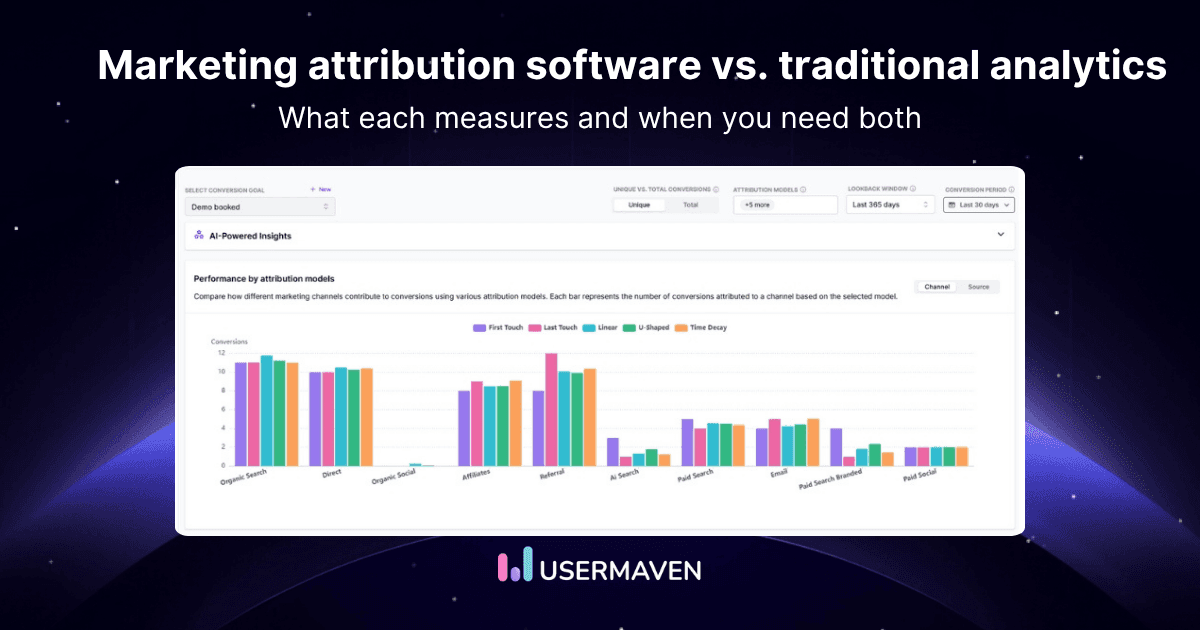
An analytics platform may offer one or more attribution models within its reporting scope. Dedicated attribution software often lets teams compare several perspectives, such as first-touch, last-touch, linear, time-decay, U-shaped, and non-direct models, against the same conversion and revenue data.
6. CRM and revenue context
Traditional analytics can record purchases and configured revenue events. Dedicated platforms are more likely to connect acquisition with qualified leads, opportunity stages, deal values, closed revenue, retention, and expansion. This turns conversion reporting into revenue attribution and changes the question from which source generated leads to which source generated valuable customers.
7. Cross-platform independence
Advertising networks apply their own attribution windows, eligible interactions, identity rules, and modeled conversions. A neutral attribution layer can apply a consistent framework across platforms. This is why ad platform discrepancies can persist even when every tag is working correctly.
8. Conversion feedback
Advanced attribution platforms can return verified first-party outcomes to advertising systems. Conversion syncs let bidding optimize toward purchases, qualified leads, upgrades, or other meaningful events rather than only early-funnel actions.
Marketing analytics vs. marketing attribution
Marketing analytics is the broader discipline. It covers campaign performance, audiences, budgets, experiments, content, customer behavior, forecasting, and business outcomes. A deeper comparison of marketing analytics vs. attribution shows why attribution is one part of that discipline, focused specifically on assigning conversion or revenue credit to touchpoints.
The SAS marketing attribution overview describes attribution as a way to analyze the impact and business value of marketing interactions so teams can make better investment decisions. That purpose separates attribution from broader descriptive reporting.
A marketing analytics platform may therefore include attribution without being a dedicated attribution product. Likewise, an attribution platform may contain dashboards and behavioral reports without replacing every function of a broader analytics stack. Product category labels matter less than the actual data, models, integrations, and decisions supported.
GA4 vs. dedicated attribution software
GA4 is the most familiar example of an analytics platform with attribution capabilities. It can report sources, media, campaigns, events, key events, purchases, attribution paths, and model-based conversion credit. That makes it more capable than a simple traffic counter.
Dedicated attribution platforms usually extend the scope through more explicit cross-channel cost data, original-source preservation, CRM contacts and accounts, opportunity stages, product activation, closed revenue, and several reporting perspectives.
The distinction is not that GA4 has no attribution; it is that the attribution remains bounded by its configured data, identity, integrations, and reporting model.
Teams evaluating that boundary can compare Usermaven vs. Google Analytics 4 or review a broader Google Analytics 4 alternative when website reporting must connect with product, CRM, and revenue outcomes.
When traditional analytics is enough
Traditional analytics may be sufficient when the measurement problem is primarily behavioral and the customer journey is relatively contained.
The website or app is the main customer experience.
Journeys are short and conversions happen entirely online.
The team mainly optimizes pages, content, funnels, checkout, or product features.
A signup, purchase, or other website event represents the final commercial outcome.
CRM pipeline and closed-revenue attribution are not required.
One advertising ecosystem dominates acquisition and directional reporting is sufficient.
When attribution software is needed
Dedicated attribution becomes more useful as the customer journey extends beyond one session, one platform, or one online conversion.
Several paid and organic channels influence the same customer.
Anonymous activity must connect with known leads, users, or accounts.
Sales cycles continue for weeks or months after the first conversion.
Qualified opportunities and closed revenue matter more than form submissions.
Marketing needs an independent view of overlapping ad-platform claims.
Product activation, retention, or lifetime value determines acquisition quality.
Verified outcomes must be returned to advertising platforms for optimization.
Traditional analytics and attribution together
Many businesses need both capabilities because the systems answer complementary questions. Consider this journey: paid campaign → landing page → signup → product activation → opportunity → customer → renewal.
Behavioral analytics explains landing-page engagement, funnel progression, feature adoption, and retention. Attribution explains the acquisition source, campaign influence, touchpoint credit, pipeline contribution, and revenue impact. When the two datasets are disconnected, teams spend time reconciling identities, dates, conversions, and totals before they can make a decision.
A shared marketing attribution dashboard can reduce that gap by placing journeys, conversion paths, campaigns, pipeline, and revenue beside the behavioral metrics that explain why customers progressed or dropped.
Drive business growth
with AI-powered analytics
What role does AI play in modern attribution?
AI helps attribution platforms examine large volumes of campaign, journey, conversion, and revenue data faster than manual reporting. It can compare converting and non-converting paths, identify recurring patterns, and surface relationships that fixed-rule reports may overlook.
AI-driven attribution can analyze historical conversion patterns to estimate which interactions are most closely associated with successful outcomes. This reduces reliance on assumptions built into first-touch or last-touch rules, while still requiring teams to understand what the model is measuring.
The same systems can flag unusual changes in campaign quality, conversion paths, source performance, pipeline contribution, or customer value. These signals help marketers investigate changes before they become larger budget or revenue problems.
Natural-language interfaces also make attribution data easier to explore. Marketers can ask which campaigns generated qualified pipeline, why conversions declined, or which sources produced retained customers, then receive summaries, comparisons, and visualized answers without manually rebuilding every report.
This is where AI-powered analytics is most useful: reducing reporting effort, highlighting possible explanations, and helping teams move from fragmented data to focused questions. It supports analysis rather than replacing the underlying tracking or attribution framework.
Where marketers still need to apply judgment
AI can surface correlations, anomalies, and possible explanations, but strategic budget decisions remain human responsibilities.
Marketers still need to consider campaign objectives, market conditions, sales feedback, seasonality, brand activity, and business priorities that may not be fully represented in historical data.
Data quality also determines how trustworthy AI-generated findings are. Missing UTMs, duplicate conversions, disconnected CRM records, weak identity resolution, or incomplete revenue data can create confident-looking but unreliable conclusions.
Teams must validate the inputs, interpret the business context, and decide which actions should follow.
How Usermaven combines both capabilities
Usermaven combines marketing attribution with website analytics, product analytics, customer journeys, funnels, contact-level context, CRM outcomes, and revenue reporting. The same measurement layer can follow a customer from acquisition through behavior and commercial value.

Connected website analytics
Website analytics connects traffic sources with landing pages, engagement, content consumption, return visits, and conversions. This preserves the behavioral context behind acquisition performance instead of reducing every campaign to a conversion total.
Product behavior and funnels
Product analytics connects acquisition with activation, feature adoption, engagement, upgrades, and retention. Funnels then show where customers progress or drop between landing pages, signups, product milestones, and paid outcomes.
Complete customer journeys
User journeys preserve the sequence of sources, pages, product events, and conversions across return visits. Teams can inspect an individual path and compare patterns across segments without rebuilding the journey from separate exports.
Marketing and revenue attribution
Attribution reporting connects channels, sources, campaigns, paid ads, content, CRM deals, pipeline, and revenue. Several attribution perspectives can be applied to the same underlying journey so discovery, assistance, conversion, and commercial value are not forced into one model.
Known users, contacts, and companies
The Contacts Hub connects acquisition and behavioral activity with known visitors, leads, users, and companies. This helps teams move from anonymous session reporting to customer and account context when identification becomes available.
Connected dashboards
Analytics dashboards can combine marketing, website, product, journey, CRM, and revenue views for different teams. Marketing can evaluate channels, product can inspect activation, revenue teams can review pipeline, and leadership can compare commercial outcomes without maintaining separate reporting definitions.
How to choose the right approach

Choose traditional analytics when
Website, app, content, funnel, or product optimization is the primary goal.
The team mainly needs behavioral and conversion insights.
CRM, account, and revenue data remain outside the reporting scope.
The customer journey is relatively short and contained.
A free or low-cost analytics baseline is sufficient.
Choose attribution software when
Marketing contribution must be measured across several channels.
CRM pipeline, opportunity, and revenue reporting are required.
Journeys span several sessions, identities, or systems.
Multi-touch model comparison affects budget decisions.
The team needs a consistent view beyond ad-platform reporting.
Choose a combined platform when
Behavior and attribution data must remain connected.
Separate tools create identity, conversion, or revenue reconciliation work.
Marketing and product teams need shared customer journeys.
Acquisition quality must be evaluated through activation, revenue, and retention.
The business wants one reporting layer rather than several point solutions.
Implementation considerations
Define commercial outcomes
Separate diagnostic activity from business outcomes. Page views, scrolls, and button clicks can explain behavior, but attribution decisions should ultimately connect with outcomes such as purchases, qualified opportunities, closed customers, revenue, retention, or lifetime value.

Standardize campaign tracking
Use consistent sources, media, campaigns, content labels, and advertising identifiers. A shared UTM parameter convention prevents one source or campaign from being divided across several spellings, capitalizations, and separators.
Connect identities
Define how anonymous activity connects with a known person after a form submission, signup, purchase, or login. B2B teams should also document how contacts roll into companies, accounts, opportunities, and shared revenue outcomes.
Integrate CRM and revenue systems
Map lifecycle stages, qualification rules, opportunity IDs, deal amounts, close dates, currencies, and closed-won status. Attribution cannot produce reliable commercial reporting when the CRM and billing systems use inconsistent definitions or duplicate outcomes.
Validate real customer journeys
Test several real paths from campaign click through conversion and downstream revenue. Confirm that sources, sessions, identities, dates, conversion values, CRM stages, and revenue totals appear as expected before the reports influence budget decisions.
Best practices
A combined measurement stack works best when each layer has a clear role and the same commercial definitions are used across teams.
Separate behavior from attribution: Use analytics to understand actions and attribution to explain marketing contribution.
Preserve original acquisition data: Do not overwrite the first known source when a customer returns through direct, email, or another later interaction.
Compare more than one model: Use different attribution perspectives for discovery, conversion, pipeline, and revenue questions.
Connect downstream outcomes: Evaluate channels through qualified pipeline, revenue, retention, and lifetime value instead of lead volume alone.
Audit discrepancies: Review differences among analytics, advertising platforms, CRM systems, billing data, and finance definitions before assuming a tag is broken.
Avoid unnecessary complexity: Choose the measurement depth the team can maintain, explain, and use consistently.
Final verdict
Traditional analytics and marketing attribution software are complementary rather than direct replacements. Traditional analytics is strongest for understanding websites, apps, funnels, and product behavior. Attribution software is strongest for connecting marketing interactions with customer journeys, CRM outcomes, and revenue.
A team optimizing content and checkout may need analytics alone. A team allocating budget across Google, Meta, LinkedIn, email, partners, and sales activity needs a broader attribution layer.
Ready to see Usermaven in action? Explore the platform or book a demo for a closer look.
See Usermaven in action
Book a free demo and discover how powerful analytics can grow your business.
FAQs
1. What is the difference between attribution software and traditional analytics?
Traditional analytics primarily measures website, app, funnel, and product behavior. Marketing attribution software primarily assigns credit to channels, campaigns, and touchpoints connected with conversions, pipeline, or revenue.
2. What is the difference between attribution software and traditional analytics?
Traditional analytics primarily measures website, app, funnel, and product behavior. Marketing attribution software primarily assigns credit to channels, campaigns, and touchpoints connected with conversions, pipeline, or revenue.
3. Is marketing attribution part of marketing analytics?
Yes. Marketing analytics is the broader discipline covering performance, audiences, campaigns, experiments, behavior, and outcomes. Attribution is the specific practice of assigning conversion or revenue credit to marketing interactions.
4. Does GA4 provide marketing attribution?
Yes. GA4 provides source and campaign reporting, attribution paths, key events, purchases, and model-based conversion credit. Dedicated attribution platforms usually extend the analysis through broader CRM, account, product, and revenue context.
5. Can GA4 replace attribution software?
GA4 may be sufficient for teams that need a free website and app attribution baseline. Dedicated software becomes more useful when journeys span several systems, CRM opportunities and revenue matter, or marketing needs independent cross-platform reporting.
6. What does traditional analytics measure?
Updated

Written by
Junaid Ahmed
Content Writer & Digital Marketer
Junaid Ahmed is a content and copywriter with 3+ years of experience creating research-driven content across SaaS, B2B, ecommerce, and digital marketing. He specializes in turning complex topics into clear, practical content that helps marketers better understand their challenges, evaluate solutions, and make informed decisions. His work spans educational content, industry insights, and actionable marketing guides.
All articles by Junaid →