June Analytics made SaaS reporting approachable. But its standalone product was scheduled to shut down on August 8, 2025, following the announcement that its founding team would join Amplitude. If June was part of your workflow, the decision now is which analytics platform can replace the metrics, account views, and reporting routines you depended on.
Product usage answers who activated and retained. When paid acquisition or CRM revenue also matters, SaaS attribution software can connect those product outcomes with the campaigns that acquired the customers. Not every June replacement needs that extra layer.

Below are eight June Analytics alternatives, including pricing, best-fit scenarios, and a practical way to rebuild reporting without assuming your historical June data is still available.
June Analytics shutdown: What happened?
On July 8, 2025, June published its official wind-down announcement. The company said its founding team was joining Amplitude and that the standalone June product would wind down on August 8, 2025. Customers were given a 30-day period to export their data or migrate to Amplitude.
That export window is historical, not an active guarantee. If no June export was saved, check existing warehouse tables, event pipelines, CRM records, BI exports, and other connected systems before assuming the data can be recovered. Confirm any remaining access directly with the relevant provider.
Amplitude was the transition destination named in June’s announcement. It remains a logical option if continuity with the founders’ new platform matters, but alternatives may fit better when the priority is lean reporting, session replay, marketing attribution, or account-level revenue analysis.
Key takeaways
- Closest product-analytics options: Mixpanel and Heap suit event-based funnels, retention, and behavioral analysis. Heap emphasizes autocapture and retroactive event definitions.
- Broad product toolkit: PostHog combines product analytics, session replay, experimentation, and feature flags, with usage-based billing.
- In-app adoption: Pendo adds guides, feedback, and product adoption workflows rather than only analytics dashboards.
- Experience diagnostics: Quantum Metric and Fullstory focus on session-level friction and digital experience intelligence.
- Different revenue questions: Usermaven connects product behavior to marketing acquisition and CRM attribution; HockeyStack centers B2B accounts and GTM intelligence.
- Migration reality: Rebuild event definitions, identity rules, and reporting baselines before comparing numbers from June with a new tool.
June Analytics alternatives at a glance
These eight products overlap on digital measurement but are not substitutes for the same job. Select the product closest to the decision that June helped you make.
| Alternative | Best fit | Pricing model |
|---|---|---|
| Usermaven | SaaS attribution + product behavior + CRM revenue | Business and Enterprise: custom quote for new customers |
| Mixpanel | Event-based product analytics and cohorts | Free up to 1M events/month; Growth usage-based |
| Heap | Autocapture and retroactive product analysis | Free up to 10K sessions/month; paid plans vary |
| PostHog | Developer-led product analytics, flags, replay | 1M product events/month free; pay per use after |
| Pendo | Product adoption, in-app guidance and feedback | Free up to 500 MAU; paid quote |
| Quantum Metric | Enterprise digital experience intelligence | Custom quote |
| Fullstory | Session replay, friction and experience diagnosis | Free up to 30K sessions/month; paid quote |
| HockeyStack | B2B account attribution and GTM intelligence | Sales-led custom quote |
Pricing limits depend on billing periods, volumes, and feature entitlements. Event counts, sessions, and monthly active users are different units, so they should not be compared as if they represented the same traffic.
What June users should preserve during migration
Before installing a replacement, document the reporting decisions June supported. For a SaaS company, the loss is rarely just a dashboard. It may also be a consistent definition of an active account, a shared customer health metric, or the history behind a retention trend.
| June reporting need | Rebuild in the new platform | Validation check |
|---|---|---|
| Active users and accounts | User ID, account ID, active-event definition | Compare distinct users and accounts independently |
| Activation and adoption | Activation event and feature usage taxonomy | Check event firing and user identification |
| Funnels and retention | Step logic, cohort start date, return event | Match date windows and denominator definitions |
| Account or CRM context | Company-to-contact links and opportunity IDs | Spot-check mapped records and Closed Won dates |
| Marketing source quality | Campaign parameters, source taxonomy and revenue goals | Compare acquisition cohorts to CRM outcomes |
A metric can retain its familiar name while changing meaning after migration. For example, a customer counted as “active” in June because they visited any page may not match a replacement dashboard counting only users who performed a meaningful product action.
The eight best June Analytics alternatives
The product sections below focus on the main reason to choose each option, its current pricing structure, and the tradeoff that matters when replacing June.
Usermaven: Best for SaaS attribution and product insights
Usermaven combines website and product analytics with marketing attribution, customer and account profiles, CRM context, conversion goals, funnels, user journeys, and revenue analysis. It fits a SaaS business that wants to keep monitoring product adoption while learning which acquisition channels bring valuable customers.
The distinction from June is the measurement scope. June concentrated on accessible product and customer reporting. Usermaven also connects marketing acquisition with signups, qualified leads, opportunities, retention, and revenue when the required events and integrations are configured.
Website and product analytics
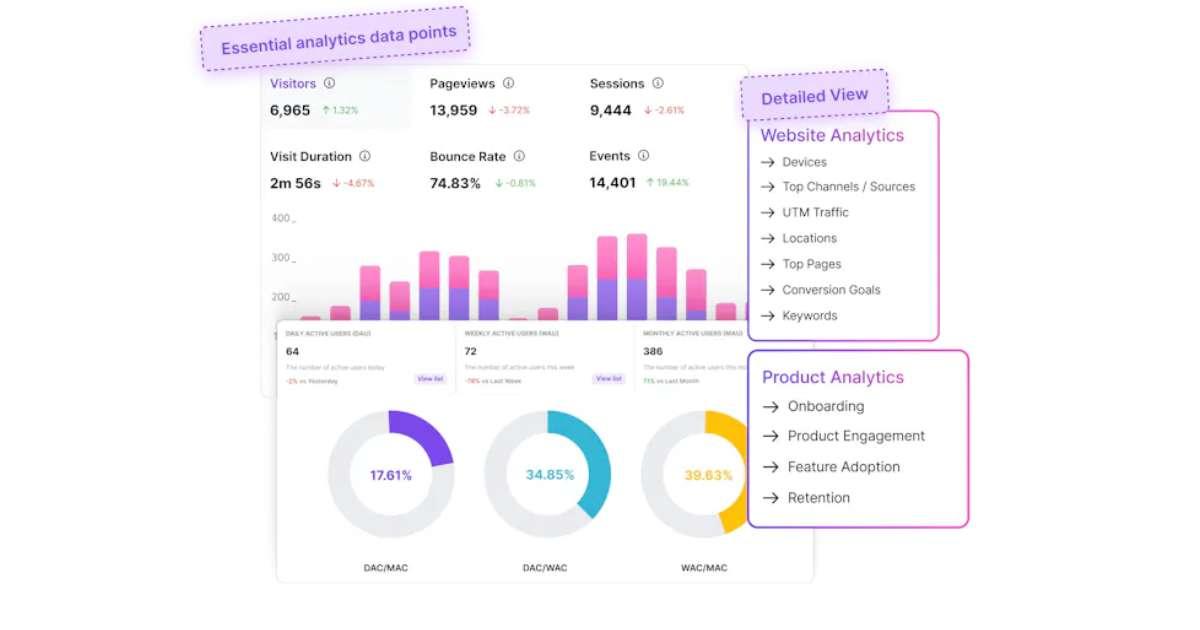
Monitor traffic and acquisition trends alongside DAU, WAU, MAU, feature adoption, and cohort behavior. Product analytics can reveal whether visitors from a campaign become activated users or whether onboarding completion predicts continued engagement.
Funnels, user journeys, and retention
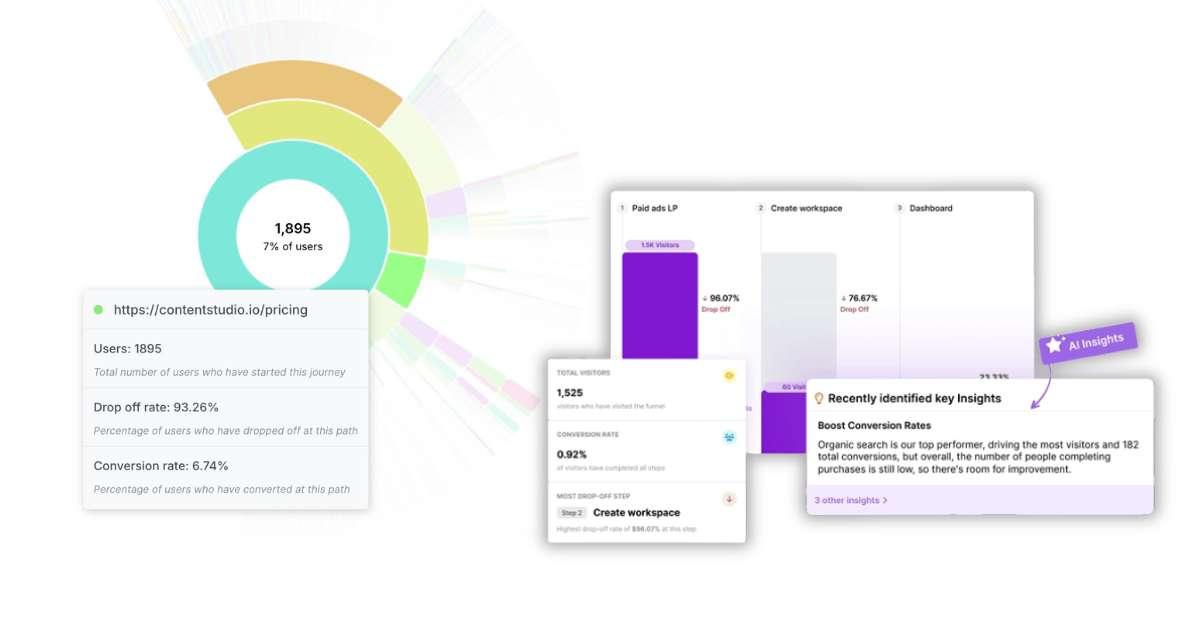
Use funnels to locate friction across signup, activation, and upgrades, then inspect user journeys to understand the paths customers take. Customer profiles, cohort analysis, and retention metrics add context when you need to investigate where adoption declines.
Marketing attribution and CRM revenue
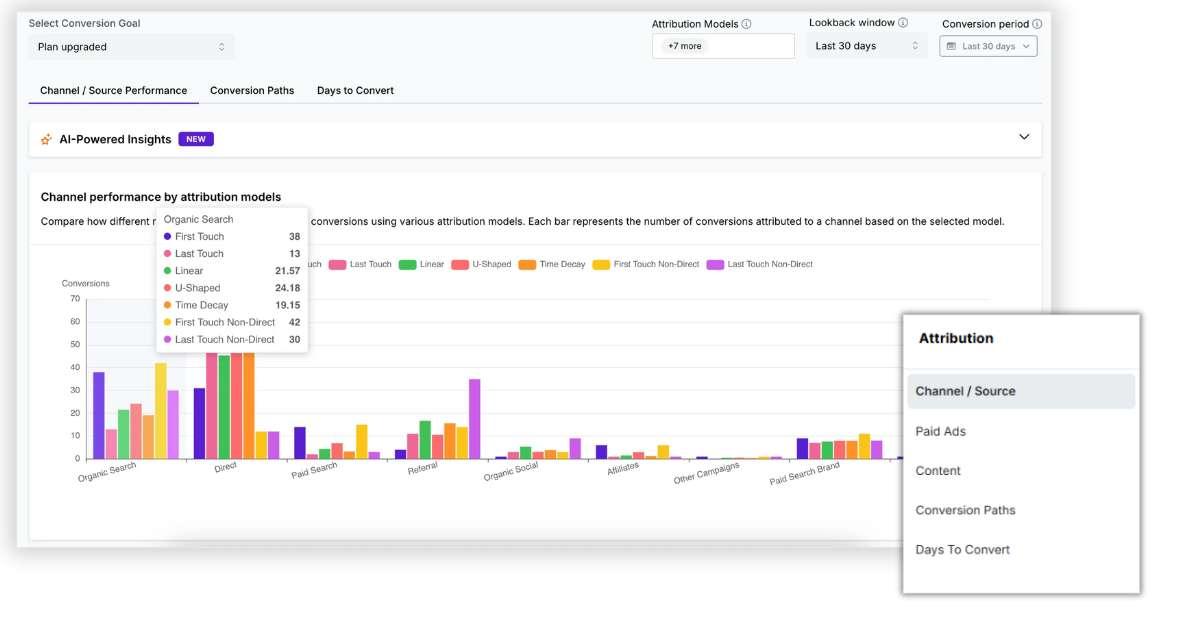
Usermaven supports standard attribution models across conversion paths, campaign and channel reporting, and CRM-linked revenue. Enterprise workspaces can also create custom attribution models. The B2B SaaS solution is relevant when marketing and sales need to compare signups with opportunities and customers.
The goal is not to add revenue totals from different attribution models together. Each model is a different allocation of the same conversions. Pick one model for a decision, keep the underlying revenue total fixed, and use alternative models as sensitivity checks.
Profiles, segments, and events
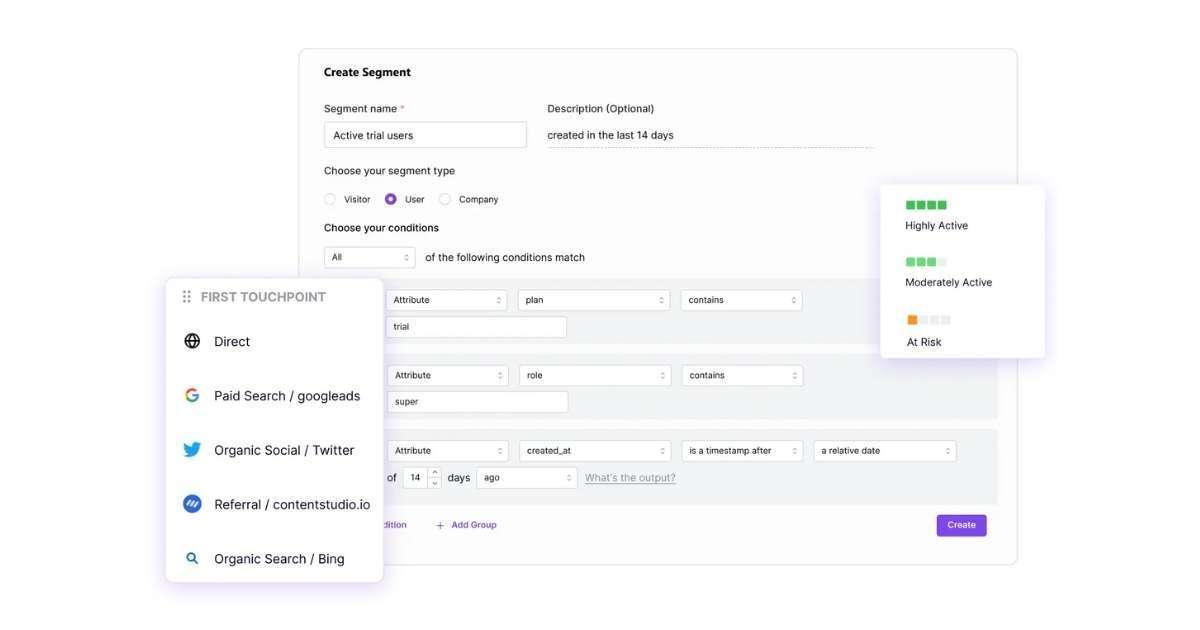
The Contacts Hub brings users, visitors, and companies into the same analysis environment. Custom events and segments let analysts compare active accounts, slipping users, paid cohorts, and expansion opportunities using agreed definitions.
Maven AI, MCP, and measurement trust
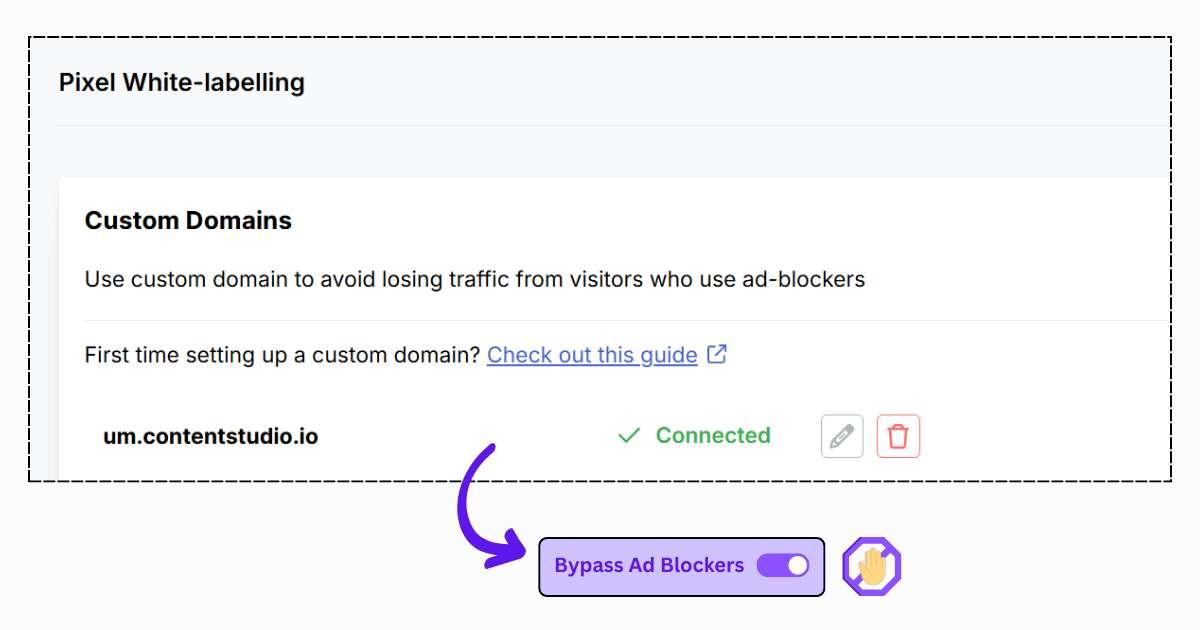
Maven AI can examine attribution, product usage, funnels, retention, and customer behavior. September 2026 updates added scheduled AI Agents and multimodal analysis, while MCP access supports compatible external AI clients. The Measurement Trust Center helps identify tracking and workspace data-quality problems before teams act on a report.
Usermaven also supports HubSpot and Salesforce connections and audience workflows, with availability depending on plan and integration setup. Agencies handling multiple SaaS clients can evaluate the agency solution for workspace and reporting requirements.
Usermaven pricing and limitations
Usermaven currently documents Business and Enterprise plans with custom pricing for new customers. The separate public pricing page still displays earlier Growth/Scale tiers, so confirm the current offer and entitlements with sales rather than treating an older published amount as a guaranteed starting price.
It is not the first choice when session replay, on-screen walkthroughs, or feature-flag experiments are the primary need. Fullstory, Pendo, and PostHog are better aligned to those specialized workflows.
Mixpanel: Best for event-driven product analysis
Mixpanel focuses on the questions June users often asked first: Which features are adopted, where do users drop out of a funnel, and which cohorts return? Funnels, flows, retention analysis, behavioral cohorts, and event-based reporting make it a strong successor when product metrics remain the primary job.
- Strengths: Detailed event queries, funnels, cohorts, session replay, experimentation, and AI-assisted analysis.
- Tradeoff: Requires clear event definitions and identity handling. Advanced CRM revenue attribution is not its main center of gravity.
- Pricing: Free up to 1 million events per month; Growth starts at $0 for the first million and scales with usage; Enterprise uses custom pricing.
Choose Mixpanel when the central requirement is exploring product behavior and comparing feature cohorts. It is less of a direct replacement for a combined marketing-to-CRM revenue stack.
Heap: Best for autocapture and retroactive analysis
Heap automatically collects many web interactions and lets analysts define certain events after collection. This can reduce the need to predefine every click, although important business events and identity rules still require deliberate instrumentation and governance.
- Strengths: Automatic capture, journeys, funnels, retroactive event definition, and Sense AI on eligible paid plans.
- Tradeoff: Autocapture does not guarantee clean metrics. Review event naming, sensitive-data handling, and session allowances before migrating.
- Pricing: Free for up to 10,000 monthly sessions; higher plans expand analysis and support, with some pricing based on a quote or tailored estimate.
Heap is a strong option if June users want to answer new behavioral questions from interactions collected before they defined a particular report.
PostHog: Best for developer-led product growth
PostHog combines product analytics, session replay, feature flags, experimentation, surveys, and technical tooling. It is an attractive choice for engineering-led SaaS companies that prefer instrumentation, experiments, and behavioral reports in one platform.
- Strengths: Integrated analytics and product experimentation, SQL-capable analysis, replay, event autocapture, and broad developer workflows.
- Tradeoff: The number of modules and separate billing meters can require ongoing governance; it is not the simplest path for every nontechnical analyst.
- Pricing: The first 1 million product analytics events are free each month, then usage-based billing applies. Other products have their own free allowances and metered prices.
Compared with June, PostHog offers a wider build-measure-test workflow. It is a better fit where the analytics owner also helps ship product changes.
Pendo: Best for in-app adoption and guidance
Pendo is more than an event reporting dashboard. It combines product usage measurement with guides, onboarding experiences, feedback, and adoption workflows, so product managers can act on what they learn without switching to a separate in-app messaging product.
- Strengths: Product analytics, feature adoption, guides, user feedback, and digital adoption workflows.
- Tradeoff: Paid adoption and analytics capabilities may require a more involved buying process. Check feature eligibility and monthly active user limits.
- Pricing: Pendo Free supports up to 500 monthly active users; paid plans require a quote.
Choose Pendo if the gap after June is not just understanding adoption but improving it through in-product guidance.
Quantum Metric: Best for enterprise journey friction
Quantum Metric is a digital experience intelligence platform focused on understanding how customers struggle, where high-impact friction occurs, and which journeys affect conversion. Session-level evidence helps large organizations connect digital behavior with troubleshooting and experience improvements.
- Strengths: Session replay, journey and friction analysis, technical diagnostics, and experience intelligence for complex digital properties.
- Tradeoff: Enterprise implementation and investigation workflows may be heavier than June’s lightweight product analytics experience.
- Pricing: Custom enterprise quote.
Quantum Metric is appropriate when diagnosing digital friction is the priority. It is less direct if the primary need is simple SaaS account health or campaign-to-revenue reporting.
Fullstory: Best for session replay and UX diagnosis
Fullstory combines automatically captured behavioral signals, session replay, heatmaps, journey and funnel analysis, and developer tools. It helps product, support, and UX specialists see what happened during a problem session and connect qualitative evidence to quantitative metrics.
- Strengths: Replay and friction analysis, funnels, segmentation, product analytics, and StoryAI features on eligible plans.
- Tradeoff: Replay-oriented investigation can be a different workflow from June’s simplified SaaS reporting. Configure masking and sensitive-data exclusions before capture.
- Pricing: FullstoryFree offers up to 30,000 sessions per month and 12 months of retention; advanced paid plans are quote-based.
Fullstory fits when “why did this user struggle?” is more urgent than reconstructing source-level marketing ROI.
HockeyStack: Best for B2B account and GTM intelligence
HockeyStack connects B2B marketing, CRM, account, pipeline, and revenue information. Its value is strongest where the buying journey spans multiple contacts, channels, and sales stages rather than an individual self-serve signup path.
- Strengths: Account-level journey analysis, multi-touch attribution, revenue reporting, and AI-assisted go-to-market intelligence.
- Tradeoff: More relevant to mature B2B demand generation and RevOps than to lightweight product adoption reporting.
- Pricing: Sales-led custom pricing; no currently verified public free attribution tier.
Choose HockeyStack if the replacement decision has shifted from product analytics toward buying-group influence, account progression, and pipeline contribution.
Should former June users choose Amplitude instead?
Amplitude is particularly relevant because June named it as a migration destination in its official 2025 announcement. It has continued expanding beyond core product analytics into experimentation, session replay, AI Agents, and MCP access.
Amplitude currently provides a free plan with up to 2 million events per month, and its Plus plan starts at $0 for the first 2 million events before usage charges. It may be the most straightforward choice for users who want a larger product analytics ecosystem, although it still requires careful event and identity mapping.
Amplitude is described separately from the eight-tool shortlist because the June-to-Amplitude route is a distinct consideration, not an overlooked tenth entry. Its product analytics scope and pricing should be evaluated on the same terms as other candidates.
Which June replacement should you choose?
| Primary problem | Start by evaluating | What to verify |
|---|---|---|
| June-style product usage and cohorts | Mixpanel or Heap | Activation events, retention rules, usable reports |
| Product analytics and engineering workflows | PostHog | Replay, experiments, billing meters, ownership |
| In-product adoption actions | Pendo | Guide eligibility, segments, MAU allowance |
| UX friction and debugging | Fullstory or Quantum Metric | Replay, masking, session scope, enterprise fit |
| Revenue attribution plus product outcomes | Usermaven | CRM mapping, conversion goals, channels, data trust |
| Account-centric B2B go-to-market | HockeyStack | Account identity, pipeline joins, attribution models |
| Official June transition path | Amplitude | Historical export availability and event migration |
The best replacement is the one that can reproduce your important June metrics before adding new features. A rich feature set does not compensate for mismatched users, missing activation events, or broken account identities.
Five-step June Analytics migration audit
Phase 1: Inventory data and historical reports
List every June dashboard, saved CSV, recurring report, CRM integration, identity field, and event source. June’s official export period ended in 2025, so inventory what your organization already retained rather than assuming its original export tool is accessible.
Phase 2: Define the event and identity model
Create a tracking dictionary for signup, activation, key feature use, subscription changes, and churn. Decide how anonymous users become known contacts and how users are grouped into B2B accounts. Keep stable user and account identifiers wherever lawful and technically possible.
Phase 3: Rebuild goals, funnels, and cohorts
Implement conversion goals and funnel steps in the new tool. Check whether June’s “active user” counted any page visit or a meaningful event, and validate cohort return definitions before publishing month-over-month trends.
Phase 4: Check integrations and reconciliation
Connect CRM, billing, product events, and paid acquisition data as needed. Reconcile source event counts with the new analytics reports, verify revenue joins to actual opportunities or orders, and isolate duplicates introduced by multiple event streams.
Phase 5: Validate decisions before switching reports
Review a representative set of users, accounts, campaigns, and deals. Document intentional differences from June’s old logic. Use a short overlap period only when both data sources are legitimately available; otherwise compare with saved exports, first-party source records, and a clearly dated new baseline.
Worked example: Suppose a previous report listed 500 activated users while a replacement shows 440. The gap is not automatically a tracking failure. Check whether the old report counted all signups, whether the new dashboard requires a defined activation event, whether date windows match, and whether duplicate user identities were merged. Only after the definitions align should the difference be treated as a collection problem.
Final verdict
June proved that SaaS analytics did not have to be complicated. Its scheduled shutdown in August 2025 means the practical task is now to restore trustworthy product reporting and choose an analytics architecture that will support the next phase of growth.
For product funnels and cohorts, Mixpanel or Heap are natural starting points. PostHog serves engineering-led products, Pendo focuses on adoption, Fullstory and Quantum Metric investigate friction, and HockeyStack specializes in enterprise B2B revenue journeys. Amplitude remains the transition route June originally recommended.
If your decision also requires explaining which campaigns contribute to activated users, CRM pipeline, and revenue, Usermaven connects those outcomes in a single analytics environment. To review the fit for your SaaS use case, book a demo.
See Usermaven in action
Book a free demo and discover how powerful analytics can grow your business.
FAQs
1. Is June Analytics still available?
June announced that its standalone product would wind down on August 8, 2025, as its founding team joined Amplitude. The official announcement gave customers a 30-day period to export data or migrate. Do not assume the historical export option remains available today.
2. What are the best June Analytics alternatives?
Mixpanel and Heap are strong choices for product funnels and cohorts. PostHog combines analytics with experimentation, Pendo focuses on adoption, and Fullstory or Quantum Metric focus on experience diagnostics. Usermaven connects product data to marketing attribution, while HockeyStack emphasizes B2B account and revenue intelligence.
3. Is Usermaven a good June Analytics alternative?
Usermaven is a strong fit when a SaaS company wants product usage analytics alongside funnels, retention, customer journeys, marketing attribution, and CRM revenue reporting. It is less suitable than dedicated tools when session replay or in-app guidance is the primary need.
4. How much does Usermaven cost compared with June?
June no longer offers an active standalone pricing plan following its announced shutdown. Usermaven currently documents custom-quoted Business and Enterprise plans for new customers. Confirm the relevant scope and pricing directly before migrating.
5. Can June Analytics data still be exported?
June originally provided a 30-day window around its August 2025 shutdown. The official announcement does not establish that the export tool remains available now. Check any exports already saved, connected event sources, CRM history, and warehouse records and ask the provider about possible remaining access.
6. Is Amplitude the official replacement for June?
June identified Amplitude as a migration destination when it announced that its founding team was joining Amplitude. Amplitude is a valid current product analytics option, but buyers should still compare event models, pricing, AI capabilities, identity mapping, and reporting needs.
7. What should a June migration checklist include?
Inventory historical reports and exports, define user and account identities, rebuild activation and retention logic, validate CRM and event integrations, and reconcile representative metrics before relying on a new reporting baseline.
Updated

Written by
Ryan Mitchell
Marketing Analytics Strategist
Ryan Mitchell is a marketing analytics strategist specializing in campaign measurement, customer journeys, and marketing performance. He writes about analytics, reporting, and data-driven marketing strategies, helping SaaS and B2B teams measure what matters across every stage of the customer journey.
All articles by Ryan →