Heap automatically captures product interactions. Amplitude pairs deep product analytics with experimentation. Usermaven connects acquisition, product behavior, and revenue through marketing attribution software.
The better choice depends on the question your team needs to answer: What do users do, why do they struggle, or which marketing investments bring valuable customers?
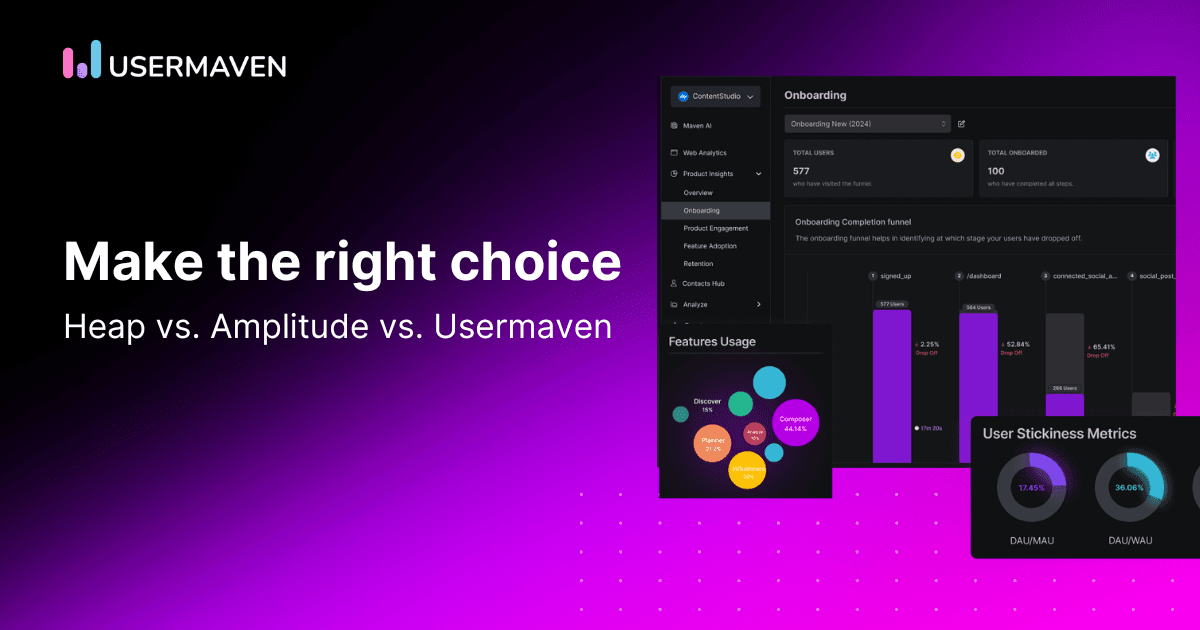
This Heap vs. Amplitude vs. Usermaven comparison examines tracking, funnels, attribution, AI, privacy controls, pricing, and the right use cases for each platform.
Power up your SaaS
with perfect product analytics
Heap vs. Amplitude vs. Usermaven at a glance
All three platforms analyze behavior, but their strengths sit in different parts of the growth workflow. The distinctions below matter more than a generic feature checklist.
| Decision factor | Heap | Amplitude | Usermaven |
| Primary strength | Autocapture and behavioral discovery | Advanced product analytics and experimentation | Marketing and revenue attribution alongside product analytics |
| Best suited to | Teams investigating digital behavior | Product-led teams testing and optimizing experiences | Marketing, product, and revenue teams sharing one journey |
| Event collection | Autocapture plus defined events | Autocapture plus custom instrumentation | Automatic collection plus custom events |
| AI approach | Sense AI for product analysis | AI Agents, MCP, and AI-supported analytics | Maven AI, scheduled Agents, and MCP |
| Pricing entry | Free tier with 10K monthly sessions | Free tier with 2M monthly events | Business and Enterprise; customized pricing |
Where each platform fits
Heap: discover behavior without predefining every event
Heap emphasizes automatic event capture and retroactive analysis, allowing teams to investigate interactions they did not explicitly label at implementation.
Its journey, funnel, and cohort reports help diagnose behavior. Heap is particularly relevant when a product team needs to explore what happened before defining a more focused tracking plan.
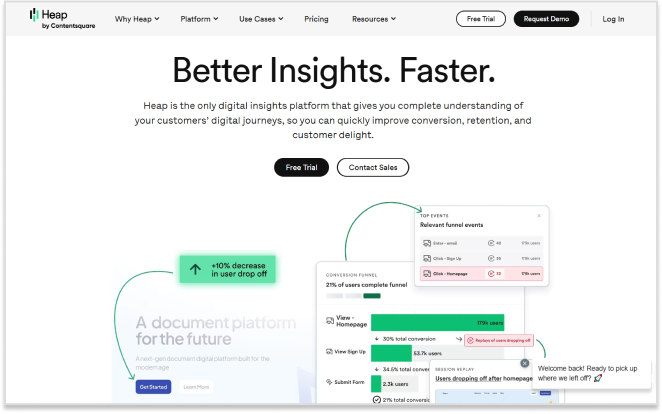
Heap is part of the Contentsquare ecosystem. Its upper tiers and optional experience analytics products are worth evaluating when replay, warehouse exports, or broader digital experience analysis matter.
Amplitude: analyze behavior and run experiments
Amplitude combines product analytics with feature experimentation, session replay, cohorts, and activation tools. It serves teams that want to measure product changes and test what improves outcomes.
Amplitude also supports autocapture and marketing attribution. It should not be described as manual-only tracking or a product with no multi-touch attribution.

Usermaven: connect acquisition to customer value
Usermaven combines website and product analytics with marketing, CRM, and revenue attribution. It helps teams identify which channels bring customers who activate and pay.
Teams can connect acquisition to funnels, journeys, retention, and pipeline outcomes rather than evaluate campaign performance and product behavior in separate reports.
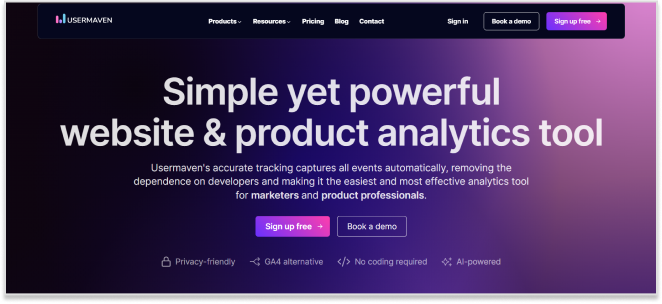
For B2B SaaS teams, the B2B SaaS solution connects campaign sources with product engagement and CRM opportunities, helping teams distinguish signup volume from revenue contribution.
Power up your SaaS
with perfect product analytics
Event tracking and implementation
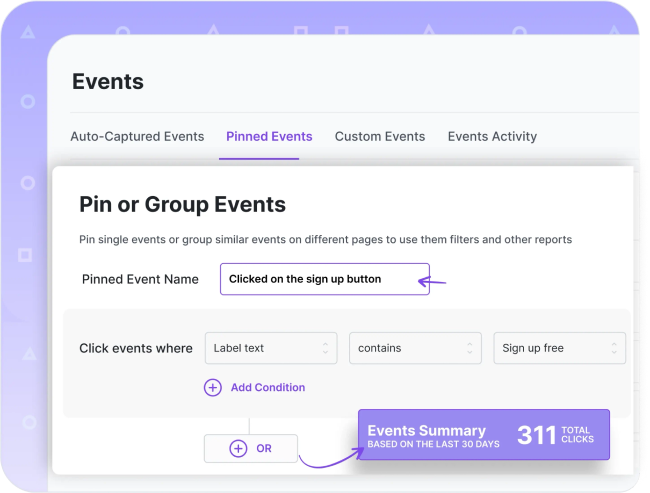
Each product supports automatic capture, but automatic collection is not the same as a complete tracking plan. Meaningful business events still require definitions and quality checks.
- Heap: Autocaptures supported web and app interactions and enables retroactive event definitions for behavior already collected.
- Amplitude: Autocapture can collect page views, form interactions, clicks, and other supported events. Teams can also define custom events.
- Usermaven: Captures common interactions automatically, with custom events available for business-specific actions and conversion goals.
The right implementation test is whether your team can track an end-to-end question: source → signup → activation → opportunity → customer. Not every event will be available without correct setup.
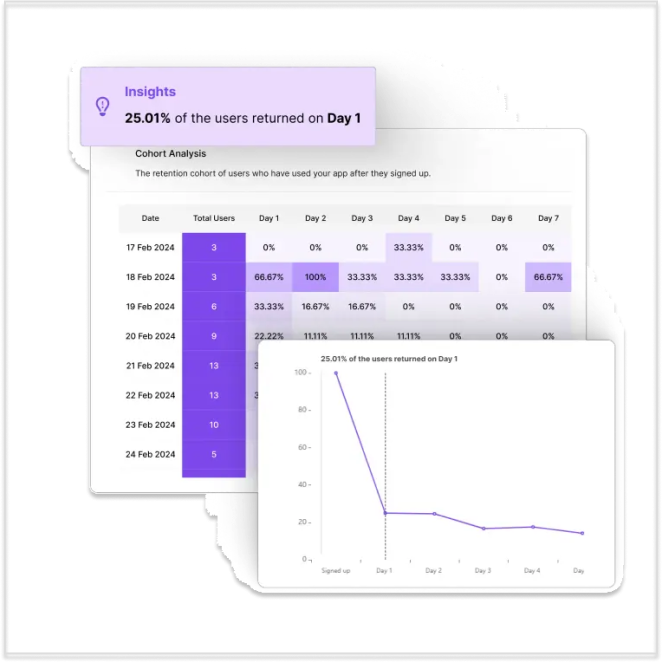
Funnels, journeys, and product retention
Heap supports funnels, journeys, cohort analysis, and behavioral discovery. Its autocapture model can help teams investigate a drop-off that was not anticipated during the initial setup.
Amplitude offers sophisticated funnels, segmentation, retention, and experimentation. It is a strong fit when teams want to evaluate product changes and test hypotheses.
Usermaven brings funnel analysis, customer journeys, and behavioral segments together, so teams can examine drop-offs alongside their acquisition sources.
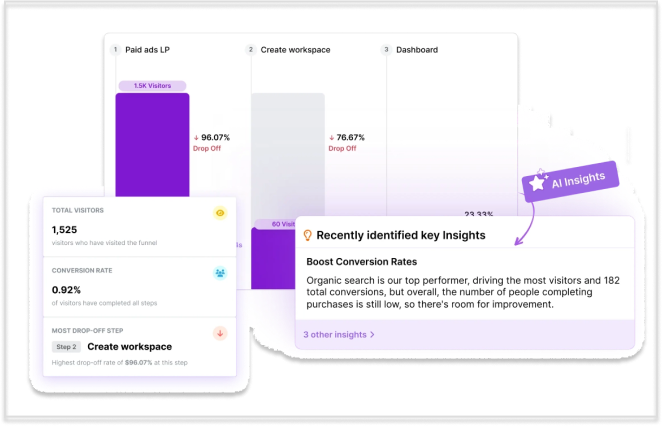
The practical question is not who has a funnel chart. It is whether the funnel can be segmented by campaign, acquisition source, account, or customer value without rebuilding the analysis.
Marketing attribution and revenue visibility
Amplitude supports configurable multi-touch attribution, including first-touch, last-touch, and custom models. Heap can analyze acquisition sources and UTM-tagged behavior.
Those capabilities should be acknowledged. The key distinction is whether the platform is built around marketing spend, CRM deals, long sales cycles, and attributed revenue—not whether it can show referral sources.
Usermaven offers multi-touch attribution models alongside campaign, content, and paid-ads reporting. It connects marketing activity with downstream conversion and CRM outcomes.
Its Enterprise workspaces can also use custom attribution models with configurable touchpoint weights and channel multipliers, according to the September 2026 product release.
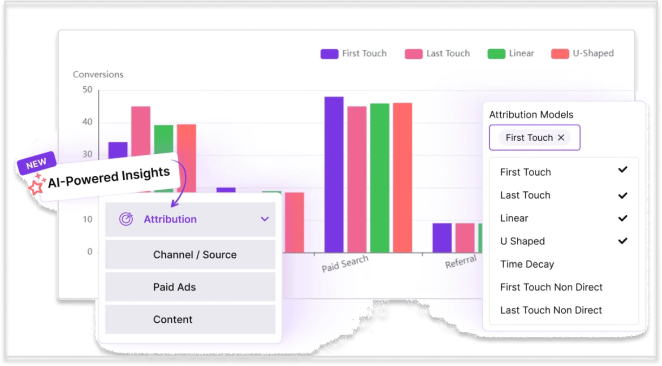
For a B2B buyer journey spanning several stakeholders, useful reporting asks: Which channel introduced the account, what influenced opportunity creation, and which interactions contributed to closed revenue?
AI features: what has actually changed
The old comparison understated both competitors. Heap offers Contentsquare Sense AI, and Amplitude now includes AI Agents and MCP across its plan lineup.
Usermaven offers Maven AI for natural-language analysis and scheduled Agents that examine adoption changes, funnel drop-offs, and retention without a manual prompt each time.
Usermaven also supports MCP-connected AI clients. Its differentiator is applying AI to connected marketing attribution and customer behavior, not claiming exclusive access to AI-assisted analytics.

| Capability | Heap | Amplitude | Usermaven |
| Autocapture | Yes | Yes | Yes |
| Funnel and retention reporting | Yes | Yes | Yes |
| Product experimentation | Not its central offering | Feature flags and native experimentation | Not its primary focus |
| AI assistance | Contentsquare Sense AI | AI Agents and MCP | Maven AI, scheduled Agents, and MCP |
| Multi-touch channel attribution | Source/UTM analysis; scope varies | Configurable models, including custom | Core marketing and revenue attribution workflow |
| CRM opportunity and revenue context | Requires assessment of integrations | Requires assessment of data model/integrations | Built into the platform workflow via CRM integrations |
| Session replay | Available via product packaging/add-ons | Included with plan-dependent allowances | Not a core session-replay product |
| Deployment and advanced controls | Plan-dependent | Plan-dependent | Enterprise options for private cloud/on-premises |
Privacy, cookies, and data reliability
All three tools offer privacy and security controls. Compliance depends on how your organization configures collection, manages consent, processes personal data, and uses integrations.
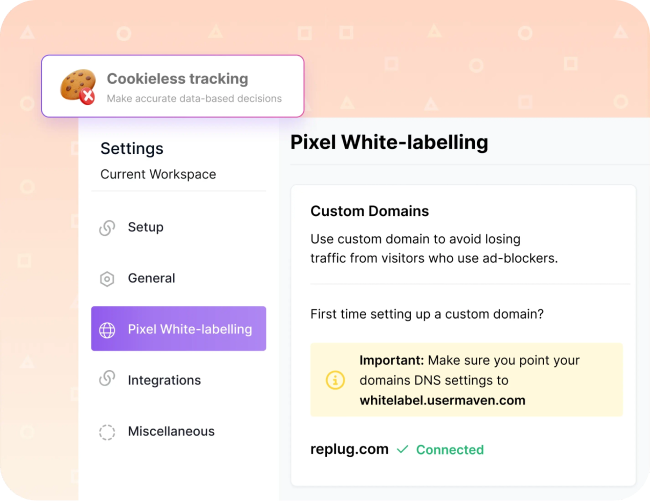
Usermaven supports optional cookieless analytics and first-party collection options. These may reduce some measurement gaps, but no platform can promise perfect accuracy or bypass every browser restriction.
Heap and Amplitude also provide configurable privacy controls. Evaluate each vendor’s data-processing terms, residency options, consent settings, and identity rules against your requirements.
Power up your SaaS
with perfect product analytics
Pricing: free usage vs. longer-term fit
The entry-price comparison has changed. Heap and Amplitude publish meaningful free allowances, while Usermaven publishes Business and Enterprise plans for new customers with customized pricing.
Heap lists Free, Growth, Pro, and Premier. Its pricing page gives the Free tier up to 10,000 monthly sessions. Growth estimates require a tracking snippet; Pro and Premier are quoted by session volume.
Amplitude’s pricing page lists 2 million monthly events on Free. Plus starts at $0 with that allowance and becomes usage-based. Growth and Enterprise are custom-priced.
Usermaven’s current pricing page lists Business and Enterprise for new customers, with pricing customized to the required analytics and attribution setup.
| Plan question | Heap | Amplitude | Usermaven |
| Free entry | Free: 10K monthly sessions | Free: 2M monthly events | No free plan listed for new customers |
| Paid options | Growth; Pro; Premier | Plus; Growth; Enterprise | Business; Enterprise |
| How pricing scales | Primarily sessions and package | Events and plan/add-ons | Customized to requirements |
| Important budget check | Sessions, retention, replay/warehouse options | Event volume, replay and experiment limits | Measurement scope, CRM integrations and requirements |
These are not identical billing units. An event, a session, and a CRM-linked revenue journey measure different things, so compare the cost of a working reporting setup rather than entry prices alone.
Power up your SaaS
with perfect product analytics
What a product analytics customer actually measured
PostNitro used Usermaven to analyze onboarding steps, identify friction, and refine a demo experience. Its published case study reports 576 demo clicks and roughly 70% demo-to-signup conversion among people who engaged with that flow.
The case study also reports about 50% less reporting time. These figures describe that customer’s experience; they are not a guaranteed outcome for other implementations.
The lesson for this comparison: behavioral reports become more useful when acquisition, activation, and conversion are examined as one decision-making process.
Choosing the right analytics platform
Choose Heap when behavioral discovery is the priority
Heap is a strong option for teams that want broad automatic collection, retroactive event definitions, and behavioral exploration. Confirm session allowances and packaging for advanced features.
Choose Amplitude for experimentation-led growth
Amplitude fits teams prioritizing deep product reporting, experiments, feature flags, replay, and AI-supported analysis. Its free allowance makes it a serious option for early product teams.
Choose Usermaven for acquisition-to-revenue analysis
Usermaven is a strong fit when marketing and product teams must connect campaigns to adoption, retention, CRM stages, and revenue. This is particularly valuable when signups do not tell the full growth story.
If the main question is “Which channel brought customers who became profitable?”, make website behavior, product engagement, and revenue attribution part of the same evaluation.
Final verdict
Heap is compelling for behavioral discovery. Amplitude is especially strong for product experimentation. Usermaven makes the strongest case when marketing attribution and revenue context must sit alongside product analytics.
Choose by workflow, not by feature-count claims. Ask each vendor to demonstrate a real business question using your own event, campaign, and customer data.
Want to see how acquisition sources, product engagement, and CRM revenue connect in practice? Book a demo to explore that workflow in Usermaven.
Power up your SaaS
with perfect product analytics
FAQs about Heap, Amplitude, and Usermaven
1. How do Heap, Amplitude, and Usermaven differ?
Heap focuses on autocapture and behavioral discovery. Amplitude combines product analytics with experimentation and AI. Usermaven links marketing attribution to website behavior, product activity, CRM outcomes, and revenue.
2. Which platform is best for tracking user journeys?
All three platforms support journey or path analysis. Heap excels at discovering behavior, Amplitude provides advanced product analysis, and Usermaven connects journeys with acquisition sources and downstream business outcomes.
3. Does Usermaven support multi-touch attribution?
Yes. Usermaven supports multiple attribution models for marketing channels and conversions. Enterprise workspaces can also use custom models with configurable touchpoint weights and channel multipliers.
4. What privacy and tracking options do they offer?
Tracking methods and privacy controls vary. Usermaven supports optional cookieless collection and first-party options. Review each provider’s documentation and configure consent and collection according to your requirements.
5. Which tool is most useful for growth teams?
Choose Heap for broad behavioral discovery, Amplitude for experimentation and product optimization, and Usermaven when growth reporting must connect acquisition, activation, and revenue.
6. Is Amplitude free for small teams?
Amplitude has a Free plan with 2 million events per month. Plus begins with the same free event allowance and scales with paid usage. Confirm product limits and add-ons when comparing total cost.
7. How does Heap pricing differ from Usermaven?
Updated

Written by
Adeel Khan
Growth Marketing Expert
Adeel Khan is a full-stack SaaS marketer with 10+ years of experience in content marketing, paid advertising, analytics, and conversion rate optimization. He shares practical insights and strategies drawn from hands-on experience, helping B2B SaaS marketers improve performance and make better marketing decisions.
All articles by Adeel →