A potential customer asks ChatGPT for a product recommendation, clicks a citation, and lands on a website. The visit may appear in analytics.
But the referral report alone cannot show whether that person became a lead or customer.
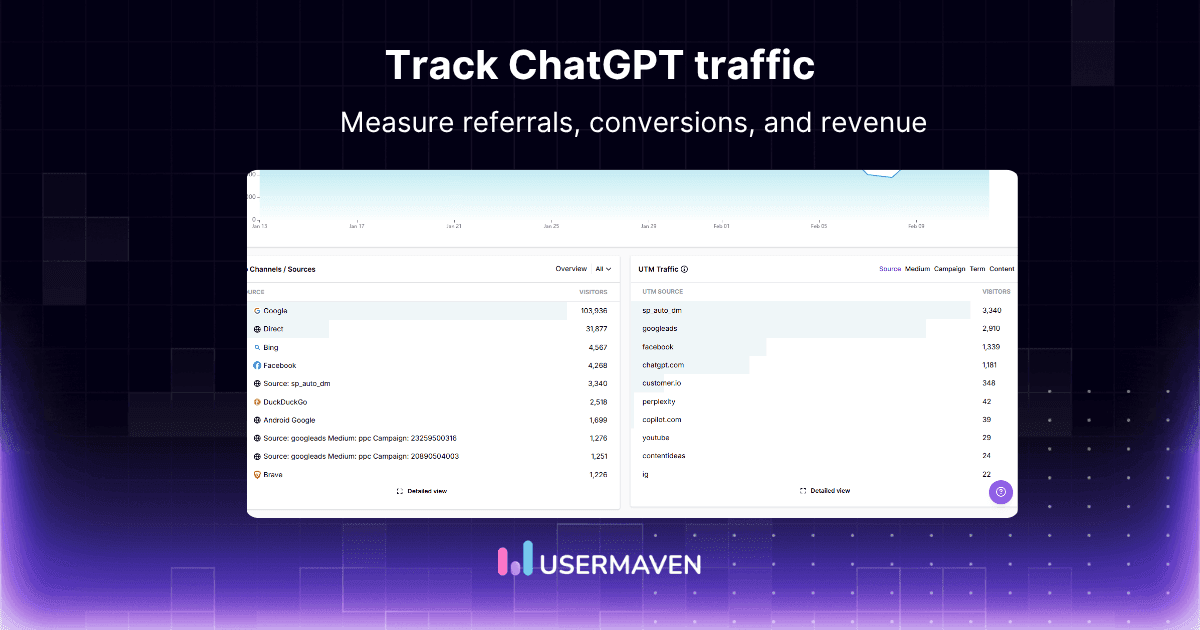
Some ChatGPT clicks arrive with recognizable source information; others do not.
Even when the visit is identifiable, its value depends on what happens next: reading, signing up, booking a demo, or purchasing.
That gap is why marketing attribution software needs to connect identifiable visits with later customer activity, without treating every unexplained session as AI traffic.
Here is how to track ChatGPT traffic, evaluate its quality, troubleshoot missing referrals, and measure conversions and revenue.
Key takeaways
- Recognizable referrals: ChatGPT visits can be measured when source, referrer, or URL parameters survive the click.
- GA4 has an AI channel: Recognized assistant visits can appear in its AI Assistant default channel group.
- Not every visit is identifiable: Direct traffic and missing referrers should not be automatically credited to ChatGPT.
- Clicks are only the beginning: Landing pages, engagement, events, and conversions reveal whether traffic is useful.
- Paid and organic require separation: ChatGPT Ads campaigns should not be mixed with non-sponsored ChatGPT referrals.
- Attribution has limits: Multi-session reports can assign credit to observed touchpoints, not prove incremental impact.
Unlock insights that drive growth
ChatGPT traffic tracking at a glance
| Question | Where to look | What to watch |
|---|---|---|
| Is ChatGPT sending visits? | Source, medium, referrer, AI channel | Visits without source evidence remain unknown |
| Which pages attract them? | Landing-page reports | An entry page is not a conversion |
| Do visitors engage? | Engagement and recorded events | Compare equivalent audiences and periods |
| Do visitors convert? | Signups, demos, purchases, goals | Events must be configured and validated |
| Do visitors return? | Journeys and identity continuity | Cross-device sessions may not connect |
| Does ChatGPT assist revenue? | Attribution plus CRM/commerce | Attributed credit is not causal lift |
How ChatGPT referrals become identifiable
ChatGPT traffic analysis starts with source evidence. A dashboard cannot reliably label a visit as ChatGPT-originated unless the browser, link, or collection system passes a recognizable signal.
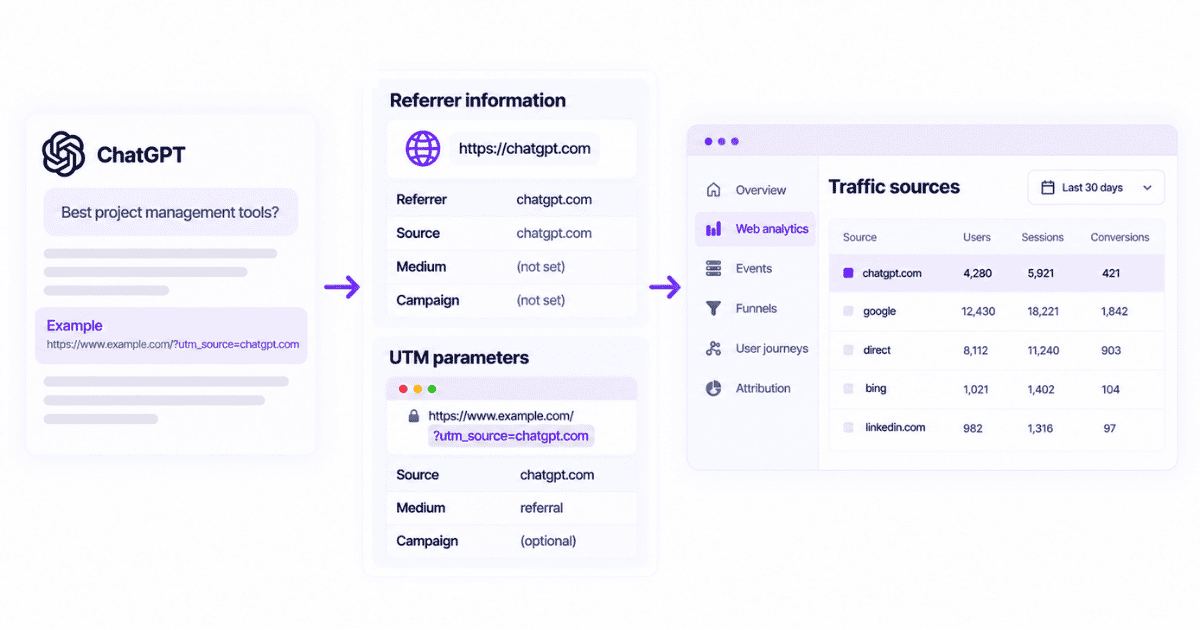
Referrer and session source
A browser may pass a ChatGPT referrer when someone clicks through to a website.
Analytics then uses that information to assign a source or channel, subject to its own classification rules.
A session source describes the visit being analyzed. First-user source addresses original acquisition, so the two can differ when someone returns through search or email.
URL parameters from ChatGPT Search
OpenAI says links from ChatGPT Search include the source parameter utm_source=chatgpt.com. Its publisher guidance explains how website owners can identify those inbound visits.
The tag helps identify eligible visits, but it should not be interpreted as a complete count of everyone who encountered a brand inside ChatGPT.
Consistent UTM parameters can also distinguish an advertiser-controlled campaign from other traffic when paid links use appropriate source and medium values.
| Signal | Useful interpretation |
|---|---|
| ChatGPT referrer | Evidence of a visit originating from a recognized ChatGPT source |
| ChatGPT Search source parameter | Explicit source information passed on eligible links |
| Session source / medium | Where the current visit is classified |
| First-user source | Acquisition source assigned to the user’s first observed visit |
| Conversion event | An action recorded after arrival |
| OpenAI crawler request | An automated request, not a human website session |
How to track ChatGPT traffic in five steps
The most useful workflow is straightforward: identify the visit, verify the source, study the landing page, track a meaningful action, and follow any later customer activity.
1. Find recognized ChatGPT sessions
Start in your analytics platform’s traffic-acquisition report and inspect source or channel values associated with ChatGPT. Record the date range and whether you are examining users or sessions.
In GA4, open Reports → Acquisition → Traffic acquisition.
Look for the AI Assistant channel under Session default channel group, then use a session-source dimension to inspect ChatGPT specifically.
Google’s default channel group documentation confirms that recognized AI-assistant referrers receive the ai-assistant medium. Google AI Overviews and AI Mode remain outside this channel.
This is enough for an initial source check. More specialized GA4 reporting can use additional source filters and Explorations when the default view does not answer the question.
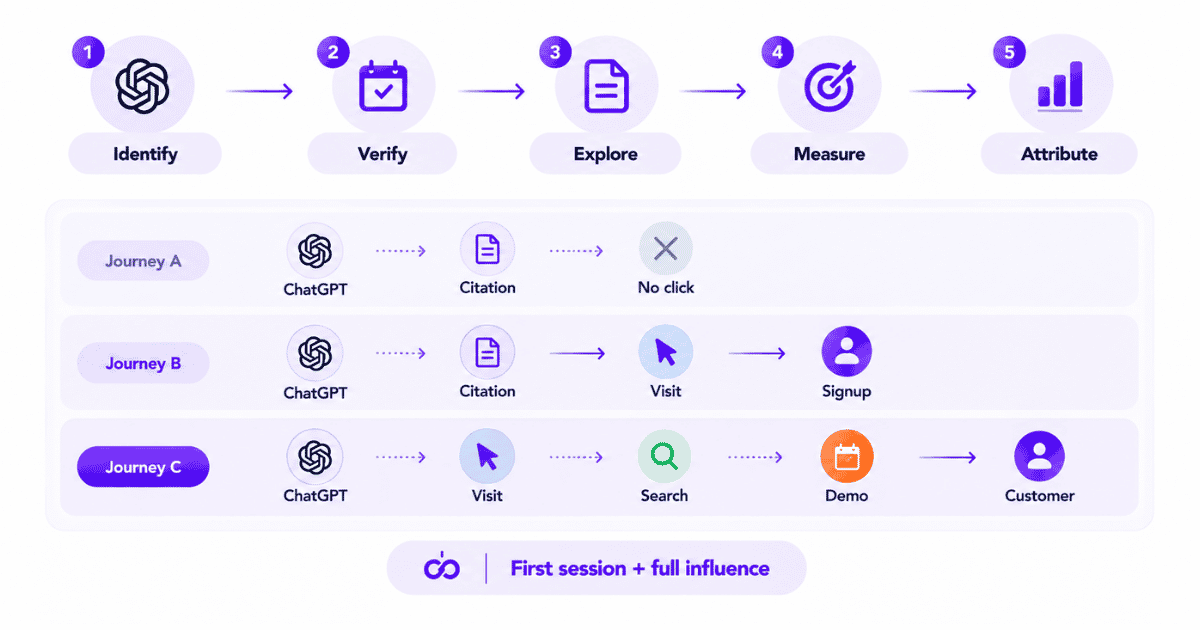
2. Validate source and channel rules
Before comparing performance, confirm whether the report includes ChatGPT Search, paid campaigns, other assistant sources, or all three.
A broad AI Assistant group is not the same as a ChatGPT-only segment.
Inspect unexpected Referral, Unassigned, and Direct traffic cautiously. A missing referrer is a measurement gap, not proof of a ChatGPT visit.
See what's working. Fix what's not. Grow faster.
3. Review ChatGPT landing pages
Identify the first pages visited after measurable ChatGPT clicks. Comparison articles, product explainers, feature pages, and pricing pages often represent different research stages.
For example, one comparison article may earn 120 visits and 12 signups, while a guide receives 200 visits but only six.
The smaller audience can still generate better acquisition efficiency.
Those figures are illustrative, not ChatGPT benchmarks. Compare pages over a consistent time window and with equivalent conversion definitions.
| Illustrative landing page | ChatGPT visits | Signups | Visit-to-signup rate |
|---|---|---|---|
| Software comparison | 120 | 12 | 10% |
| Product feature | 80 | 4 | 5% |
| Educational guide | 200 | 6 | 3% |
4. Record conversions, not just sessions
Choose events that reflect the business model. SaaS companies may track signups, activation, and upgrades. B2B teams may track demos and qualified leads. Stores may track purchases.
Verify each event fires when the action occurs. Otherwise a clean source report can coexist with missing conversions, producing the false impression that ChatGPT visitors never act.
5. Follow the journey after the first visit
A buyer might arrive through ChatGPT, leave, return from a branded search, and book a demo days later.
This is why customer journey analytics matters: a single-session report cannot explain the full sequence.
Where consent, identity continuity, and connected systems permit, follow the identifiable visitor across later sessions and compare the initial acquisition touchpoint with the eventual outcome.
Why some ChatGPT traffic goes missing
ChatGPT visits can be undercounted when referral or tracking information disappears before the analytics system records the session.
Links opened without source context
A person may copy a URL from ChatGPT into a new tab, share it privately, or arrive through a redirect. The visit may lose its ChatGPT label.
Browser privacy settings, redirects, consent decisions, or incorrect instrumentation may also affect measurement. None of these gives a reliable basis for estimating a hidden ChatGPT total.
Different channel definitions
GA4 labels recognized assistant referrals as AI Assistant. Another analytics product may use AI Search or classify some visits as Referral.
Both systems can apply consistent rules while reporting different totals because their definitions and available data differ.
Events that were never configured
A tagged visit does not guarantee a tracked conversion.
Form submissions, demo confirmations, purchases, and CRM-stage changes require reliable data collection before they can support performance reporting.
This missing-source problem belongs to broader AI traffic analytics, which also separates human referrals from automated retrieval and AI visibility.
Organic ChatGPT traffic vs. ChatGPT Ads
Not every visit associated with ChatGPT represents the same marketing activity.
A citation clicked inside a normal answer and a click on a sponsored placement should be analyzed separately.
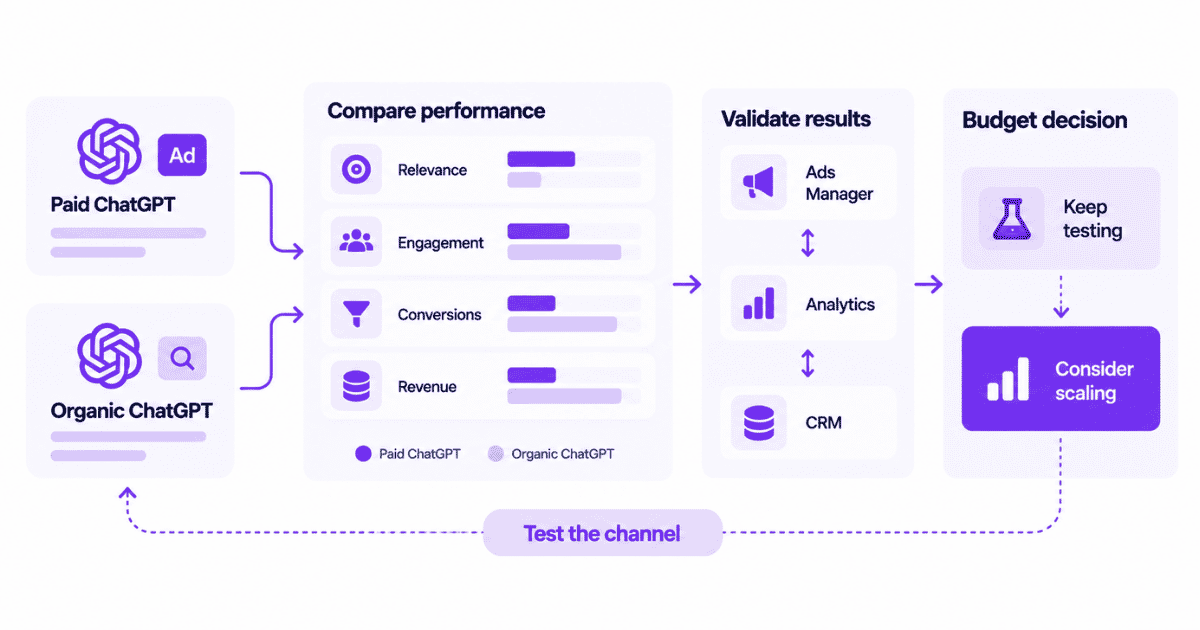
| Organic ChatGPT referral | Paid ChatGPT Ad visit |
|---|---|
| Non-sponsored link inside a ChatGPT experience | Sponsored placement with an advertiser buying process |
| Evaluate discoverability, page fit, and conversions | Evaluate campaign economics and post-click quality |
| Often identified by source or referrer signals | Should also carry deliberate paid campaign context |
Campaign source and medium rules matter because both visits may share the ChatGPT name.
Analytics tools should not automatically treat every ChatGPT-related source value as an organic referral.
Evaluating ChatGPT Ads also requires spend and platform conversion data. Website analytics then assesses the visitors who actually arrive from those campaigns.
How to measure ChatGPT traffic quality
Traffic volume is a discovery metric, not a business outcome.
A useful comparison looks at whether ChatGPT visitors engage with the right pages and complete the actions that matter.
| Metric | What it helps answer |
|---|---|
| Engagement rate | Did visitors meaningfully interact? |
| Key events | What actions occurred after arrival? |
| Landing-page signup rate | Which entry pages generate new users? |
| Demo or lead rate | Is ChatGPT generating B2B demand? |
| Activation rate | Do acquired users reach product value? |
| Revenue per identifiable visitor | What commercial value is assigned to the cohort? |
Visit-to-conversion rate = converting ChatGPT visits ÷ identifiable ChatGPT visits × 100.
Revenue per visitor = revenue attributed to the defined ChatGPT cohort ÷ identifiable ChatGPT visitors.
Use the same cohort scope, date range, conversion window, and denominator across channels. A session-based conversion rate and a user-based revenue metric answer different questions.
Compare ChatGPT with organic search, paid search, direct, and other AI assistants. Lower traffic with more qualified leads can be more valuable than high-volume, low-intent referrals.
From first ChatGPT visit to closed revenue
Consider a B2B SaaS buyer who clicks a ChatGPT comparison citation, returns through Google Search, joins a webinar, and later requests a demo.
A CRM opportunity is created weeks after the original visit.
The final session tells only part of the acquisition story; revenue attribution can help connect recorded touchpoints with pipeline or closed revenue.
First-touch reporting asks which source introduced the buyer. Last-touch reporting identifies the most recent recorded source before conversion.
Multi-touch attribution distributes credit across observed interactions under a selected model.
No model proves the deal would not have happened without ChatGPT. That requires a different kind of causal assessment.
How Usermaven analyzes ChatGPT traffic
Usermaven combines identifiable source information with website and product behavior, conversion events, customer journeys, and attribution.
The goal is to judge the value of a visit rather than stop at its referral label.
Recognize AI Search visits
Usermaven classifies recognized AI referrers and bounded source tokens, including ChatGPT, under AI Search.
Its channel mapping documentation explains how custom rules can separate paid campaigns when source and medium values are configured.
Custom channels are evaluated before defaults. That makes intentional campaign naming useful when sponsored and non-sponsored ChatGPT activity would otherwise be hard to distinguish.
Use the AI Traffic dashboard
The prebuilt AI Traffic dashboard separates human visitors from AI assistants and recognized crawler or bot activity. It can be added as a workspace template.
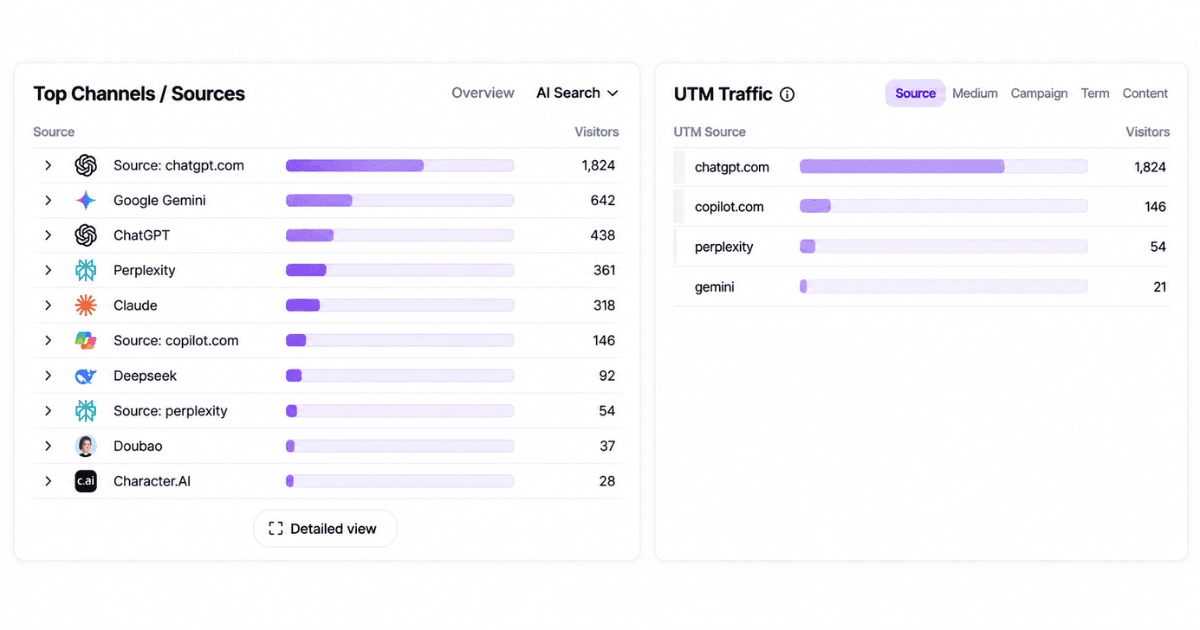
This distinction matters: a crawler fetching a page can signal retrieval activity, but it is not a human session or a conversion opportunity.
Connect visits to conversion behavior
Teams can use website analytics to inspect landing-page activity, then record meaningful Events such as signups, demos, and purchases.
A Funnels analysis shows where identifiable ChatGPT visitors drop off. Customer journeys help explain what happens when the same buyer returns through additional channels.
For B2B SaaS teams, connected CRM and revenue data can put recorded ChatGPT visits alongside qualified opportunities, subject to available identity and event data.
Question the data before trusting it
Source attribution depends on reliable collection. The Measurement Trust Center evaluates data health across collection, identity, integrations, delivery, and reliability.
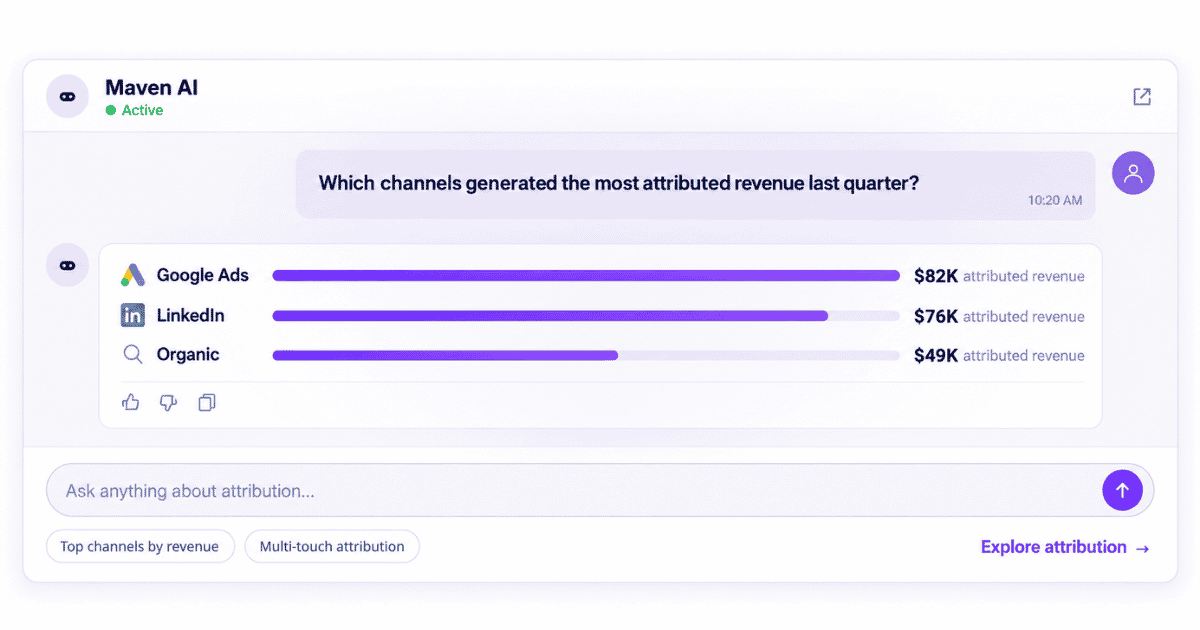
Maven AI can help investigate patterns within the collected data, such as which AI-referred landing pages precede signups. It cannot recover visits that were never identifiable or recorded.
How Contentpen used AI Search attribution
Contentpen, a SaaS content platform, needed to understand what visitors did after arriving from search and which journeys eventually led to signups.
In its published case study, the team specifically identified separating organic search and AI Search users as a useful improvement.
Better journey and funnel visibility supported faster optimization.
Across its broader analytics work, Contentpen reported a 30–32% increase in conversions, 25–28% higher engagement, and a 50% reduction in analysis time.
These are overall outcomes from Contentpen’s analytics changes, not proof that ChatGPT tracking alone caused the gains.
What ChatGPT tracking cannot prove
A ChatGPT citation is not a visit. An OpenAI crawler request is not a visitor. A direct session is not automatically an untracked AI referral.
OpenAI documents distinct automated identities for search indexing, training, and user-requested page fetches. These belong in crawler or server-log analysis, not human conversion counts.
Equally, a measurable ChatGPT first touch does not establish that the channel caused a sale. It shows what the available source, event, and attribution data can support.
The safest reporting approach is to label observable referrals clearly and acknowledge the influence that cannot be measured from a website visit alone.
Final verdict
Tracking ChatGPT traffic starts with a recognizable referral signal. Better analysis connects that visit to the landing page, engagement, conversion events, and any later customer outcomes.
Use the native analytics classifications available today, verify the source, separate paid from organic activity, and check reporting gaps before making budget or content decisions.
The most useful ChatGPT report does not simply count arrivals. It explains which identifiable visitors contributed to meaningful business results.
Book a demo to see how Usermaven connects ChatGPT-originated visits with customer journeys, conversion events, pipeline, and revenue.
FAQs
1. How can I track ChatGPT traffic to my website?
Use analytics acquisition reports to identify visits carrying recognized ChatGPT referrers or source parameters. Then review landing pages, engagement, and conversion events for that defined traffic segment.
2. Does Google Analytics track ChatGPT automatically?
GA4 recognizes eligible AI assistant referrals in its AI Assistant default channel. Visits without the necessary source evidence may appear elsewhere or remain unidentifiable.
3. Where can I find ChatGPT traffic in GA4?
Open Reports → Acquisition → Traffic acquisition, inspect the AI Assistant channel, and use a session-source dimension to narrow the view to recognized ChatGPT visits.
4. What counts as ChatGPT referral traffic?
A measurable website visit with credible source or referrer information showing that the click came from ChatGPT. Mentions, citations, and crawler requests are different signals.
5. Why does ChatGPT traffic appear as Direct?
A visit can lose source context through copying links, app transitions, redirects, or other tracking limitations. Direct does not prove ChatGPT was the original source.
6. Does ChatGPT add UTM parameters to links?
OpenAI documents a source-identifying UTM parameter on ChatGPT Search referral links. Whether analytics receives that value depends on the visit and tracking conditions.
7. Can ChatGPT traffic generate conversions?
Yes. Identifiable visitors can complete signups, demos, or purchases. The analytics system must record those events before their conversion rates can be measured.

Written by
Ryan Mitchell
Marketing Analytics Strategist
Ryan Mitchell is a marketing analytics strategist specializing in campaign measurement, customer journeys, and marketing performance. He writes about analytics, reporting, and data-driven marketing strategies, helping SaaS and B2B teams measure what matters across every stage of the customer journey.
All articles by Ryan →