Choosing an alternative to Usermaven starts with a more useful question than which platform has the longest feature list: what do you need your analytics to explain? Product teams may need experiments and session replay. Publishers may need lightweight traffic reporting. B2B marketers may need to connect campaigns with opportunities and revenue.
If those goals do not match the role of marketing attribution software in your stack, another platform may be a better investment. This guide compares 11 Usermaven alternatives using their strongest use cases, meaningful limitations, current pricing models, and the work required to migrate.
Key takeaways
- Best for product analytics: Mixpanel or Amplitude for behavioral analysis, experiments, and increasingly capable AI workflows.
- Best for developers: PostHog for analytics, flags, replay, experiments, and usage-based pricing.
- Best for simpler website reporting: Plausible or Fathom; choose Matomo or Piwik PRO when governance and deployment control matter.
- Best for B2B revenue intelligence: Dreamdata or HockeyStack deserve direct evaluation alongside Usermaven.
- Do not compare sticker prices alone: event volume, identity resolution, CRM coverage, feature entitlements, implementation effort, and reporting trust change the actual cost.
Usermaven alternatives at a glance
| Platform | Best fit | Key distinction | Published pricing direction |
|---|---|---|---|
| Usermaven (baseline) | B2B SaaS, marketing and agencies | Marketing-to-product-to-CRM revenue measurement | New-customer Business and Enterprise quotes |
| Google Analytics 4 | Web/app measurement tied to Google Ads | Broad event and acquisition reporting | Standard free; 360 quote |
| Mixpanel | Product-growth and lifecycle teams | Funnels, retention, experimentation, AI and replay | Free to 1M events/month |
| Matomo | Data ownership and self-hosting | Web analytics with control over hosting | Free self-hosted; paid cloud |
| Plausible | Lightweight website reporting | Cookie-free web analytics, goals and paid-plan funnels | From $9/month on entry plan |
| Fathom Analytics | Simple, privacy-conscious sites | Clear traffic, event and revenue reporting | From $15/month at 100k pageviews |
| Amplitude | Product analytics at scale | AI, experiments, cohorts, replay and activation | Free to 2M events/month |
| Heap | Retroactive behavior exploration | Automatic capture and product journeys | Free to 10k monthly sessions |
| PostHog | Engineering-led product teams | Analytics, replay, flags and experiments together | Free to 1M events/month |
| Piwik PRO | Regulated and compliance-heavy teams | Consent, tag management, data activation | Business from €36/month |
| Dreamdata | Account-based B2B marketing | Account-level journeys and revenue attribution | Free tier; advanced quotes |
| HockeyStack | B2B GTM and RevOps | Unified marketing, sales and revenue intelligence | Contact sales for pricing |
These are not interchangeable products. A low-cost website analytics tool might eliminate complexity but also remove account-level attribution. Conversely, a sophisticated B2B attribution platform can be excessive if you only need pageviews and goal completions.
The right alternative depends on the job
| The business question | Test these platforms | What to confirm in a demo |
|---|---|---|
| Where do users abandon onboarding? | Mixpanel, Amplitude, Heap, PostHog | Funnel step logic, identity stitching and event governance |
| Which campaigns influenced closed-won revenue? | Usermaven, Dreamdata, HockeyStack | CRM deal links, lookback windows and credit rules |
| How much traffic does each page receive? | Plausible, Fathom, GA4 | Referrer accuracy, events, exports and pageview limits |
| Where can data be hosted and governed? | Matomo, Piwik PRO | Hosting model, consent settings, retention and contracts |
| Can engineers ship experiments faster? | PostHog, Amplitude, Mixpanel | Flags, experiment exposure, cohorts and release workflow |
| Can an agency prove client ROI? | Usermaven, Dreamdata, HockeyStack | Multi-client access, attribution, branded reports and cost per client |

Where Usermaven fits, and where it does not
Usermaven connects website and product activity with acquisition, attribution and CRM outcomes. Its value is most apparent when a business needs to follow a buyer from the first marketing interaction through signup, opportunity, and closed revenue, rather than analyzing those events in isolated reports.
For B2B SaaS, its SaaS measurement workflows connect marketing sources, product usage and CRM pipeline. Agencies can use client-focused revenue reporting to evaluate which campaigns contribute to results, not just traffic.
Current strengths worth evaluating
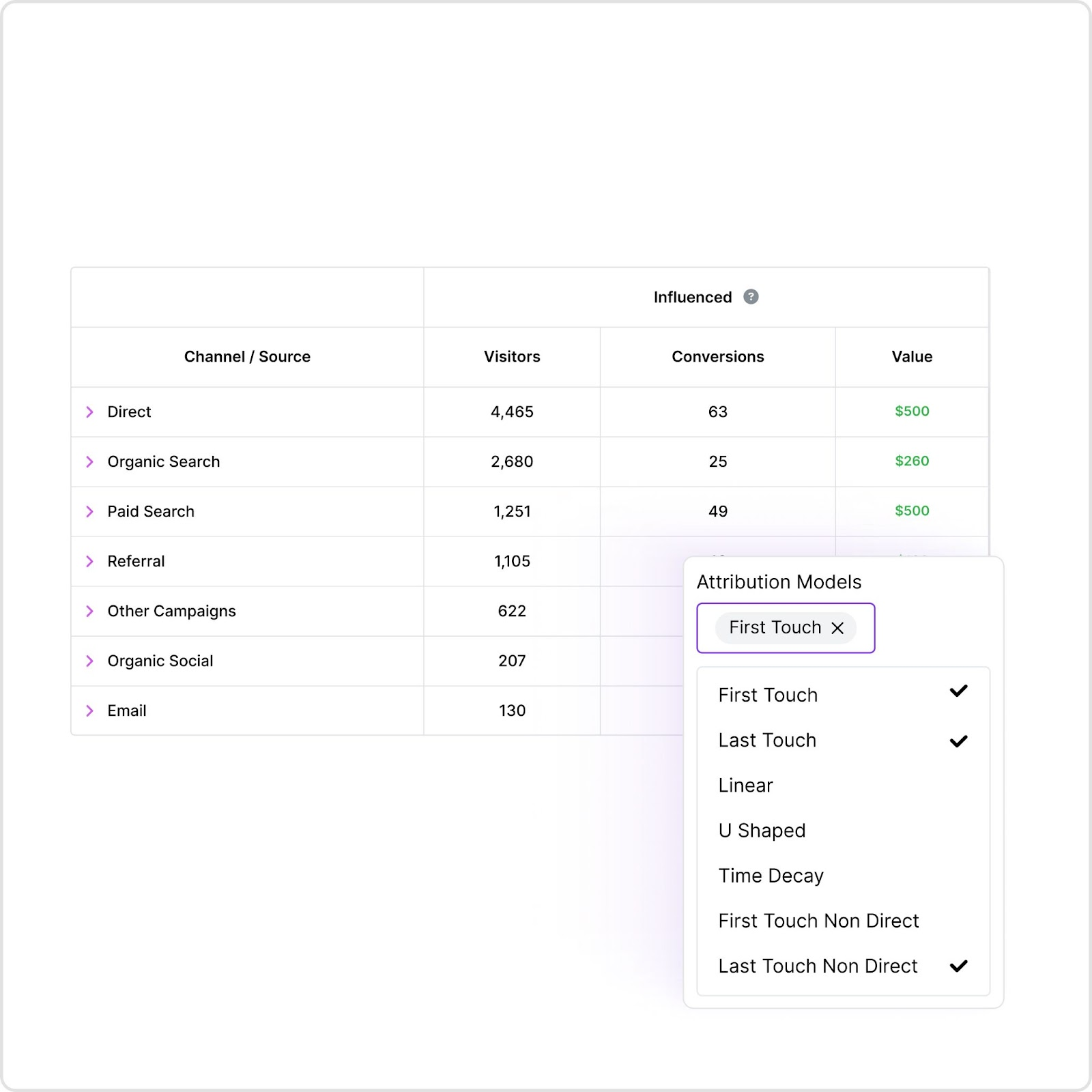
- Revenue attribution: multiple standard attribution models, conversion paths, paid channel data and CRM-linked pipeline; Enterprise workspaces can build custom attribution models.
- Product and journey context: product analytics, funnels, journeys, and behavior-based segments.
- Connected outcomes: Salesforce read-only CRM integration, HubSpot activation workflows, and imported events via Event Sources.
- AI operations: Maven AI with scheduled Agents and MCP access for supported AI clients.
- Measurement quality: a Trust Center for identifying data-health concerns before acting on reports.


When a different platform may be stronger
Choose a specialized alternative when your primary requirement is native experimentation, deep replay-led UX investigation, self-hosting, a broad Google Ads reporting workflow, or publisher-oriented site metrics. A marketing attribution platform does not automatically replace every experimentation suite, session replay system, consent platform, or data warehouse.
A pricing detail to clarify before buying
Usermaven’s current new-customer billing documentation describes Business and Enterprise as custom-quoted plans. A separate public pricing page still displays Growth at $84/month and Scale at $199/month for a 250,000-event tier. Because these published surfaces differ, confirm eligibility, included features, event limits, and the actual offer directly rather than treating either page as a universal quote.
For all alternatives, compare total annual cost at your projected volume and add the price of complementary tools and implementation. The least expensive starting tier is not necessarily the cheapest way to answer your actual question.
The 11 best Usermaven alternatives
These eleven platforms cover distinct needs across product analytics, web traffic, governance and B2B attribution. Each assessment shows when the alternative is compelling and which requirements deserve additional validation.
Google Analytics 4 for Google-centric teams

Google Analytics 4 provides event-based website and app measurement, acquisition reporting, explorations, data-driven attribution, and extensive Google Ads integration.
Its free tier is compelling for teams that already use Google marketing tools and have analysts who can maintain an event taxonomy. GA4 has Realtime reporting, so it should not be described as having no live data; standard report processing can still introduce delays.
- Choose it when: Google Ads, web analytics and cross-platform app reporting are the core requirements.
- Check before switching: Event-level retention settings, identity configuration, consent behavior, exports and CRM revenue reconciliation.
- Pricing snapshot: Standard GA4 is free; Analytics 360 pricing is individually negotiated.
For a focused comparison of conversion-path reporting, the GA4 alternative page explains where acquisition reporting and revenue attribution differ.
Mixpanel for product growth

Mixpanel combines funnels, flows, retention, behavioral cohorts, session replay, experimentation and AI-assisted analysis. It also supports campaign reporting and multi-touch attribution on eligible plans.
Mixpanel is a serious product-analysis choice when questions center on activation and engagement rather than just website sessions. It would be inaccurate to say Mixpanel cannot build complex funnels or lacks attribution altogether.
- Choose it when: Product managers need detailed behavioral analytics and a growing experimentation workflow.
- Check before switching: Account/deal attribution requirements, plan-level eligibility, governance needs, and costs above the free volume.
- Pricing snapshot: Free up to 1 million events/month; paid Growth scales with usage; Enterprise quoted.
Compare the exact customer outcome you need using Usermaven vs. Mixpanel rather than feature-count alone.
Matomo for data ownership

Matomo is a web analytics platform offered through self-hosted and cloud deployments, with strong control over collection, retention and hosting.
Matomo can be the better alternative when data residency, self-hosting and governance are purchase requirements. It also supports goals, ecommerce tracking and extended analysis through platform options, so it should not be reduced to basic page counters.
- Choose it when: The organization controls infrastructure or has strict data-processing requirements.
- Check before switching: Hosting and maintenance effort, paid extensions, feature entitlements and whether marketing-to-CRM revenue analysis is needed.
- Pricing snapshot: Self-hosted Community edition is free software; cloud plans are traffic-based.
The Matomo comparison is useful when weighing hosted marketing workflows against self-managed analytics.
Plausible for lightweight reporting

Plausible focuses on clear cookie-free website analytics, campaign sources, goal tracking and a lightweight reporting experience.
It has evolved beyond pageviews: the Business plan includes funnel analysis and visitor journey exploration. The real distinction is scope. Plausible is built around website visitors and goals, not the same account-level CRM attribution workflow as a B2B revenue platform.
- Choose it when: Fast-to-understand website and content reporting is the priority.
- Check before switching: Whether you need individual account relationships, feature retention or CRM-closed revenue rather than site-level goals.
- Pricing snapshot: Paid plans are pageview-based and start at about $9/month; feature access differs by tier.
Fathom Analytics for simple website metrics

Fathom Analytics provides a straightforward website dashboard with campaigns, event and revenue goals, exports and an API.
Its simplicity is a genuine advantage for publishers, consultants and smaller businesses. Fathom is not featureless: revenue and event tracking are included. However, it does not aim to provide full B2B account matching, product cohort analysis or pipeline attribution.
- Choose it when: Pageviews, referrers and a manageable set of conversion goals answer the business question.
- Check before switching: Whether visitor-to-account stitching or advanced activation analysis is a non-negotiable requirement.
- Pricing snapshot: From $15/month for up to 100,000 monthly pageviews; higher tiers scale by usage.
Amplitude for advanced product decisions

Amplitude offers product analytics, AI Agents, MCP, session replay, experimentation, guides and surveys within a unified product growth suite.
Amplitude is particularly compelling when teams need behavioral analytics plus experimentation and activation. Its current free plan is substantial, so any comparison must credit that rather than calling it inherently expensive for startups.
- Choose it when: Product usage, experimentation and growth lifecycle analysis outweigh acquisition-to-CRM pipeline requirements.
- Check before switching: The cost and availability of advanced account analytics, enterprise permissions and activation integrations at scale.
- Pricing snapshot: Free includes 2 million events/month; Plus usage-based above free volume; Growth and Enterprise custom quoted.
Heap for retroactive behavior analysis
Heap captures many website and product interactions automatically so analysts can define events retroactively and explore paths, funnels and friction.
Its strength is understanding what people did before you knew which interaction to tag. Heap also offers AI-assisted analysis in eligible paid tiers, but automatic capture still requires careful event definitions and data governance.
- Choose it when: Autocapture and exploratory product analytics are the central need.
- Check before switching: Session-based pricing, data retention, sensitive-field controls and limits of account-level marketing attribution.
- Pricing snapshot: Free up to 10,000 monthly sessions; paid Growth, Pro and Premier depend on usage and requirements.
PostHog for engineering-led teams
PostHog combines product analytics, session replay, feature flags, experiments and developer workflows with a modular, usage-based billing model.
It is often a better choice than an attribution-first platform if engineers want one toolkit for instrumenting, shipping, observing and iterating on product features. Its broader technical surface may be unnecessary for a marketing team that primarily needs revenue accountability.
- Choose it when: Experimentation, flags and detailed product instrumentation drive the purchase.
- Check before switching: Event taxonomy ownership, warehouse plans, replay volume and the actual cost across several billed product modules.
- Pricing snapshot: Free includes 1 million analytics events and 5,000 session recordings/month; pay-as-you-go above free allowances.
Piwik PRO for regulated businesses
Piwik PRO combines analytics, tag management, consent tooling and data activation with governance-focused deployment and enterprise support options.
Its strengths lie in regulated measurement programs where privacy architecture and data controls are central. Piwik PRO has also introduced AI integration via MCP, so blanket claims that it lacks modern automation are outdated.
- Choose it when: Compliance, data governance and consent integration come before marketing workflow simplicity.
- Check before switching: The exact deployment, module and integration entitlements for your organization.
- Pricing snapshot: Business plans start around €36/month; Enterprise capabilities are quoted.
Dreamdata for B2B account attribution
Dreamdata specializes in B2B account journeys, contact-to-company relationships, revenue attribution and audience activation.
Dreamdata is a credible alternative when a RevOps or marketing operations team wants a specialized account-based GTM data model. It has advanced attribution and its own AI/MCP capabilities, so the comparison should focus on implementation scope and workflow fit, not a supposed absence of AI.
- Choose it when: Complex multi-stakeholder buying groups and enterprise-level B2B attribution are the main use cases.
- Check before switching: CRM joins, historical coverage, data-model maintenance, sales-cycle assumptions and actual onboarding requirements.
- Pricing snapshot: Free foundational B2B analytics tier; advanced Attribution & Activation are custom-priced.
HockeyStack for revenue intelligence
HockeyStack unifies marketing and sales interactions for buyer journeys, account intelligence, GTM reporting and attributed revenue analysis.
It is a relevant direct competitor for revenue teams that need to connect campaigns to opportunities and accelerate sales workflows. The buying decision should compare the real CRM model, attribution logic, data integration and deployment complexity rather than declaring either platform universally superior.
- Choose it when: GTM teams want account-level pipeline visibility and revenue operations intelligence.
- Check before switching: Identity joins, modeling rules, data completeness, plan scope and cost for the required CRM and ad integrations.
- Pricing snapshot: Pricing is sales-led and tailored to the organization; request a quote.
Which Usermaven alternative should you choose?
A short list becomes more useful when it is based on the output a stakeholder needs, not the number of charts a vendor advertises. The table below translates common requirements into an initial shortlist.
| Priority | Start with | Do not forget |
|---|---|---|
| Marketing spend to closed revenue | Usermaven, Dreamdata, HockeyStack | Opportunity association, attribution windows, duplicate credit |
| Product activation and retention | Mixpanel, Amplitude, Heap | Identity merging, event schemas and cohort eligibility |
| Developer-controlled experiments | PostHog, Amplitude, Mixpanel | Exposure logging, flag audit and analysis integrity |
| Minimal website analytics | Plausible, Fathom | Conversion events, API exports and campaign sources |
| Google Ads and standard acquisition | GA4 | Conversion definitions, modeled events and BigQuery costs |
| Self-hosting or governance | Matomo, Piwik PRO | Deployment complexity, compliance configuration and ongoing maintenance |
What revenue attribution changes in practice
Imagine a B2B account first discovers a company via LinkedIn, revisits after reading an organic article, clicks an email, signs up for the product, and eventually closes a $20,000 deal. A product-only report may capture feature activation, while a revenue attribution report attempts to connect earlier marketing touches with that same deal.
Worked example: under a last-touch model, Email might receive $20,000 in credit. Under a linear model across four eligible touchpoints, each could receive $5,000. These are alternative distributions of the same $20,000, not $40,000 of revenue to add together. Exact allocations depend on the model, eligible touchpoints and the system’s rules.
This is where the choice between product analytics and a revenue attribution platform becomes material. Before comparing reports, agree on the revenue event, account identity, time window and attribution model. Do not label reallocated credit as incrementally generated revenue.
A relevant first-party example
In the published Hyperengage case study, attribution coverage expanded from four channels to six, and organic search became visible as a first-touch conversion source where it had previously received no such credit. The reported 22.19% visitor-to-goal conversion rate describes observed performance; it is not an isolated experiment proving that attribution caused the conversion rate.
What user feedback can and cannot establish
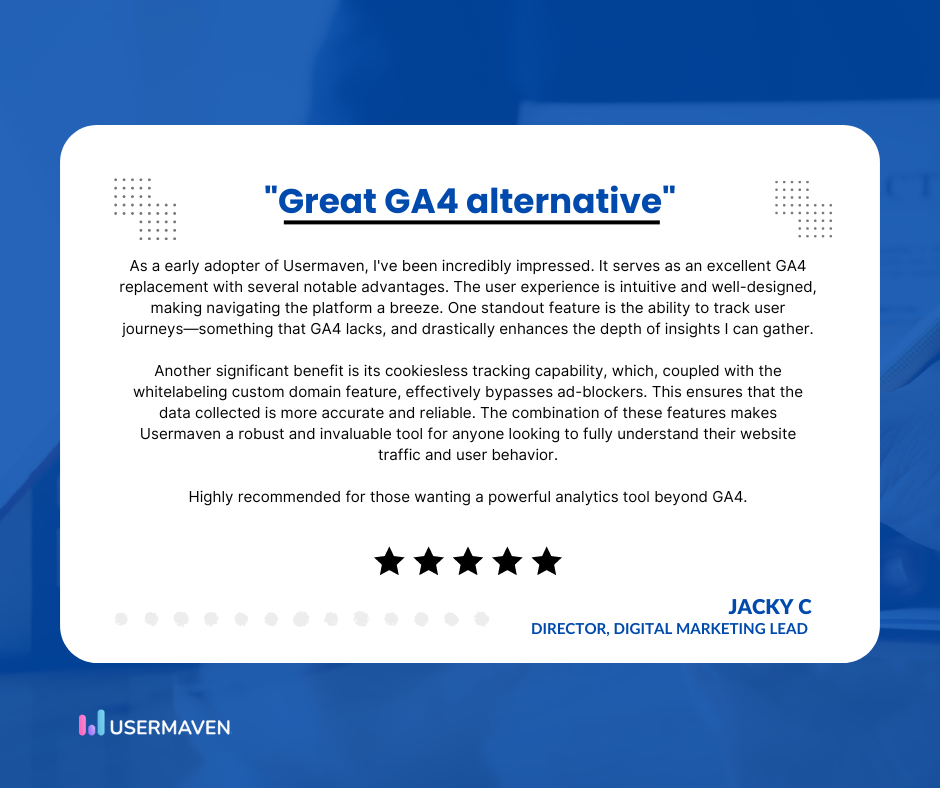
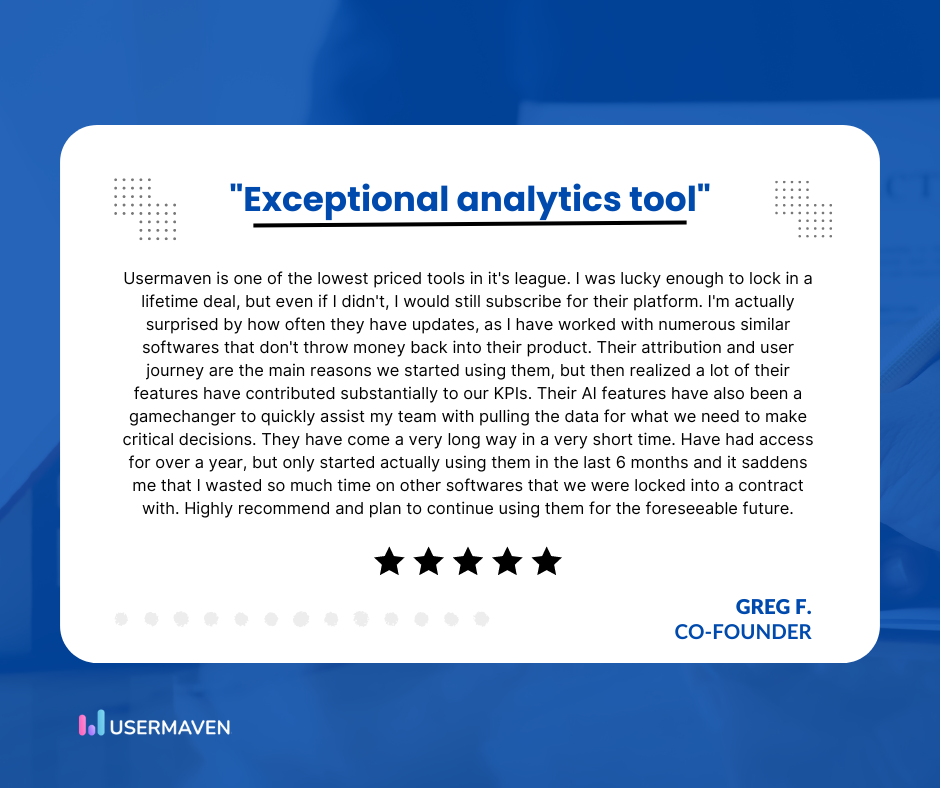
The historical review examples below illustrate users describing their experience with Usermaven. They are subjective customer feedback, not independent benchmark data or proof of performance against competing products.
Five checks before migrating analytics
Phase 1: Define the decision and source rules
Document the business questions, approved source and medium rules, campaign mapping, referrer exclusions and lookback periods. Include how AI referrals, direct traffic and untagged conversions will be treated.
Phase 2: Validate events, goals and identity
List your canonical events, signup or purchase goals, company and user IDs, deduplication keys, consent requirements and CRM opportunity identifiers. Test that each conversion is counted once under a stable definition.
Phase 3: Run both platforms in parallel
For a representative reporting window, compare sessions, users, events, goal completions and revenue across the old and new tools. Document why totals legitimately differ, including sessionization, consent, bot filtering and attribution rules.
Phase 4: Reconcile attribution and revenue
Match a sample of known CRM opportunities or orders to the analytics conversion record. Compare the same revenue population under the same attribution window before comparing models or channels.
Phase 5: Verify stakeholder workflows
Ask marketing, product, RevOps and leadership to reproduce five recurring decisions: campaign allocation, onboarding bottlenecks, qualified pipeline, retention performance and monthly reporting. Only retire the old tool when the new workflow covers the decisions you need.
Where Usermaven remains a practical choice
Usermaven is worth retaining when the business needs to join campaign performance with contact and account context, follow conversion paths into CRM stages, and compare spend with qualified revenue. The recent Events functionality and connected data features help bring outcomes into the same workspace, but the quality of attribution still depends on the source data and identity mapping.
The platform is less likely to replace a dedicated session-replay suite or experimentation stack for engineering-led product organizations, and it may be unnecessarily broad for a publisher needing only daily traffic totals. These are valid reasons to choose a competitor.

How to compare total cost of ownership
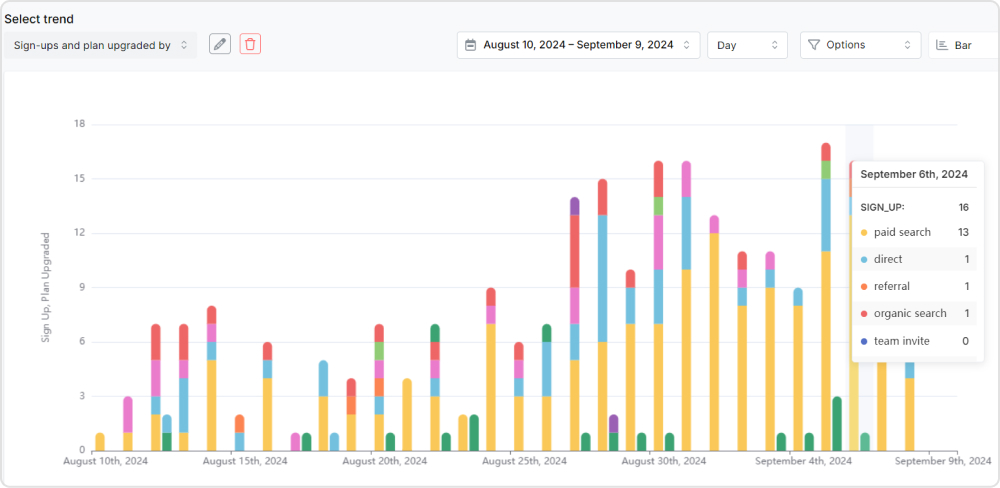
Request an estimate based on the same tracked event volume, data-retention period, users, workspaces, integrations and implementation scope. Include the engineering time needed for clean events and CRM matching, not only the starting subscription. Pricing snapshots age quickly, so confirm the commercial offer before switching.
Final verdict: Select for the outcome, not the logo
There is no universal winner among Usermaven alternatives. Mixpanel, Amplitude, PostHog and Heap can be better fits for product-analysis depth and experimentation; Plausible and Fathom are compelling for simple web reporting; Matomo and Piwik PRO excel where hosting and governance matter; and Dreamdata or HockeyStack may suit complex B2B revenue operations.
If the hard question is which campaigns, journeys and product interactions contribute to qualified pipeline and revenue, Usermaven belongs on the shortlist. Book a demo to review your attribution requirements, CRM setup and reporting goals against the platform before committing.
FAQs
Why would a business look for Usermaven alternatives?
A business may need deeper product experimentation, extensive session replay, self-hosting, lower-cost traffic reporting, or a specific B2B revenue data model. The right alternative depends on the job, budget and available implementation resources.
Which alternative is best for product analytics?
Mixpanel and Amplitude are strong choices for funnels, retention and experimentation. Heap is useful for retroactive analysis and PostHog is compelling for developer-led analytics with feature flags and session replay.
Which tools are alternatives for B2B attribution?
Dreamdata and HockeyStack are direct options for account-level revenue intelligence. Compare them with Usermaven using CRM opportunity coverage, attribution rules, identity resolution, pricing and implementation needs.
Is there a free Usermaven alternative?
GA4 has a free standard offering. Mixpanel includes up to 1 million free monthly events, Amplitude includes up to 2 million, and PostHog includes 1 million analytics events and additional free product allowances. Feature limits differ by vendor.
Are Plausible and Fathom suitable for SaaS teams?
They can be useful for website traffic, referrer and conversion-goal reporting. Plausible also offers funnels and user journeys on its Business plan. Teams needing linked account-level CRM revenue and deep product retention should test those requirements separately.
How does Usermaven pricing compare with competitors?
Usermaven new-customer billing documentation describes custom-quoted Business and Enterprise plans, while a separate public pricing page displays Growth and Scale figures. Confirm the current offer and compare event volume, feature access, integrations and support on the same basis.
Updated

Written by
Adeel Khan
Growth Marketing Expert
Adeel Khan is a full-stack SaaS marketer with 10+ years of experience in content marketing, paid advertising, analytics, and conversion rate optimization. He shares practical insights and strategies drawn from hands-on experience, helping B2B SaaS marketers improve performance and make better marketing decisions.
All articles by Adeel →