A SaaS company appears in Perplexity answers for several buyer questions. The team expects more visitors, but its analytics still show almost no Perplexity referrals.
Is Perplexity choosing the wrong pages, are readers satisfied without clicking, or is the tracking missing visits? Those are three different problems.
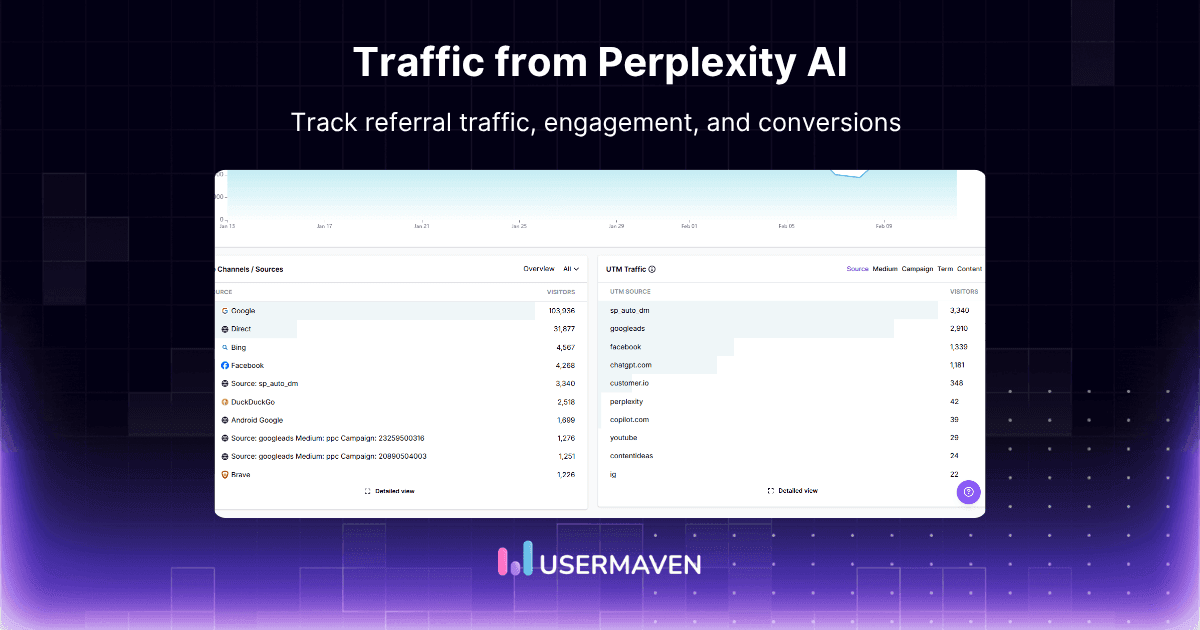
Getting traffic from Perplexity AI requires useful source content, accessible pages, and a reason to open the original website. Here, marketing attribution software helps connect referrals to actions that matter.
This guide shows how to find relevant citation opportunities, diagnose missing clicks, track referrals, and decide which Perplexity-related improvements are worth making.
Key takeaways
A useful Perplexity traffic strategy separates citation opportunities from measurable visits and checks whether those visits lead to meaningful outcomes.
Citations create opportunities, not visitors. A Perplexity reference does not guarantee a click or a customer.
Target questions with a reason to click. Detailed comparisons, research, and implementation resources can offer useful depth beyond a short answer.
Verify access before changing content. Permitting PerplexityBot helps discovery, but does not guarantee citation placement.
Keep the evidence separate. Crawler requests, sampled citations, referral sessions, and conversions count different things.
Measure qualified actions. Landing-page engagement, demos, and qualified leads matter more than referral totals alone.
Avoid causal overclaims. Revenue credit assigned to Perplexity under an attribution model is not proof of incremental revenue.
Perplexity AI traffic at a glance
First, distinguish the signal being measured. Perplexity audience estimates, automated requests, citations, and identifiable website visits are not interchangeable.
| Signal | What it measures | What it does not prove |
|---|---|---|
| Traffic to perplexity.ai | Visits to Perplexity’s own website | Visits Perplexity sends to publishers |
| PerplexityBot requests | Automated retrieval of website URLs | Human visits or citation frequency |
| Perplexity citations | Source appearances in tested answers | Referral clicks |
| Perplexity referral sessions | Identifiable arrivals from Perplexity | Every AI-influenced visit |
| Perplexity conversions | Recorded goals for an eligible cohort | The source caused the outcome |
| Attributed revenue | Credit under a defined model | Incremental revenue |
Traffic to Perplexity describes its audience. Traffic from Perplexity describes identifiable visits received by another website. This article focuses on the second question.
For the broader separation of referrals, crawlers, and visibility, see how AI traffic analytics evaluates these signals without adding them together.
Unlock insights that drive growth
How Perplexity sends traffic to websites
A Perplexity answer can expose a publisher’s content, but the publisher records referral traffic only when a visit actually reaches its website.
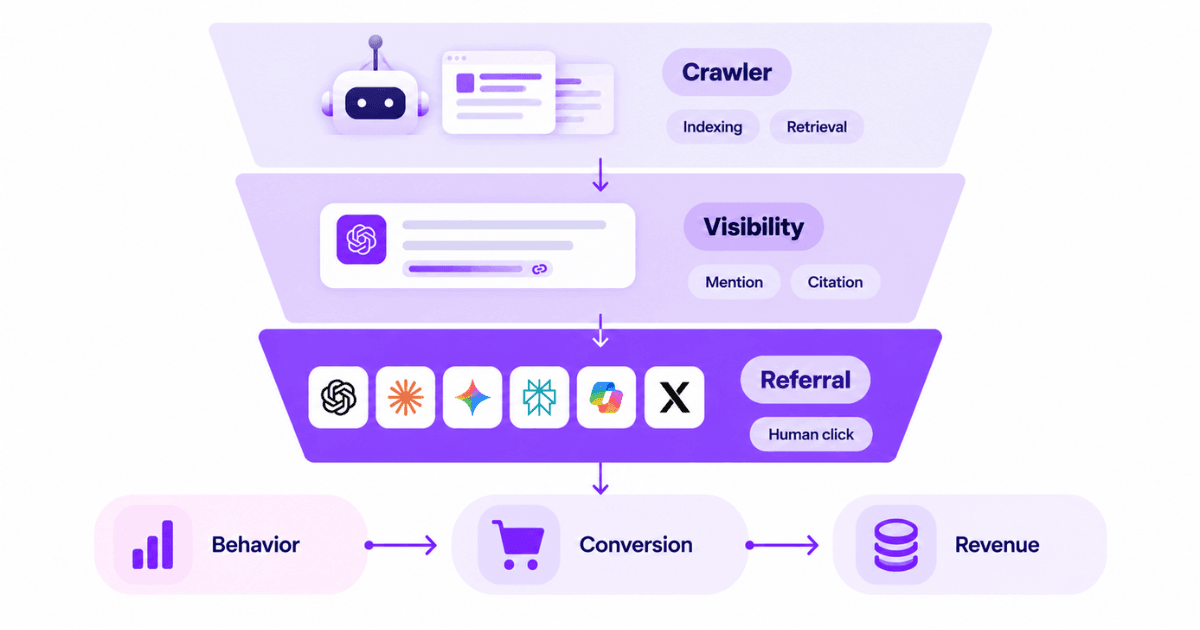
A citation provides a route to the source
Perplexity answers can include linked references to external material. When someone opens a source, the publisher has a chance to earn a website visit.
That opportunity depends on the question and the usefulness of the linked page. Many users never need to leave the answer.
A measurable visit requires a recorded click
Analytics can identify an arrival when usable source or referral information survives the browser transition. The click must also be captured by the site’s tracking setup.
A reader may instead remember a brand and return through Google or Direct. Referral analytics cannot safely label that later visit Perplexity-originated without connecting evidence.
| Discovery eligibility → Observed citation → Referral click → Website engagement → Conversion → Commercial credit. Each stage needs its own evidence. |
How to get traffic from Perplexity AI
Prioritize the questions and source pages most likely to help prospective customers make a decision, then test whether that visibility generates identifiable visits.
1. Find buyer questions worth answering
Start with customer language. Review Search Console queries, sales calls, support tickets, product comparisons, and questions prospects ask before booking a demo.
Segment potential Perplexity questions into awareness, problem-solving, and evaluation. Prioritize those related to your product’s real strengths and a meaningful next action.
For an attribution platform, “How can SaaS teams reconcile CRM pipeline with ad performance?” offers a clearer commercial context than a generic definition of analytics.
2. Study the pages Perplexity cites
Test a fixed set of relevant questions. Record the precise cited URL, page format, source depth, and what the answer leaves unresolved.
Look for gaps your team can genuinely fill: dated product comparisons, unexplained benchmarks, missing calculations, or technical advice without an implementation example.
A currently cited competitor is evidence about one observed answer. It is not a disclosed ranking factor or a guarantee that copying its format will work.
3. Publish source material worth opening
Create content that answers the core question directly but gives readers a practical reason to examine the full page. Specificity matters more than keyword repetition.
Content formats and reasons to click
| Content asset | Why it may be cited | Reason to open the source |
|---|---|---|
| Original research | A verifiable data point | Methods, tables, and limitations |
| Software comparison | Side-by-side evaluation evidence | Feature trade-offs and current pricing details |
| Technical walkthrough | A concrete procedure | Full configuration steps and examples |
| Calculator or template | A reusable decision aid | Use the working asset |
| Case study | An observed business outcome | Review process and evidence |
For broader principles about appearing in answer engines, see answer engine optimization. Here, the goal is specifically an identifiable Perplexity visitor.
4. Improve the page after the click
A technical citation should lead to a technically useful page. A comparison citation should lead to explicit criteria, alternatives, and limitations rather than a generic sales pitch.
Check mobile readability, speed, navigation, and whether the page offers a natural next action. Do not assume the most prominent CTA is the most helpful one.
5. Strengthen evidence and maintenance
Use original figures, attributed sources, accurate product descriptions, and clear update practices. Review significant changes to products, facts, and examples when freshness affects the answer.
Accessible, credible material creates a better basis for evaluation. None of these editorial practices guarantees a Perplexity citation or a higher referral count.
See what's working. Fix what's not. Grow faster.
Check whether Perplexity can access content
Before improving a page for citations, confirm that relevant content is reachable and that automated retrieval is not being blocked unintentionally.
Distinguish PerplexityBot from Perplexity-User
Perplexity documents two automated identities. PerplexityBot supports surfacing and linking websites in search results. Perplexity-User can retrieve a page during certain user-requested actions.
Neither automated fetch should be counted as a person visiting the website. Perplexity-User may ignore robots.txt rules because it operates in response to a user request.
Access and evidence checks
| Check | What to confirm | What it means |
|---|---|---|
| Page response | Important URL returns usable content | Page can be reached |
| robots.txt | PerplexityBot access is not prohibited | Discovery access is permitted |
| Firewall / CDN | Legitimate bot requests are not blocked | Requests can reach the page |
| Bot identity | User agent and published IP ranges align | Stronger confidence about the requester |
| Server log | URL, timestamp, status, and requester recorded | Automated access can be audited |
The official Perplexity crawler documentation provides bot descriptions and current IP-range endpoints. User-agent text alone can be spoofed, so use the published verification guidance.
Perplexity recommends allowing PerplexityBot for search discovery. That enables access; it does not prove indexing, citation, ranking, or traffic.
How to check Perplexity citations
Track citations with a repeatable set of questions, rather than treating a few isolated Perplexity answers as a reliable visibility trend.
Choose a repeatable question sample
Begin with 30–50 commercially relevant questions, grouped by intent. This is a manageable working sample, not a statistically representative sample of all Perplexity searches.
Fix the question wording before the test. Record date, location and account conditions when available, and avoid changing several testing variables at once.
Capture citations, not impressions you cannot see
For each query, record whether the brand was mentioned, whether its URL was cited, and which competitor URLs appeared. Preserve the complete cited path.
Where Perplexity links to a different page than expected, note whether that page answers the question better or simply offers a different kind of evidence.
Calculate sampled citation frequency
Sampled citation frequency = tested questions citing at least one target URL ÷ all tested questions × 100.
Illustrative example: a team tests 40 questions and observes citations to its website in 12. Its sampled citation frequency is 30% (12 ÷ 40).
This does not mean the brand appears in 30% of all Perplexity answers, or that the 12 observed citations generated measurable clicks.
| Citation checks observe answers for a defined question sample. Referral analytics observes recorded visitors. Their denominators are not interchangeable. |
Why Perplexity citations may not bring traffic
When citations rise but referrals do not, identify the specific missing step before assuming that analytics is broken.
Diagnosing the citation-to-visitor gap
| Observed symptom | Possible cause | Better next check |
|---|---|---|
| Crawler activity, no citations | Accessible page not selected in tested answers | Query relevance and source usefulness |
| Citations, no referrals | Answer satisfies readers; weak click value | Question intent and linked-page depth |
| Referrals classified elsewhere | Source or channel rules differ | Referrer, session source/medium |
| Visitors exit quickly | Poor match between question and page | Landing-page usefulness and engagement |
| Visits, no tracked demos | Conversion friction or missing event | Event firing and funnel step |
| More visits, fewer qualified leads | Different question mix or intent | Qualified conversion rates |
A citation without a click can reflect complete answer satisfaction rather than a tracking error. A click without a conversion can reflect poor fit, friction, or unreliable event collection.
Prioritize the explanation that fits the available evidence. Do not infer an unobserved click simply because a page was cited.
How to track traffic from Perplexity AI
Source-level analytics can show recognizable Perplexity arrivals, while landing-page and event reports explain what happens after those visits.
Find identifiable Perplexity sessions in GA4
Open GA4 → Reports → Acquisition → Traffic acquisition. Review Session default channel group, then inspect Session source / medium for recognizable Perplexity values.
GA4 can classify eligible AI-assistant referrals under its native AI Assistant channel, but source evidence and configuration determine what actually appears in a given report.
Google’s default channel documentation distinguishes the AI Assistant channel from Google AI Overviews and AI Mode, which belong to Organic Search.
Inspect landing pages and event quality
Compare Perplexity session sources with landing pages, engagement, and key events over the same reporting period. Look for pages receiving useful traffic but few downstream actions.
Test important demo or signup events independently. An empty conversion column can reflect missing goals, not necessarily an absence of qualified visitors.
Treat missing source information as unknown
Redirects, privacy controls, browser behavior, and tracking restrictions can affect referral recognition. An unexplained Direct visit is not sufficient evidence of Perplexity origin.
Use consistent session definitions when comparing tools. A users count from one platform should not be compared directly with session totals from another.
For intentionally tagged campaigns, consistent UTM parameters help document source and medium. Tags cannot reconstruct Perplexity referrals whose original source information was never received.
The full multi-platform setup belongs in the dedicated Tracking AI Traffic guide; this section concentrates on Perplexity-specific interpretation.
How to convert Perplexity visitors
The landing page must continue the visitor’s research and offer a relevant next step. A referral by itself is not a conversion.
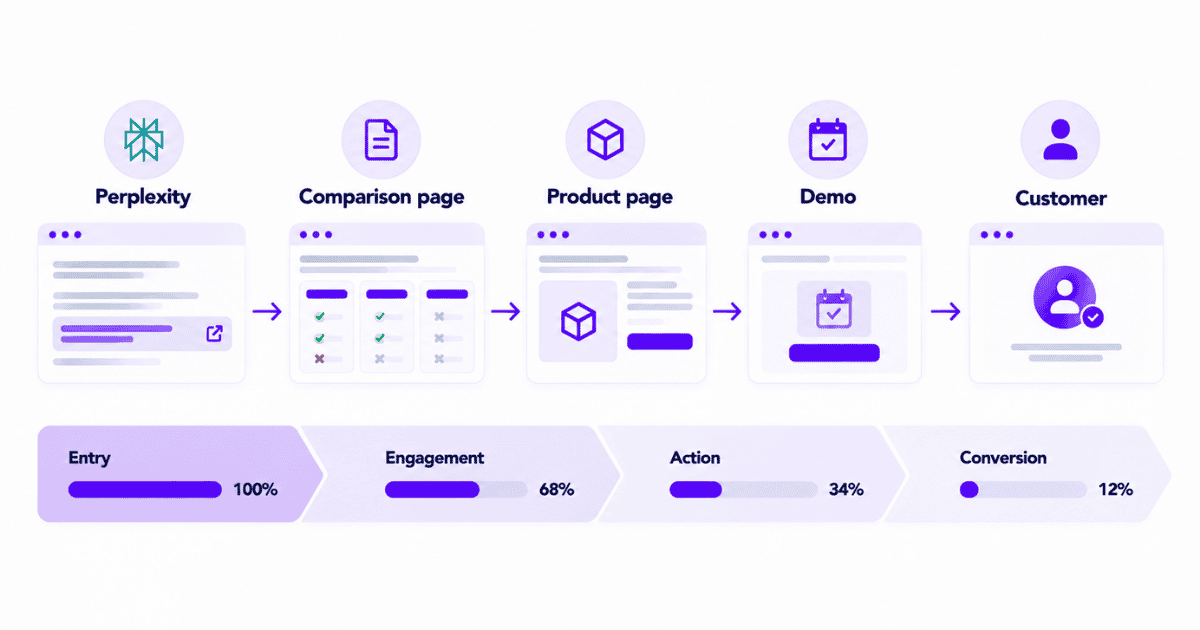
Match the page with the visitor’s next question
A visitor from a software comparison may want proof of fit, limitations, and implementation details. A visitor from an educational answer may need a worked example or checklist.
Connect the source content with its natural next step. Avoid sending every Perplexity visitor to the same generic demo prompt.
Measure the progression, not only the arrival
For B2B SaaS teams, useful outcomes might include pricing-page evaluation, trial signup, activation, demo request, and qualified opportunity creation.
Each step needs a consistent event definition. Compare cohorts using the same period and measure before drawing conclusions about referral quality.
Diagnose the drop-off
If identifiable Perplexity visitors read a comparison but rarely request a demo, investigate clarity, friction, and message match before dismissing the source.
If events are not firing correctly, fix tracking first. A funnel cannot diagnose actual behavior when its measurements are incomplete.
Which Perplexity traffic metrics matter?
Judge each metric by the decision it supports, keeping sampled answer visibility separate from traffic, conversion rates, and later commercial outcomes.
Metrics and decisions
| Metric | What to calculate or inspect | Decision supported |
|---|---|---|
| Sampled citation frequency | Cited questions ÷ tested questions | Which question groups show citations? |
| Identifiable referral sessions | Sessions with a recognized Perplexity source | Is measurable referral traffic growing? |
| Landing-page mix | Entry URLs in the Perplexity cohort | Which pages attract useful visits? |
| Session conversion rate | Converting sessions ÷ eligible sessions | Do identifiable visitors take action? |
| Qualified opportunities | Matched opportunities from the defined cohort | Are tracked outcomes commercially useful? |
| AI-assisted paths | Conversion journeys with an eligible recorded AI touch | Is AI involved in later conversions? |
One example, four different evidence levels
Suppose a SaaS company tests 40 commercial questions, sees 12 cited answers, records 80 identifiable Perplexity referral sessions, and observes four demo-converting sessions.
Two matched opportunities subsequently emerge from its defined referral cohort. All figures are illustrative, not observed customer results or industry benchmarks.
Illustrative measurement snapshot
| Measurement | Result | Correct interpretation |
|---|---|---|
| Questions tested | 40 | Defined prompt sample |
| Questions with site citation | 12 (30%) | Citation frequency within sample |
| Perplexity referral sessions | 80 | Identifiable visits in reporting month |
| Demo-converting sessions | 4 (5%) | Session conversion rate for cohort |
| Matched qualified opportunities | 2 | Downstream outcomes linked under stated matching rules |
The 12 citations cannot be assumed to have produced the 80 sessions. The two opportunities do not establish that Perplexity caused those sales outcomes.
Session conversion rate = 4 demo-converting sessions ÷ 80 identifiable Perplexity sessions × 100 = 5%. The numerator counts distinct converting sessions, not event repetitions.
If a team needs to allocate commercial credit across returning visits and channels, AI traffic attribution explains the separate model-based calculation.
A five-step Perplexity traffic audit
Run this sequence before investing more in Perplexity-specific content. Each phase should produce a recorded output that can be compared after changes.
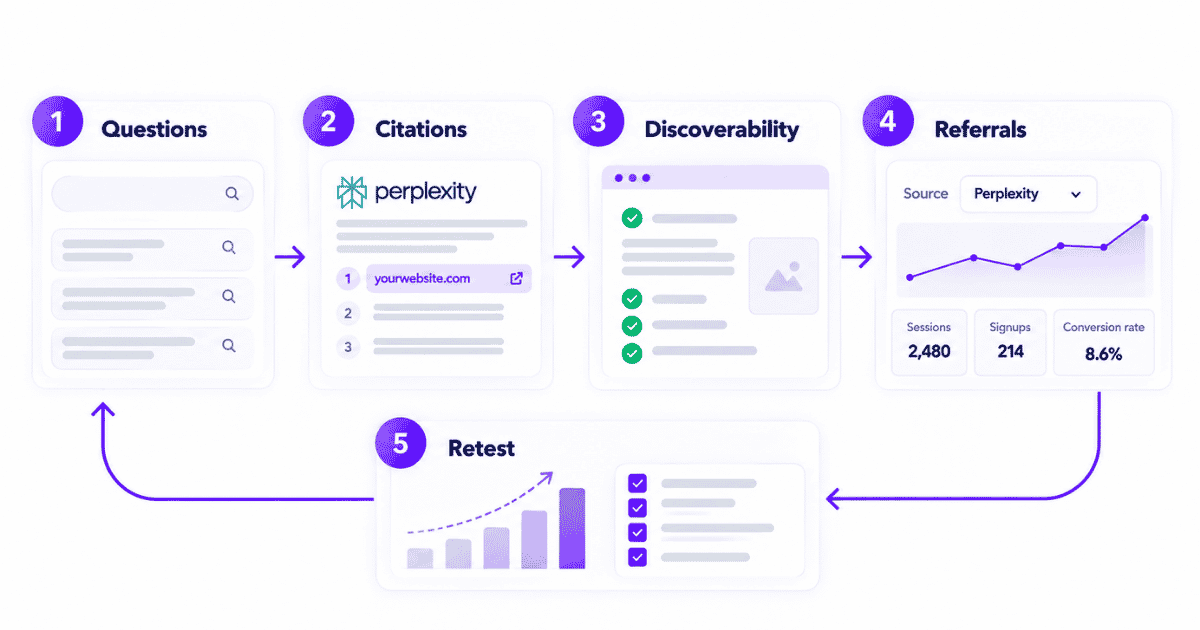
1. Prioritize questions with business intent
Create a fixed list of questions and group them by awareness, implementation, and evaluation. Flag those directly connected to the product and an actionable page.
Output: a ranked query list with the customer question, target URL, and intended next action.
2. Record observed citation visibility
Check the same questions under documented conditions. Capture the cited URLs and identify which answers include the brand without citing its website.
Output: a question-level citation ledger, not an estimated share of all Perplexity answers.
3. Audit technical access and source usefulness
Test page responses, robots directives, bot access, and firewall restrictions. Then assess whether each target URL offers meaningful information beyond the summarized answer.
Output: prioritized technical fixes and content gaps with an owner for each.
4. Reconcile referrals with conversion data
Review recognizable Perplexity sessions, landing pages, event collection, and conversion rates. Separate classification issues from genuine visitor behavior.
Output: a source-level report with collection limitations and clearly scoped conversion metrics.
5. Retest and decide what changes next
Make specific improvements, record the dates, and repeat the same citation and analytics checks. Avoid changing the question sample during a before-and-after comparison.
Output: a documented keep, improve, or stop decision for each content experiment.
| The aim is not more citations at any cost. It is relevant discovery that can be connected to useful visitor outcomes. |
How Usermaven measures Perplexity traffic
Usermaven supports the observable part of this journey: classifying recognizable Perplexity visits, reviewing their behavior, and validating conversion data.
Identify Perplexity as an AI Search source
Usermaven recognizes supported Perplexity referrer and source signals within AI Search. Its custom channel rules can also refine classification when the default reporting category is insufficient.
The documented AI Search channel mapping uses recognized referrers and token-bounded source values. It does not manufacture a Perplexity origin for unknown traffic.
Review landing behavior and conversion paths
Website analytics can show which pages identifiable AI-referred visitors open. Events capture meaningful actions, such as a signup or demo request.
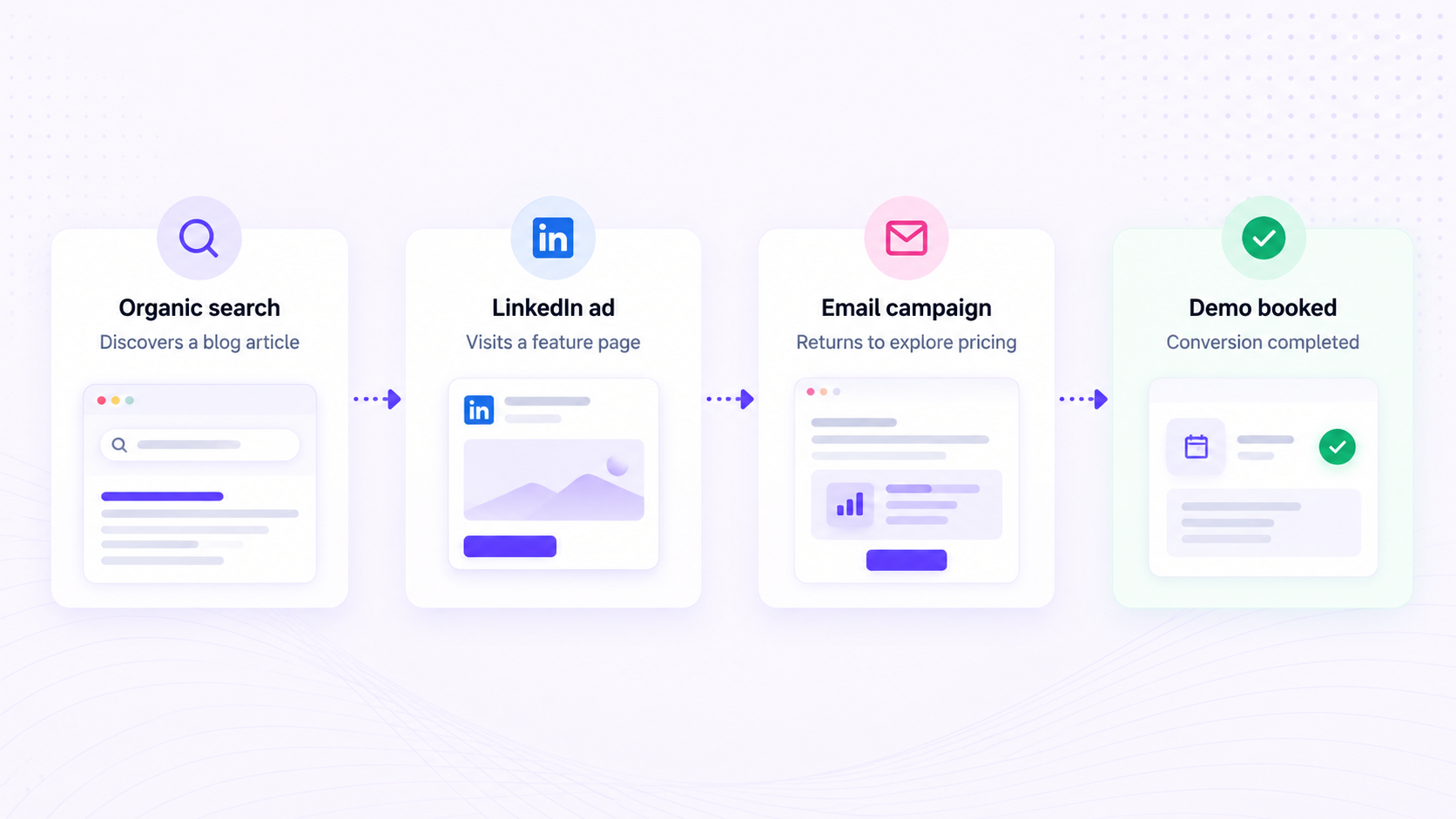
Funnel analysis helps diagnose observed drop-offs, while customer journeys can reveal connected returning visits when identity continuity permits.
The AI Traffic dashboard provides separate views for human AI referrals and recognized AI crawler activity. These two views answer different questions and must not be merged.
Check whether the measurement is trustworthy
Usermaven’s Measurement Trust Center highlights issues with campaign tracking, customer matching, connected platforms, conversion feedback, and data confidence.
That helps teams investigate reporting gaps before changing acquisition strategy. It cannot recover an unidentified Perplexity visit when no usable source signal exists.
First-party evidence: Contentpen
In the Contentpen case study, the team described separating Organic Search from AI Search users as a meaningful improvement in understanding acquisition and behavior.
Its broader engagement and conversion results were not isolated Perplexity outcomes, so they should not be presented as proof of Perplexity-specific revenue growth.
What Perplexity traffic data cannot prove
Crawler requests do not establish source citations. Observed citations do not establish clicks. Referral sessions show identifiable arrivals, not every buyer influenced by an answer.
Likewise, a connected conversion does not automatically establish that the original AI interaction caused the purchase. Model-assigned attribution credit and incremental effect answer different questions.
A manual citation audit cannot reveal Perplexity’s complete distribution of impressions or the queries that produced every recorded referral visit.
Use these limits as reporting labels, not reasons to stop measuring the evidence that is available.
Final verdict
Traffic from Perplexity AI starts with commercially useful questions and credible, accessible source pages. Citations can create discovery, but only identifiable clicks become referral traffic.
Measure the landing pages, conversion events, and qualified outcomes that follow. When results disappoint, diagnose whether the problem is visibility, click value, visitor fit, or collection quality.
Explore how AI referrals contribute to your measurable customer journeys. Book a demo to see how Usermaven connects recognized AI traffic with on-site behavior and conversion reporting.
FAQs
These answers address common questions about Perplexity citations, referral tracking, and the limits of measurable AI-originated visits.
1. How can I get traffic from Perplexity AI?
Target relevant buyer questions, publish useful accessible source pages, check observed citations, and measure referral visits. Perplexity may cite a page without sending visitors, so optimize for meaningful click value.
2. Does Perplexity AI send traffic to websites?
Yes. People can open linked sources in Perplexity answers. A citation creates an opportunity to visit the website, but no click is guaranteed and some source information may be lost.
3. How does Perplexity choose websites to cite?
Perplexity uses retrieval and source-selection systems to support answers. Relevant, accessible, credible content may be useful, but its complete source-ranking rules are not publicly disclosed or guaranteed.
4. How can a website get cited by Perplexity?
Check technical accessibility, answer relevant questions clearly, contribute original evidence, and review a repeatable sample of Perplexity queries. None of these steps guarantees citation placement.
5. How is Perplexity traffic tracked in GA4?
Open Traffic acquisition, inspect recognized AI Assistant traffic, and review Session source / medium for Perplexity-related values. Validate the reporting period, source evidence, and conversion events.
6. Why can Perplexity cite a page without sending visitors?
The generated answer may satisfy the reader, or the source page may offer insufficient extra value to justify a click. Missing referral signals can also limit what analytics identifies.
7. What is the difference between PerplexityBot and a visitor?

Written by
Adeel Khan
Growth Marketing Expert
Adeel Khan is a full-stack SaaS marketer with 10+ years of experience in content marketing, paid advertising, analytics, and conversion rate optimization. He shares practical insights and strategies drawn from hands-on experience, helping B2B SaaS marketers improve performance and make better marketing decisions.
All articles by Adeel →