Heap, Pendo, and Mixpanel all help teams understand product behavior. But they solve different problems: Heap emphasizes retroactive behavioral analysis, Pendo combines product analytics with in-app guidance, and Mixpanel focuses on event-based exploration and experimentation.
The harder question is whether any of them connects campaign performance to pipeline and revenue. Teams evaluating marketing attribution software should assess that requirement separately from product engagement. This comparison explains the features, implementation trade-offs, pricing models, and where Usermaven fits.
Heap vs. Pendo vs. Mixpanel: Key differences
Start with the job your team needs the platform to do. A product manager designing onboarding has a different buying checklist from a growth marketer reporting channel ROI.
| Primary focus | Heap | Pendo | Mixpanel | Usermaven |
| Best fit | Retroactive product behavior analysis | Product adoption and in-app guidance | Event-based product analytics | Marketing attribution plus web and product analytics |
| Data collection | Autocapture, defined events | Automatic interaction collection, tagged pages/features, track events | Autocapture plus custom events | Automatic capture plus configured business goals |
| Distinctive strength | Analyze earlier interaction data | Guides, onboarding, user feedback | Funnels, retention, cohorts, experiments | Channel, campaign, CRM and conversion-path reporting |
| Primary trade-off | Event organization and analytics governance | MAU-based cost and adoption-oriented emphasis | Business context still needs well-defined events | Not a native in-app guide builder |

Heap: Useful when a product team wants to examine historical clicks and workflows without predefining every interaction. Autocapture reduces instrumentation work, but event definitions and analysis still need governance.
Pendo: Strong for improving in-product onboarding and feature adoption. Analytics and guides work together, so teams can identify a friction point and respond with a walkthrough or message inside the product.
Mixpanel: Strong for behavioral segmentation, product funnels, retention, and experimentation. Its modern setup supports autocapture as well as precisely instrumented events for key business actions.
Usermaven: Combines product analytics with marketing attribution so teams can analyze both feature usage and the channels, campaigns, and contacts associated with conversion. It is a better fit when analytics must inform acquisition and revenue decisions.
Implementation and data collection
The old assumption that Heap captures automatically while Mixpanel and Pendo require entirely manual tracking is no longer accurate. All three can collect common interaction data, although they differ in how events become useful reports.
| Implementation question | Heap | Pendo | Mixpanel | Usermaven |
| Common web interactions | Autocaptured | Recorded after install; tag pages/features | Autocapture available | Auto-captured |
| Business-specific events | May need definitions or added instrumentation | Custom Track Events may require code | Custom events for precise semantics | Define goals and custom events as needed |
| Historical interpretation | Retroactive event definition | Retroactive feature/page tagging | Analyze events captured since instrumentation | Depends on events captured and identities resolved |
| Main ongoing work | Event governance | Guide/feature tagging, administration | Tracking taxonomy and cohort definitions | Goal, channel and identity validation |
Heap automatically captures many interactions, making it possible to define useful events after the fact. However, tracking a meaningful business milestone still requires agreement on what qualifies and how events should be named.
Pendo begins collecting interaction data after its SDK is installed. Teams can tag pages and features retroactively in its visual designer. More specialized Track Events can require developer instrumentation, so calling Pendo wholly manual is misleading.
Mixpanel introduced Autocapture for commonly tracked website and app interactions. Product teams can then add custom events for more exact measurements such as activated accounts, completed orders, or paid upgrades.
Usermaven simplifies initial event collection, but reliable attribution also depends on conversion goals, campaign tagging, and identity mapping. Its Measurement Trust Center is relevant when checking whether data quality issues affect analysis.
Product analytics and user experience

A strong product analytics tool should help answer three questions: What did users do? Where did they stop? Which behavior predicts continued usage? Heap and Mixpanel are particularly capable here; Pendo connects similar evidence directly to product adoption workflows.
| Capability | Heap | Pendo | Mixpanel | Usermaven |
| Funnel reporting | Yes | Yes | Yes | Yes |
| Behavioral cohorts | Yes | Yes, using segments | Yes | Yes, using segments/cohorts |
| Retention analysis | Yes | Yes | Yes | Yes |
| Session replay | Plan/add-on dependent | Included in select paid plans | Plan-based allowances | Not its core positioning |
| In-app guides | Not a core native offering | Core strength | Not a core native offering | Not a native guide builder |
| Campaign-to-revenue focus | Not primary | Not primary | Campaign and attribution reporting | Primary differentiator |
For deeper feature adoption analysis, Heap can surface product friction from automatically captured interactions. Mixpanel lets analysts segment funnels and retention behavior in detail. Pendo adds product engagement interventions such as guides and onboarding experiences.
Usermaven brings funnels, user journeys, and segments together with acquisition analysis. It helps teams compare whether users from different channels activate, adopt features, and progress toward a defined commercial goal.
Marketing attribution and conversion paths

Marketing attribution is a different problem from tracking product events. An event report can show that a visitor signed up, but a marketer may also need to know which paid campaigns, organic sources, and CRM activities contributed to that conversion.
| Attribution question | Heap | Pendo | Mixpanel | Usermaven |
| Referrer and UTM capture | Yes | Implementation-dependent | Yes | Yes |
| First-/last-touch context | Available from attribution properties | Not a central marketing workflow | Campaign attribution reporting | Dedicated attribution views |
| Multi-touch reporting | Possible through queries/integrations | Not the product focus | Available | Built-in models and Enterprise custom models |
| Ad spend and channel ROI | Usually requires additional work | Not core | Possible with configured data | Paid channel and conversion reporting |
| CRM and pipeline context | Requires integrations/analysis | Not core | Requires integrations/analysis | CRM connections and stage-based reporting |
Heap captures referrers and UTMs and supports initial vs. later-touch analysis. It is inaccurate to describe Heap as having no attribution. However, teams needing spend-adjusted, multi-touch revenue reports may require additional data modeling or integrations.
Mixpanel includes campaign reporting and multi-touch attribution. Its strength remains connecting events and cohorts within product analytics; buyers should verify whether their specific ad spend, CRM, and pipeline requirements are supported in their chosen configuration.
Pendo centers analytics on product adoption, not on measuring the complete marketing-to-pipeline journey. Its in-app guidance may be more valuable than a broader attribution tool when the primary goal is onboarding and feature discovery.
Usermaven supports multi-touch attribution and conversion-path analysis, with stage-based attribution and Salesforce/HubSpot connections. Enterprise workspaces can configure custom attribution weights and channel multipliers; this should not be represented as available on every plan.
Measurement tip: Compare attribution models as alternative credit allocations. If one $10,000 deal is shown as $10,000 under first-touch and $10,000 under linear attribution, it is still one $10,000 deal—not $20,000 of revenue.
Funnels, retention, and feature adoption

All four platforms can support conversion funnel analysis. The important difference is the next action: Heap helps investigate paths and friction, Pendo can deliver guidance inside the product, and Mixpanel supports detailed segment and retention exploration.
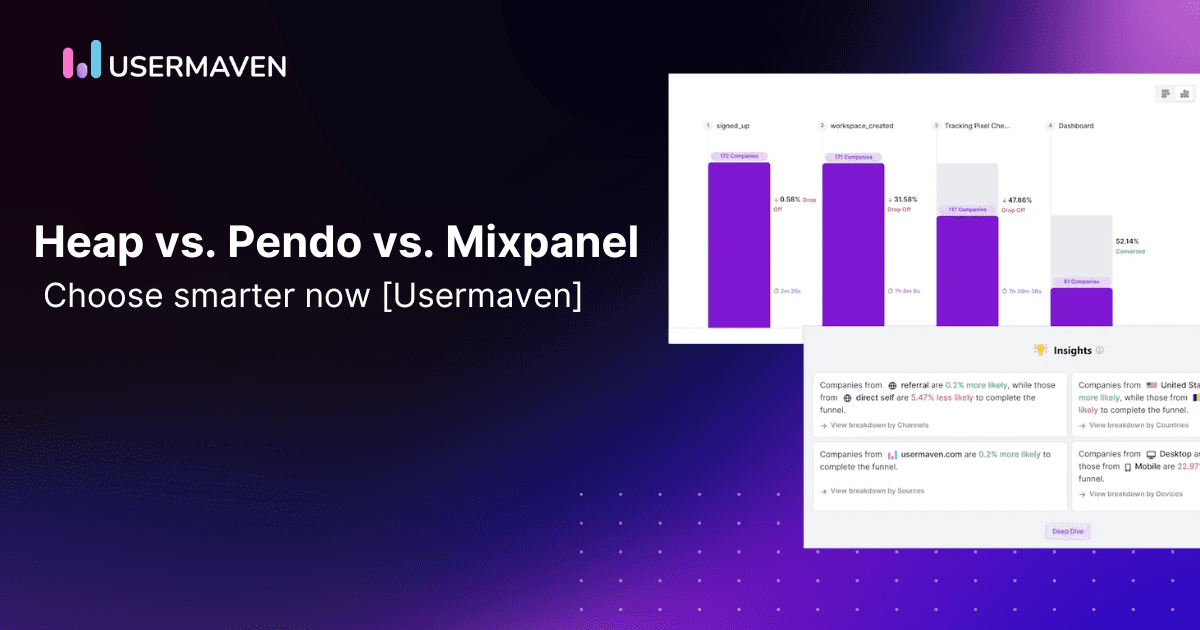
For a SaaS team, an informative funnel might be signup → first key action → invited teammate → activated account. That requires stable event definitions and a consistent counting unit, such as users or accounts, regardless of which tool is used.
Usermaven adds channel and campaign context to this analysis, helping marketing and product teams test whether acquisition sources are producing qualified, activated users rather than only signups. More information on the measurement design appears in our funnel analysis guide.
AI capabilities in each platform

AI capabilities are now a genuine comparison category across all four platforms. Claims that Heap or Pendo lack AI—or that Mixpanel provides no meaningful AI assistance are outdated.
| Platform | AI capability | Practical use |
| Heap | Sense AI | Query product behavior and speed up report exploration |
| Pendo | Leo, AI insights, Agent Analytics | Explore adoption, feedback, and interactions with AI agents |
| Mixpanel | Mixpanel Agent and MCP | Ask product questions and work with analysis from connected AI tools |
| Usermaven | Maven AI and scheduled Agents | Investigate analytics, monitor adoption and journey changes, share proactive insights |
Usermaven’s Maven AI now supports recurring Agents for feature adoption, journey drop-offs, and retention signals, plus multimodal analysis. The relevant buyer question is not simply which vendor has AI, but which assistant can access the data and workflows your team actually needs.
Heap vs. Pendo vs. Mixpanel pricing
These platforms use different billing units, so comparing headline prices alone is misleading. Request the expected cost at your actual event volume, active-user count, retention requirement, and feature tier.
| Platform | Published entry point | Primary scaling factor | What to check |
| Heap | Free plan up to 10,000 monthly sessions | Sessions and plan | History, replay, AI, integrations |
| Pendo | Free up to 500 MAUs; paid Base, Core and Ultimate quoted | Monthly active users and feature bundle | Guides, replay, modules, contract |
| Mixpanel | Free up to 1 million events monthly; paid Growth and Enterprise | Events and add-ons | Reporting limits, replay, group analytics |
| Usermaven | Business and Enterprise custom quotes for new customers | Scope, volume and business requirements | Attribution features, AI, CRM connections, security |
Heap: The official pricing page lists a Free plan and Growth, Pro, and Premier tiers. History, AI, support, and replay availability vary by plan. Avoid treating an old annual figure as a universal minimum.
Pendo: Its Free plan supports up to 500 monthly active users. Paid plans are custom-priced, and the amount depends on MAUs and selected capabilities. A previously cited $132,400 example represents a possible contract-scale figure, not Pendo’s standard starting price.
Mixpanel: The Free plan allows up to 1 million monthly events. Growth scales by events and Enterprise requires a quote. The old statement that Mixpanel prices primarily by tracked users is incorrect; specific experiments and add-ons can introduce other limits.
Usermaven: Its current documentation states that new customers are offered Business and Enterprise plans with customized quotes. This supersedes the old $14/month and 30-day trial claims in this article, while an older public pricing page still displays Growth and Scale. Confirm the applicable offer directly with sales.
A pricing review should compare first-year total cost and renewal exposure: subscription + volume increases + onboarding + paid add-ons + internal implementation effort. Our Heap pricing and Mixpanel pricing guides provide more vendor-specific context.
Which analytics platform should a team choose?
| Business requirement | Best starting point | Reason |
| Retroactive exploration of uncategorized interactions | Heap | Autocapture and event definition after data collection |
| In-app onboarding, guides, and product adoption | Pendo | Guides and analytics in one product workflow |
| Advanced funnels, retention, and product experimentation | Mixpanel | Event-centric analysis, cohorts, and experimentation |
| Marketing sources tied to conversion and revenue | Usermaven | Attribution-first reporting across journeys and CRM signals |
| Primarily product analytics with no revenue reporting need | Evaluate Heap or Mixpanel first | A specialized product workflow may be sufficient |
For organizations measuring both product activation and acquisition efficiency, consider whether one shared identity and goal framework can connect the two. A strong product tool may not replace marketing attribution, and an attribution platform is not a substitute for Pendo’s native guide builder.
Before purchasing, ask each vendor for a live walkthrough using the same three questions: Which channels produce activated accounts? Where do new users abandon onboarding? Which reporting or intervention requires an additional tool?
Conclusion
Heap, Pendo, and Mixpanel are credible products with distinct strengths. Heap is compelling for retroactive behavior analysis, Pendo for guided adoption, and Mixpanel for deep product exploration. No platform is automatically best for every team.
For teams that need to connect campaigns, user behavior, CRM stages, and conversions in one attribution-led workflow, Usermaven is worth evaluating. Book a demo to assess whether its analytics and revenue reporting match your measurement requirements.
Target the right audience
with Usermaven Segments
FAQs
1. What is the main difference between Heap, Pendo, and Mixpanel?
Heap emphasizes retroactive behavioral analysis, Pendo combines product analytics with in-app guidance, and Mixpanel specializes in event-based funnels, retention, and experimentation. The right option depends on your team’s primary workflow.
2. Does Mixpanel support automatic event tracking?
Yes. Mixpanel Autocapture collects commonly tracked web interactions, and teams can also instrument precise custom events for business-specific actions.
3. Does Pendo require developers for every tracked feature?
No. Pendo collects interaction data after its SDK is installed and allows teams to tag pages and features retroactively. Certain custom Track Events still require developer instrumentation.
4. Does Heap offer attribution and AI?
Yes. Heap captures UTMs and referrers, supports first- and last-touch analysis, and offers Sense AI on eligible paid plans. Broader marketing attribution with ad spend and CRM data may require additional configuration or tools.
5. Which platform is best for onboarding users?
Pendo is a strong option when in-app guides, contextual walkthroughs, and adoption workflows are primary requirements. Heap and Mixpanel concentrate more on analysis than native in-app guidance.
6. How do Heap, Pendo, and Mixpanel charge customers?
Heap uses plan and session limits, Pendo pricing centers on monthly active users and feature bundles, and Mixpanel pricing scales mainly with event volume. Plan entitlements and add-ons affect the final cost.
7. How does Usermaven compare for marketing attribution?
Updated

Written by
Adeel Khan
Growth Marketing Expert
Adeel Khan is a full-stack SaaS marketer with 10+ years of experience in content marketing, paid advertising, analytics, and conversion rate optimization. He shares practical insights and strategies drawn from hands-on experience, helping B2B SaaS marketers improve performance and make better marketing decisions.
All articles by Adeel →