Third-party cookies were supposed to disappear from Chrome. That did not happen.
What happened instead is more complicated. Safari already blocks third-party cookies, Firefox partitions cross-site cookies, Chrome still lets users control third-party cookies, and privacy settings, consent choices, ad blockers, and browser storage rules all affect which advertising signals remain observable.
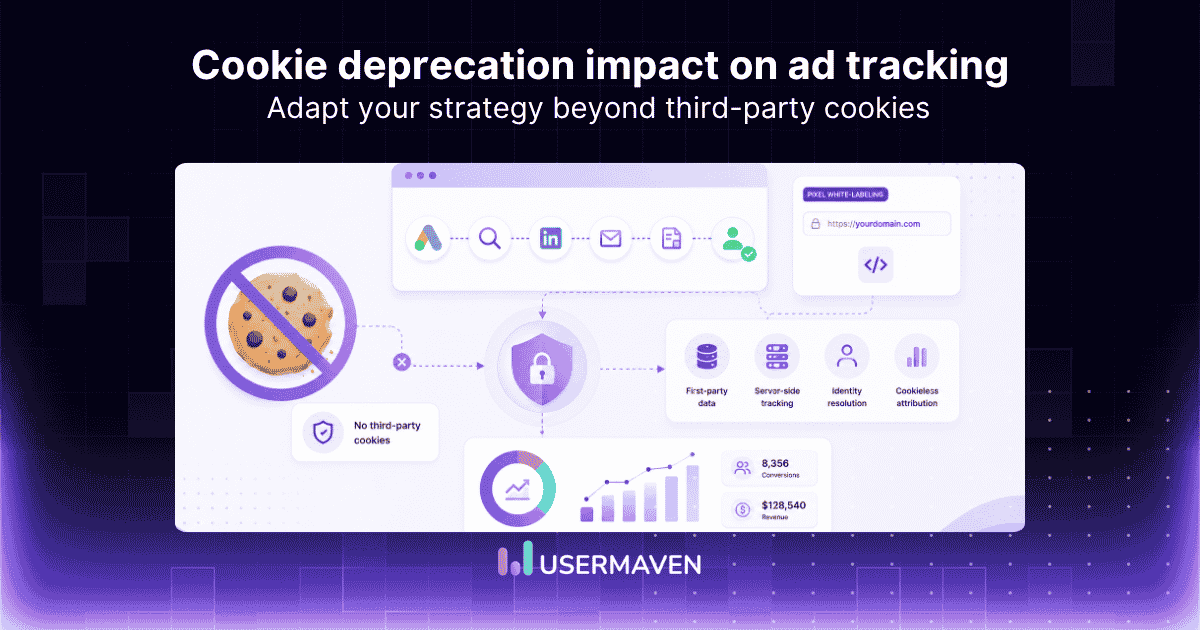
The practical result is not “no tracking.” It is fragmented tracking. Marketers can still connect campaigns with visits, events, conversions, CRM outcomes, and revenue, but they need a measurement foundation that relies less on opaque cross-site identifiers. That shift is the real cookie deprecation impact on ad tracking: less deterministic cross-site visibility, not the end of measurement.
Modern marketing attribution software increasingly combines campaign parameters, first-party events, consented identity, server-side conversion delivery, and verified business outcomes instead.
Cookie deprecation at a glance
Cookie deprecation in 2026 is best understood as the declining reliability of third-party-cookie-based tracking rather than one universal date when all browsers stopped supporting cookies.
| Question | Short answer |
|---|---|
| Are third-party cookies gone? | No, not universally |
| Did Chrome remove them for everyone? | No |
| Does Safari block third-party cookies? | Yes |
| Does Firefox restrict cross-site cookies? | Yes |
| What is most affected? | Cross-site identity, retargeting, view-through attribution |
| What still works? | UTMs, click IDs, first-party events, CRM and revenue outcomes |
| Does server-side tracking solve everything? | No |
| Are first-party cookies the complete answer? | No |
| What replaces third-party cookies? | No single technology |
| Best modern approach | First-party measurement plus server-side delivery and verified outcomes |
The useful question for marketers is no longer:
When will cookies disappear?
It is:
Which parts of the measurement chain remain observable, and which parts now require different evidence?
Key takeaways
- Chrome did not universally remove third-party cookies. Safari and Firefox impose much stronger cross-site restrictions.
- Anonymous cross-site measurement is affected most. Retargeting, view-through attribution, frequency control, and open-web journey stitching lose the most deterministic signal.
- First-party measurement still works. UTMs, click IDs, website events, known customer identity, CRM stages, purchases, subscriptions, offline conversions, and revenue remain useful.
- Server-side tracking improves event delivery. It cannot reconstruct signals a browser or platform never exposed.
- First-party data is broader than first-party cookies. The durable asset is the direct customer relationship and verified business outcome.
- Modeled conversions help fill gaps, but they remain estimates. They should not be treated as recovered deterministic observations.
- The goal is measurement resilience. Preserve enough trustworthy evidence to connect ad spend with qualified customers, pipeline, and revenue.
What cookie deprecation means in 2026
The biggest problem with much of the existing cookie-deprecation content is that it still describes a future Chrome phaseout that never happened.
Chrome changed course
Google announced in April 2025 that Chrome would maintain its existing approach to third-party-cookie choice rather than launch a new standalone third-party-cookie prompt. Users can continue to manage third-party cookies through Chrome’s privacy settings, according to Google’s Privacy Sandbox update.
Google’s Privacy Sandbox roadmap also changed substantially afterward.
As of August 2026, Google lists major advertising technologies including Attribution Reporting, Protected Audience, Topics, Shared Storage, Private Aggregation, Related Website Sets, and Aggregation Service for deprecation or removal.
The result is important:
Chrome did not eliminate third-party cookies, but the advertising industry still cannot treat them as a dependable universal measurement foundation.
The current Google roadmap can be checked in the official Privacy Sandbox feature status.
Safari already blocks cross-site cookies
Safari takes a much stricter position.
WebKit’s Intelligent Tracking Prevention blocks third-party cookies by default and applies additional restrictions to cross-site tracking and script-writeable storage. It also includes defenses against link-decoration tracking and CNAME cloaking.
That matters because some tracking approaches simply move identifiers from third-party storage into first-party JavaScript storage.
Safari can still restrict that behavior.
The technical details are documented in WebKit’s official Tracking Prevention documentation.
Firefox isolates cross-site cookies
Firefox uses Total Cookie Protection by default.
Instead of allowing one third-party cookie or token to be reused freely across different sites, Firefox isolates cookies into site-specific storage. That prevents a third party from easily following the same anonymous browser across unrelated websites.
This means the modern tracking environment is fragmented by design.
The same customer journey may therefore be more observable in one browser than another.
Unlock insights that drive growth
Where AI helps in a fragmented tracking environment
AI can help investigate tracking gaps, but it cannot reverse browser privacy controls.
It can flag campaigns with unusual conversion loss, compare attribution differences between sources, identify missing campaign data, summarize shifts in browser-level conversion rates, and surface places where platform ROAS diverges from CRM revenue.
What it cannot do is recreate an ad impression, customer identity, or conversion signal that was never collected.
A missing third-party identifier remains missing.
A consent-denied event remains unavailable.
A view-through interaction that never enters the measurement system cannot become deterministic simply because an AI model analyzes the remaining data.
AI can interpret incomplete measurement. It cannot make incomplete measurement complete.
Browser tracking status in 2026
The practical effect of cookie deprecation depends heavily on browser and context.
| Browser or context | Current position | Ad-tracking implication |
|---|---|---|
| Chrome | Third-party cookies remain user-configurable | No universal cutoff, but cookie-dependent tracking remains fragile |
| Safari | Third-party cookies blocked by default | Cross-site tracking heavily restricted |
| Firefox | Cross-site cookies partitioned by site | Anonymous cross-site identity strongly constrained |
| Private browsing | Storage more limited or ephemeral | Less persistent identification |
| Ad blockers and privacy tools | Scripts and requests may be blocked | Additional event and identifier loss |
Safari also limits more than traditional third-party cookies.
WebKit documents a seven-day cap on certain script-writeable storage after no user interaction and tighter restrictions when link decoration or CNAME cloaking is detected.
That creates an important distinction:
Switching from a third-party cookie to a first-party JavaScript cookie is not a universal fix.
The underlying browser can still limit how long or how broadly that state can be used.
What cookie deprecation breaks
Cookie deprecation has the strongest impact where measurement depends on recognizing the same anonymous person across different websites or contexts.
Cross-site identity
The traditional third-party-cookie model allowed an advertising or analytics domain to recognize the same browser while it moved across many unrelated sites.
That becomes unreliable when browsers block, isolate, or limit third-party storage.
One person can therefore appear as several disconnected anonymous identities.
Retargeting audiences
Retargeting depends on identifying people who previously visited or interacted with a site.
When cross-site identifiers are restricted, audience pools can shrink, become less complete, or depend more heavily on logged-in platform identity and first-party audience uploads.
The result is not necessarily the end of retargeting.
It is a shift away from universal browser-level recognition.
View-through attribution
A view-through journey might look like:
Meta impression → no click → branded search three days later → purchase
When the impression and later conversion cannot be connected deterministically, view-through attribution becomes more dependent on platform identity, aggregated reporting, or modeling.
This is one of the areas where native platform reports and independent analytics can legitimately disagree.
Anonymous cross-device journeys
A customer may:
see an ad on mobile → research on desktop → convert on tablet
Without a stable known identity, each device can appear to be a different customer.
Logged-in platforms may be able to connect some of those interactions internally.
Independent analytics may not.
Open-web multi-touch attribution
For multi-touch attribution, a customer journey may contain interactions on websites the advertiser does not control.
If those interactions cannot be observed or tied to the same person, the journey becomes incomplete before the attribution model even begins distributing credit.
The problem is therefore not only model choice.
It is evidence availability.
Cross-site frequency capping
Frequency capping becomes harder when a shared identifier cannot reliably tell multiple websites that the same anonymous user already saw an ad.
Platforms with strong logged-in identity can mitigate some of this internally.
The open web cannot assume the same capability.
Impact by tracking capability
| Tracking capability | Impact | Why |
|---|---|---|
| UTM attribution | Low | Campaign parameters travel with the landing URL |
| First-party website events | Low to medium | Owned-site events remain observable when implemented correctly |
| Ad-click attribution | Medium | Depends on click IDs, consent, and downstream event delivery |
| Anonymous cross-session identity | Medium to high | Browser storage and identity persistence vary |
| Anonymous cross-site identity | High | Third-party storage is blocked or partitioned in major browsers |
| Retargeting audiences | High | Cross-site audience recognition becomes less complete |
| View-through attribution | High | Impression-to-conversion stitching relies more on platform identity or modeling |
| CRM and revenue attribution | Low to medium | Business records remain available, but connecting them to earlier anonymous activity can still be incomplete |
See what's working. Fix what's not. Grow faster.
What still works after cookie deprecation
A great deal of useful advertising measurement remains possible.
| Signal | Still useful? | Why |
|---|---|---|
| UTMs | Yes | Preserve campaign and source context |
| Ad click IDs | Yes | Connect eligible ad clicks with downstream events |
| First-party page and product events | Yes | Actions occur on owned properties |
| Known customer identity | Yes | Can connect sessions after identification |
| CRM outcomes | Yes | Leads, opportunities, customers, Closed Won |
| Payment data | Yes | Purchases, subscriptions, revenue |
| Offline conversions | Yes | Can be imported when identity exists |
| Server-side events | Yes | Improve conversion delivery reliability |
| Cross-domain owned journeys | Often | Requires correct configuration |
| Anonymous cross-site recognition | Much weaker | Primary area of signal loss |
The practical takeaway is:
Cookie deprecation does not make conversion tracking impossible. It changes which evidence is available and how confidently anonymous cross-site behavior can be reconstructed.
Detailed cookieless implementation belongs in a separate tracking workflow. Here, the focus stays on which advertising signals weaken, which remain dependable, and how that changes attribution decisions.
Tracking vs targeting after cookie deprecation
Tracking and targeting are often discussed as if they were the same thing.
They are not.
Tracking
Tracking asks:
Did advertising contribute to a visit, lead, purchase, opportunity, subscription, or revenue?
Targeting
Targeting asks:
Which person or audience should receive the ad?
Cookie restrictions affect both, but differently.
A marketer can still measure:
ad click → landing page → signup → purchase
even while having less ability to follow the same anonymous visitor across unrelated websites for retargeting.
| Area | Main impact |
|---|---|
| Ad targeting | Smaller or more restricted anonymous cross-site audiences |
| Conversion tracking | Some signal loss, but still viable |
| Attribution | Fewer directly observed journey interactions |
| Optimization | Less deterministic feedback in some cases |
| Revenue measurement | Still possible with first-party and business-system outcomes |
That distinction is important because headlines about the “end of cookies” often overstate the effect on basic conversion tracking.
First-party data vs first-party cookies
First-party data and first-party cookies are not interchangeable.
First-party data
First-party data can include:
- form submissions;
- signups;
- purchases;
- subscription activity;
- product events;
- CRM records;
- customer IDs;
- payment records;
- account attributes.
This information originates from the business’s direct relationship with its visitors and customers.
First-party cookies
A first-party cookie is only one storage mechanism used in the context of the business’s own website.
Browser protections, private mode, storage caps, cookie deletion, consent settings, and device changes can still reduce its persistence.
Safari’s tracking protections show why this distinction matters. WebKit can limit script-writeable first-party storage when it appears to be used for tracking purposes.
The strategic conclusion is:
The durable asset is the first-party customer relationship and verified outcome data, not one specific browser cookie.
Server-side tracking cannot restore lost identity
Server-side tracking is often presented as the solution to cookie deprecation.
That is only partially true.
Server-side tracking can improve event delivery because important events can be sent from a backend, CRM, payment system, or server rather than depending entirely on a browser script.
It can improve measurement of:
- purchases;
- subscriptions;
- account creation;
- CRM stage changes;
- backend product events;
- payment events;
- offline conversions.
Usermaven’s current Events system also supports server-side and webhook events so backend outcomes can join the same event stream as browser activity.
But server-side tracking cannot automatically recreate:
- an anonymous impression on another website;
- an identity the browser never revealed;
- a denied-consent signal;
- cross-device identity without a usable identifier;
- an ad exposure that only the platform can observe.
So the accurate conclusion is:
Server-side tracking improves event delivery. It does not magically restore every signal lost to browser privacy restrictions.
How ad platforms are adapting
Advertising platforms have responded to signal loss by combining multiple forms of evidence.
The modern system increasingly relies on:
first-party customer data + click identifiers + platform identity + server-side conversion events + modeled conversions
rather than one third-party cookie.
Google Enhanced Conversions
Google Enhanced Conversions can use hashed first-party customer data to improve conversion matching when traditional browser identifiers are unavailable or incomplete.
The objective is not to recreate unrestricted browser tracking.
It is to improve the probability that Google can match an observed business conversion with the relevant signed-in or platform-side user.
Meta Conversions API
Meta CAPI lets businesses send supported conversion events from a server or trusted system directly to Meta.
This can reduce reliance on the browser for event delivery.
Usermaven made its Meta Conversions API setup production-ready in April 2026, with stronger validation, better event handling, clearer sync visibility, and improved reliability.
Modeled conversions
When direct observation is incomplete, ad platforms can estimate missing outcomes using statistical or machine-learning models.
Modeled conversions can improve reporting continuity. Usermaven’s guide to ad platform reporting limitations explains why native platforms can use modeled data correctly while still showing a different performance picture from CRM or independent attribution.
They remain estimates.
That distinction matters when comparing an ad platform with CRM, analytics, or independent attribution.
| Measurement approach | Main purpose |
|---|---|
| Enhanced Conversions | Improve first-party conversion matching |
| Meta CAPI | Improve server-side conversion delivery |
| Modeled conversions | Estimate outcomes that cannot be observed directly |
| Independent attribution | Compare channels using one attribution framework |
| CRM and payment data | Verify downstream business outcomes |
The modern ad-tracking measurement chain
Modern ad tracking works best when the measurement system is treated as a chain.
Ad impression or click
→ campaign parameter or click ID
→ first-party visit
→ event
→ known identity when available
→ conversion
→ CRM or payment outcome
→ revenue
→ attribution
→ conversion feedback
Every layer can fail for a different reason.
| Layer | Common failure |
|---|---|
| Impression | Not observable outside the platform |
| Click | UTM or click ID missing |
| Visit | Script blocked or consent withheld |
| Event | Tracking not implemented correctly |
| Identity | Anonymous journey fragments |
| Conversion | Event never delivered |
| CRM | Contact or deal not associated |
| Revenue | Billing data disconnected |
| Attribution | Model or window mismatch |
| Feedback | CAPI or conversion sync not configured |
This framework matters because cookie deprecation affects only some parts of the chain directly.
A missing purchase event is not a cookie-deprecation problem.
A CRM integration that stopped syncing is not a browser-privacy problem.
A short attribution window is not signal loss.
The correct fix depends on identifying the earliest broken layer.
Unavoidable signal loss vs broken implementation
One of the biggest risks in modern measurement is blaming privacy changes for problems caused by configuration.
| Problem | Privacy or browser limitation? | Implementation issue? |
|---|---|---|
| Safari blocks a third-party cookie | Yes | No |
| Missing campaign UTMs | No | Yes |
| Anonymous cross-device journey missing | Often | No |
| Purchase event not firing | No | Yes |
| View-through interaction unavailable | Often | No |
| CRM revenue not connected | No | Yes |
| Broken Meta CAPI sync | No | Yes |
| Attribution window too short | No | Yes |
| Private browsing loses persistent state | Yes | No |
This is why a tracking audit should distinguish between unavoidable observability loss and avoidable measurement failure.
Usermaven’s guide to why ad tracking is inaccurate explains how collection, identity, conversion, CRM, and reporting failures create inaccuracies even when browser privacy is not the root cause.
Likewise, ad platform discrepancies explains why two correctly configured ad platforms can still report different totals because they use different windows, identity rules, view-through logic, and modeled conversions.
Do not blame cookie deprecation for a measurement setup that is already broken.
How Usermaven reduces dependence on third-party cookies
Usermaven does not try to recreate unrestricted anonymous cross-site tracking.
Its role is to build measurement around signals a business can collect, validate, and connect to commercial outcomes.
Preserve acquisition context
Consistent UTM parameters and click IDs remain valuable because they carry acquisition context into the first-party visit.
Usermaven’s paid ads attribution combines spend, impressions, clicks, campaign structure, first-party conversions, conversion value, and attributed revenue across Google, Meta, LinkedIn, and Microsoft Ads.
This preserves the question:
Which advertising investment produced the customer journey?
even when anonymous cross-site tracking is incomplete.
Track first-party events
Usermaven Events can capture page activity, clicks, forms, signups, purchases, product actions, custom events, revenue events, and server-side outcomes.
The important point is that these are events on systems the business controls or can connect directly.
Cookie deprecation does not prevent a business from knowing that its customer upgraded, subscribed, booked a demo, or purchased.
Bring off-site outcomes into attribution
Not every meaningful conversion happens on a website.
Usermaven Event Sources can bring in:
payments → subscriptions → CRM outcomes → webinars → webhooks → CSV imports → offline conversions
and make those outcomes available across attribution, journeys, funnels, trends, and conversion goals.
This is especially useful because many of the strongest business signals live downstream from the browser. Connecting those outcomes through full-funnel revenue attribution keeps CRM and revenue evidence tied to the marketing journey instead of stopping measurement at a browser conversion.
A Closed Won opportunity does not need a third-party cookie to exist.
The measurement challenge is reconnecting that outcome to the earlier acquisition evidence.
Reconstruct owned customer journeys
User Journeys can help marketers understand behavior across the properties and events they can observe directly.
That will not reveal every impression on the open web.
It can still preserve a valuable path such as:
Meta click → article → pricing → return visit → signup → activation → purchase
which is much more useful than evaluating only the last browser session.
Handle cross-domain conversion paths
Cross-domain journeys are another source of measurement fragmentation.
A prospect might:
click an ad → visit brand.com → move to booking-platform.com → complete purchase
Without cross-domain tracking, the journey can break into two disconnected sessions.
Usermaven supports cross-domain tracking so organizations can preserve continuity across approved properties when customers move between domains.
This does not recreate unrelated cross-site tracking.
It preserves measurement across the business’s own measurable conversion journey.
Send conversion signals back to Meta
Usermaven’s Meta Conversion Sync can send supported conversion events back to Meta through CAPI.
That gives Meta a stronger optimization signal than relying exclusively on a browser pixel.
But the boundary remains important:
CAPI improves delivery of known conversion signals. It does not restore unrestricted anonymous cross-site tracking.
Check measurement health
The Measurement Trust Center is particularly relevant in a fragmented tracking environment.
It evaluates measurement health across:
campaign tracking → customer matching → connected platforms → conversion feedback → data confidence
and surfaces issues such as missing campaign data, weak customer matching, stale platform connections, and conversion-feedback problems.
This helps answer a more useful question than:
Are cookies making my data wrong?
The better question is:
Which missing signals are unavoidable, and which missing signals can we actually fix?
Investigate measurement gaps with Maven AI
Maven AI can investigate the measurement that remains available.
Useful questions might include:
Which paid sources show the largest conversion drop by browser?
Which campaigns have high platform conversions but weak CRM revenue?
Which sources have the highest unattributed conversion rate?
Where are campaign identifiers missing?
AI can accelerate diagnosis.
It cannot reconstruct signals that browsers or users deliberately made unavailable.
Evidence: Salt Marketing Group closed cross-domain gaps
Salt Marketing Group provides a useful example of measurement resilience.
This is not evidence that cookie deprecation caused Salt’s attribution gaps.
It demonstrates the broader problem: important customer journeys can become fragmented when marketing and conversion happen across different domains and systems.
Salt Marketing Group manages paid campaigns across more than 15 client accounts. For many clients, visitors clicked an ad on a marketing site and later moved to a separate third-party booking domain to complete the conversion.
Before Usermaven, those journeys were difficult to prove end to end.
After standardizing cross-domain tracking, pinned events, and conversion goals, the agency reported:
| Evidence | Result |
|---|---|
| Client accounts tracked | 15+ |
| Conversions attributed | 10,000+ |
| Paid campaign types measured | 3 |
| Cross-domain tracking standard | 1 |
The Salt Marketing Group case study shows why durable measurement is increasingly about maintaining continuity across systems the business controls rather than trying to recreate unrestricted cross-site identity.
That is particularly relevant for marketing agencies managing clients with different domains, booking tools, checkout systems, and paid-media stacks.
What marketers should prioritize now
The priority is not finding one technology to “replace cookies.” The modern stack needs several complementary layers.
Preserve campaign context: Keep UTMs, click IDs, campaign names, and creative identifiers intact so acquisition evidence reaches the landing page.
Validate core events: Confirm that signup, demo, purchase, activation, subscription, and other business-critical events fire reliably before interpreting attribution.
Connect business outcomes: Bring CRM, billing, ecommerce, and offline records into the measurement chain so reporting reaches pipeline and revenue rather than stopping at a browser conversion.
Use known identity carefully: Reconnect sessions and customer activity when a consented, valid identifier is available instead of trying to recreate unrestricted anonymous tracking.
Move critical events server-side: Deliver backend and revenue events from trusted systems when browser-only tracking is too fragile.
Improve platform feedback: Use Meta CAPI and Google enhanced conversion workflows where they can return stronger first-party conversion signals to ad platforms.
Audit cross-domain journeys: Make sure booking, checkout, app, and payment domains do not split one customer journey into disconnected sessions.
Monitor measurement health: Fix avoidable tracking gaps before changing attribution models or budget decisions.
Document blind spots: Record what cannot be observed directly instead of hiding uncertainty behind modeled numbers. Usermaven’s ad tracking without third-party cookies guide covers the implementation methods for building this type of measurement architecture.
Cookie deprecation impact checklist
| Check | Question |
|---|---|
| Browser mix | Which browsers make up the customer base? |
| Targeting | Are retargeting pools shrinking or changing? |
| Click tracking | Are UTMs and click IDs preserved? |
| First-party events | Are important website and product events reliable? |
| Identity | Can known customers be connected across sessions? |
| Cross-domain | Does checkout or booking preserve journey continuity? |
| Server-side | Are important backend events delivered reliably? |
| CRM | Are leads, opportunities, and revenue connected? |
| Attribution | Are model and lookback assumptions documented? |
| Ad platforms | Are CAPI or enhanced conversion workflows configured? |
| Data health | Which gaps are avoidable? |
| Blind spots | Which signals are fundamentally unavailable? |
Final verdict
Cookie deprecation did not create one universal moment when ad tracking stopped. Instead, it produced a fragmented measurement environment where some identifiers, cross-site signals, and anonymous journeys are far less dependable than they once were.
The strongest modern measurement systems rely more on campaign parameters, click IDs, first-party events, consented identity, server-side conversion delivery, CRM and payment outcomes, and independent attribution.
These methods do not recreate every lost signal, but they preserve the evidence that matters most for business decisions.
The objective is not to restore unrestricted cross-site tracking. It is to maintain enough trustworthy evidence to connect advertising investment with qualified customers, conversions, pipeline, and revenue.
Ready to see Usermaven in action? Explore the platform or book a demo for a closer look.
FAQs about cookie deprecation and ad tracking
Updated

Written by
Lauren Brooks
Lifecycle Marketing Strategist
Lauren Brooks is a lifecycle marketing strategist with 4+ years of experience helping SaaS businesses create meaningful customer experiences. She specializes in user engagement, retention, and conversion optimization, helping brands build stronger customer relationships beyond acquisition.
All articles by Lauren →