Black Friday can bring attention to your SaaS product, but a rush of discounted signups is not the same as sustainable growth. A successful promotion has to work with your billing model, buying cycle, onboarding capacity, and the value customers receive after the sale.
That makes B2B software different from ecommerce. A self-serve app can convert an annual-plan offer in minutes; a sales-led product may need security reviews, several decision-makers, and implementation support. A practical SaaS marketing strategy accounts for those differences instead of copying retail tactics.
This guide covers 15 Black Friday marketing ideas for SaaS companies in 2026, with execution steps, best-fit audiences, and the metrics to monitor. Black Friday falls on November 27, 2026, and Cyber Monday on November 30, so the planning advice also works for teams launching in November.
Key takeaways
- Match the offer to the buying cycle: Annual discounts suit fast self-serve purchases, while migration support, pilots, and price locks can better address sales-led deals.
- Protect recurring revenue: State eligibility, billing commitment, renewal pricing, and the expected cost of incentives before launching a promotion.
- Segment instead of broadcasting: Different messages belong to new prospects, active trials, existing customers, former subscribers, and open opportunities.
- Make the offer easy to act on: Align the landing page, checkout, CRM, email, and sales team on one clear set of terms.
- Measure customer quality: Track conversions and attributed revenue, then review activation, renewals, and retention rather than declaring success from signup volume alone.
Black Friday SaaS marketing ideas at a glance
Compare the 15 ideas below by their best-fit audience and primary objective, then choose the tactics that match your campaign goals.
| Idea | Best suited to | Primary objective |
|---|---|---|
| 1. Limited annual-plan discount | Self-serve SaaS | Annual conversions and upfront cash |
| 2. Existing-customer upgrade incentive | Tiered subscriptions | Expansion revenue |
| 3. Seats, credits, or add-on bundle | Usage-based and team software | Perceived value without deep price cuts |
| 4. Onboarding or migration fee waiver | Sales-led B2B platforms | Reduce implementation friction |
| 5. Extended trial or guided pilot | Complex software | Move qualified evaluations forward |
| 6. Early access for warm audiences | Existing pipeline and customers | Reward readiness and intent |
| 7. Trial and freemium segmentation | Product-led SaaS | Activation and trial-to-paid conversion |
| 8. Win-back former users and stalled deals | CRM-rich SaaS | Reactivation |
| 9. Partner and referral campaign | Agency and integration ecosystems | Qualified introductions |
| 10. Live demo tied to a real use case | Consultative SaaS | Product understanding and sales conversations |
| 11. Dedicated campaign landing page | Most SaaS teams | Clear offer comprehension and conversion |
| 12. Segmented email sequence | Email and CRM-enabled SaaS | Timely, relevant follow-up |
| 13. High-intent retargeting | SaaS with sufficient consented audiences | Re-engage evaluators |
| 14. Sales-assisted offer and price lock | Mid-market and enterprise SaaS | Reduce procurement friction |
| 15. Cyber Monday follow-up | All qualified non-converters | Capture remaining eligible demand |
These ideas are a menu, not a checklist every SaaS company should implement. Choose the few that remove a real buying barrier for your audience. For buyers evaluating software rather than planning a promotion, Usermaven also maintains a Black Friday SaaS deals roundup.
Drive business growth
with AI-powered analytics
Should your SaaS company run a Black Friday promotion?
A seasonal promotion makes sense when it brings forward valuable demand or removes a real barrier to purchase. It makes less sense when most purchasers would have renewed anyway, the discount undermines price expectations, or support and onboarding costs exceed the contribution generated.
Start with three questions: Who is the promotion for? What behavior should it change? What will that behavior cost? New acquisition, annual upgrades, reactivation, and qualified pipeline acceleration are different objectives, and they deserve different offers.
| Business model | Offers worth testing | Main risk to check |
|---|---|---|
| Self-serve subscription | Annual pricing, plan upgrades, add-on bundles | Low-value subscribers and renewal shock |
| Product-led growth | Guided trials, activation-based upgrade offers | Discounting before users experience value |
| Sales-led B2B | Fee waivers, implementation support, price locks | Sales approvals and delivery capacity |
| Enterprise contracts | Pilot extensions, scoped services, procurement windows | Inappropriate short deadlines for multi-person deals |
| Agency-focused SaaS | Seat packs, team bundles, referral incentives | Accounts expanding seats without sustained adoption |
Before choosing a percentage, model the price over the customer’s expected first year and renewal. A 30% introductory annual discount, for example, is not the same as 30% off every year. Be explicit about taxes, minimum seat commitments, eligible plans, proration, refunds, and the date normal pricing resumes.
Five Black Friday offer ideas for SaaS companies
These five offers address different buying barriers, from annual commitment to implementation. Choose an incentive that fits your product, audience, and customer economics.
1. Offer a limited annual-plan discount
Best for: Self-serve SaaS with a clear monthly-to-annual upgrade path.
An annual-plan discount offers buyers immediate savings and can improve near-term cash collection. It works best when the value of the product is already clear and the checkout can show the full first-year price and subsequent renewal rate without ambiguity.
How to execute: Choose eligible plans, set the exact sale window, and show the price compared with the equivalent billing baseline. Target annual upgrades separately from new annual customers. Keep the original monthly plan visible so people can make an informed choice.
Example: A team collaboration app offers a time-limited incentive for a new annual Team subscription. The checkout shows the annual payment, billing frequency, and the renewal rate before purchase.
Measure: annual purchases, monthly-to-annual upgrades, net new annual recurring revenue, discount cost, and renewal behavior.
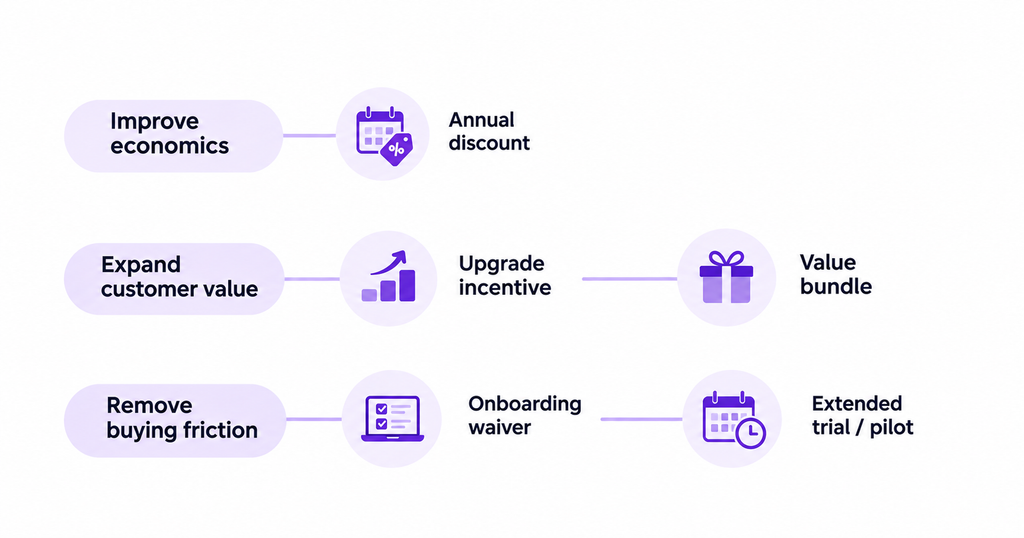
2. Give existing customers an upgrade incentive
Best for: Products with meaningful higher tiers, capacity limits, or advanced features.
Black Friday does not have to target first-time buyers. Existing customers may be more likely to understand a higher tier’s value, particularly when they’ve reached usage limits or asked about a missing feature.
How to execute: Select eligible accounts based on current plan, actual usage, and product fit. Offer a clearly defined upgrade benefit, such as an introductory higher-tier price or a temporary premium add-on. Explain whether the upgrade is prorated and what happens when the promotion ends.
Example: An agency reporting app invites growing teams that consistently reach their dashboard limit to add capacity at a promotional rate.
Measure: eligible upgrade rate, additional recurring revenue, feature adoption, support burden, and downgrades after the introductory term. Do not treat an upgrade as profitable until its cost and persistence are understood.
3. Bundle seats, usage credits, or premium add-ons
Best for: Team software, APIs, AI tools, and usage-based subscriptions.
A bundle can increase perceived value without permanently lowering the base subscription price. Additional seats, temporary API credits, training sessions, or a premium module may solve a more tangible problem than an across-the-board discount.
How to execute: Select benefits with predictable delivery costs, limit the validity of promotional credits, and make expiration and rollover terms clear. Confirm that customers understand whether add-ons become paid at renewal. If you offer additional AI usage, account for the real processing cost.
Example: A developer platform provides extra testing credits with eligible annual subscriptions.
Measure: bundle acceptance, credits consumed, activation, additional seats retained, and contribution margin after usage costs. Avoid promoting credit allowances that typical buyers cannot realistically use.
4. Waive onboarding or migration fees
Best for: B2B software where implementation effort delays buying decisions.
In sales-led SaaS, the biggest obstacle may not be subscription price. A buyer could already accept the product’s annual value but worry about data migration, team training, setup time, or technical resources.
How to execute: Define the implementation services included, hours or project boundaries, eligibility, and the calendar by which setup must begin. Coordinate with customer success and engineering before offering anything that could create an unmanageable backlog.
Example: A CRM-connected reporting vendor offers a fixed-scope onboarding package for new annual customers signed during the promotion window.
Measure: qualified opportunities progressing to close, sales-cycle length, activation time, delivery cost, and support tickets. The offer should remove genuine friction, not just relabel normal customer support as a discount.
5. Extend a trial or run a guided pilot
Best for: Software with a meaningful evaluation period or multiple stakeholders.
A short-term price cut may not help a team that has not completed its technical evaluation. An extended trial or guided pilot can give buyers enough time to test a real workflow and establish the basis for an internal approval.
How to execute: Qualify the prospect, agree on success criteria, identify the features and data needed for evaluation, and schedule a review before the pilot ends. Do not extend every trial automatically. Focus on buyers with a clear use case and the ability to make a decision.
Example: A marketing data platform offers a guided evaluation for qualified B2B teams needing to connect a CRM and advertising accounts.
Measure: completed evaluations, product activation, qualified pipeline, time to decision, and conversion to paid accounts. A trial extension is a success only if it helps the buyer establish value.
Five audience and acquisition strategies
The right audience can be as important as the offer itself. Use these five strategies to reach prospects and customers with a relevant reason to act.
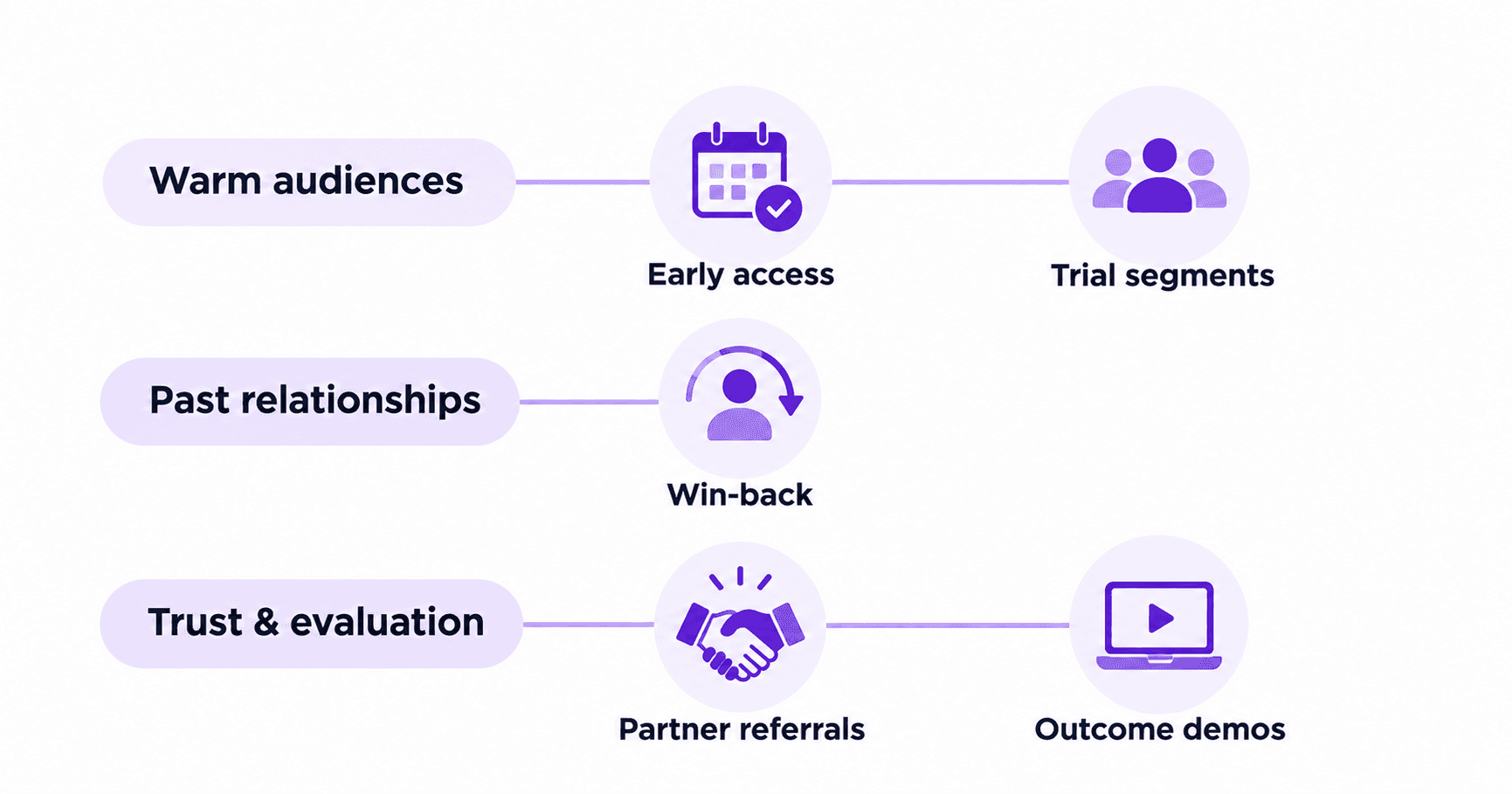
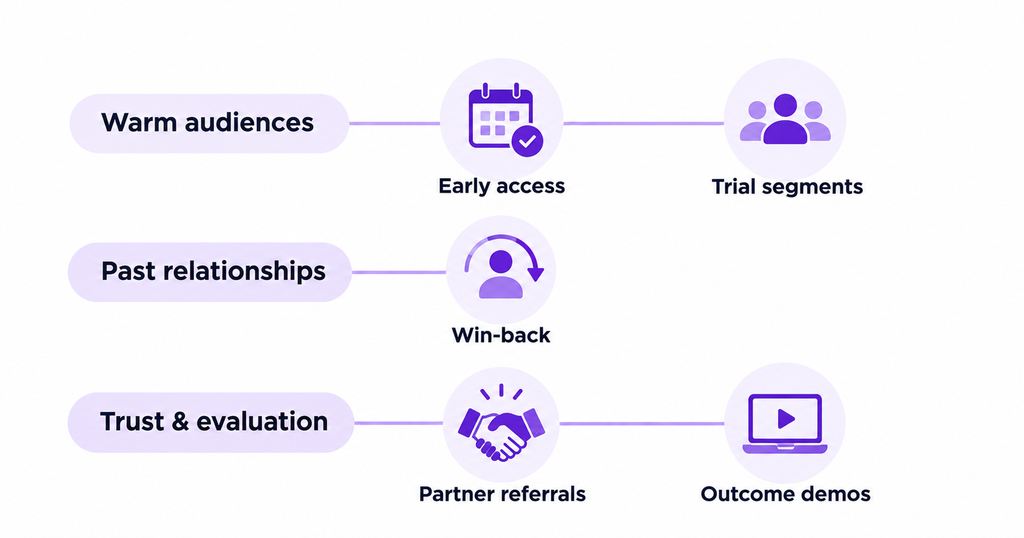
6. Give customers and warm prospects early access
Best for: SaaS businesses with active customer communities, qualified leads, or a substantial CRM database.
An early-access window can reward customers and engaged prospects without forcing a public race to the bottom. It also lets the team check landing pages, checkout logic, and support demand with a smaller group before the broad launch.
How to execute: Define who qualifies, open access for a stated period, and provide an audience-specific message. Current customers may value an upgrade benefit; prospects might care more about plan eligibility and procurement requirements. Do not imply exclusivity if the same deal is available to everyone.
Example: A SaaS company previews its annual-plan offer to active trials and past demo attendees before the sitewide campaign.
Measure: early-access conversion, support volume, abandoned checkout, and conversion differences across eligible groups. Use early access to learn, not to fabricate scarcity.
7. Segment trial users and freemium accounts
Best for: Product-led SaaS with meaningful behavioral data.
A trial user who has completed setup and returned several times is different from someone who signed up but never activated. Sending both the same urgent coupon misses that difference and may discount people who first need help using the product.
How to execute: Define segments from real events, plan status, feature usage, acquisition source, and time since signup. For an activated trial, explain the paid value and applicable offer. For a dormant trial, lead with an onboarding problem and only introduce the promotion if appropriate.
Usermaven’s customer segmentation software supports dynamic filters for behavior, events, attributes, and acquisition sources, helping teams compare how these groups convert.
Measure: activation, eligible trial-to-paid conversion, conversion value, and later retention, not merely email opens.
8. Win back former users and stalled opportunities
Best for: SaaS companies with accurate churn reasons, canceled-account records, and CRM opportunity history.
Former customers and stalled deals can provide more context than a new cold audience. But a discount won’t resolve every reason someone left. A prospect who struggled with onboarding needs a different message from someone who canceled because the product lacked a critical integration.
How to execute: Review cancellation and lost-opportunity reasons, filter for people you are permitted to contact, and group outreach by the obstacle. Explain what actually changed, such as a new integration, pricing flexibility, or implementation help. Avoid claiming a product issue is fixed unless it is.
Example: An email automation company contacts former customers who cited migration difficulty, offering scoped setup assistance rather than just a lower subscription price.
Measure: reactivation, qualified replies, support costs, re-churn, and revenue collected after the promotional term.
9. Launch a referral or partner campaign
Best for: Agency software, integrations, developer tools, and B2B products with an active partner ecosystem.
A well-placed recommendation from an agency, consultant, or implementation partner can reach buyers with a more specific problem than broad seasonal advertising. The incentive should reward legitimate introductions rather than encourage poor-fit signups.
How to execute: Give partners a clear use-case brief, approved offer terms, tracking or referral identifiers, and compliant disclosure guidance. Define when a reward is earned, such as after an eligible customer becomes a paying account and any refund period has passed.
Example: A reporting platform offers onboarding credits for agency partners’ qualifying client referrals.
Measure: referred qualified opportunities, paid conversions, partner costs, refund rates, and subsequent revenue. Make referral terms clear enough that partners do not overpromise availability or savings.
10. Host a demo around a concrete outcome
Best for: Consultative SaaS and products whose value is difficult to see on a pricing page.
Some prospects need proof of a workflow more than a discount. A focused live demo, workshop, or customer Q&A can build understanding and help the sales team address concerns about integrations, security, and practical implementation.
How to execute: Choose one buyer problem, demonstrate a realistic workflow without fictitious customer results, and make the offer optional rather than the entire presentation. Provide a direct follow-up for attendees who need documentation, a trial, or a commercial proposal.
Example: A CRM analytics provider demonstrates how a marketer can trace a campaign through signup, opportunity creation, and revenue, then explains a limited onboarding incentive.
Measure: attendance, qualified meetings, evaluated accounts, opportunities created, and closed-won outcomes. Webinar registrations alone are not the result.
Five promotion and conversion strategies
Once your offer and audience are clear, these five tactics can help you communicate the value and guide qualified buyers toward a decision.
11. Build a dedicated Black Friday landing page
Best for: Nearly every SaaS company running a defined offer.
A campaign page should answer what a prospect receives, who qualifies, what the total payment will be, and what happens after the promotional period. A discount badge and a generic signup button are not enough for a buyer choosing a subscription.
How to execute: Show the plan, benefits, price basis, start and end dates, eligibility, renewal terms, cancellation rules, customer proof, and a clear CTA. Ensure the page and checkout agree. Use a separate request-demo path when a plan requires a sales conversation.
Example: A B2B subscription platform gives its annual promotion a clear pricing explanation and a secondary route for teams that need procurement approval.
Measure: qualified visits, click-to-checkout, purchases or demo requests, and conversion errors. Audit the entire journey on mobile as well as desktop.
12. Build a segmented email sequence
Best for: SaaS teams with permission-based customer and prospect lists.
Instead of one all-subscriber announcement, use a short, purposeful series. A pre-launch message establishes relevance, a launch email explains the offer, a mid-campaign message addresses objections, and a closing message accurately states the deadline.
How to execute: Separate existing customers, activated trials, dormant trials, former subscribers, and qualified pipeline. Exclude people who already purchased or are in an incompatible contract. Check send frequency, suppression rules, unsubscribes, and whether each segment’s offer is truly available.
Example: Trial users receive a feature-led upgrade email, while former customers receive a product-update message tied to their earlier problem.
Measure: qualified replies, trial-to-paid conversion, attributed revenue, unsubscribe rate, and complaint rate. Email opens are directional, not a substitute for commercial outcomes.
13. Retarget high-intent visitors instead of everyone
Best for: SaaS companies with sufficient eligible audiences and properly configured consent and advertising accounts.
Retargeting can remind engaged prospects of an offer they already considered. But targeting every visitor with the same ad wastes spend and may reinforce discount-seeking behavior rather than qualified demand.
How to execute: Prioritize eligible pricing-page visitors, qualified demo prospects, or visitors who started but did not complete signup. Exclude recent purchasers, existing customers who cannot use the offer, and audiences without the necessary consent. Match each ad to the correct landing page and plan.
Example: A SaaS team runs separate creatives for pricing-page visitors and prospects who downloaded an implementation checklist.
Measure: incremental conversion where testable, spend, eligible conversions, attributed revenue, and cost per acquired paying customer. Do not claim a platform’s retargeting attribution establishes incremental lift by itself.
14. Give sales teams a time-bound, approved offer
Best for: Mid-market and enterprise SaaS with open opportunities.
For a business that purchases through procurement, a weekend-only coupon may be irrelevant. A contract price lock, agreed implementation package, or extended purchasing window can be more useful, as long as the offer respects the actual approval process.
How to execute: Define eligible deal stages, approved pricing floors, maximum concessions, sign-off authority, and the period during which quotes remain valid. Equip account executives with accurate language for security reviews and finance approvals. Avoid asking sales to promise implementation capacity it cannot deliver.
Example: A platform offers a written price lock for qualified opportunities that begin procurement during Black Friday week.
Measure: stage progression, sales-cycle days, closed-won revenue, discount given, and gross margin. Evaluate whether the offer accelerates deals instead of merely discounting purchases already likely to close.
15. Use Cyber Monday for a relevant final follow-up
Best for: SaaS businesses with a genuine offer ending near November 30.
Cyber Monday is a final communication opportunity, not a reason to reset a false countdown. A useful final message helps eligible prospects understand the deadline and any remaining steps rather than pressuring everyone with repeated urgency.
How to execute: Identify non-converters who showed qualified interest, suppress recent purchasers, and repeat the exact terms and cutoff time with its time zone. Where buyers require approvals, offer a legitimate documented alternative instead of suggesting a deal lasts longer than advertised.
Example: A subscription platform sends an accurate final-day reminder to eligible trial users who reached a paid-plan comparison page.
Measure: net additional paid conversions, campaign cost, refund requests, and early post-purchase activation. Monitor support tickets so the final rush does not overwhelm new customers.
A real SaaS Black Friday example: Kodeco’s annual upgrades
A useful historical case comes from Kodeco, the developer education subscription business previously known as raywenderlich.com. In a Paddle customer case study, Paddle reports that Kodeco ran a 45% Black Friday offer on video subscriptions, promoted it through targeted emails, and began the sale three days before Black Friday.
The company also simplified the monthly-to-annual upgrade process to a single click and contacted former subscribers with a win-back campaign. These choices combined the promotional offer with a lower-friction checkout and a specific existing-customer segment.
Paddle reported a 960% increase in transactions, a 942% revenue increase compared with an average week, more than 1,700 new and reactivated customers, and more than 500 upgrades to annual subscriptions for the 2018 campaign. Those are vendor-reported results from one historical campaign, not 2026 benchmarks or proof that the discount alone caused the increases.
The transferable lesson is to coordinate the offer, audience, and buying process. Kodeco’s numbers should not be used as a target forecast for a B2B SaaS company with a different audience, price point, and sales cycle.
Black Friday SaaS campaign timeline for November 2026
Teams planning from early November still have time to run a focused campaign, but they should prioritize execution quality over launching every tactic.
| Dates | Priority | Deliverable |
|---|---|---|
| Nov 3–9 | Decide who and what to promote | Approved economics, target segments, offer terms |
| Nov 10–16 | Build and validate the journey | Landing page, checkout, email and sales instructions, tracking QA |
| Nov 17–26 | Warm relevant audiences | Early-access communication, demos, partner and remarketing setup |
| Nov 27–30 | Launch and monitor | Live offer checks, conversion monitoring, support coverage, genuine deadline |
| Dec 1 onward | Learn and retain | Onboarding, refund checks, revenue and retention cohort review |
These dates are a suggested operating calendar, not a mandatory industry schedule. Sales-led companies may need longer evaluation windows, and some promotions will start before Black Friday.
How to measure whether your Black Friday SaaS campaign worked
The first report should establish what happened: campaign spend, qualified traffic, trial or demo conversions, paid subscriptions, upgrade revenue, and refunds. But the more important question is whether the campaign attracted customers who activate, use the product, and renew.
To avoid confusing reporting with proof, distinguish attributed revenue from incremental revenue. Attribution allocates recorded outcomes across marketing interactions according to a defined model. Incrementality requires an appropriate comparison or experiment to estimate what would have happened without the campaign.
| Layer | What to inspect | Decision it informs |
|---|---|---|
| Acquisition | Spend, sources, qualified visits, campaign contribution | Which sources attracted relevant buyers? |
| Conversion | Trial-to-paid, demos, annual upgrades, contract closes | Did the offer remove a buying barrier? |
| Revenue | Conversion value, attributed revenue, discounts and refunds | What value did the campaign actually book? |
| Customer quality | Activation, product usage, retention and renewal cohorts | Are promotional customers worth retaining? |
Connect acquisition with business outcomes in Usermaven
Usermaven is marketing attribution software that connects supported acquisition data with recorded customer journeys, conversion goals, and revenue events. Its paid ads attribution reporting can compare spend with attributed conversion value and ROAS across connected ad networks.
That is relevant for a Black Friday promotion running across paid search, paid social, email, and other channels. Two campaigns can generate similar signup counts but different amounts of attributed revenue. Reviewing the conversion goal and model helps teams avoid automatically giving every conversion the same value.
Usermaven also supports behavioral segments and funnel analytics. Teams can compare eligible trial users, annual subscribers, or product-activated accounts, provided the events and identifiers needed for the analysis are captured and connected. Subsequent activation and retention still require appropriate follow-up periods.
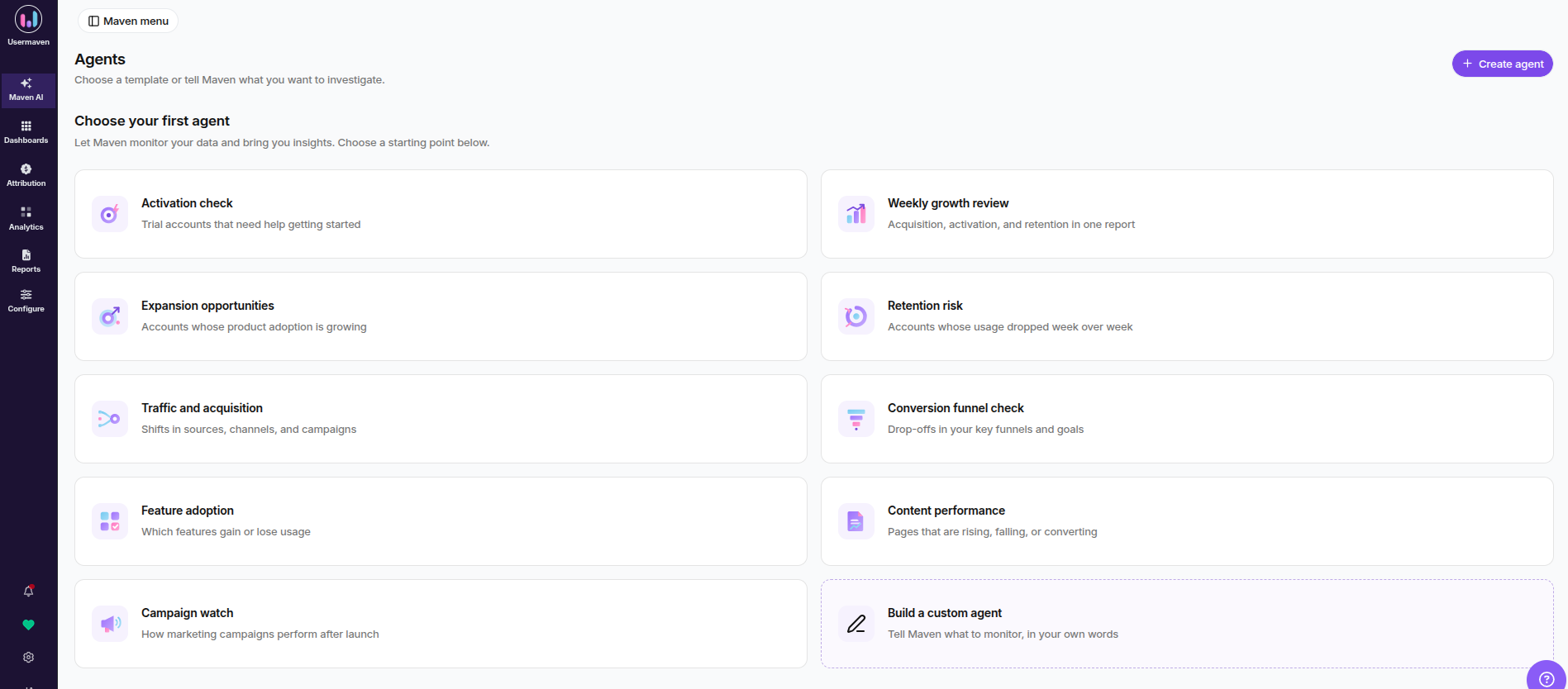
With Maven AI Agents, teams can schedule recurring analyses of campaign and acquisition shifts, conversion funnel drop-offs, and account behavior. Agents provide evidence-backed findings that analysts can review and share; they do not independently prove a campaign’s incremental revenue. This differs from a Scheduled Report, which delivers configured reporting views at specified times.
A dedicated walkthrough of campaign tagging, attribution windows, and conversion QA belongs in the next article in this Black Friday series. Here, the operational rule is simpler: define the business outcome before spending money and check the quality of the customers the promotion brings in.
Common Black Friday marketing mistakes SaaS teams should avoid
Avoid these common mistakes to protect customer trust and make the campaign easier to evaluate.
- Discounting without a clear objective: A price cut needs an intended outcome, such as converting qualified trials or improving annual upgrades.
- Comparing unlike prices: Saying “50% off” without a correct monthly or annual billing baseline misleads buyers.
- Hiding renewal terms: The promotional charge and subsequent subscription price should be understandable before purchase.
- Giving everyone the same message: A prospect who never activated needs different help from a customer who has outgrown their plan.
- Overstating urgency: Expiration dates must be genuine, consistent across channels, and stated with the correct time zone.
- Ignoring delivery cost: Free setup, premium usage credits, or added seats can create real support and infrastructure costs.
- Using signups as the only KPI: Low-intent subscribers can lift the conversion count while weakening long-term economics.
- Confusing attribution with causality: Recorded campaign credit does not by itself show how many purchases were truly additional.
Black Friday SaaS launch checklist
Use this checklist to prepare your offer, customer journey, and measurement before launch.
- Offer: Confirm eligibility, plans, price basis, renewal, cancellation, tax treatment and cutoff time.
- Audience: Define prospects, customers, trials, past customers, and exclusions with clear consent requirements.
- Channels: Align landing pages, email, paid creative, partner messaging, and sales scripts.
- Checkout: Test coupons, proration, currency, taxes, upgrades, payment failures, and receipts.
- Tracking: Confirm the intended conversion events, source classification, cross-domain paths and revenue values.
- Operations: Assign ownership for customer support, onboarding, approvals and rollback decisions.
- Reporting: Agree on conversion, attributed revenue, refunds, acquisition costs, and post-sale cohort reviews.
- Aftercare: Make sure new customers know how to activate and where to get help after the offer ends.
Final thoughts
The best Black Friday marketing ideas for SaaS aren’t necessarily the biggest discounts. They’re offers that address an identifiable barrier: annual commitment, onboarding effort, missing capacity, unclear product value, or a lengthy procurement process.
Choose the ideas that suit your product and audience, communicate terms precisely, and measure what buyers do after the promotion. A smaller campaign that brings customers who activate and remain valuable may be preferable to a high-volume sale built around temporary bargain hunting.
If your team needs to connect marketing spend, conversion journeys, and revenue during Black Friday, book a Usermaven demo to explore how its attribution and analytics workflows support that analysis.
FAQs
1. Should B2B SaaS companies run Black Friday deals?
Only when the promotion supports a clear commercial objective and its economics make sense. Self-serve software may benefit from annual-plan offers, while enterprise SaaS may be better served by implementation support or a guided pilot.
2. What is the best Black Friday promotion for a SaaS startup?
There is no universal best offer. A startup with high trial activation might test an annual-plan incentive; one with complicated setup might test onboarding assistance. Compare expected margin, acquisition quality, and the likelihood of renewal before choosing.
3. When should SaaS companies start Black Friday marketing in 2026?
Black Friday is November 27 and Cyber Monday is November 30. Teams starting in early November can prioritize offer approval, landing-page QA, customer segmentation, and a small number of proven acquisition channels rather than launching an overly complex campaign.
4. How much of a discount should a SaaS company offer?
Set the discount from the economics of your product, expected retention, support and implementation costs, and customer willingness to pay. Do not choose a percentage solely because competing companies advertise it. Show the billing baseline and renewal amount clearly.
5. How can a SaaS company promote Black Friday without discounting?
It can offer onboarding support, extended evaluations, temporary usage credits, additional seats, implementation workshops, or a legitimate price lock. The incentive should help the right customer realize value without creating unsustainable costs.
6. Can Black Friday campaigns work for sales-led B2B software?
Yes, but the buying process may be too long for weekend checkout pressure. Sales-approved commercial terms, scoped migration help, and realistic procurement windows are often more appropriate than a one-time coupon.

Written by
Junaid Ahmed
Content Writer & Digital Marketer
Junaid Ahmed is a content and copywriter with 3+ years of experience creating research-driven content across SaaS, B2B, ecommerce, and digital marketing. He specializes in turning complex topics into clear, practical content that helps marketers better understand their challenges, evaluate solutions, and make informed decisions. His work spans educational content, industry insights, and actionable marketing guides.
All articles by Junaid →