Improving ad performance is not only about lowering CPC or increasing CTR. A campaign can attract cheaper clicks and still produce fewer qualified leads, weaker customers, or less revenue.
The strongest optimization process works across three layers: the ad platform, the post-click experience, and the measurement signal that tells the platform what a valuable outcome looks like.
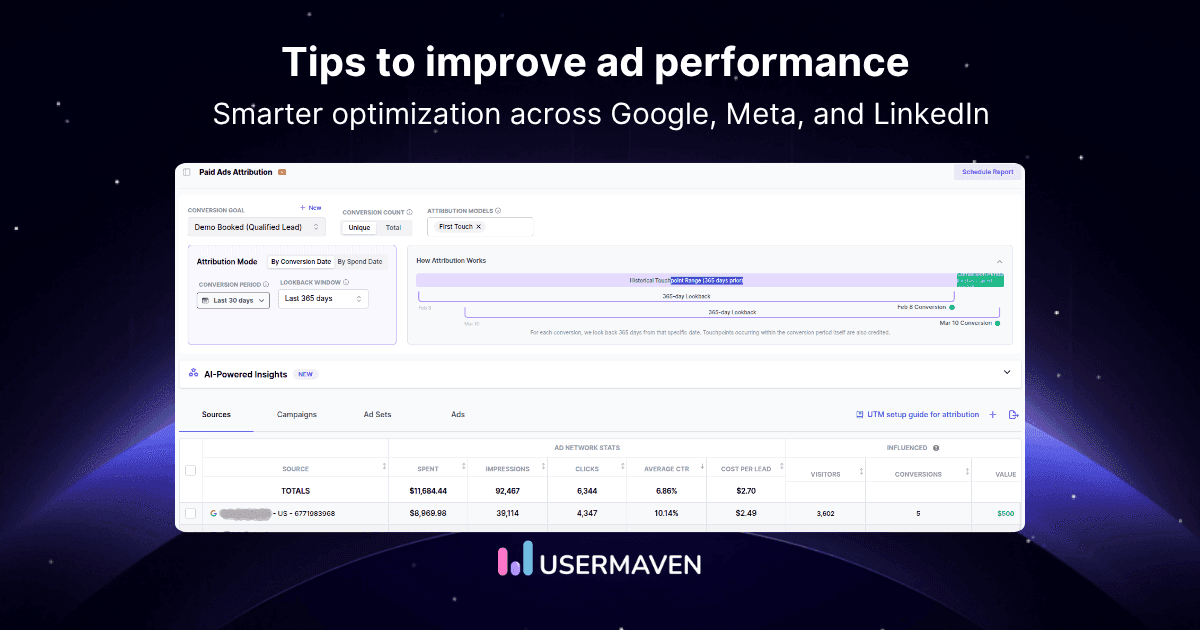
Google, Meta, and LinkedIn each require different tactical adjustments, but all three perform better when decisions are tied to meaningful conversions based on incredble tips to improve ad performance.
With marketing attribution software, teams can compare paid channels under one measurement framework and see whether campaign changes improve customer journeys, conversion quality, and revenue, not just platform metrics.
Key takeaways
Optimize the outcome, not the click. CTR, CPC, and CPL matter only when they support the business result the campaign is supposed to create.
Fix measurement before changing bids. Broken or shallow conversion signals make automated optimization learn from the wrong outcome.
Treat creative, targeting, landing pages, and data as one system. Weakness in any layer can make the campaign look worse than the actual problem.
Google, Meta, and LinkedIn need different tactics. Search intent, creative discovery, and professional targeting create different optimization levers.
Compare platforms with independent attribution. Each native dashboard is useful for its own optimization, but cross-platform budget decisions need one consistent view of conversions and revenue.
Tips to improve Ad performance at a glance
| Performance area | Google Ads | Meta Ads | LinkedIn Ads |
| Main intent signal | Search/query intent | Audience + creative discovery | Professional/business intent |
| Creative priority | Ad relevance + assets | Creative variety + fatigue control | Message + professional relevance |
| Targeting priority | Keywords, search themes, audiences | Algorithmic/broad audiences + signals | Job, company, seniority, professional data |
| Optimization signal | Conversions or conversion value | Conversion quality/value | Conversions, qualified leads, or conversion value |
| Landing-page risk | Intent mismatch | Message mismatch after a strong creative hook | Offer mismatch or weak B2B qualification |
| Common diagnostic trap | Blaming bids for tracking/query problems | Blaming targeting for creative fatigue | Optimizing for cheap leads instead of qualified outcomes |
| Ad performance improves only when the metric being optimized moves the business outcome in the right direction. |
Unlock insights that drive growth
Start with one optimization hierarchy
Before changing platform settings, separate four questions. Otherwise, teams often fix the wrong layer.
| Layer | Question | Example signal |
| 1. Measurement | Can the platform and analytics system see the right outcome? | Conversions missing, duplicated, or mapped to the wrong value |
| 2. Traffic quality | Are the right people clicking? | Good CTR but weak qualification |
| 3. Post-click experience | Can good traffic convert efficiently? | Strong traffic but high landing-page or form drop-off |
| 4. Media efficiency | Are bids and budgets allocating spend well? | Conversion data is healthy but CPA/ROAS is inefficient |
This hierarchy prevents a common mistake: changing bids or audiences when the real issue is a broken conversion event or a landing page that does not match the ad.
1. Optimize for the business outcome, not clicks
A campaign objective should match the outcome the business actually values. If a campaign is judged on demos, purchases, qualified leads, or subscription upgrades, clicks should not become the final optimization target simply because they arrive faster.
Consider two campaigns. Campaign A produces 1,000 low-cost clicks and 30 low-quality leads. Campaign B produces 450 more expensive clicks and 22 leads, but eight become customers. Campaign A wins the traffic report. Campaign B wins the business outcome.
| Campaign | Clicks | Leads | Customers | What it really tells you |
| A | 1,000 | 30 | 1 | Strong traffic volume, weak customer quality |
| B | 450 | 22 | 8 | Lower volume, much stronger downstream value |
Use ad performance metrics in layers: delivery metrics for diagnosing the ad, conversion metrics for diagnosing the funnel, and revenue metrics for deciding where budget should ultimately go.
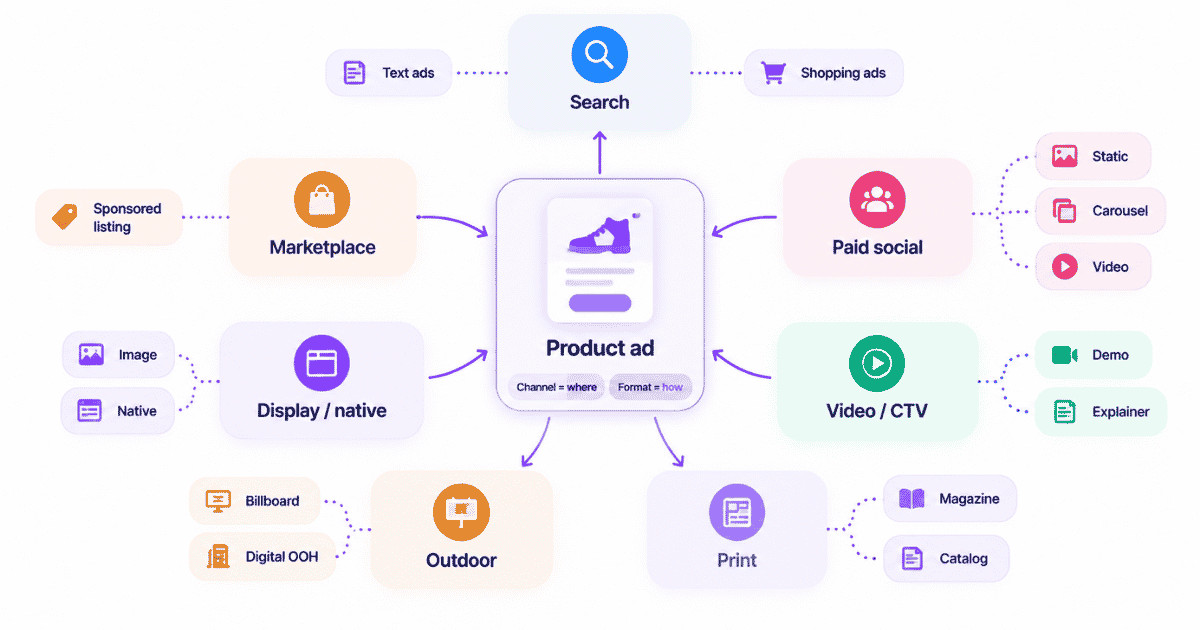
2. Fix conversion tracking before changing bids
Automated bidding systems can only optimize from the signals they receive. A missing purchase event, duplicated lead event, or low-value conversion marked as the primary goal can send the algorithm in the wrong direction.
Before changing bids, verify that the conversion is firing at the right stage, only once, with the right value, and with enough identity context to connect it back to the paid interaction.
Google’s campaign setup guidance explicitly treats conversion tracking as a prerequisite for conversion-based Smart Bidding. That same principle applies across ad platforms: optimize from a trustworthy outcome first, then tune media settings.
3. Match the ad promise to the landing page
A high CTR can hide a message mismatch. If the ad promises a pricing calculator, comparison, discount, or enterprise demo but the landing page opens with a generic homepage experience, the campaign may be attracting the right people and losing them after the click.
Audit the sequence as one message:
| Ad promise -> landing-page headline -> proof -> CTA -> form or checkout |
The headline should confirm the intent that earned the click. The CTA should continue the same job rather than changing the user’s task halfway through the journey.
4. Separate traffic problems from funnel problems
Do not assume a low conversion rate means the audience is wrong. The post-click funnel may be creating the loss.
| Symptom | Where to investigate first |
| Low CTR | Creative, keyword/query relevance, message, audience |
| Good CTR + immediate exits | Ad-to-page mismatch, traffic quality, page speed |
| Good visits + low form starts | Offer, proof, CTA, landing-page friction |
| High form starts + low completion | Form length, unclear fields, technical issues |
| Many leads + few qualified leads | Targeting, offer, lead definition, conversion signal |
| Qualified leads + weak revenue | Sales fit, deal quality, pricing, later-stage journey |
Use funnel analytics to isolate the step where paid traffic actually drops rather than treating every low-conversion campaign as a media-buying problem.
See what's working. Fix what's not. Grow faster.
5. Test meaningful creative variations
Creative testing is most useful when each version represents a real hypothesis. Changing only a button color or one adjective rarely teaches enough to guide the next campaign.
Test larger creative ideas such as:
Problem-led vs. outcome-led messaging
Product demonstration vs. customer proof
Founder/expert angle vs. brand angle
Direct-response offer vs. educational offer
Static image vs. short-form video where the placement supports both
Keep the business outcome consistent while testing the creative idea. If the CTA, audience, landing page, and offer all change at once, a winning result cannot tell you which variable mattered.
6. Give campaigns enough data before judging them
Campaigns need enough observations to separate a trend from noise. That does not mean waiting forever, but it does mean avoiding major conclusions from a handful of conversions or one unusually strong day.
Evaluate campaigns using the time required for the real conversion to mature. A B2B demo may take days or weeks to become an opportunity. A subscription may require a trial period. A purchase may happen in one session.
This is why delayed conversion data matters. A campaign can look weak in week one and become profitable after the normal conversion window has passed.
7. Track downstream lead and customer quality
CPL can improve while revenue gets worse. The campaign may simply be finding people who are easier to convert at the first stage.
| Optimization level | Example metric | Better question |
| Traffic | CPC | Did the traffic match the intended audience? |
| Lead | CPL | Did the leads qualify? |
| Opportunity | Cost per opportunity | Did paid leads become pipeline? |
| Customer | CAC | Did the campaign acquire paying customers efficiently? |
| Revenue | Attributed ROAS | Did the campaign generate enough value for the spend? |
| A cheaper conversion is not automatically a better conversion. |
8. Improve Google Ads by matching bids to the goal
Google Ads performs best when the bid strategy is aligned with the conversion objective and the conversion data is reliable. If every conversion has roughly the same value, conversion-count strategies can make sense. If purchases, deals, or plans carry different values, value-based optimization can give Google a stronger economic signal.
Current Google guidance separates conversion-focused strategies such as Maximize conversions and Target CPA from value-focused strategies such as Maximize conversion value and Target ROAS.
Do not switch strategies every few days. Make one meaningful change, allow the strategy to process enough fresh data, and compare the result against the business goal instead of reacting to normal short-term fluctuations.
9. Improve Google Ads query and ad relevance
Search campaigns can waste budget when the search query, ad message, and landing page solve different problems.
Review search terms and group related intent together. Ads should directly reflect what the searcher appears to want, while assets should give the user useful paths such as pricing, demos, categories, or high-intent product pages.
Google also recommends multiple ads and sufficient assets because more useful combinations give the system more ways to match the message to the auction.
The key is not to chase Ad Strength as an isolated score. Use relevance, query quality, conversion rate, and downstream value together.
10. Use conversion value when Google outcomes differ
If one conversion is worth $50 and another is worth $5,000, treating them as identical can make the algorithm favor volume instead of value.
Send dynamic or meaningful conversion values where the business can support them. For SaaS, this might be a paid upgrade value. For ecommerce, it may be order revenue. For B2B, a deeper qualified event can be more useful than every raw form submission when the platform supports it.
The broader principle is simple: the closer the optimization signal gets to customer value, the less likely the campaign is to scale low-quality conversions.
11. Refresh Meta creative before blaming targeting
Meta performance often changes because the same audience has seen the same creative too many times, not because the audience suddenly became irrelevant.
Watch creative-level CTR, conversion rate, frequency, spend concentration, and downstream conversion quality. If one ad receives most delivery while performance gradually declines, test a materially new creative angle before rebuilding the entire audience strategy.
Refresh the concept, hook, proof, format, or offer rather than producing five nearly identical variants.
12. Test Meta delivery against downstream quality
Broad or algorithmic delivery can increase scale, but scale should be evaluated against what happens after the click.
If Meta finds cheaper leads but those leads convert poorly to qualified opportunities or customers, the campaign has not necessarily improved. Compare audience or delivery changes using the same downstream KPI.
| Surface result | Possible hidden result |
| CPC decreases | Traffic becomes less qualified |
| CTR increases | Creative attracts curiosity rather than intent |
| CPL decreases | Lead qualification falls |
| Lead volume rises | Opportunity or purchase rate stays flat |
Treat platform efficiency and customer quality as two separate checks.
13. Send stronger first-party signals back to Meta
When the ad platform can see only an early conversion, it learns to find more people likely to complete that early action. Sending deeper verified outcomes gives the algorithm a better picture of what success means.
Usermaven’s conversion syncs can send supported first-party conversion and revenue events back to Meta and Google, helping those networks optimize around meaningful outcomes instead of relying only on browser-side signals or shallow conversions.
Keep the event mapping clean. If a purchase, upgrade, demo, and low-intent form fill are all treated as equivalent, the optimization signal becomes noisy.
14. Match LinkedIn objectives to funnel stage
LinkedIn campaigns should optimize toward the stage the campaign is genuinely responsible for. Website Visits can be useful when traffic is the goal, but a B2B team expecting qualified pipeline should not judge success only by landing-page clicks.
LinkedIn’s current conversion optimization guidance recommends Website Conversions or Lead Generation for conversion-oriented campaigns and supports deeper options such as qualified-lead and conversion-value optimization when the required data is available.
The mistake is not choosing a top-funnel objective. The mistake is choosing it while expecting the platform to optimize for a bottom-funnel result.
15. Judge LinkedIn by qualified outcomes, not only CPL
LinkedIn can look expensive at the lead stage because professional targeting often produces higher media costs. That makes it especially important to continue the measurement beyond raw CPL.
Compare:
Lead-to-qualified-lead rate
Cost per qualified lead
Opportunity rate
Pipeline generated
Closed Won revenue
Attributed ROAS where spend and revenue are available
A $200 lead that consistently becomes pipeline can outperform a $60 lead that rarely qualifies. This is also why campaign objective, CRM outcome, and attribution setup should be reviewed together.
For a deeper LinkedIn-specific audit, see the LinkedIn Ads mistakes guide.
Why better ads can still look worse in dashboards
After improving creative, bidding, targeting, or the landing page, teams often expect the platform dashboard to provide one final answer. Cross-platform journeys make that difficult.
| Meta impression -> LinkedIn click -> Google search -> website conversion -> one customer |
Meta may report influence under its own window and rules. LinkedIn can report a conversion tied to its interaction. Google can receive credit for the search click. The CRM still records one customer.
Those views are useful inside each platform, but they should not be added together as though every reported conversion is unique.
The ad platform reporting limitations guide explains why platform totals can differ without automatically making one dashboard wrong.
Measure Google, Meta, and LinkedIn consistently
Once platform-specific optimization is working, cross-platform budget decisions need one measurement layer that uses the same conversion definition, attribution window, and revenue outcome across channels.
| Measurement layer | Best use |
| Google / Meta / LinkedIn dashboard | Bidding, delivery, creative diagnostics, platform-specific optimization |
| Independent attribution | Cross-channel comparison, journey credit, budget allocation |
| Website / funnel analytics | Post-click behavior, friction, conversion leaks |
| CRM / revenue data | Qualified pipeline, paying customers, actual value |
A dedicated cross-platform ad tracking workflow can standardize campaign identifiers and connect paid interactions with downstream outcomes without treating each network’s reporting model as the same thing.
How Usermaven helps improve ad performance
Usermaven adds the measurement and post-click layer that helps performance marketers understand whether Google, Meta, LinkedIn, and Microsoft campaigns are producing valuable outcomes, not just activity inside the ad platform.
Compare spend, conversions, revenue, and ROAS
With Paid Ads Attribution, teams can bring Google Ads, Meta Ads, LinkedIn Ads, and Microsoft Ads into one reporting layer with spend, impressions, clicks, conversions, conversion value, attributed revenue, and ROAS.
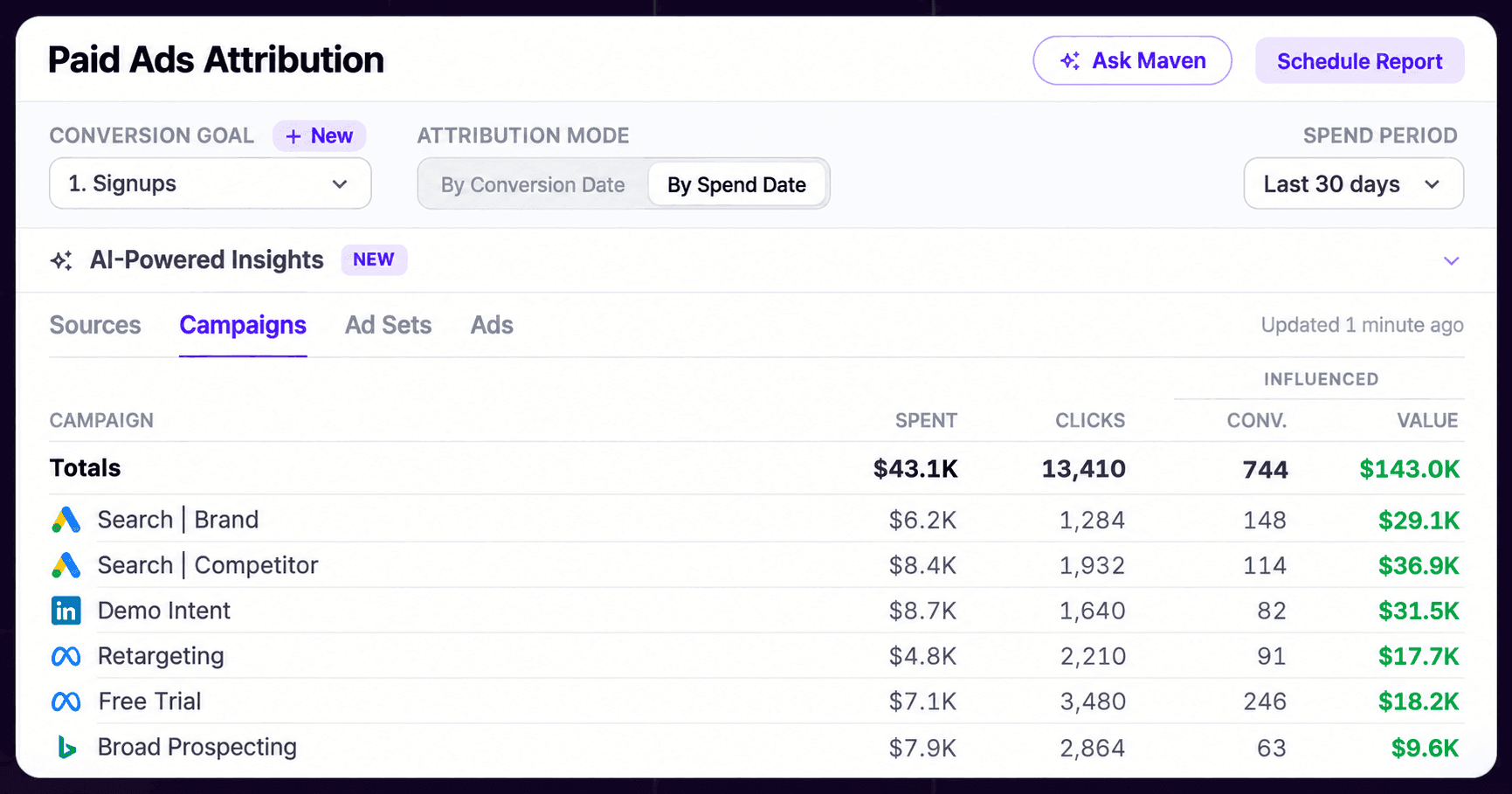
That makes it easier to compare channels under one conversion definition and identify campaigns that look efficient at the click or lead level but underperform on revenue.
Find post-click leaks with funnels
Use Funnels to see where paid users drop between landing, form, signup, checkout, upgrade, or another key conversion stage. Campaign breakdowns can help separate a media-quality issue from a conversion-path problem.
See what happens after the click
Use User Journeys to inspect the paths users take after arriving from a campaign, including return visits and non-linear journeys that native ad dashboards do not show.
Bring in off-site outcomes
With Event Sources, supported CRM, payment, webhook, CSV, webinar, and other off-site events can become part of the same attribution and funnel analysis. That is useful when the most valuable outcome happens after the original website session.
Verify data health before scaling spend
The Measurement Trust Center checks campaign tracking, customer matching, connected platforms, conversion feedback, and data confidence. This gives performance teams a concrete way to verify that the measurement foundation is healthy before increasing budgets.
Send deeper outcomes back to ad platforms
Conversion Sync can return supported conversion and revenue events to Google Ads and Meta so platform optimization can learn from stronger first-party signals.
That creates a feedback loop:
| Paid click -> customer action -> Usermaven conversion -> conversion sync -> ad platform optimization |
Monitor changes with reports and alerts
Usermaven Reports and Alerts can schedule attribution, funnel, trend, and key-stat reports and notify teams when important metrics spike, drop, or cross a threshold. That is useful for catching campaign or funnel deterioration without manually checking every dashboard.
Analyze performance with Maven AI
With Maven AI, performance teams can ask questions such as which campaigns increased spend but lost conversion value, where paid users drop out, or which channels create the strongest downstream outcomes.
The September 2026 release added faster streaming, concurrent conversations, visible execution steps, and interactive funnel visualizations. AI can speed up diagnosis, but it still depends on accurate campaign, conversion, and customer data.
Use MCP for advanced AI workflows
For teams working inside external AI clients, Usermaven MCP can expose authorized marketing, product, journey, funnel, and attribution data to compatible tools such as ChatGPT, Claude, Cursor, and Codex.
MCP is an advanced analysis layer rather than a prerequisite for ad optimization, so it should support the workflow, not replace campaign or attribution fundamentals.
Evidence: ContentStudio optimized ads around paying customers
ContentStudio is a useful example because its problem was not a lack of ad-platform metrics. Google Ads and Meta Ads already showed clicks and reported conversions, and the team also tested LinkedIn and X. The missing layer was whether those campaigns produced signups, demo bookings, upgrades, paying customers, and revenue.
In the ContentStudio case study, Usermaven connected campaign activity with downstream customer outcomes so the team could reallocate budget based on measured revenue rather than platform activity alone.
| Reported result | Outcome |
| Signups | +128% |
| Plan upgrades | +92% |
| Demo bookings | +242% |
| Traffic | +329% |
| Overall ROAS | +30% |
The case study also reports that some paid conversions took 7 to 14 days after the original ad click. That timing view prevented campaigns from being cut before delayed conversions matured.
ContentStudio ultimately concentrated spend in channels where cost per paying customer and revenue were stronger, while deprioritizing tests that looked weaker downstream. The point is not that one ad network is universally better. It is that optimization decisions became tied to customer and revenue evidence.
| Better ad performance is not just more clicks or cheaper leads. It is more valuable outcomes for the same or lower spend. |
A weekly ad performance review checklist
| Check | Question |
| Tracking | Are conversions firing correctly and only once? |
| Goal quality | Is the platform optimizing for the outcome the business values? |
| Creative | Is CTR or conversion declining as frequency or spend rises? |
| Traffic quality | Are the right users reaching the site? |
| Landing page | Does the page continue the promise that earned the click? |
| Funnel | Where do paid users drop? |
| Lead quality | Are leads becoming qualified opportunities or customers? |
| Revenue | Which campaigns create the most attributed value? |
| Conversion lag | Have campaigns had enough time to mature? |
| Platform comparison | Are Google, Meta, and LinkedIn evaluated under the same rules? |
| Data health | Are campaign tracking and customer matching trustworthy? |
| Next test | What single hypothesis should be tested next? |
Final verdict
The best way to improve ad performance is to stop treating creative, targeting, bidding, landing pages, and measurement as separate problems. Each layer affects what the next layer can learn.
Google, Meta, and LinkedIn require different tactical adjustments, but the decision standard should remain consistent: are the campaigns producing stronger conversions, higher-quality customers, and better revenue efficiency?
Use native ad platforms to optimize delivery and bidding. Use post-click analytics and independent attribution to understand what happens after the interaction and compare paid channels under one measurement framework.
Book a Usermaven demo to see how Google, Meta, LinkedIn, and Microsoft campaigns connect with customer journeys, conversions, and revenue.
FAQs
What is the fastest way to improve ad performance?
Start by verifying conversion tracking and the optimization goal. If the platform is learning from the wrong or incomplete outcome, changing bids, targeting, or creative can optimize the wrong behavior. Once measurement is healthy, diagnose creative, traffic quality, and the post-click funnel.
Which ad performance metrics matter most?
Use metrics in layers. CTR and CPC diagnose delivery and creative efficiency, conversion rate and CPL show whether traffic completes the intended action, and CAC, attributed revenue, ROAS, pipeline, or customer value show whether the campaign creates business value.
How often should ad creatives be refreshed?
There is no universal schedule. Refresh when performance data shows fatigue, such as rising frequency, declining CTR, weaker conversion rate, or heavy delivery concentration on one creative. A materially new idea is usually more useful than a cosmetic variation.
How can I improve Google Ads performance?
Use accurate conversion tracking, align the bid strategy with the campaign goal, review query and keyword relevance, improve ad and landing-page alignment, and use conversion value when outcomes have meaningfully different economic values.
How can I improve Meta Ads performance?
Test meaningful creative variations, monitor fatigue, compare broader delivery against downstream customer quality, and send reliable first-party conversion signals back to Meta where supported so the platform learns from stronger outcomes.
How can I improve LinkedIn Ads performance?
Choose an objective that matches the funnel stage, use professional targeting intentionally, give the campaign enough data to learn, and evaluate qualified leads, opportunities, pipeline, or revenue instead of judging performance only by CPL.

Written by
Ryan Mitchell
Marketing Analytics Strategist
Ryan Mitchell is a marketing analytics strategist specializing in campaign measurement, customer journeys, and marketing performance. He writes about analytics, reporting, and data-driven marketing strategies, helping SaaS and B2B teams measure what matters across every stage of the customer journey.
All articles by Ryan →