Facebook Ads Manager is now Meta Ads Manager, but marketers still search for Facebook Ads Manager alternatives when the native interface becomes too slow, repetitive, complex, or difficult to trust.
The catch is that most alternatives do not replace the underlying Meta advertising account. They replace or extend one part of the workflow: campaign creation, bulk launching, automated optimization, creative production, multi-account management, or reporting.
This guide compares eight options by the job they solve and explains when marketing attribution software is the better addition because the real problem is not campaign execution, but proving which ads create customers and revenue.
Facebook Ads Manager alternatives at a glance
The right alternative depends on the bottleneck. A high-volume agency needs a different tool from a small business that wants a simpler interface or a growth team that no longer trusts platform-reported ROAS.
| Tool | Best for | Category | Manages Meta campaigns? | Main caveat |
| Meta Business Suite | Basic free Meta management | Native simplified workflow | Basic | Limited advanced campaign control |
| AdEspresso | Simpler campaign creation and testing | Campaign manager | Yes | Better for simpler Meta workflows |
| AdManage | High-volume bulk launching | Campaign operations | Yes | Execution-focused, not independent attribution |
| Bïrch | Rule-based automation | Automation | Yes | Best once campaign volume justifies automation |
| Madgicx | Meta-focused AI optimization | AI optimization | Yes | More Meta-centric than enterprise orchestration tools |
| Smartly | Enterprise creative and media operations | Enterprise orchestration | Yes | Usually excessive for small teams |
| Usermaven | Independent attribution and revenue measurement | Attribution platform | No | Does not create or publish campaigns |
| Cometly | Ad tracking and attribution workflows | Attribution/reporting | Limited controls | Primarily measurement-oriented |
“Alternative” does not always mean replacement. Usermaven and Cometly, for example, are alternatives to relying on Meta Ads Manager as the final source of performance truth, not substitutes for building campaigns inside Meta.
Key takeaways
- Meta Ads Manager remains the execution layer. Most third-party tools still depend on the underlying Meta ad account, billing, pixel, audiences, and delivery system.
- Different alternatives replace different jobs. Campaign launching, automation, creative scale, multi-account operations, and attribution are separate problems.
- Small teams may not need another platform. Native Meta Ads Manager or Meta Business Suite can be enough when campaign volume and reporting needs are modest.
- Bulk-launch tools solve operational friction. They do not automatically improve attribution or revenue measurement.
- AI optimization tools reduce decision workload, but they cannot repair broken tracking, missing CRM data, or inconsistent conversion definitions.
- Attribution platforms answer a different question: what happened after the click, across the customer journey, and which campaigns created meaningful business outcomes.
- Usermaven should not be positioned as a campaign-management replacement. Its fit is independent paid-media attribution and downstream revenue measurement.
- The best setup may be Meta Ads Manager plus a specialist sidecar rather than replacing Meta Ads Manager entirely.
What counts as an Ads Manager alternative?
Facebook Ads Manager alternatives fall into several categories because marketers are rarely trying to replace the same job. Some teams want to launch hundreds of ads faster. Others want automated rules, creative production, agency governance, or an independent view of revenue.
| Category | What it replaces or extends | Examples |
| Campaign launcher | Manual campaign and ad setup | AdManage, AdEspresso |
| Automation engine | Manual monitoring and optimization rules | Bïrch |
| AI optimization | Analysis and campaign decision workload | Madgicx |
| Creative automation | Creative production at scale | Smartly |
| Enterprise operations | Multi-account governance and workflows | Smartly |
| Attribution platform | Native reporting and revenue measurement | Usermaven, Cometly |
| Simplified native workflow | Basic Meta management | Meta Business Suite |
Direct operational alternatives
Direct operational alternatives can launch, edit, automate, or manage campaigns through a connected Meta account. AdManage, Bïrch, Madgicx, Smartly, and AdEspresso belong here because they help advertisers do work that would otherwise happen inside Ads Manager.
Unlock insights that drive growth
Measurement sidecars
Measurement sidecars leave campaign execution in Meta and add a separate analytics layer. Usermaven and Cometly fit this category because their strongest value is understanding attribution, journeys, conversion value, and revenue rather than publishing the ads.
An attribution platform is not an alternative to Meta’s campaign builder. It is an alternative to treating Meta’s own dashboard as the final source of performance truth.
Where AI helps Meta ad management
AI is useful when the bottleneck is deciding what to change. It can surface weak campaigns, recommend budget actions, summarize performance, analyze creative fatigue, identify anomalies, and speed up reporting.
But AI optimization is different from measurement accuracy. An AI assistant cannot reconstruct a missing Ad ID, repair a broken conversion event, fill in a CRM opportunity that never synced, or reconcile two platforms that use different attribution rules.
Madgicx, for example, uses AI to recommend and execute Meta optimization actions, while Smartly combines AI with creative and media workflows at larger scale.
The practical rule is simple: use AI to accelerate decisions after the data foundation is trustworthy, not to create confidence in incomplete measurement.
Do you actually need an alternative?
Meta Ads Manager is free, capable, and still the system where the campaign ultimately lives. Before buying another platform, identify whether the native workflow is actually the problem.
Keep Meta Ads Manager alone
- One or two ad accounts are manageable.
- Campaign launch volume is low.
- Native automated rules cover the team’s needs.
- Creative production is not a major bottleneck.
- The business advertises mainly on Meta.
- Platform-level reporting is sufficient for current decisions.
Add an operations tool
An operations tool makes sense when launches take too long, naming and tracking become inconsistent, teams repeat the same changes across many campaigns, or agencies manage several accounts and client workflows.
Add an attribution platform
An attribution platform becomes more useful when Meta-reported ROAS does not match the CRM, several ad platforms claim the same customer, conversion value occurs days or months later, or the business cares more about paying customers than platform conversions.
| Main problem | Better category |
| Ads Manager feels too complicated | Simpler management interface |
| Launching 100 ads takes hours | Bulk launcher |
| Constant manual monitoring | Automation platform |
| Creative volume is the bottleneck | Creative automation |
| Too many client accounts | Agency/enterprise workflow |
| Meta conversion numbers are not trusted | Attribution platform |
| Meta needs deeper conversion signals | Attribution + Conversion Sync |
How to choose an Ads Manager alternative
A useful comparison should reflect the job the buyer needs done. Generic feature counts make a campaign launcher, an enterprise creative platform, and an attribution tool look comparable when they are not.
| Criteria | Why it matters |
| Can create/manage Meta campaigns | Shows whether it is a direct operational alternative |
| Bulk launching | Important for high-volume creative testing |
| Automated rules | Reduces repetitive monitoring |
| AI optimization | Helps prioritize account actions |
| Creative tools | Matters when asset production limits scale |
| Multi-account support | Important for agencies and multi-brand teams |
| Cross-channel support | Avoids another Meta-only silo |
| Attribution/revenue tracking | Connects advertising with business outcomes |
| Conversion feedback | Can return deeper signals to Meta |
| Pricing model | Determines fit by spend, accounts, or team size |
8 Facebook Ads Manager alternatives for 2026
These tools solve different Ads Manager problems. They are organized by best-fit use case rather than by an arbitrary overall ranking.
1. AdManage: For bulk launching
Best for: agencies, DTC teams, and paid-social teams launching large creative batches.
AdManage is built around a specific operational pain: creating dozens or hundreds of Meta ads without rebuilding each one manually. Its current workflow supports bulk launches, cloud and Google Sheets imports, naming and UTM governance, post-ID workflows, batch review, and repeated campaign templates.
That makes it useful when Meta Ads Manager is not conceptually difficult but becomes too slow at scale. Teams can prepare creatives, apply standards once, review a batch, and publish at volume rather than repeating the same sequence for every ad.
Current public pricing starts at about £99.99 per month for one ad account, with higher tiers for in-house teams, agencies, and enterprise accounts.
Main limitation: AdManage solves campaign operations. It does not replace independent customer-journey or revenue attribution.
Choose it when launch throughput, naming consistency, post IDs, and QA are visibly slowing the team down. If those tasks are already under control and the problem is proving revenue, the bottleneck sits elsewhere in the stack.
2. Bïrch: For rule automation
Best for: performance teams that spend too much time monitoring and adjusting campaigns manually.
Bïrch, formerly Revealbot, focuses on automation across Meta and other ad networks. Teams can build rules around spend, performance, budgets, and campaign conditions, while also using bulk creation and reporting workflows.
The main value is transparent automation. Instead of relying only on opaque AI recommendations, advertisers can define the conditions that should trigger actions and keep control over the logic.
Current pricing is tied to connected ad spend, with plans starting around $49 per month for lower-spend accounts and higher tiers as spend grows.
Its strongest buyers usually already know the actions they want automated: pause, scale, alert, rebalance, or react to performance thresholds. Teams that still lack trustworthy conversion data should fix measurement before automating decisions around it.
3. Madgicx: For AI optimization
Best for: Meta-heavy performance marketers who want AI-assisted optimization and a more guided account-management experience.
Madgicx positions AI Marketer as an account assistant that audits Meta performance and recommends actions. Its Ads Manager 2.0 adds smart filters, bulk actions, AI bidding, performance views, and direct campaign-management capabilities.
This is a stronger fit when the recurring question is “What should I change in my Meta account today?” rather than “How should Meta share revenue credit with Google, organic, email, and CRM activity?”
Madgicx also offers a tracking add-on, but the platform remains centered on improving paid-media execution and optimization.
4. Smartly: For enterprise media and creative scale
Best for: large advertisers, agencies, and enterprise teams managing complex media, creative, and governance workflows.
Smartly combines media operations with high-volume creative production. For Meta, it supports bulk campaign creation, multiple ad accounts in one view, feed-driven automation, templates, personalization, reporting, and creative testing at scale.
Its biggest advantage is breadth. Teams can coordinate creative, media buying, automation, and cross-platform workflows across several social networks instead of bolting together multiple point solutions.
5. AdEspresso: For simpler campaign management
Best for: small and mid-sized advertisers that want a more approachable Facebook and Instagram campaign workflow with straightforward testing and team features.
AdEspresso remains active in 2026. Current plans include Facebook and Instagram campaign creation, split testing, performance triggers, bulk creation, client/team workflows, approval controls, reporting, and collaboration features.
Its Starter plan currently begins at $49 per month with a $1,000 monthly ad-spend limit, while higher plans remove that limit and add team and workflow capabilities.
6. Meta Business Suite: For free basic management
Best for: small businesses that want a simpler Meta-native environment for basic Facebook and Instagram activity without adding another paid SaaS tool.
Meta Business Suite is not a third-party replacement. It is Meta’s own business-management environment, and Meta’s documentation allows businesses to manage Pages, linked Instagram accounts, ads, insights, and related tasks through its tools. Meta Business Suite is therefore the most sensible “alternative” when the real need is simplicity rather than advanced campaign operations.
7. Usermaven: For revenue attribution
Best for: Marketing teams and growth teams whose real problem is trusting Meta-reported performance, not creating the campaigns.
Usermaven does not create, publish, or manage Meta campaigns. Instead, it connects Meta ad spend with first-party website behavior, customer journeys, conversions, conversion value, and revenue.
Usermaven is strongest when the question is not “How do we launch ads faster?” but “Which Meta campaigns actually create valuable customers, revenue, or pipeline when the full journey is considered?”
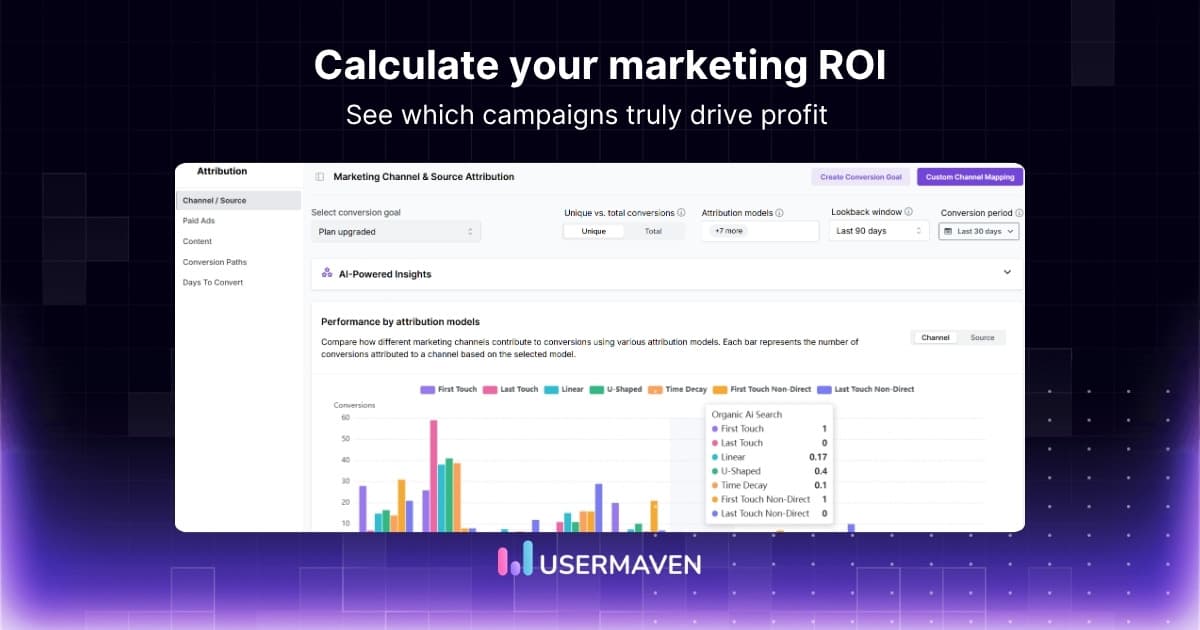
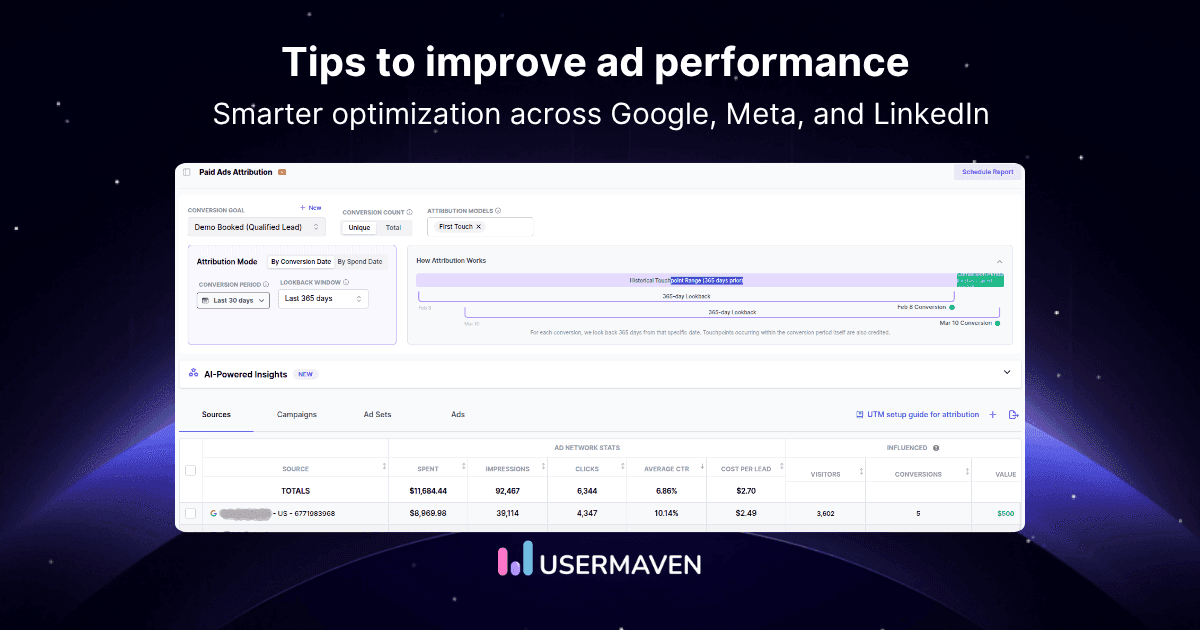
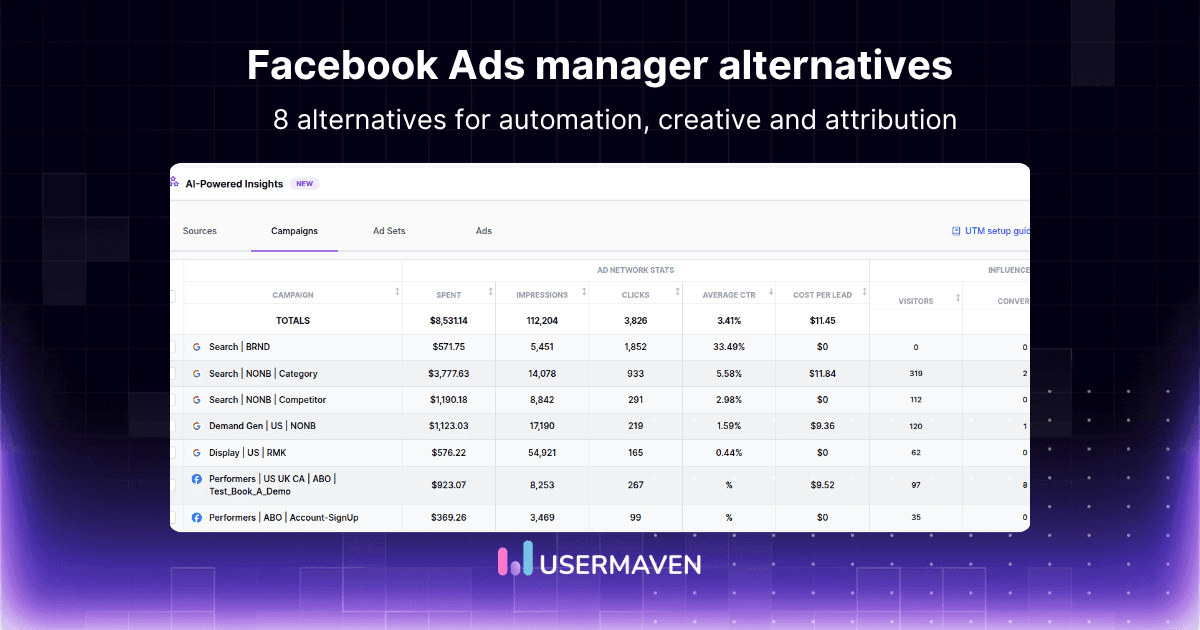
Paid Ads Attribution can drill from the ad network into campaigns, ad sets, and individual ads, and compare Meta with Google, LinkedIn, and Microsoft Ads under the same attribution environment.
8. Cometly: For ad attribution
Best for: teams primarily looking for paid-ad tracking, multi-touch attribution, and conversion feedback.
Cometly focuses on connecting advertising interactions with customer journeys and downstream events. It is relevant when the buyer’s frustration with Ads Manager is measurement rather than campaign construction.
Like Usermaven, Cometly belongs in the measurement-sidecar category rather than the bulk-launch or creative-automation category.
Facebook Ads Manager alternatives compared
The most useful comparison is to separate operational capabilities from measurement capabilities. That prevents a revenue-attribution platform from looking weak simply because it cannot publish ads, and prevents a campaign launcher from looking complete simply because it can move faster inside Meta.
| Tool | Campaign creation | Bulk launch | Rules | AI optimization | Creative scale |
| Meta Business Suite | Basic | Limited | Limited | Meta-native | Basic |
| AdEspresso | Yes | Yes | Yes | Limited | Testing-focused |
| AdManage | Yes | Strong | Some | Some | Launch-focused |
| Bïrch | Yes | Yes | Strong | Some | Limited |
| Madgicx | Yes | Yes | Yes | Strong | Strong |
| Smartly | Strong | Strong | Strong | Strong | Strong |
| Usermaven | No | No | No | Analysis | No |
| Cometly | Limited | No | Some | Analysis | No |
| Tool | Multi-account | Cross-channel | Revenue attribution |
| Meta Business Suite | Some | No | No |
| AdEspresso | Yes | Some | Limited |
| AdManage | Strong | Yes | Limited |
| Bïrch | Yes | Yes | Limited |
| Madgicx | Yes | Some | Some |
| Smartly | Strong | Strong | Some |
| Usermaven | Analytics | Strong | Strong |
| Cometly | Reporting | Strong | Strong |
The trade-off is straightforward. Tools that sit closest to campaign execution tend to be strongest at launching, editing, automation, and creative operations.
Measurement platforms sit farther downstream, where the questions become conversion quality, customer journeys, revenue, and cross-channel credit. Some enterprise suites cover more than one layer, but that breadth usually comes with higher cost and implementation complexity.
Which alternative fits which use case?
| Team or problem | Better fit |
| Small business needing a simpler Meta workflow | Meta Business Suite or AdEspresso |
| Performance team launching creative at volume | AdManage |
| Team wanting automated campaign rules | Bïrch |
| Meta-heavy team wanting AI optimization | Madgicx |
| Enterprise creative/media operation | Smartly |
| Agency managing many Meta accounts | AdManage, Smartly, or Bïrch |
| Marketing team questioning Meta ROAS | Usermaven or Cometly |
| Multi-channel team measuring revenue | Usermaven |
| Team wanting native execution + independent measurement | Meta Ads Manager + attribution platform |
The correct choice is determined by the bottleneck, not by which product has the longest feature list.
For a solo advertiser, an enterprise orchestration platform can add more process than it removes. For an agency launching hundreds of ads, a simple reporting dashboard will not solve the operational problem.
And for a growth team that already knows how to operate Meta campaigns, another launcher may be less useful than independent measurement. The buyer should therefore start with the job that consumes the most time or creates the most uncertainty, then choose the narrowest tool that solves it.
When Meta reporting is the real problem
A Meta campaign can look excellent in Ads Manager and still produce weak business outcomes.
Imagine Meta reports 120 conversions at a $34 CPA and 4.2× ROAS. The business still needs to know which conversions became paying customers, how much revenue they created, whether they retained, and whether other channels also contributed to the same journey.
That is why a dedicated Facebook ads attribution view can be more useful than another campaign-management interface. Native platforms measure under their own rules, while independent attribution evaluates Meta alongside the rest of the customer journey.
When Meta, Google, CRM, and analytics reports disagree, the ad platform discrepancies often come from different attribution windows, identities, conversion definitions, and credit rules rather than one dashboard simply being “wrong.”
If the problem is campaign creation, buy an operations tool. If the problem is whether Meta-reported ROAS reflects actual customers and revenue, buy a measurement layer.
How Usermaven complements Meta Ads Manager
Usermaven keeps Meta Ads Manager as the execution layer and adds an independent measurement layer around the campaigns.
Connect Meta spend with first-party outcomes
The paid ads attribution workflow combines Meta spend, impressions, clicks, campaigns, ad sets, and ads with first-party conversion and revenue data.
That makes it possible to evaluate campaigns by attributed conversions, conversion value, ROAS, and downstream business outcomes rather than only by the numbers reported inside Meta.
Preserve campaign and Ad ID context
Precise attribution depends on preserving the Meta Ad ID and campaign parameters. Usermaven’s Facebook ad tracking workflow relies on the Ad ID to connect later customer behavior with the correct campaign, ad set, and creative.
Without that identifier, the campaign may still produce traffic, but the downstream attribution view becomes less complete and less actionable.
Compare Meta with other paid channels
A major advantage of an independent attribution layer is that Meta, Google, LinkedIn, and Microsoft Ads can be evaluated under one measurement framework rather than inside four different platform dashboards.
This helps prevent every ad network from becoming the “winner” simply because each uses its own attribution rules.
Measure delayed returns from ad spend
Some customers convert days or weeks after the original ad click. Usermaven supports spend-period attribution, look-ahead analysis, custom calculated Paid Ads metrics, and attribution lookback windows up to 365 days.
That matters when early campaign reports look weak even though the customers influenced by the spend have not finished converting yet.
Send deeper outcomes back to Meta
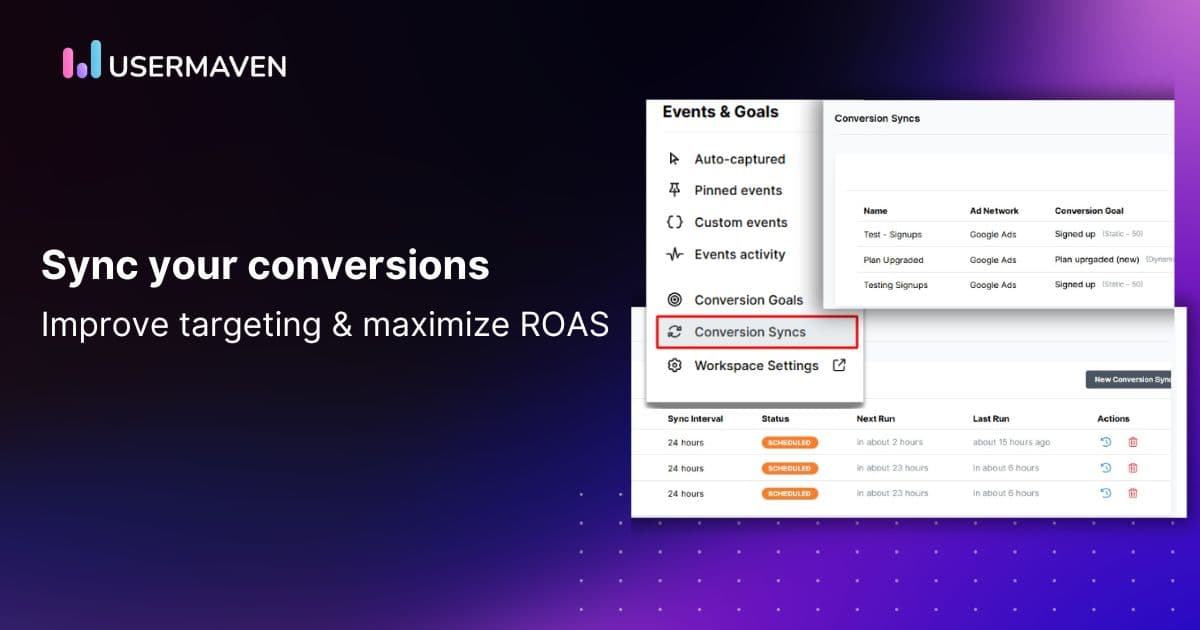
Usermaven’s conversion syncs can send supported conversion and revenue events back to Meta through the Conversions API when the required identifiers are available.
The architecture becomes: Meta ad → Usermaven journey → qualified or revenue event → Conversion Sync → Meta.
Operate campaigns in Meta, measure them independently, then return deeper business outcomes to Meta’s optimization system.
Check measurement before changing budget
The Measurement Trust Center evaluates measurement health across Collection, Identity, Integrations, Delivery, and Reliability.
This is useful when the real reason for seeking an Ads Manager alternative is “I do not trust these numbers.” Before cutting spend, confirm the underlying tracking and integrations are healthy.
Analyze paid performance with Maven AI
Maven AI can investigate questions such as which Meta campaigns created the most attributed revenue, which ad sets have high conversion volume but weak value, or which campaigns look strong in Meta but weak across the full customer journey.
AI becomes most useful after the paid-media and conversion data is reliable enough to support the question.
This also keeps the stack logically separated: Meta owns campaign delivery, Usermaven owns independent measurement, and Maven AI accelerates analysis of the measurement layer.
That separation makes it easier to understand whether a performance change came from the campaign itself, from attribution settings, or from the quality of the downstream conversion data.
Evidence: ContentStudio measured beyond Meta
ContentStudio is a strong example of why some teams need an alternative to Meta’s reporting rather than an alternative to Meta’s campaign builder.
The company ran acquisition across Google Ads and Meta Ads while also testing LinkedIn and X. Each platform showed clicks, costs, and reported conversions, but the team could not reliably tell which campaigns generated signups, demo bookings, plan upgrades, and paying customers.
After connecting paid acquisition with downstream product and revenue events, the ContentStudio case study reports substantial improvements in the outcomes the team could measure and optimize.
| Outcome | Result |
| Signups | +128% |
| Plan upgrades | +92% |
| Demo bookings | +242% |
| ROAS | +30% |
The most important lesson is not that Usermaven replaced Ads Manager. It did not. Meta remained an acquisition channel and execution environment.
The value came from connecting ad spend with real customer outcomes, identifying campaigns that produced revenue, fixing a funnel leak, and recognizing that many paid conversions occurred 7–14 days after the original click.
That is the measurement problem a campaign-management alternative cannot solve by itself.
Facebook Ads Manager alternative checklist
- Problem: What exactly is wrong with the current Meta workflow?
- Execution: Does the new tool actually create or modify campaigns?
- Volume: Is bulk launching important enough to justify another platform?
- Automation: Are repeated optimization decisions consuming significant time?
- Creative: Is asset production the main bottleneck?
- Accounts: Does the team manage many brands, clients, or ad accounts?
- Channels: Does the tool work beyond Meta if the business is multi-channel?
- Measurement: Is Meta-reported ROAS the real issue?
- Revenue: Can campaign performance be tied to customer value or revenue?
- Tracking: Are Ad IDs and UTMs preserved correctly?
- Feedback: Can deeper conversion signals be returned to Meta?
- Pricing: Is the model based on spend, accounts, seats, or a flat subscription?
- Complexity: Will the new tool genuinely reduce operational overhead?
Final verdict
There is no single Facebook Ads Manager replacement because campaign creation, automation, creative production, account operations, and attribution are different jobs.
Use a tool such as AdManage, Bïrch, Madgicx, AdEspresso, or Smartly when the problem is operating Meta campaigns. Stay with Meta alone when the native workflow is manageable and its capabilities are sufficient.
When the real problem is understanding whether Meta advertising creates customers and revenue across a multi-channel journey, keep Ads Manager as the execution layer and add independent attribution.
Ready to see Usermaven in action? Explore the platform or book a demo for a closer look.
FAQs
What is the best Facebook Ads Manager alternative?
There is no universal best option because the tools solve different problems. AdManage is strong for bulk launching, Bïrch for rules, Madgicx for Meta-focused AI optimization, Smartly for enterprise creative and media operations, AdEspresso for simpler management, and Usermaven when the problem is independent attribution and revenue measurement.
Is Facebook Ads Manager now Meta Ads Manager?
Yes. Meta now uses the Meta Ads Manager name, although many marketers still search for Facebook Ads Manager because the older terminology remains familiar.
Can third-party tools fully replace Meta Ads Manager?
Usually not. Most operational tools connect to the underlying Meta ad account and use Meta’s infrastructure for billing, audiences, delivery, pixels, and campaign objects. They replace or simplify parts of the workflow rather than replacing Meta advertising itself.
What is the best free Facebook Ads Manager alternative?
Meta Business Suite is the most practical free option for basic Meta business management. It is better suited to simpler workflows than to advanced performance-marketing operations.
What is the best alternative for agencies?
Agencies usually benefit from tools that support multiple accounts, bulk launches, governance, repeatable naming, and team workflows. AdManage, Smartly, and Bïrch are stronger fits than measurement-only platforms when operational scale is the primary issue.
What is the best alternative for automation?
Bïrch is a strong rule-based automation option, while Madgicx adds a more AI-guided Meta optimization layer. The better choice depends on whether the team prefers explicit automation logic or AI-assisted recommendations and actions.
Updated

Written by
Adeel Khan
Growth Marketing Expert
Adeel Khan is a full-stack SaaS marketer with 10+ years of experience in content marketing, paid advertising, analytics, and conversion rate optimization. He shares practical insights and strategies drawn from hands-on experience, helping B2B SaaS marketers improve performance and make better marketing decisions.
All articles by Adeel →