PPC (pay-per-click) is a digital advertising pricing model in which an advertiser pays when someone clicks an ad.
It is widely used in paid search, where businesses bid to reach people searching for relevant products or services. PPC can generate visits quickly, but paying for traffic does not guarantee customers or profit.
A campaign with a low cost per click can still lose money if its visitors never purchase. A more expensive click may be worthwhile when it produces a qualified lead or paying customer.
This guide explains PPC auctions, campaign types, costs, setup, and metrics, then shows how to calculate the break-even click price and connect ad spend with actual business outcomes.
Key takeaways
- PPC meaning: Pay-per-click describes how an advertiser is charged, not a guarantee that a click converts.
- Auction mechanics: Bids matter, but eligibility, ad relevance, landing-page quality, and context also affect placement.
- Cost discipline: Budget around conversion rate and margin, not an industry-average CPC in isolation.
- Measurement chain: Track clicks through qualified leads, purchases, revenue, and retained customers.
- Profitability: ROAS is a revenue ratio; contribution after advertising determines whether the economics work.
- Start focused: Launch a narrow test, validate tracking, then expand based on business outcomes.
PPC advertising at a glance
PPC usually refers to paying for clicks in search advertising, although marketers sometimes use “PPC” loosely to describe paid digital campaigns billed on other bases. The distinction matters because impression-based and conversion-based campaigns have different cost mechanics.
| Quick question | Practical answer |
|---|---|
| What does PPC stand for? | Pay-per-click. |
| When do advertisers pay? | When the billable click occurs under a CPC arrangement. |
| Where does PPC appear? | Search engines, shopping listings, and selected social or display placements. |
| How are ads ranked? | Auctions consider bids, quality, eligibility, and context; details vary by platform. |
| What does PPC cost? | Click price × billable clicks, subject to budget and platform rules. |
| Which metric matters most? | The metric closest to the business outcome, such as profit or qualified acquisition. |
| How quickly can results appear? | Traffic can begin after approval and delivery, while reliable outcome data needs time. |
| Is PPC the same as SEO? | No. PPC buys eligible ad traffic; SEO seeks unpaid organic visibility. |
The central distinction: PPC purchases an opportunity to bring someone to a page. Conversion tracking and revenue measurement establish what that opportunity produced.
Unlock insights that drive growth
How does PPC advertising work?
In paid search, an advertiser chooses objectives, targeting, eligible keywords or search themes, creatives, a landing page, and a spending strategy. When an eligible search occurs, the platform decides which ads may appear and where.
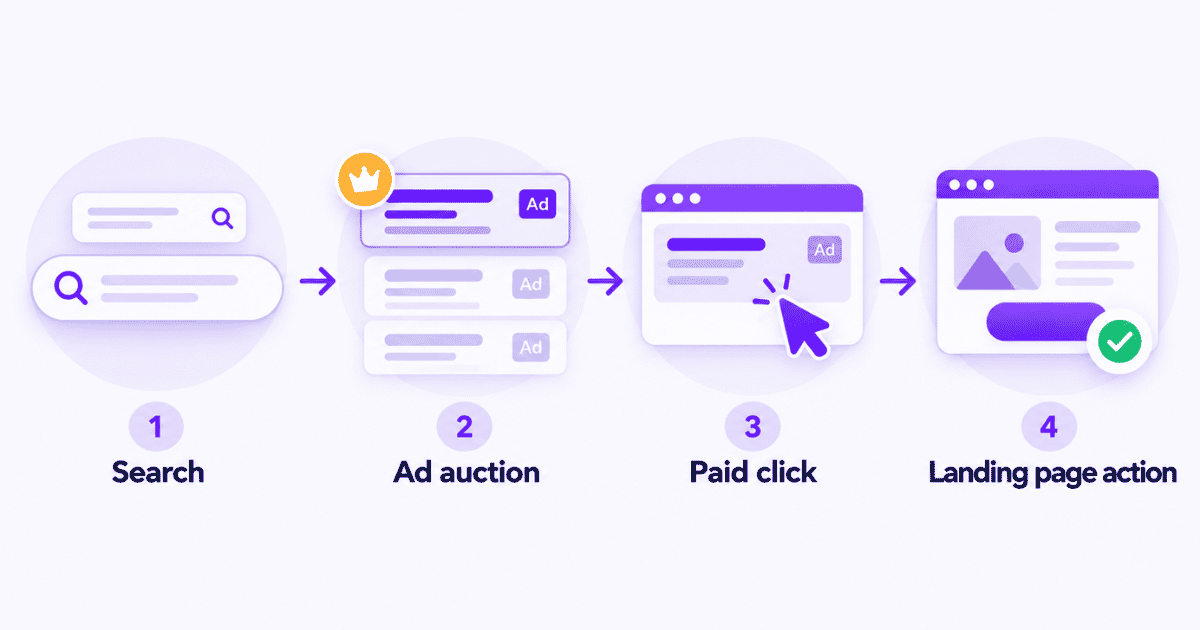
1. A relevant search triggers an auction
A user searches for “project management software for agencies.” Eligible advertisers may enter an ad auction based on their targeting and account settings.
Matching a keyword does not guarantee an impression; budget, policy status, bids, and auction rules still matter.
2. The auction evaluates more than the bid
Bidding expresses how much an advertiser is willing to pay or which conversion value it wants the system to optimize.
On Google Search, factors such as ad and landing-page quality, auction competitiveness, search context, thresholds, and asset impact contribute to Ad Rank.
The highest bid therefore does not automatically win the best placement. Google’s published Ad Rank criteria explain why quality and search context affect eligibility and positions.
3. The advertiser is charged for a billable click
Under CPC pricing, spend accumulates when qualifying clicks occur. The actual price can be below a maximum bid, and not every advertising platform charges in the same way.
For example, a $2 average CPC and 400 billable clicks produce $800 in click charges. That calculation says nothing yet about customer acquisition or revenue.
4. The visitor takes an action or leaves
After the click, a person may browse, compare alternatives, submit a form, purchase, or return later. A campaign’s usefulness depends on whether the landing page matches intent and whether meaningful actions can be measured reliably.
This is why conversion tracking belongs in PPC setup before the first campaign launches, not after the budget has already been spent.
Where do PPC ads run?
PPC is not one platform. The right channel depends on whether potential customers are actively searching, browsing content, comparing products, or responding to demand-generation creatives.
| Channel | Typical advertiser goal | Important qualification |
|---|---|---|
| Google Search | Capture expressed search intent | Keyword eligibility and ad auction determine delivery. |
| Microsoft Advertising | Reach additional search audiences | Placement, competition, and volume differ from Google. |
| Shopping or retail ads | Promote products close to purchase | Product feeds and merchant data strongly affect delivery. |
| Meta ads | Generate interest, traffic, leads, or sales | Many campaigns optimize and bill by impressions, not solely clicks. |
| LinkedIn ads | Reach professional audiences and accounts | Click costs may be higher; lead quality and pipeline matter. |
| Display and remarketing | Re-engage audiences or reach content readers | Viewability, audience exclusions, and frequency matter. |
| Video ads | Build demand or support later conversions | Billing may use views, impressions, or other supported models. |
Microsoft’s new advertiser guidance illustrates how a search advertiser sets objectives, budgets, and ads across Microsoft properties and its partner network. Google’s Ad Rank guidance also explains the auction factors that influence search-ad eligibility and placement.
Search PPC vs. paid social
Search advertising commonly starts with explicit demand. Social advertising can create or influence demand before someone searches for a solution. Treating a social feed impression as equivalent to a high-intent search click can lead to misleading budget comparisons.
A useful multi-channel attribution framework shows how paid search, paid social, email, and organic interactions appear across the same customer journey rather than giving each platform an isolated story.
See what's working. Fix what's not. Grow faster.
Types of PPC campaigns and when to use them
Campaign type should follow the buying task. A local emergency service, a subscription product, and a consumer ecommerce brand are unlikely to need the same initial mix.
Search and high-intent lead generation
Search campaigns can reach people looking for an immediate solution. Separate brand, non-brand, and competitor-focused themes when they need different budgets or performance analysis.
Branded terms may show excellent reported ROAS because existing customers already know the business. That is useful operational data, but it does not prove every branded click created new demand.
Shopping and ecommerce acquisition
Product-focused campaigns depend on accurate feeds, stock status, prices, landing pages, and product-level value. A campaign can generate purchases yet lose margin on discounted or low-value items.
For ecommerce brands, repeat purchases, refunds, and net order value can matter more than a campaign’s headline conversion count.
Remarketing and demand generation
Remarketing reaches people who have already interacted with the business. It can improve conversion efficiency, but overlap with organic purchasing intent can make reported credit larger than the additional sales actually caused.
The difference between credited conversions and causal lift is explained in our incrementality vs. attribution analysis. For a basic PPC pillar, the key lesson is to avoid treating all attributed revenue as additional revenue.
How much does PPC advertising cost?
There is no reliable universal PPC price. Actual costs vary with platform, audience, keyword intent, location, ad quality, season, bidding strategy, and competition.
Published average CPC benchmarks can provide context, but cannot determine what a specific business should afford.
Estimated click spend = Average CPC × Clicks. If a test receives 1,000 billable clicks at $1.80 on average, the click spend is approximately $1,800.
Set a budget from acquisition economics
Instead of asking only whether a keyword costs $1 or $10, establish the maximum cost per qualified outcome.
An ecommerce business can use order value and contribution margin. A B2B company may begin with the percentage of leads that become customers and the expected contribution from a new account.
Campaign budgets should also leave room for conversion lag, creative tests, landing-page improvements, and the limits of small samples. A campaign generating one sale from ten clicks does not establish a durable 10% conversion rate.
PPC costs beyond click charges
The ad platform is not necessarily the full cost of acquisition. Landing-page work, creative production, agency fees, analytics, discounts, sales labor, and fulfillment may change the economics.
Customer acquisition metrics help teams separate media-only CPA from fully loaded customer acquisition cost. That distinction prevents a profitable-looking ad dashboard from hiding an expensive acquisition process.
PPC metrics that actually matter
A useful report connects spending and user activity to a consistent outcome. Metrics at the top of the funnel are valuable diagnostics, but they should not replace customer and revenue outcomes.
| Metric | Formula | What it diagnoses |
|---|---|---|
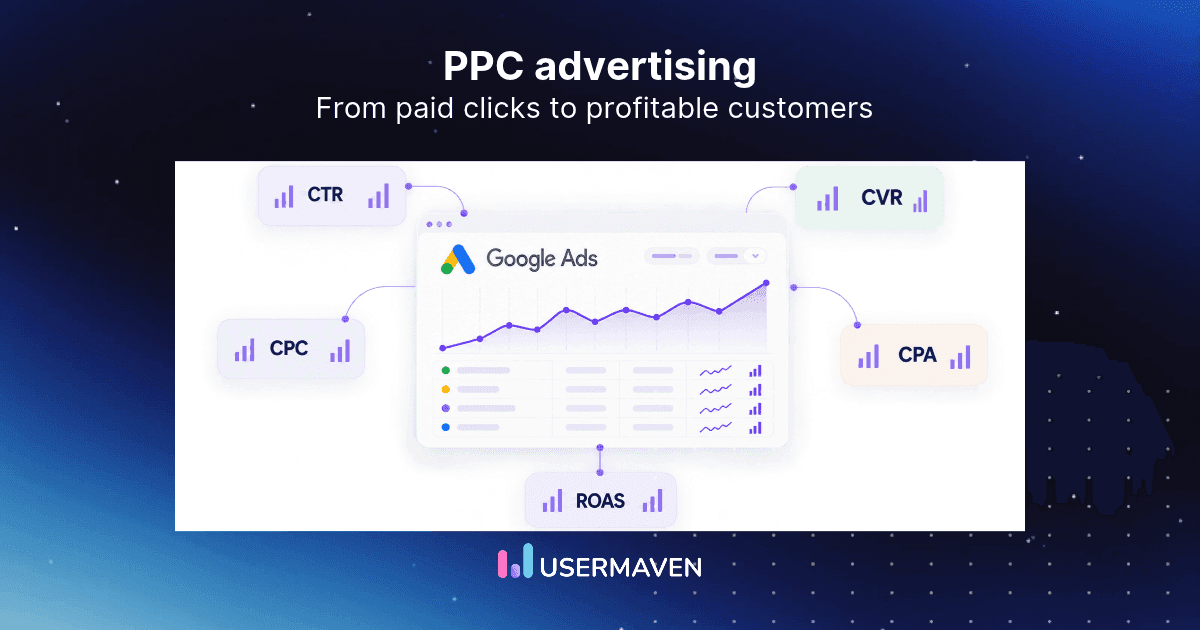
| Click-through rate (CTR) | Clicks ÷ impressions × 100 | Whether the message attracts attention. |
| Cost per click (CPC) | Click spend ÷ billable clicks | Cost to acquire a click. |
| Post-click conversion rate | Converting visits ÷ eligible visits × 100 | How well traffic completes a defined action. |
| Cost per acquisition (CPA) | Applicable ad spend ÷ acquired outcomes | Paid acquisition efficiency for a named outcome. |
| Customer acquisition cost (CAC) | Relevant acquisition costs ÷ new customers | Total cost of obtaining customers. |
| Return on ad spend (ROAS) | Attributed revenue ÷ ad spend | Revenue credit per advertising dollar. |
| Contribution after media | Revenue × contribution margin − ad spend | Simplified economics after ad cost. |
Metrics used: Impressions, clicks, CPC, visits, conversion rate, purchases or qualified leads, conversion value, spend, CPA, CAC, ROAS, and contribution after media.
The denominator matters. For instance, ad-platform clicks and analytics sessions may not match because a click does not always become a loaded page, and a person may return in a later session.
More detailed ad performance metrics are helpful once the business has established a clear conversion definition and its source of truth.
The PPC profitability example
A cheap click is not automatically a good click. The business needs to know whether visitors convert into revenue that covers advertising and other variable costs.
One campaign with complete economics
Consider a hypothetical ecommerce campaign with the following results. All figures are illustrative, not customer performance data.
| Input or outcome | Campaign result |
|---|---|
| Billable clicks | 3,000 |
| Average CPC | $2.00 |
| Ad spend | $6,000 |
| Purchasing customers | 120 |
| Purchases per billable click | 4.0% |
| Average order revenue | $150 |
| Attributed purchase revenue | $18,000 |
| Contribution margin before ads | 40% |
The arithmetic is straightforward. CPC equals $6,000 ÷ 3,000, or $2.00. The purchase rate equals 120 ÷ 3,000, or 4%. CPA equals $6,000 ÷ 120, or $50.
Attributed revenue is 120 × $150 = $18,000. ROAS is $18,000 ÷ $6,000 = 3.0x. At a 40% contribution margin before advertising, the purchase contribution is $7,200.
Simplified contribution after media = $7,200 − $6,000 = $1,200. This excludes any additional acquisition or operating costs not already reflected in the margin.
Calculate the break-even CPC
For this simplified model, a break-even CPC can be estimated from the probability of purchase and the contribution generated by a purchase.
Break-even CPC = Purchases per billable click × Revenue per purchase × Contribution margin.
Using the same campaign, 0.04 × $150 × 0.40 = $2.40. With an actual CPC of $2.00, the campaign has $0.40 of modeled contribution headroom per click before omitted costs.
This is more decision-useful than a generic “good CPC” benchmark. If the purchase rate falls to 2%, break-even CPC also falls to $1.20, assuming order value and margin stay unchanged.
Why cheaper clicks can lose more money
Compare a second hypothetical campaign that attracts 3,000 clicks at $1 CPC but converts only 1% of them. At the same $150 order value and 40% contribution margin, it produces 30 purchases and $4,500 in revenue.
Its ad spend is $3,000, purchase contribution is $1,800, and simplified contribution after media is −$1,200. The cheaper traffic loses money despite costing half as much per click.
| Economic comparison | Campaign A | Campaign B |
|---|---|---|
| Average CPC | $2.00 | $1.00 |
| Purchase rate | 4.0% | 1.0% |
| Ad spend | $6,000 | $3,000 |
| Attributed revenue | $18,000 | $4,500 |
| ROAS | 3.00x | 1.50x |
| Contribution after media | +$1,200 | −$1,200 |
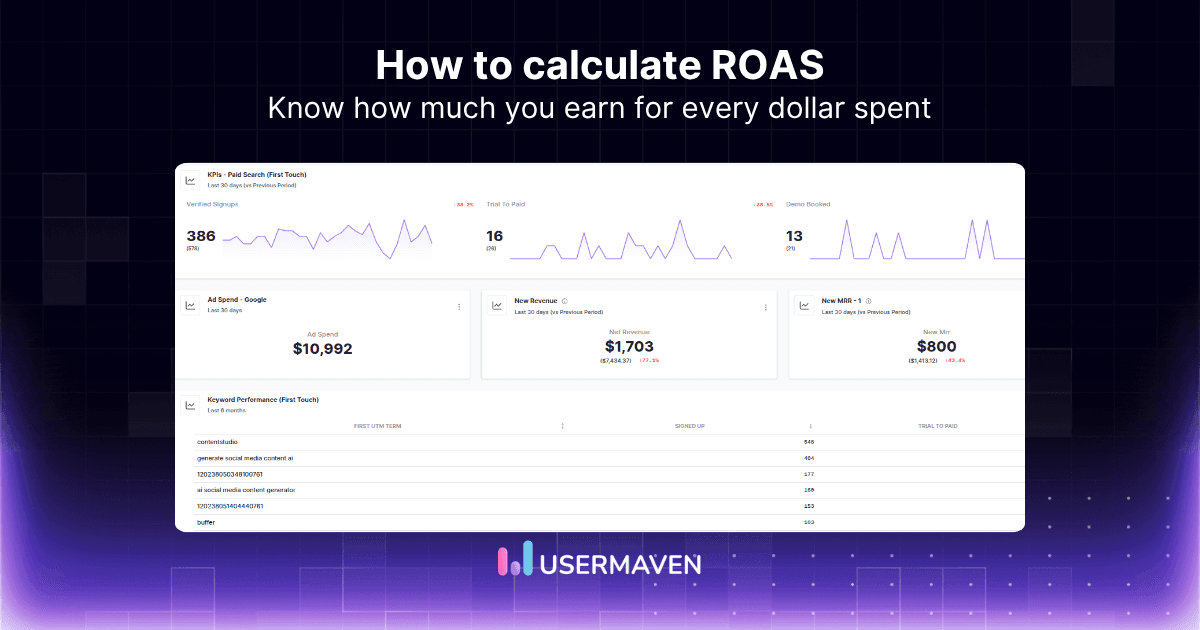
Our detailed ROAS calculation guide explains attribution and revenue inputs more deeply. ROAS here is based on attributed, not experimentally estimated incremental revenue.
How to launch a PPC campaign step by step
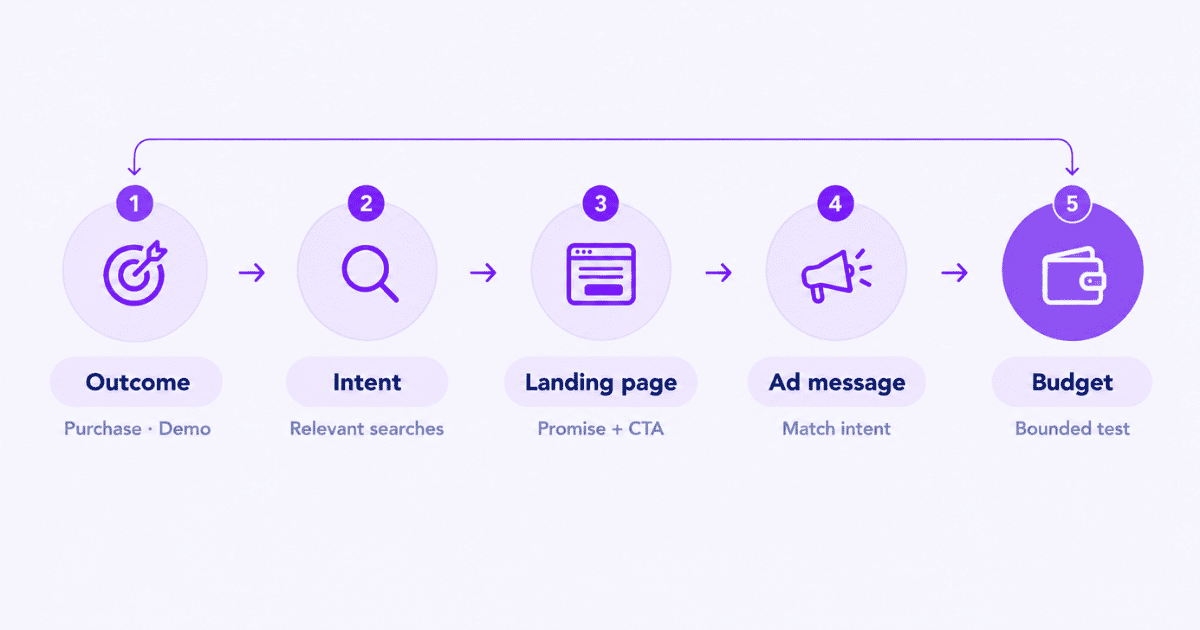
A reliable launch process starts with the business outcome and works backward to advertising decisions. The following sequence is suitable for a small initial paid-search test and can be adapted to other networks.
1. Choose one measurable outcome
Decide whether success means a purchase, qualified demo, paid subscription, or closed deal. Record exactly what counts, who owns the data, and how duplicates will be prevented.
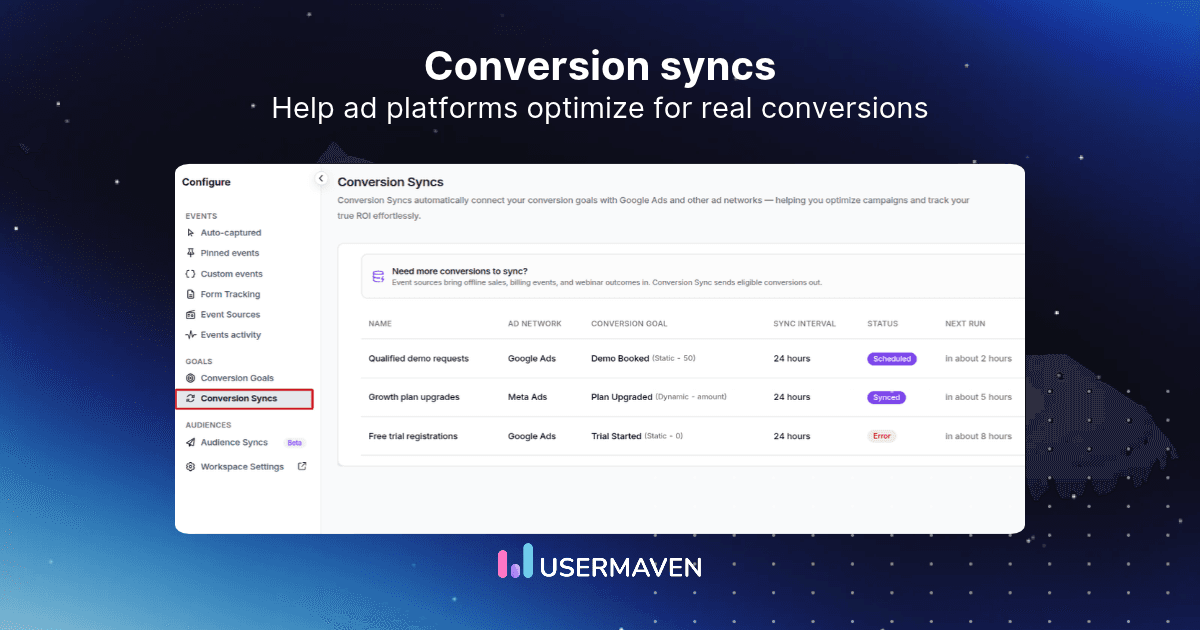
The conversion goals documentation explains how Usermaven can define goals from page visits, pinned events, or custom events with static or dynamic values.
2. Select a specific audience and intent
Start with a manageable region, product, or customer problem. Group search terms by intent rather than mixing research questions, brand searches, and purchase-ready queries into one undifferentiated campaign.
Avoid presenting targeting restrictions as a workaround for platform policies. Location, audience, privacy, and consent requirements still apply.
3. Build a relevant landing-page experience
Use a headline aligned with the advertisement. Show the promised product or service, remove unnecessary friction, and make the next action obvious. Test the page on mobile and confirm forms, payments, and thank-you states work.
A strong CTR cannot compensate for a broken checkout or a form that never submits.
4. Write ads that match the search intent
Use precise claims, useful differentiators, and clear next steps. A searcher looking for a price comparison should not land on a generic corporate homepage if a product-specific page exists.
Prepare several relevant messages so optimization is based on measured behavior rather than guesses about the winning headline.
5. Set a bounded budget and bidding strategy
Begin with a spending level the business can afford to learn from. Choose bidding objectives consistent with the desired conversion; do not optimize toward low-value actions merely because they are easier to count.
Automated bidding depends on the conversion signals supplied to it. If every free download is treated like a customer purchase, the system may optimize efficiently for the wrong result.
6. Install and validate tracking before launch
Test the complete path from a tagged ad click to conversion, payment, and eventual CRM status. Confirm campaign parameters, the correct conversion value, stable order IDs, and compatible reporting time zones.
Usermaven’s event tracking setup provides implementation guidance for recording meaningful customer and purchase actions.
7. Launch, monitor, and optimize deliberately
Review search terms, budgets, rejected ads, conversion quality, audience exclusions, and landing-page performance. Make one interpretable change at a time when possible.
Do not cut a slow-converting campaign after a few hours if the sales cycle normally lasts weeks. Conversely, do not keep an unprofitable campaign running indefinitely because its click volume looks healthy.
How to measure PPC beyond the click
The complete measurement chain is impression → click → visit → meaningful event → qualified outcome → customer → revenue → retention. Each stage has different sources, potential gaps, and decision value.
Connect campaign and conversion data
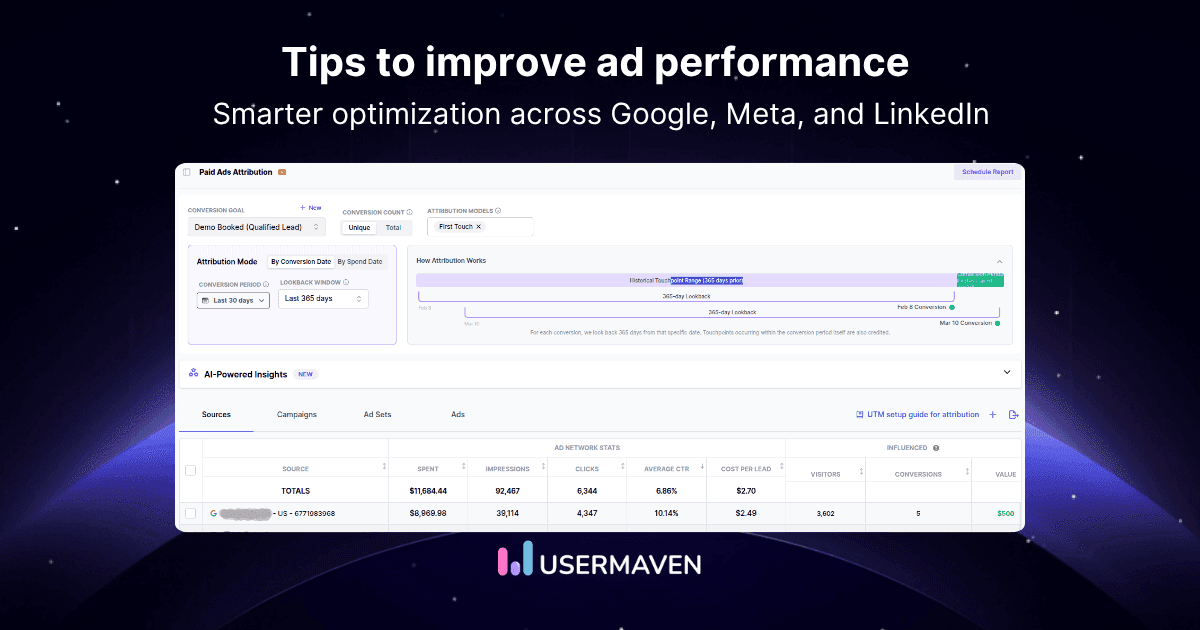
Campaign tags and supported ad click identifiers help connect a landing visit with the advertising source. Usermaven’s Paid Ads Attribution documentation covers supported network connections, required campaign parameters, conversion goals, and campaign-level reporting.
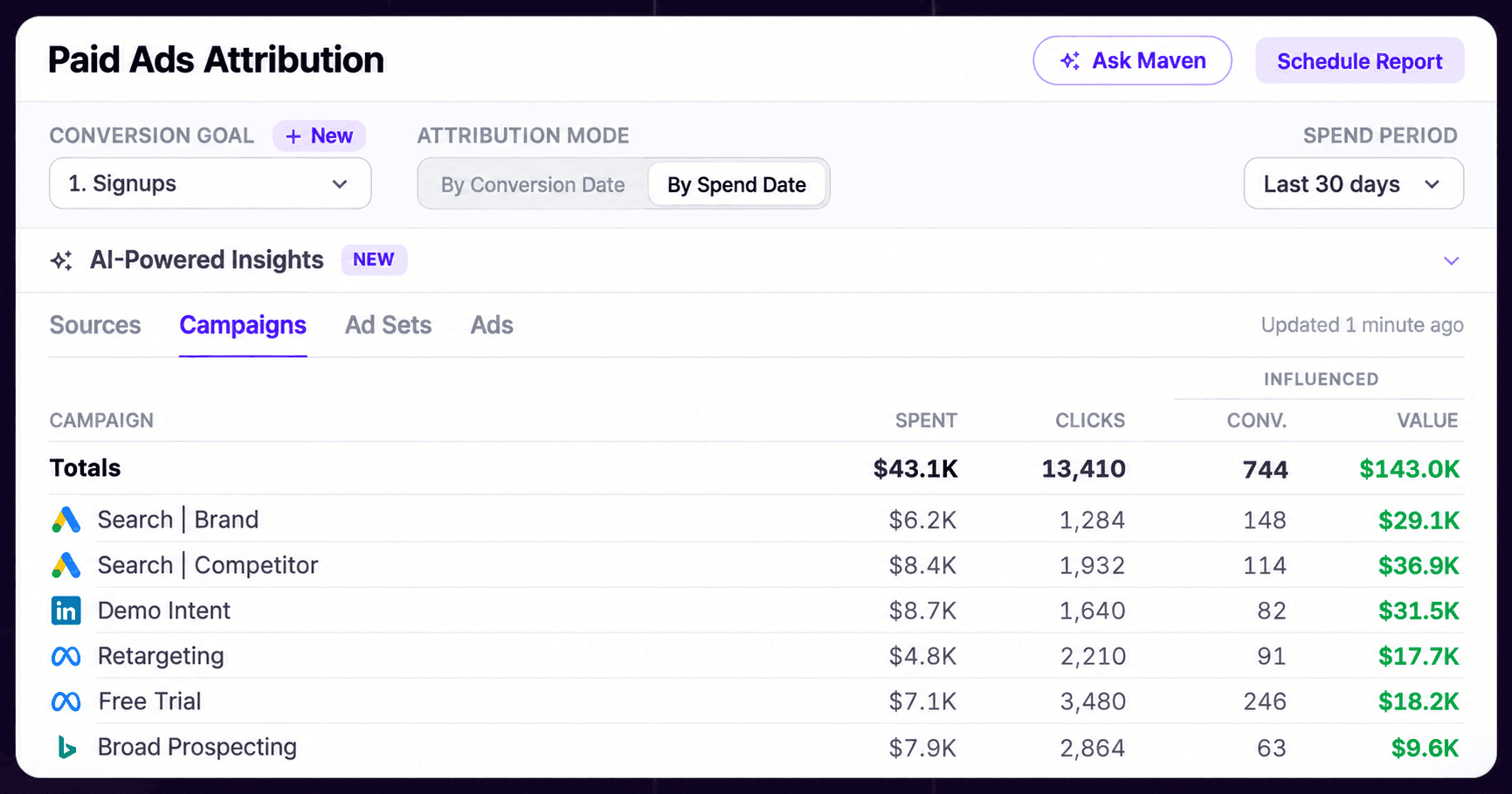
Paid Ads Attribution can compare spending, clicks, attributed conversions, conversion value, and attributed ROAS across supported networks. Those are credit-assignment reports, not proof that a campaign caused every credited sale.
Follow the customer into CRM and billing
For B2B SaaS, a form submission may become an MQL, SQL, opportunity, and finally closed-won revenue months later. Comparing Google and LinkedIn by cost per form fill alone can favor the channel sending cheaper but less qualified leads.
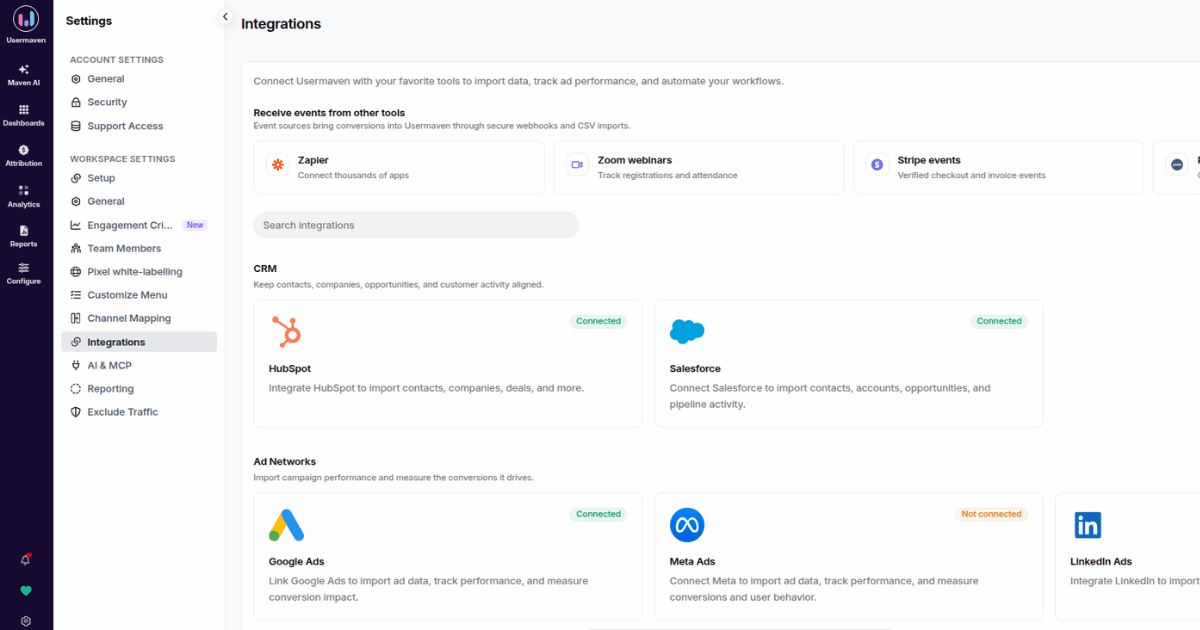
Usermaven’s Event Sources can bring supported payments, subscriptions, refunds, CRM events, and offline outcomes into the same measurement environment. Stable identities and transaction identifiers reduce ambiguity and duplicate counting.
Separate conversion date from spend date
A PPC report can answer two different questions. Conversion-date reporting asks which ads influenced outcomes that occurred in a selected period. Spend-date reporting follows clicks from a spend cohort into a defined look-ahead window.
These approaches can produce different recent-period numbers without either being inherently wrong. The distinction is developed further in performance marketing attribution, especially for campaigns with delayed purchases.
Investigate reporting discrepancies before reallocating budget
A platform may report more conversions than a CRM because it uses different attribution windows, conversion definitions, modeled outcomes, or interaction rules. Reconcile those differences rather than summing every platform’s claimed conversions.
Usermaven’s Measurement Trust Center checks campaign tagging, customer matching, connected-platform health, and conversion feedback. Its diagnostics help identify tracking issues, although no platform can reconstruct interactions that were never recorded with certainty.
What a real PPC measurement improvement looks like
ContentStudio’s published customer story provides a useful example of why post-click reporting matters.
The company ran paid acquisition across Google and Meta, but initially lacked a consistent view of which campaigns generated paying subscribers rather than only visits and signups.
After connecting campaign activity with product goals and subscription outcomes in Usermaven, ContentStudio reported a 30% increase in ROAS, 128% growth in signups, 92% more plan upgrades, and 242% more demo bookings.
These are figures reported in the ContentStudio case study.
The case describes budget reallocation, improved conversion visibility, and changes to its demo-booking journey.
Because it is not presented as a controlled causal experiment, these improvements should not be interpreted as proof that attribution software alone caused every reported result.
The transferable lesson is simpler: PPC performance becomes easier to manage when the team can distinguish a click, a signup, an upgraded subscriber, and actual revenue.
PPC vs. SEO and other acquisition channels
PPC and SEO are often compared as competitors, but they solve different timing and distribution problems. PPC pays for eligible ad delivery or clicks.
SEO aims to earn unpaid search visibility over time through relevant, accessible content and website quality.
| Dimension | PPC | SEO | Paid social |
|---|---|---|---|
| Typical initial visibility | Can begin after approval | Often develops over time | Can begin after approval |
| Primary distribution | Paid search or click-based placements | Organic search results | Audience and feed-based placements |
| Direct media spend | Usually required | No fee per organic click | Usually required |
| Demand state | Often active search intent | Research through purchase intent | Discovery through retargeting |
| Main risk | Spend without profitable outcomes | Slow, uncertain organic rankings | Paying for reach without qualified outcomes |
| Measurement concern | Attribution and conversion value | Organic contribution and assisted paths | Impression and cross-channel credit overlap |
Search-led PPC and organic SEO can reinforce each other. Search-term data may reveal useful content questions, while organic pages can support visitors who are not ready to buy at the first ad click.
The broader marketing attribution picture becomes especially important when a buyer moves between paid and unpaid channels before becoming a customer.
Five checks before scaling PPC spend
A PPC audit should trace the full customer journey, not just sort campaigns by CTR. The following five checks produce a concrete action at each stage.
| Audit stage | Diagnostic question | Verification test | Action if failing |
|---|---|---|---|
| Traffic | Are the searches and audiences relevant? | Review search terms and landing pages | Exclude irrelevant demand; refine targeting |
| Collection | Are clicks tied to valid visits and events? | Test tags, identities, and IDs | Repair missing or duplicate tracking |
| Conversion | Is the desired action recorded correctly? | Submit a test form or purchase | Fix the goal and counting rules |
| Revenue | Do leads become customers at sustainable cost? | Match CRM or billing to campaigns | Reallocate by qualified outcomes |
| Economics | Does contribution cover advertising cost? | Recalculate break-even CPC and CPA | Cap or redesign unprofitable spend |
Diagnose weak campaigns in the right order
High impressions, low CTR: Improve relevance, targeting, and ad message before blaming the landing page.
Healthy CTR, few conversions: Test the page, its offer, load speed, form, and measurement integrity before increasing bids.
Many leads, few customers: Review qualification and sales follow-up; cheaper leads may have lower commercial value.
Strong attributed ROAS, uncertain profit: Check margin, refunds, acquisition overhead, and whether existing demand is being credited to the campaign. A separate causal test may be needed to estimate incremental impact.
Incomplete data: Fix identity, campaign tagging, and conversion definitions before reading small performance differences as meaningful.
AI-assisted analysis can help identify anomalies or summarize changes, but it should accelerate investigation rather than replace verified events and a clear business decision.
When is PPC worth the investment?
PPC is worth considering when the business can identify a relevant audience, provide a credible offer, track the desired outcome, and afford a realistic acquisition cost.
It is less attractive when economics are unknown, the landing experience is broken, or the business cannot follow leads through to meaningful revenue.
A practical first-month plan is to define the conversion, run a bounded campaign, validate the data, calculate the break-even click or acquisition cost, and expand only after the evidence supports it.
For teams running multiple networks, a consistent paid ads attribution solution can connect advertising spend to customer journeys and revenue reporting.
The decision to scale should still reflect the business’s margins, tracking limitations, and the quality of the underlying outcomes.
Final verdict on PPC:
PPC can deliver relevant traffic quickly, but business value begins after the click. Strong campaigns connect auctions and bids to qualified customers, dependable revenue, and an acceptable acquisition cost.
If measuring those outcomes across platforms is the bottleneck, book a demo to see how Usermaven connects paid campaigns with conversion and revenue reporting.
FAQs
1. What does PPC mean in marketing?
PPC stands for pay-per-click. It is an advertising payment model in which a business pays for eligible clicks on its ads. PPC is commonly associated with paid search, although not every paid digital campaign uses click-based billing.
2. How much should a beginner spend on PPC?
Start with a test budget based on the maximum affordable cost per acquisition, expected conversion rate, and amount of data needed to learn. There is no universal minimum that guarantees reliable results or profitable outcomes.
3. What is the difference between PPC and CPC?
PPC describes the payment model. CPC, or cost per click, is the price paid per click, commonly calculated as click spend divided by billable clicks. A PPC campaign can have a different CPC for different keywords or audiences.
4. Is PPC better than SEO?
Neither is universally better. PPC can create eligible paid visibility quickly but requires spending. SEO may build durable organic visibility, but results usually take time and are not guaranteed. Many businesses use both for different search intents.
5. How can a business tell whether PPC is profitable?
Track actual acquisition outcomes, attributed revenue, relevant costs, and contribution margin. Calculate the maximum affordable CPC or CPA, then compare it with actual performance. A high CTR or ROAS alone is not proof of profit.
6. Does a 3x ROAS mean a PPC campaign is profitable?
Not necessarily. A 3x ROAS means the attribution model credits $3 in revenue for each advertising dollar. Product costs, refunds, fulfillment, and other expenses can still make the campaign unprofitable.
7. What are the main types of PPC campaigns?

Written by
Junaid Ahmed
Content Writer & Digital Marketer
Junaid Ahmed is a content and copywriter with 3+ years of experience creating research-driven content across SaaS, B2B, ecommerce, and digital marketing. He specializes in turning complex topics into clear, practical content that helps marketers better understand their challenges, evaluate solutions, and make informed decisions. His work spans educational content, industry insights, and actionable marketing guides.
All articles by Junaid →