Amplitude offers product analytics, experimentation, session replay, and AI tools, but its pricing depends on how much data you track and which capabilities you need.
Its Free plan includes 2 million events per month, while Plus starts at $0 and grows with usage. Growth and Enterprise use custom event-based pricing.
The important question is whether Amplitude’s product-focused analytics match your measurement needs or whether an Amplitude alternative built around marketing attribution and revenue makes more sense.
This guide breaks down Amplitude’s current plans, usage limits, and buying considerations, then compares the platform with Usermaven.
What is Amplitude?
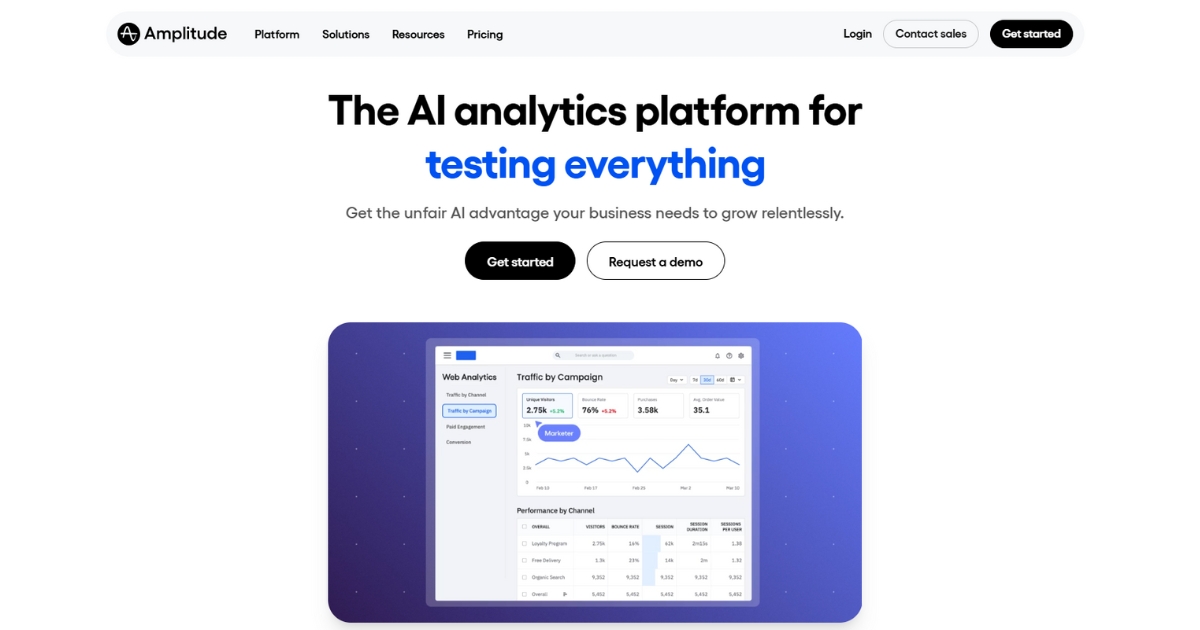
Amplitude helps product and growth teams understand behavior, feature adoption, funnels, retention, and digital experiences. Its broader platform also offers experimentation, session replay, activation, and AI-assisted analysis.
Key features
- Feature flagging: Control feature rollouts and assess their impact on user engagement.
- Advanced product analytics: Gain deep insights into user behaviors and interactions.
- A/B testing: Experiment with product features to refine strategy based on user preferences.
- Behavioral cohorts: Segment users by behavior to tailor marketing and product strategies.
- Session replay: Visualize user sessions to identify usability issues and enhance the customer journey.
- Dynamic audience segmentation: Segment customers based on shared behaviors and product data.
- Heatmaps: Visualize engagement hotspots, such as clicks and scrolls, on your website or app.
Breaking down Amplitude pricing plans
Amplitude currently lists four plans: Free, Plus, Growth, and Enterprise. Its pricing page uses monthly event volume for Free and Plus, with custom event-based agreements for Growth and Enterprise.
The published figures below come from Amplitude’s official pricing page. The cost of Plus beyond its free allowance depends on tracked usage.
| Plan | Public price | Usage allowance | Primary purpose |
|---|---|---|---|
| Free | $0 | 2 million events/month | Core analytics, session replay, AI, and limited experimentation |
| Plus | Starts at $0; usage-based above free allowance | First 2 million events/month free; scalable event volumes | Growing product teams needing cohorts, heatmaps, and custom analyses |
| Growth | Custom, event-based | Agreed event volume | Advanced analysis, permissions, and monitoring |
| Enterprise | Custom, event-based | Agreed event volume | Advanced governance, access controls, and support |
Free
Amplitude’s Free plan has no time limit and does not require a credit card. It includes 2 million tracked events per month, replacing the older Starter limits described in this article.
- Product analytics and AI-powered analysis
- AI Agents and MCP connectivity
- 10,000 monthly session replays
- Limited experimentation, guides, surveys, and activation
- Unlimited team seats
The main constraint is event volume and limited access to advanced functionality. Teams can use Free indefinitely while their needs fit those allowances.
Plus
Amplitude Plus now starts at $0. The first 2 million events each month are free; paid usage scales beyond that allowance, replacing the older flat-price model.
- Scales with event volume, with a published plan limit of up to 70 million events
- Custom events and formulas
- Up to 20 behavioral cohorts
- Heatmaps, alerts, and 2-year data access
- AI Agents and MCP, alongside the Free plan capabilities
Plus requires a credit card. For an accurate budget, estimate the monthly events your product generates and check the price for that volume on Amplitude’s calculator.
Growth
Growth is a custom-priced plan for teams that need more advanced product analytics. Amplitude prices it by event volume and business requirements rather than posting a single monthly rate.
- Advanced behavioral exploration and analysis
- Monitoring, alerts, and causal insights
- 20,000 monthly session replays before add-on expansion
- Single sign-on and project permissions
- AI Agents and MCP
Growth adds deeper analytical and governance features, but the price depends on the agreement. Buyers should confirm event allowances, add-ons, and support terms.
Enterprise
Enterprise is Amplitude’s custom plan for organizations with complex data and security needs. It builds on Growth with expanded governance, permissions, and customer support.
- Advanced access controls and role-based user management
- Unlimited projects per portfolio
- Unlimited monitoring and alerts
- 50,000 monthly session replays before add-on expansion
- Customer success and dedicated account management
Both Growth and Enterprise use custom event-based pricing. Compare the required features and contracted usage, rather than assuming Enterprise has a fixed premium.
Pros and cons of using Amplitude
Here’s a quick look at the pros and cons to help you decide whether Amplitude analytics is the right tool for your business.
Pros
- Comprehensive analytics: Track user behavior across multiple touchpoints and get detailed insights into the user journey.
- Real-time data: Make quick, data-driven decisions with up-to-date user information.
- Advanced experimentation: A/B testing and feature flagging tools help optimize user experience with minimal disruption.
- Customizable reports: Create tailored reports and dashboards to meet specific business needs.
Cons
- Usage-based scaling: Plus starts at $0, but costs increase when event volume exceeds the included allowance.
- Steep learning curve: The platform can be difficult to navigate for teams without technical expertise.
- Limited customization on lower-tier plans: Entry-level plans offer fewer features, requiring an upgrade for more control.
- Custom-plan evaluation: Growth and Enterprise require a tailored pricing discussion, making public cost comparisons harder.
- Feature allowances: Experiments, guides, session replay, and advanced controls have plan-specific limits or add-ons.
What users are saying about Amplitude
When considering a tool like Amplitude, it’s important to hear from the users who rely on it every day.
Overall, Amplitude receives strong feedback for its powerful analytics, but there are some common concerns that are worth noting before jumping in.
Users have shared that mastering Amplitude takes time due to its complexity and range of options. While the core features are easy to use, advanced functionalities require a deeper understanding of analytics.
One review mentioned how the setup process was challenging, with many advanced features buried in the settings.
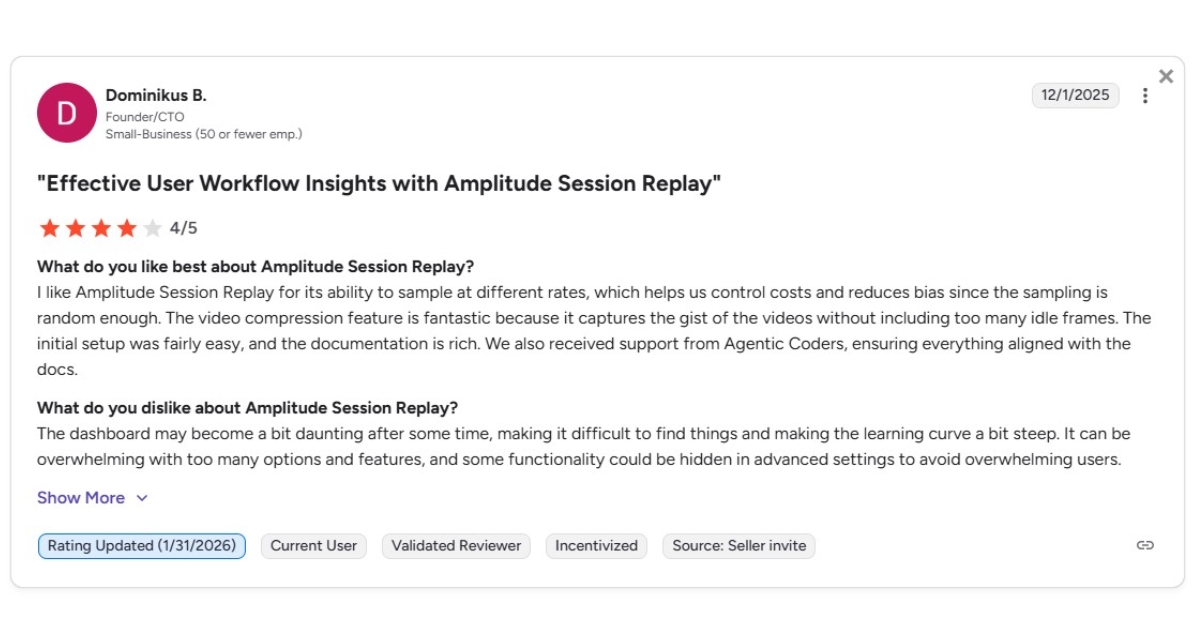
One user highlighted that while the platform offers flexibility, the limitations and pricing structure can be frustrating.
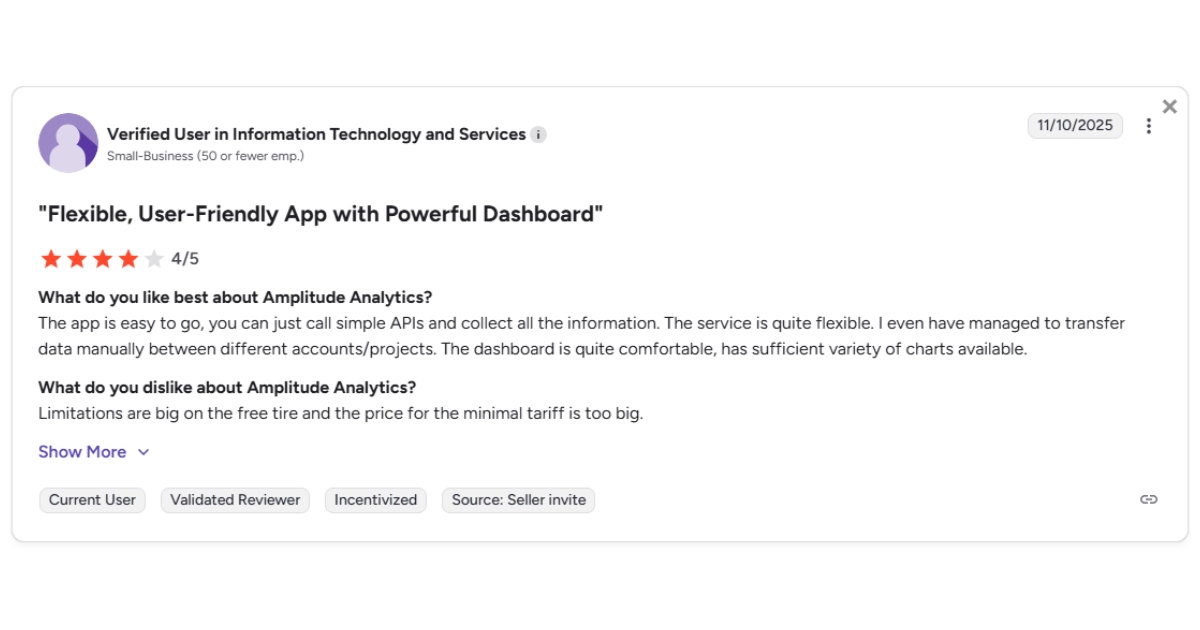
The reviews illustrate how a feature-rich platform can require time to learn. Teams should weigh setup and analysis requirements alongside event-based costs.
Teams prioritizing marketing measurement may also want to explore Amplitude analytics alternatives that connect campaigns with conversion paths and revenue.
Where Usermaven differs from Amplitude
Usermaven connects marketing attribution, website analytics, and product behavior to the conversions, pipeline, and revenue that follow.
Amplitude is built around deep product analysis and experimentation. Usermaven is a stronger match when teams need to understand which campaigns and customer journeys produce valuable customers.
Usermaven’s product analytics and funnels show activation and drop-offs after acquisition, while attribution reports help explain what brought those users in.
See Usermaven in action
Book a free demo and discover how powerful analytics can grow your business.
Business plan: attribution and customer insights
Usermaven offers a Business plan that combines multi-touch and paid ads attribution with customer journeys, funnels, dashboards, retention analysis, and CRM integrations.
Business also includes custom attribution models, Maven AI, MCP connectivity, reports, and alerts. Teams can explore how these workflows fit their data during a demo.
Enterprise plan: security and flexibility
Enterprise extends Usermaven with custom integrations, data warehouse export, advanced access controls, private-cloud or on-premise deployment, and dedicated support.
This can matter for organizations with stricter governance, hosting, or data integration requirements. Usermaven does not list fixed numerical prices for either plan.
AI, Agents, and MCP for recurring insights
Maven AI helps teams ask questions about their analytics. Maven AI Agents can run scheduled analyses to surface shifts in feature adoption, retention, and user journeys.
MCP lets compatible external AI tools access authorized Usermaven analytics data. Amplitude also provides AI Agents and MCP, including on its Free plan, so the difference lies in the data and workflows each platform supports.
Customer result: PostNitro’s activation analysis
In the PostNitro case study, behavioral tracking and funnel analysis helped the team introduce a product demo flow. Around 70% of users who engaged with that demo signed up.
That outcome illustrates Usermaven’s value for product-led teams: finding a measurable point of friction and linking the fix to activation, not merely collecting events.
Usermaven vs. Amplitude pricing: which fits?
Amplitude has a permanent Free tier and a Plus plan that scales with event volume. Usermaven offers Business and Enterprise plans with a demo-led evaluation, without fixed public numerical prices.
Because the billing structures differ, comparing starting prices alone would be misleading. The better question is which capabilities support the team’s reporting and revenue decisions.
| Decision area | Amplitude | Usermaven |
|---|---|---|
| Available plans | Free, Plus, Growth, Enterprise | Business and Enterprise |
| Public starting price | Free: $0; Plus: starts at $0 | No fixed numerical prices shown |
| Usage basis | Events; custom terms on Growth and Enterprise | Plan and requirements discussed in a demo |
| Buying process | Self-serve Free/Plus; sales for Growth/Enterprise | Book a demo |
| Primary strength | Product analytics, experimentation, and digital experience tools | Marketing attribution connected to product activity and revenue |
| Product behavior | Funnels, cohorts, session replay, heatmaps, experimentation | Product analytics, funnels, journeys, retention, segments |
| Marketing and CRM attribution | Campaign reporting and analytics; review integration scope | Multi-touch, paid ads, CRM and revenue attribution |
| AI capabilities | AI-powered analysis, Agents, MCP across plans | Maven AI, scheduled Agents, MCP |
| Experimentation | Native feature flags, experiments, guides and surveys | Not positioned as a native feature experimentation suite |
| Data governance | Advanced controls on higher tiers | Enterprise custom controls, SSO, and deployment options |
| Best fit | Product teams prioritizing advanced experimentation and exploration | Marketing, growth, and product teams connecting acquisition to revenue |
How Amplitude usage affects the bill
Amplitude defines an event as a tracked action, such as a pageview or signup. Its Free plan includes 2 million events monthly, while Plus can charge for higher volumes.
The official pricing page says Plus avoids overage penalties. Still, teams should estimate event volume, data retention, and paid add-ons before comparing total costs.
When Usermaven is the better fit
- Revenue attribution: Connect channel and campaign performance to CRM deals and pipeline.
- Product-led journeys: Trace acquisition through activation, feature engagement, funnels, and retention.
- AI workflows: Use Maven AI, scheduled Agents, and MCP to investigate data and surface changes.
- Enterprise needs: Discuss custom integrations, hosting, governance, and support with Usermaven.
Amplitude remains a compelling choice for native experimentation and advanced behavioral research. Usermaven stands out when marketing impact and customer revenue need to be measured alongside product behavior.
For additional context, see Mixpanel vs. Amplitude vs. Usermaven and Heap vs. Amplitude vs. Usermaven.
Wrapping up
Amplitude now offers a substantial free analytics tier and event-based Plus pricing, alongside custom Growth and Enterprise plans. It also includes AI Agents and MCP.
Usermaven’s strength is connecting marketing attribution, CRM revenue, website activity, and product behavior. Its Business and Enterprise plans suit teams seeking a more integrated measurement workflow.
To see how acquisition, activation, and revenue reporting connect in your own setup, book a Usermaven demo.
FAQs about Amplitude pricing
1. How does Amplitude calculate MTUs?
An MTU is a unique user who triggers at least one event in a calendar month. Amplitude now emphasizes event volume in its entry plans: Free includes 2 million events per month.
2. How much does Amplitude Plus cost?
Amplitude Plus starts at $0, with the first 2 million monthly events included. Paid usage increases with tracked event volume; the exact amount can be estimated using the calculator on Amplitude’s pricing page.
3. Why choose Usermaven instead of Amplitude?
Usermaven is a strong option for teams that want to connect marketing attribution with customer journeys, product behavior, funnels, retention, and CRM revenue. Amplitude is particularly useful for advanced product experimentation and analysis.
4. How does Usermaven pricing compare with Amplitude?
Amplitude offers a Free plan and a Plus plan starting at $0, with custom Growth and Enterprise pricing. Usermaven offers Business and Enterprise plans without fixed public numerical prices. The best comparison depends on required capabilities, integrations, and usage.
Updated

Written by
Ryan Mitchell
Marketing Analytics Strategist
Ryan Mitchell is a marketing analytics strategist specializing in campaign measurement, customer journeys, and marketing performance. He writes about analytics, reporting, and data-driven marketing strategies, helping SaaS and B2B teams measure what matters across every stage of the customer journey.
All articles by Ryan →