Plausible Analytics makes website reporting easier, but it may not answer every question about product adoption, customer journeys, and marketing revenue. The best alternative depends on the data that actually informs your next decision.
For teams that need advanced attribution software rather than a lightweight traffic dashboard, the priorities are different from those of a publisher tracking pageviews. This guide compares nine Plausible alternatives by use case, capabilities, cost structure, and limitations.

The options range from free website analytics to enterprise platforms, so a lower price does not automatically mean a better fit.
Plausible alternatives at a glance
| Tool | Best for | Key difference |
| Usermaven | Marketing and revenue teams | Connects attribution, product analytics, CRM context, and revenue |
| Matomo | Data ownership and self-hosting | Open-source analytics with flexible deployment and plugins |
| Heap | Product analytics teams | Autocaptured product events and retroactive analysis |
| Piwik PRO | Regulated enterprises | Governed analytics and deployment controls |
| Fathom Analytics | Publishers and small businesses | Straightforward cookie-free website measurement |
| Google Analytics 4 | Google-centered marketing stacks | Broad free analytics and Google integrations |
| Kissmetrics | Lifecycle and SaaS teams | Person-based tracking, cohorts, funnels, and revenue reports |
| Adobe Analytics | Large analytics organizations | Enterprise digital and cross-channel analysis |
| LogRocket | Product engineering and UX | Session replay, product analytics, and error debugging |
When Plausible is enough, and when it is not
Plausible is a capable website analytics platform. It tracks pageviews, referrers, goals, and custom events, and its Business tier includes funnels, user journeys, and ecommerce revenue attribution. It is not accurate to describe these features as completely unavailable.
The bigger question is whether a team needs persistent account-level behavior, product adoption analysis, CRM-linked pipeline, or advanced marketing revenue attribution beyond website-oriented reporting.
| Decision | Plausible is a good fit when… | Look elsewhere when… |
| Website traffic and referrals | Simple acquisition and page performance are enough | Business outcomes need to be traced through product and CRM stages |
| Goals and events | Configured site conversions answer the question | Persistent user or account behaviors must be compared over time |
| Funnels and journeys | Website journeys and conversion steps meet the requirement | A cross-channel revenue or lifecycle view is essential |
| Privacy and control | Cookie-free EU-hosted cloud reporting suits the organization | A custom deployment model or advanced governance is required |
| Reporting budget | Low traffic and a compact team favor an entry tier | Data volume, implementation, and feature tiers change the economics |
Plausible currently lists Starter at $9/month, Growth at $14/month, and Business at $19/month at the 10,000-pageview tier. Fees rise with usage; the Business plan is the relevant comparison for funnels, journeys, custom properties, and ecommerce revenue reporting.
The 9 best Plausible alternatives
1. Usermaven
Best for: B2B SaaS, agencies, and growth teams connecting marketing activity to conversions, pipeline, and revenue.
Usermaven combines website analytics, product analytics, funnels, journeys, and multi-touch marketing attribution. It is suited to questions like which campaign introduced a customer, which touchpoints assisted, and whether that customer later converted or became an opportunity.
- Attribution: Seven built-in models; Enterprise customers can create custom models and compare credit allocation.
- AI: Maven AI supports natural-language analysis and scheduled AI Agents.
- Operational analysis: conversion funnel reports, cohort and segment analysis, and attribution reporting.
- Connected workflows: CRM context, marketing integrations, and MCP connections where configured.
Trade-offs: It is a broader paid platform than Plausible. Tracking quality, identity resolution, defined conversion goals, and CRM connections still affect the quality of attribution conclusions.
Pricing: New-customer Business and Enterprise plans are custom-quoted. Ask for pricing based on events, workspaces, attribution needs, integrations, and support.
Usermaven review references
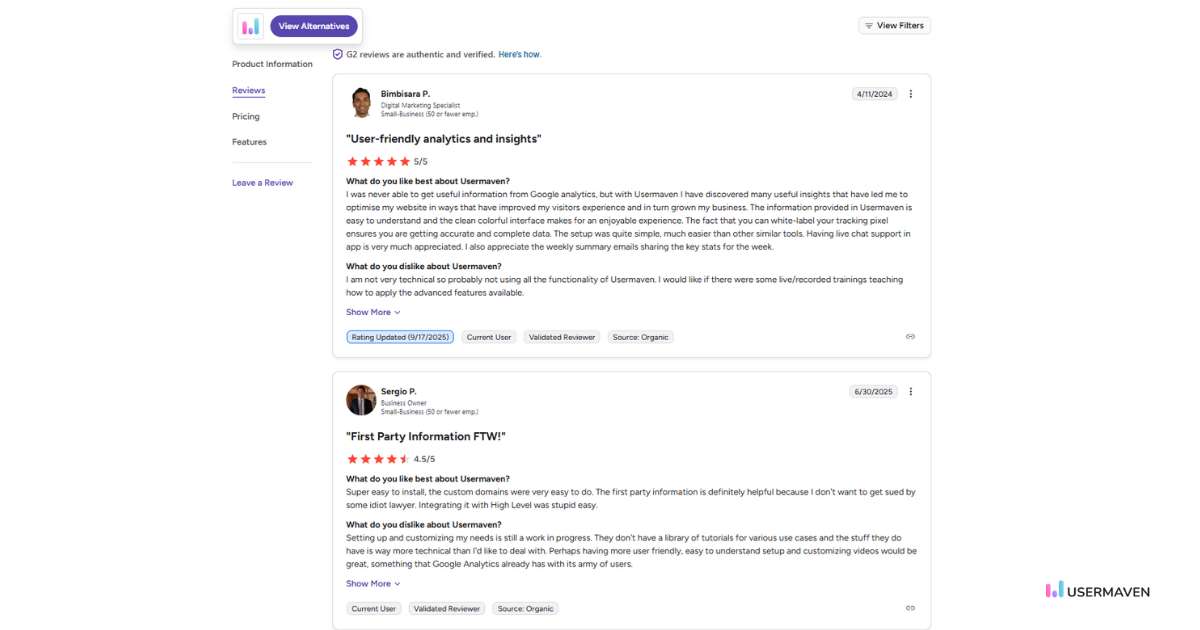
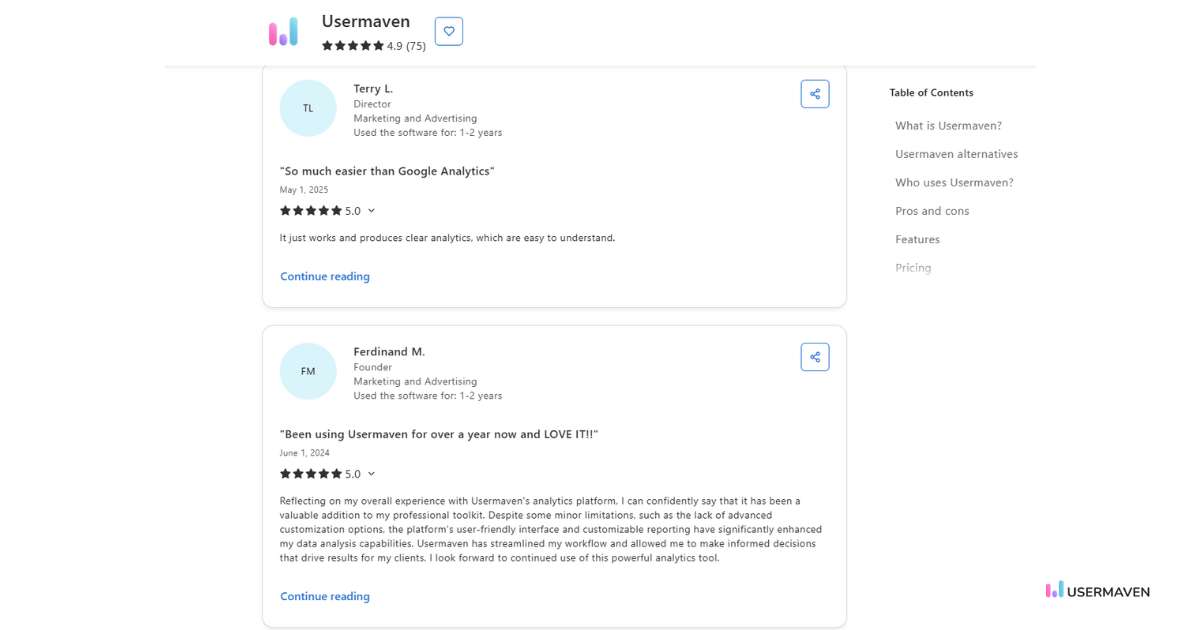
For independent customer feedback, compare G2 reviews and Capterra reviews. Reviews are useful context, but suitability should be tested against your own tracking and reporting requirements.
2. Matomo
Best for: Organizations that value ownership of analytics data, self-hosting, and configurable web reporting.
Matomo offers open-source On-Premise software alongside hosted Cloud plans. It supports goals, ecommerce reporting, consent controls, and optional premium features such as multi-channel attribution and search keyword reporting. Contrary to the original article, it can import Google Search Console data.
Trade-offs: Self-hosting transfers infrastructure, updates, and maintenance to your team. Some advanced features depend on paid plugins, while Cloud pricing depends on hits and plan configuration.
Pricing: The self-hosted core is free, excluding hosting and paid extras. Cloud offers usage-based Business pricing and custom Enterprise quotes.
For a direct comparison of the privacy and attribution differences, see Matomo vs. Plausible vs. Usermaven.
3. Heap
Best for: Product teams that want behavioral event capture without specifying every interaction in advance.
Heap centers on autocaptured interaction data, funnels, journey analysis, and the ability to define useful events after collection. Paid tiers offer Contentsquare Sense AI-assisted exploration. This makes it relevant for feature and product behavior questions that go beyond basic website reporting.
Trade-offs: Autocapture still requires governance, event definitions, and interpretation. Teams looking primarily for ad-to-revenue attribution should check whether additional tools are needed.
Pricing: A Free plan covers up to 10,000 monthly sessions and includes six months of data history. Growth, Pro, and Premier scale by functionality and usage; request a quote or estimate for the relevant tier.
4. Piwik PRO
Best for: Enterprises with strict governance, security, deployment, or regulated-sector requirements.
Piwik PRO offers analytics, tag management, and data activation features with controls oriented toward enterprise governance. It can fit healthcare and other regulated deployments that require contractual and technical safeguards.
Trade-offs: It is not a like-for-like low-cost replacement for Plausible. Procurement, deployment, implementation, and organizational requirements can be significant.
Pricing: Enterprise is quote-based. Healthcare Enterprise, including a business associate agreement framework, is advertised from $30,000 annually for qualifying configurations.
5. Fathom Analytics
Best for: Publishers, bloggers, and small businesses seeking simple reporting without cookies.
Fathom provides a focused website dashboard with goals, UTM analysis, event and revenue tracking, shared reports, an API, and automatic bot filtering. It competes more directly with Plausible on ease and privacy than on complex attribution or product analytics.
Trade-offs: It is not intended to replace full product analytics, CRM-linked attribution, or session debugging platforms.
Pricing: $15/month for up to 100,000 monthly pageviews, with higher traffic tiers and the same core analytics feature set.
Teams comparing similarly simple tools can also review Fathom alternatives.
6. Google Analytics 4 (GA4)
Best for: Teams already invested in Google Ads, Search Console, BigQuery, and the wider Google ecosystem.
GA4 supports web and app events, explorations, funnels, audience analysis, attribution, and Google integrations. Enhanced measurement automatically captures several common website interactions, while business-specific events can require additional configuration.
Trade-offs: Reporting can require expertise, privacy configuration, and validation. The existence of a free tier does not eliminate implementation costs or reporting effort.
Pricing: The standard GA4 product is free; Analytics 360 is priced through enterprise sales rather than a universal published starting rate.

For a broader comparison of GA4 and competing platforms, read GA4 alternatives.
7. Kissmetrics
Best for: SaaS and lifecycle teams that need person-based behavior tracking, cohorts, and conversion analysis.
Kissmetrics focuses on people and lifecycle reporting rather than anonymous pageviews alone. Current product pages describe autocapture, AI-assisted metrics, funnels, cohorts, path analysis, and campaign and product usage reports.
Trade-offs: Data modeling and tracking decisions still matter, and different tools can define users, sessions, revenue, and attribution differently.
Pricing: A Free plan includes up to 100,000 monthly events. Growth starts at $99/month for 500,000 events, with annual-billing discounts and higher-volume tiers.
8. Adobe Analytics
Best for: Large enterprises with established analytics teams and complex digital measurement requirements.
Adobe Analytics provides customizable reporting, segmentation, cross-channel analysis, and integration across Adobe Experience Cloud. Its enterprise scope suits teams managing detailed digital data and governance across departments.
Trade-offs: Licensing and deployment are typically more complex than lightweight tools. Comparing it with Plausible on monthly starting price alone would be misleading.
Pricing: Custom enterprise quote. Final costs depend on the analytics product, data requirements, contract, and implementation.
9. LogRocket
Best for: Product managers, developers, and UX teams investigating friction and bugs.
LogRocket connects session replay with product analytics, error monitoring, and AI-assisted session investigation. It is useful for discovering why a user abandoned a form or where a front-end error affected a flow.
Trade-offs: Recorded-session volume, privacy masking, retention settings, and engineering workflows should be evaluated. Session replay is not the same as marketing revenue attribution.
Pricing: Session-volume pricing with an interactive calculator. Plans and totals vary by sessions, seats, retention, and add-ons; verify the current quote for your volume.
Plausible alternatives: pricing comparison
Published starting prices are not directly comparable because the products bill for different units. One tool may count pageviews and events, another sessions, and another custom enterprise requirements. Prices below are indicative for the stated entry conditions, not equivalent feature bundles.
| Tool | Current pricing approach | What to check |
| Plausible | From $9/mo at 10k pageviews; Business from $19/mo | Funnels and journeys are Business-tier capabilities |
| Usermaven | Business and Enterprise: custom quote | Event volume, attribution, integrations, implementation |
| Matomo | Self-hosted core free; Cloud usage-based | Infrastructure, hits, premium plugins |
| Heap | Free up to 10k monthly sessions; paid tiers vary | Session allowance, history, AI, add-ons |
| Piwik PRO | Enterprise: custom; Healthcare Enterprise from $30k/year | Security, governance, minimums and deployment |
| Fathom | $15/mo for 100k monthly pageviews | Monthly pageviews and custom events |
| GA4 | Standard free; Analytics 360 quote-based | Tracking setup, reports, data processing |
| Kissmetrics | Free up to 100k events/mo; Growth $99/mo | Event allowance and required advanced reports |
| Adobe Analytics | Custom enterprise quote | Licensing, implementation, cross-product scope |
| LogRocket | Session-based, variable | Recorded sessions, retention, seats, add-ons |
How to choose a Plausible alternative
Start with the decision the analytics platform must support. If the answer is simply which pages attract visitors, Plausible itself or Fathom can remain the simplest fit. Replacing a focused tool with an enterprise platform can introduce more complexity than value.
- To keep control of hosting and data: Compare Matomo deployment options and the cost of self-hosting.
- To investigate product behavior: Consider Heap or Kissmetrics for event-based and lifecycle analysis.
- To investigate user friction: LogRocket brings replay and technical diagnostics.
- For an established Google stack: GA4 provides a broad baseline at no software licensing cost.
- For enterprise privacy and governance: Compare Piwik PRO and Adobe Analytics against security and procurement requirements.
- For marketing-to-revenue decisions: Evaluate Usermaven when channel, campaign, product, and CRM data need to be connected in an attribution workflow.
Four questions to test before switching
Choose a representative reporting period and ask each candidate to answer the same questions: What conversion was counted? Which channel received credit under which model? Can you reconcile conversions with your source of truth? Can a stakeholder reproduce the report without manual spreadsheet work?
If different attribution models assign credit to the same underlying conversion, compare their distributions rather than adding their attributed revenue totals together. A model comparison changes how credit is allocated; it does not create additional sales.
Final verdict
Plausible remains a strong choice for straightforward, privacy-focused website analytics. It now includes more event, funnel, and journey functionality than many older alternatives articles acknowledge, so leaving Plausible should be driven by a specific missing capability.
For teams that need marketing attribution, product behavior, and revenue outcomes analyzed together, Usermaven is worth evaluating. For session replay, self-hosting, or complex enterprise governance, another specialist may be the better fit.
To evaluate how Usermaven connects campaigns, customer journeys, conversions, and revenue, book a demo.
FAQs
1. What is the best alternative to Plausible Analytics?
The best option depends on your goal. Fathom is a close fit for simple privacy-focused website reporting, Matomo for self-hosting, Heap for product behavior, LogRocket for session replay, and Usermaven for marketing attribution and revenue analysis.
2. Does Plausible support funnels and user journeys?
Yes. Plausible offers funnel analysis and user journeys on its Business plan. It also supports custom events, goals, and ecommerce revenue attribution. Compare the exact plan and reporting depth rather than assuming these features are missing.
3. Which Plausible alternatives are free?
GA4 has a free standard version, Matomo offers a free self-hosted core, Heap has a limited free tier, and Kissmetrics lists a free tier for up to 100,000 monthly events. Hosting, implementation, and paid upgrades can still add cost.
4. How does Usermaven differ from Plausible?
Plausible focuses on straightforward website traffic and goal reporting. Usermaven connects website and product analytics with multi-touch marketing attribution, customer journeys, CRM context, and revenue outcomes. The right choice depends on whether those additional workflows matter.
5. Is Matomo a good Plausible alternative for privacy?
Matomo is worth considering when self-hosting, data ownership, and flexible analytics configuration matter. Plausible is simpler for many website-only use cases. Compare consent requirements, hosting, plugins, and maintenance costs.
6. What is Plausible pricing for 10,000 pageviews?
At the published 10,000-pageview tier, Plausible lists Starter at $9 per month, Growth at $14, and Business at $19. Prices rise with usage, and feature access depends on the selected plan.
Updated

Written by
Lauren Brooks
Lifecycle Marketing Strategist
Lauren Brooks is a lifecycle marketing strategist with 4+ years of experience helping SaaS businesses create meaningful customer experiences. She specializes in user engagement, retention, and conversion optimization, helping brands build stronger customer relationships beyond acquisition.
All articles by Lauren →