HubSpot can tell you which campaign created a contact. The harder question is whether that campaign created a qualified account, an active product user, a closed deal, and a retained customer.
HubSpot does offer contact, deal, and revenue attribution. The problem is that its most commercially important deal and revenue reports require Marketing Hub Enterprise, while many teams also need behavioral, product, offline, or cross-platform context that does not naturally live inside the CRM.
You do not necessarily need to replace HubSpot to solve that problem.
A dedicated marketing attribution platform can sit alongside HubSpot, preserve it as the CRM and system of record, and add deeper visibility into anonymous visits, customer journeys, product activity, pipeline, and revenue.
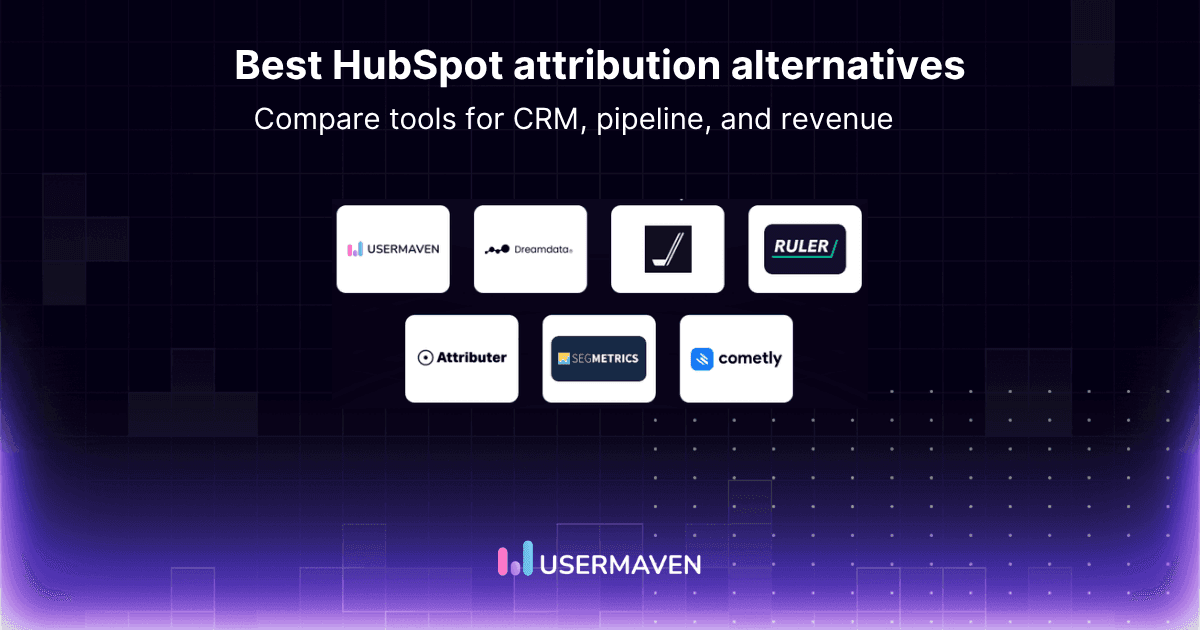
This guide compares seven HubSpot marketing attribution alternatives by use case, attribution depth, HubSpot integration, revenue coverage, implementation, and pricing access.
Key takeaways
HubSpot is a strong attribution option when marketing, CRM, sales, and revenue activity already operate inside the HubSpot ecosystem.
HubSpot provides contact-create attribution on eligible Professional and Enterprise plans, but deal-create and revenue attribution require Marketing Hub Enterprise.
Most teams do not need to migrate away from HubSpot. They can retain it as the CRM while adding a separate attribution, behavioral analytics, or offline measurement layer.
Usermaven is the strongest overall alternative for teams that want HubSpot contacts, companies, deals, and pipeline connected with paid and organic acquisition, website behavior, product activity, customer journeys, and revenue.
7 best HubSpot marketing attribution alternatives
HubSpot covers CRM reporting, but these alternatives offer deeper attribution across journeys, pipeline, and revenue.
1. Usermaven: Best overall HubSpot attribution alternative

Overview
Usermaven is the strongest overall alternative for teams that want to keep HubSpot as their CRM while adding attribution, website behavior, product usage, customer journeys, pipeline, and revenue context.
HubSpot remains the system of record. Usermaven becomes the attribution and behavioral-insight layer.
Usermaven collects anonymous and identified activity through its own website and product tracking. It then maps HubSpot contacts, companies, deals, pipelines, email events, calls, meetings, and other CRM data onto those journeys using identity matching.
Best for
B2B SaaS companies
Product-led businesses
Revenue and growth teams
Agencies managing several clients
Companies connecting acquisition with product adoption
Teams that want public pricing and self-serve evaluation
Businesses that want HubSpot to remain the CRM
Why it stands out
Usermaven does not stop at the contact or deal.
It connects:
Paid and organic acquisition
Website behavior
Product activity
Funnels
Conversion paths
Customer journeys
HubSpot CRM stages
Pipeline
Closed revenue
Retention
Expansion
That makes it possible to compare two campaigns not only by leads or opportunities, but also by activation, engagement, retention, and customer value.
How it works with HubSpot
The Usermaven HubSpot integration uses Usermaven’s own tracking as the behavioral foundation.
HubSpot data is then connected through matching identifiers such as email. Companies, contacts, deal pipelines, deals, email activity, calls, meetings, and other engagements can be synchronized into the analytical journey.
Deal stages can become events in Usermaven, allowing teams to use stages such as qualified opportunity or closed won as conversion goals. The integration is read-only, so Usermaven does not alter CRM records.
The HubSpot integration documentation explains the data flow, identity matching, synchronized objects, and setup process.
Key capabilities
Paid and organic attribution
CRM pipeline and revenue attribution
Multi-touch conversion paths
Anonymous-to-known identity stitching
Website analytics
Retention and cohort reporting
Customer and company profiles
Public pricing
AI-assisted analysis through Maven AI
The product analytics layer is particularly useful for evaluating whether users from a campaign activate, adopt features, and remain engaged. Usermaven connects marketing and product data so acquisition can be evaluated against downstream usage and retention.
Pricing and access
Usermaven’s Growth plan starts at $84 per month and includes website, product, and ecommerce analytics, funnels, user journeys, account profiles, segments, and five years of data history.
Scale starts at $199 per month and adds paid-ad attribution, channel-level revenue attribution, CRM pipeline and revenue attribution, multi-touch conversion paths, customer-journey attribution, Maven AI, and retention reporting.
Enterprise offers custom pricing with options such as warehouse export, private-cloud or on-premises deployment, SAML SSO, role-based controls, audit logs, custom retention, data residency, and dedicated support. A 14-day trial is available.
Verdict
Usermaven is the best overall HubSpot marketing attribution alternative for organizations that need more than CRM-native attribution.
It is particularly strong when the business wants to follow the journey from:
Anonymous visit → contact → signup → activation → opportunity → customer → retention
Teams that need only HubSpot-native contact and deal reporting may not need another platform. Teams that need attribution connected with website behavior, product adoption, and recurring revenue have a stronger reason to add Usermaven.
2. Dreamdata: Best for specialized B2B revenue attribution

Overview
Dreamdata is a B2B revenue-attribution platform built around account journeys, buying committees, pipeline, and revenue.
It is designed for organizations where several people participate in one purchase and where the customer journey spans marketing, sales, and customer-success interactions.
Best for
B2B SaaS companies
Account-based marketing teams
Revenue marketers
Organizations with long sales cycles
Companies with multi-stakeholder buying processes
Why it stands out
Dreamdata treats the company or account as the central buying unit rather than evaluating each contact in isolation.
It can connect activities across multiple stakeholders and apply multi-touch attribution between different pipeline stages. This helps teams evaluate not only which channels created contacts, but which activities influenced accounts as they progressed toward pipeline and revenue.
How it works with HubSpot
HubSpot supplies contact, company, deal, lifecycle, and pipeline information.
Dreamdata combines that CRM data with website, advertising, content, sales, and other GTM activity to create account-level journeys.
The platform is useful when several contacts from one company engage with different parts of the business before a deal is opened or closed.
Key capabilities
Multi-touch B2B attribution
Account-level journey timelines
Contact-to-account mapping
Buying-committee analysis
Pipeline-stage attribution
Revenue attribution
Content performance
Audience activation
Raw-data access
Pricing and access
Dreamdata offers trial access, while advanced attribution and activation packages use a sales-led buying process.
The total fit depends on the number of connected data sources, B2B complexity, attribution requirements, and implementation scope.
Verdict
Dreamdata is the stronger choice when specialized account-level B2B attribution is the main requirement.
Usermaven is broader for teams that also need website analytics, product activity, funnels, retention, and self-serve access in the same platform.
The Dreamdata alternative comparison examines those differences more closely.
3. HockeyStack: Best for enterprise GTM intelligence

Overview
HockeyStack is an enterprise B2B attribution and GTM-intelligence platform designed to connect marketing, sales, website, intent, CRM, and other revenue data.
Its focus extends beyond standard channel attribution into account intelligence, buyer journeys, scoring, lift, and enterprise reporting.
Best for
Large B2B organizations
Revenue operations teams
Enterprise demand-generation teams
Businesses with complex account structures
Organizations combining many GTM data sources
Why it stands out
HockeyStack emphasizes complete buyer journeys from anonymous engagement to closed-won revenue.
It provides multi-touch attribution, side-by-side model comparison, account-level journeys, and lift reporting designed to evaluate whether campaigns influenced exposed accounts differently from unexposed groups.
How it works with HubSpot
HubSpot can remain one part of the broader GTM stack.
HockeyStack uses CRM records alongside website interactions, advertising data, intent signals, sales activity, and other sources to build account-level reporting.
This is useful when the organization wants a governed enterprise measurement environment rather than a reporting add-on used mainly by the marketing team.
Key capabilities
Account-level buyer journeys
Multi-touch attribution
Attribution-model comparison
Account scoring
Intent analysis
Pipeline reporting
Lift and incrementality views
Enterprise dashboards
AI-assisted GTM analysis
Pricing and access
HockeyStack uses a demo-led, custom-pricing model.
The buying process is better suited to organizations prepared for guided onboarding, data-model planning, and a larger enterprise implementation.
Verdict
HockeyStack is best for complex B2B companies that need enterprise GTM intelligence and account-level measurement.
Smaller SaaS and growth teams may prefer Usermaven’s public pricing, trial access, product analytics, and faster self-serve path.
The HockeyStack alternative page compares the two approaches.
4. Ruler Analytics: Best for calls and offline revenue

Overview
Ruler Analytics is designed for businesses whose customer journeys frequently convert through forms, phone calls, live chat, sales teams, or other offline processes.
It connects a visitor’s earlier marketing interactions with the lead, CRM opportunity, and eventual revenue.
Best for
Professional-services businesses
Call-heavy lead-generation companies
High-value commerce
Travel and appointment-based organizations
Teams connecting online acquisition with offline sales
Why it stands out
Ruler can track visitors across marketing sessions and then match a conversion completed through a form, phone call, live chat, or ecommerce transaction with earlier campaign interactions.
When the lead progresses in the CRM, attributed revenue can be connected back to the channels, campaigns, keywords, and landing pages that influenced it.
How it works with HubSpot
Ruler can send marketing-source information into HubSpot and use HubSpot revenue data to close the measurement loop.
This enables teams to evaluate campaigns using won business rather than only form submissions or lead counts.
Key capabilities
Form tracking
Call tracking
Live-chat attribution
Visitor-level journey tracking
CRM integration
Multi-touch attribution
Offline revenue attribution
Conversion data sent to advertising and analytics tools
Pricing and access
Ruler uses a demo-led buying process.
The investment depends on website traffic, call tracking, connected systems, reporting requirements, and the number of conversion sources being measured.
Verdict
Ruler Analytics is the strongest alternative on this list for businesses whose revenue journey regularly continues through phone calls and offline sales.
Usermaven is more suitable when product behavior, SaaS activation, funnels, retention, and connected web-product analytics are the priority.
Teams comparing deployment, pricing, and offline-conversion coverage can review the Ruler Analytics alternative page.
5. Attributer: Best lightweight HubSpot attribution add-on

Overview
Attributer is not a complete multi-touch attribution platform.
It is a focused lead-source utility that captures campaign and channel information and writes it into hidden form fields so the data enters HubSpot with the contact record.
Best for
Small marketing teams
Lead-generation businesses
Companies with unreliable source fields
Teams using HubSpot or third-party forms
Organizations that do not need a separate analytics platform
Why it stands out
Attributer captures information such as:
Marketing channel
Channel drilldown
UTM parameters
Landing page
Landing-page group
Referrer information
The data is stored while a visitor moves through the website and is passed into HubSpot when the person submits a form. It can also classify organic and direct channels where UTM parameters are not present.
How it works with HubSpot
The typical flow is:
Visitor arrives → source data is captured → hidden fields are populated → form is submitted → attribution data enters HubSpot
Once the data appears in HubSpot properties, teams can use it in lists, reports, workflows, lead routing, and revenue analysis.
Key capabilities
First-click source capture
UTM capture
Organic-channel classification
Landing-page capture
HubSpot Forms compatibility
Third-party form compatibility
CRM field enrichment
Simple setup
Pricing and access
Attributer offers free access to get started, while paid plans begin at $29 per month.
Verdict
Attributer is a practical choice when the goal is to improve lead-source data inside HubSpot.
It is not the right replacement for teams that need multi-touch journeys, product analytics, account attribution, retention, or an independent attribution dashboard.
6. SegMetrics: Best for customer lifetime value

Overview
SegMetrics connects HubSpot contact data with advertising, payment, subscription, and customer activity data.
Its strongest use case is evaluating long-term customer value rather than measuring only the initial lead or deal conversion.
Best for
Subscription businesses
Membership businesses
Course and information-product companies
Teams evaluating repeat purchases
Businesses measuring customer lifetime value
Organizations connecting CRM and payment data
Why it stands out
SegMetrics matches advertising spend and purchases with the email addresses stored in HubSpot.
It can use HubSpot payments, an external payment processor, or HubSpot deal values as the revenue source. It also supports recurring subscription information when the required HubSpot line-item properties are available.
Its customer and campaign reporting can examine:
Lifetime revenue
Repeat purchases
Subscription performance
Monthly recurring revenue
Churn
Campaign-level lifetime value
Historical customer data
How it works with HubSpot
HubSpot provides contact and lifecycle information.
SegMetrics connects those contacts with advertising costs and payment records, primarily using email as the shared identifier.
Historical HubSpot data is imported when the integration is connected, allowing teams to analyze earlier customer and campaign performance.
Key capabilities
HubSpot contact synchronization
Advertising-spend matching
Payment and purchase matching
Customer lifetime value
Subscription reporting
MRR and churn analysis
Historical data import
Campaign revenue analysis
Pricing and access
SegMetrics offers published tiered plans. Buyers should review limits related to contacts, integrations, data requirements, and reporting scope before selecting a plan.
Verdict
SegMetrics is best for businesses that care most about lifetime revenue, subscriptions, and repeat customer value.
It is less focused on combining attribution with broad product analytics and real-time user-journey exploration.
7. Cometly: Best for paid-media-to-pipeline attribution

Overview
Cometly is a marketing attribution platform focused on connecting paid-media interactions with CRM lifecycle stages, pipeline, customers, and revenue.
It is particularly relevant for performance teams that want ad-platform optimization to use downstream CRM outcomes rather than only website conversions.
Best for
Paid-media-heavy SaaS companies
Performance-marketing teams
Businesses using HubSpot and payment systems
Teams optimizing campaigns against pipeline
Marketing operations teams
Why it stands out
Cometly offers two-way HubSpot synchronization and maps contact, lead, and opportunity-stage changes to marketing sources.
Its HubSpot pipeline attribution positioning includes real-time event synchronization, multi-touch attribution, buying-committee credit, and feedback signals that connect CRM progression with advertising campaigns.
How it works with HubSpot
HubSpot supplies lifecycle, contact, opportunity, and deal-stage data.
Cometly connects those events with advertising touchpoints and uses the combined data in pipeline, customer-acquisition-cost, return-on-ad-spend, and lifetime-value reporting.
Key capabilities
HubSpot CRM integration
Paid-media attribution
Multi-touch attribution
Pipeline dashboards
Account journeys
Server-side tracking
Revenue and LTV reporting
Advertising conversion signals
AI-assisted reporting
Pricing and access
Cometly uses a sales-led evaluation process rather than publishing a simple self-serve price for every buyer.
Final cost depends on the advertising, CRM, data, and implementation requirements discussed during the sales process.
Verdict
Cometly is a strong option for teams whose main question is whether paid campaigns create pipeline and revenue.
Usermaven provides a broader connected environment when the organization also needs website analytics, product analytics, funnels, customer journeys, retention, public pricing, and self-serve access.
The Cometly alternative page provides a direct comparison.
HubSpot marketing attribution alternatives at a glance
Use this table to compare the strongest HubSpot marketing attribution alternatives by best fit, core strength, and the type of team each platform serves best.
| Platform | Best for | How it works with HubSpot | Primary strength | Pricing access |
|---|---|---|---|---|
| Usermaven | SaaS, B2B, product-led teams, and agencies | Keeps HubSpot as the CRM and adds an attribution and behavioral-insight layer | Marketing attribution plus website, product, journey, pipeline, and revenue context | Public plans and custom Enterprise |
| Dreamdata | Specialized B2B revenue attribution | Uses HubSpot contact, company, deal, and lifecycle data | Account journeys and buying-committee attribution | Free trial and sales-led plans |
| HockeyStack | Complex enterprise B2B GTM teams | Connects HubSpot with advertising, website, sales, intent, and other GTM data | Account intelligence and enterprise buyer journeys | Demo-led |
| Ruler Analytics | Calls, forms, live chat, and offline revenue | Sends marketing-source data into HubSpot and connects closed revenue back to campaigns | Online-to-offline attribution | Demo-led |
| Attributer | Lightweight lead-source capture | Writes channel, campaign, UTM, and landing-page data into HubSpot fields | Simple attribution data inside CRM records | Public pricing |
| SegMetrics | Customer lifetime value and subscriptions | Matches HubSpot contacts with advertising and payment data | Long-term revenue and subscription analysis | Published plans |
| Cometly | Paid-media-to-pipeline attribution | Syncs HubSpot lifecycle and opportunity events with advertising data | Paid-media, pipeline, and revenue reporting | Sales-led |
These platforms are not identical replacements for HubSpot.
Attributer is primarily a data-capture utility. Dreamdata and HockeyStack focus on B2B revenue intelligence. Ruler Analytics specializes in calls and offline conversions. SegMetrics emphasizes customer lifetime value, while Cometly concentrates more heavily on paid media and CRM-connected pipeline.
Usermaven offers the broadest balance for teams that want attribution, website analytics, product analytics, journeys, pipeline, and revenue in one connected environment.
What does HubSpot marketing attribution include?
HubSpot should not be dismissed as a platform with no attribution capabilities. It provides several forms of attribution reporting connected directly with its CRM objects, campaigns, assets, and tracked interactions.
According to HubSpot’s official attribution documentation, its reporting is divided into contact-create, deal-create, and revenue attribution.
Contact-create attribution
Contact-create attribution evaluates which sources, campaigns, assets, and interactions contributed to generating new contacts.
It can help teams understand:
Which channels generate leads
Which landing pages contribute to contact creation
Which campaigns influence new contacts
Which forms and content assets participate in conversion
How different attribution models change lead credit
This is useful for top-of-funnel reporting, particularly when lead generation is the primary marketing objective.
However, creating a contact is not the same as creating qualified pipeline or revenue. A channel can generate hundreds of contacts that never progress beyond an initial form submission.
Deal-create attribution
Deal-create attribution evaluates the interactions that contributed to creating new deals.
This moves reporting beyond contact volume and toward pipeline generation. It can help teams understand which channels, campaigns, and assets influence contacts who eventually become sales opportunities.
HubSpot currently restricts deal-create attribution to Marketing Hub Enterprise.
Revenue attribution
Revenue attribution assigns credit from closed-won deals to eligible interactions recorded across the customer journey.
It is designed to answer questions such as:
Which campaigns influenced closed revenue?
Which content assets appeared in revenue-generating journeys?
Which interaction sources contributed to won deals?
How does channel value change under different attribution models?
HubSpot revenue attribution requires closed-won deals with associated contacts and known values for important fields such as amount, creation date, and close date. Interactions outside HubSpot may also be excluded when they are not connected through supported tracking and CRM associations.
The detailed guide to HubSpot revenue attribution explains what qualifies for these reports and where reporting gaps can appear.
HubSpot attribution models
HubSpot supports a broad selection of attribution models, including:
First interaction
Last interaction
Linear
U-shaped
W-shaped
Time-decay
Full-path
J-shaped
Inverse J-shaped
The available model can depend on the report type. For example, full-path attribution is available in revenue attribution reports, while W-shaped attribution requires deal-related interactions.
This means the case for an alternative should not be based on the claim that HubSpot lacks model variety.
The more important questions are:
Which plan gives the team access to the required report?
Which customer interactions are actually captured?
Can anonymous activity be connected with known CRM records?
Is post-signup product behavior included?
Can calls and offline conversions be incorporated?
Does attribution remain useful outside the HubSpot ecosystem?
What is the total platform and implementation cost?
HubSpot attribution strengths
HubSpot remains a strong option when:
Contacts, companies, deals, and marketing campaigns already live in HubSpot
CRM-native reporting is more important than independent measurement
The organization uses the required Marketing Hub package
Product behavior is not central to the attribution question
Most relevant interactions are recorded through HubSpot-supported tracking
The team prefers one vendor and reporting environment
The platform’s core advantage is proximity to the CRM. Teams do not need to build a separate connection between attribution reports and HubSpot deal records when the required data already exists inside the platform.
Why look for a HubSpot marketing attribution alternative?
The need for an alternative does not necessarily mean HubSpot is the wrong CRM. It usually means the business needs a measurement layer with a different focus.
Revenue attribution requires Enterprise access
HubSpot currently lists Marketing Hub Professional from $800 per month with annual billing and Enterprise from $3,600 per month. Required onboarding is listed at $3,000 for Professional and $7,000 for Enterprise. Marketing contacts, additional seats, add-ons, and other HubSpot products can increase the overall investment.
Because deal-create and revenue attribution require Marketing Hub Enterprise, a team may have to upgrade a much broader marketing suite when attribution is the main additional capability it needs.
That may be reasonable for organizations that also need Enterprise automation, governance, journey orchestration, and reporting. It can be excessive for teams that primarily want to connect campaigns with pipeline and revenue.
Attribution is bundled into a broader marketing suite
HubSpot attribution is part of a CRM and marketing platform rather than a standalone attribution product.
That provides convenience, but it also means attribution decisions are tied to:
HubSpot packaging
Marketing-contact tiers
Core seats
Required onboarding
HubSpot’s tracking structure
HubSpot CRM associations
The wider set of products in the account
A dedicated attribution platform allows the business to purchase measurement more directly without making a broader marketing-suite upgrade the center of the decision.
Product behavior after signup may need another layer
A form submission, contact, or deal does not show whether a user:
Completed onboarding
Activated
Adopted an important feature
Became a power user
Returned consistently
Upgraded
Renewed
Expanded
This is particularly important for SaaS and product-led companies.
A campaign can appear successful because it generates many signups while producing users who never activate. Another campaign may create fewer signups but attract customers with stronger product adoption, retention, and revenue.
That distinction requires product and behavioral context in addition to CRM attribution.
Teams may want measurement independent of one CRM
HubSpot-centered attribution is useful when HubSpot contains most of the relevant journey.
A dedicated cross-platform marketing attribution layer can provide a more neutral view across:
Google Ads
Meta Ads
LinkedIn Ads
Organic search
Email
Websites
Products
HubSpot
Billing platforms
Data warehouses
Calls
Offline activity
This becomes important when several systems report different versions of channel performance. The IAB’s cross-channel measurement playbook also emphasizes connecting and standardizing signals across platforms before comparing performance.
Anonymous and account-level journeys may require more context
Long B2B journeys often begin well before a contact submits a form. McKinsey’s 2024 B2B Pulse research reported that buyers use an average of ten interaction channels across the purchase journey.
Several people from the same company may:
Read content
Attend webinars
Visit the pricing page
Engage with advertisements
Speak with sales
Start a trial
Invite colleagues
Participate in procurement
A contact-level report can understate the account journey when these interactions belong to several stakeholders.
A B2B marketing attribution platform may need to connect anonymous visitors, identified contacts, companies, opportunities, buying committees, and closed deals.
Calls and offline conversions may be commercially important
For professional services, healthcare, education, high-value commerce, travel, legal services, and other lead-generation businesses, the conversion may occur through:
A phone call
Live chat
An in-person consultation
A sales meeting
A retail location
An offline contract
A payment recorded outside the marketing platform
These organizations may need a specialized attribution product that connects online acquisition with offline revenue.
Some teams only need cleaner source data
A complete multi-touch attribution platform is not always necessary.
A small lead-generation team may simply need to preserve:
Source
Medium
Campaign
Landing page
Referrer
Channel
Click identifiers
inside HubSpot contact records.
A lightweight capture tool can solve that problem without introducing a separate analytics environment.
Can attribution software work with HubSpot?
Yes. For many organizations, the most practical setup is to keep HubSpot as the CRM while using a separate platform for attribution, journeys, product behavior, or offline measurement.
A typical data flow looks like this:
Advertising and content → Website and product → Attribution platform ↔ HubSpot CRM → Billing and revenue
Each layer has a different responsibility.
Advertising and content systems
These systems provide:
Ad spend
Campaigns
Clicks
Impressions
Content interactions
Source and campaign parameters
Website and product tracking
This layer captures:
Anonymous sessions
Page views
Form interactions
Signups
Feature usage
Product milestones
Funnel progression
Retention activity
The attribution platform
The attribution platform:
Connects identities
Builds customer journeys
Applies attribution models
Connects channels with outcomes
Compares campaign performance
Reports pipeline and revenue influence
HubSpot CRM
HubSpot remains responsible for:
Contacts
Companies
Lifecycle stages
Deals
Deal pipelines
Sales activity
Opportunity values
Closed-won status
Billing or finance systems
These systems provide the commercial outcome:
Payments
Subscription revenue
Renewals
Refunds
Expansion revenue
Recognized revenue
A useful companion guide is why HubSpot users need Usermaven, which explains how behavioral analytics can complement HubSpot CRM records.
Detailed HubSpot attribution alternative comparison
| Platform | HubSpot connection | Multi-touch attribution | CRM pipeline | Product analytics | Account journeys | Calls and offline | LTV and subscriptions | Pricing access |
|---|---|---|---|---|---|---|---|---|
| Usermaven | CRM data enrichment and journey connection | Yes | Yes | Strong | User and company context | HubSpot engagements and imported events | Revenue, retention, and expansion | Public and custom |
| Dreamdata | CRM and GTM integration | Yes | Strong | Not primary | Strong | Integration-dependent | Revenue focused | Trial and custom |
| HockeyStack | Enterprise CRM and GTM connection | Yes | Strong | Behavioral context | Strong | Supported through connected data | Revenue focused | Custom |
| Ruler Analytics | CRM and revenue connection | Yes | Strong | Not primary | Limited | Strong | Revenue focused | Custom |
| Attributer | Writes fields into HubSpot | Primarily first-click source capture | Through HubSpot reports | No | No | No | No | Public |
| SegMetrics | Contact and revenue synchronization | Yes | Limited | Engagement focused | Individual customer focus | Integration-dependent | Strong | Published |
| Cometly | Two-way CRM synchronization | Yes | Strong | Limited | Yes | Server-side and imported | Strong with payment data | Sales-led |
Integration details, feature limits, data-refresh schedules, pricing, and packages can change. Buyers should verify the final written proposal before making a decision.
Best HubSpot attribution alternative by use case
The best HubSpot attribution alternative depends on whether your team needs CRM reporting, product behavior, account journeys, paid-ad tracking, or full revenue attribution.
| Use case | Recommended platform | Why |
|---|---|---|
| Attribution plus website and product behavior | Usermaven | Connects acquisition, website activity, product usage, journeys, CRM, and revenue |
| Specialized B2B account attribution | Dreamdata | Built around accounts, stakeholders, pipeline stages, and revenue |
| Enterprise GTM intelligence | HockeyStack | Combines attribution, account journeys, intent, scoring, and lift |
| Calls and offline sales | Ruler Analytics | Connects forms, calls, live chat, CRM outcomes, and revenue |
| Lead-source fields inside HubSpot | Attributer | Lightweight source, UTM, and landing-page capture |
| Customer lifetime value | SegMetrics | Connects acquisition with payments, subscriptions, and long-term revenue |
| Paid media and CRM pipeline | Cometly | Connects advertising touchpoints with HubSpot lifecycle and opportunity data |
Unlock insights that drive growth
How to choose a HubSpot marketing attribution alternative
Choosing a HubSpot attribution alternative starts with one question: what can’t HubSpot explain clearly enough today? Use the criteria below to compare tools by outcomes, CRM fit, data sources, attribution models, implementation effort, and total cost.
1. Define the commercial outcome
Start by documenting what the platform must measure:
Contacts
Qualified leads
Accounts
Opportunities
Pipeline
Closed revenue
Paid subscriptions
Renewals
Expansion
Customer lifetime value
A tool that performs well for lead attribution may not support account-level pipeline or recurring revenue.

2. Decide whether HubSpot will remain the CRM
For most teams evaluating this category, the answer will be yes.
The alternative should complement HubSpot rather than force the organization to migrate:
Contacts
Companies
Deals
Pipelines
Sales processes
Workflows
Historical records
Review whether the integration is read-only, one-way, or two-way and which objects are synchronized.
3. Map every required data source
List the systems that contain meaningful touchpoints and outcomes:
Advertising platforms
Websites
Applications
Product databases
HubSpot CRM
Marketing automation
Billing systems
Call tracking
Events
Warehouses
Finance records
Offline sales data
A platform cannot attribute a touchpoint it cannot collect, import, or connect.
4. Determine whether individual or account attribution is required
Individual-level attribution may be sufficient for a short consumer journey or simple lead-generation process.
B2B companies may need to group several contacts into:
One company
One opportunity
One buying committee
One closed deal
Dreamdata and HockeyStack are more specialized for account-based journeys. Usermaven provides user and company context alongside product, website, and CRM activity.
5. Review attribution-model requirements
Determine whether the team needs:
First-click
Last-click
Linear
U-shaped
W-shaped
Time-decay
Full-path
Algorithmic or data-driven attribution
The number of available models should not be the only selection criterion.
A model cannot repair missing identities, untracked channels, incomplete deal values, duplicated conversions, or inconsistent campaign naming.
The guide to marketing attribution models explains how different rules distribute credit, while multi-touch attribution is more appropriate when several interactions contribute to a conversion.
6. Evaluate implementation requirements
Ask:
Is a website tracking script required?
Does product instrumentation need engineering?
Is automatic event capture available?
How is historical data handled?
How are anonymous visitors identified?
How are contacts matched?
How frequently does HubSpot data synchronize?
How are duplicate deals managed?
Are custom fields and objects supported?
Who maintains the integration after launch?
A lower subscription price can become less attractive when the implementation requires substantial engineering or ongoing consulting.
7. Compare total cost, not only the license
Include:
Marketing contacts
Core seats
Onboarding
Tracking volume
Ad accounts
Workspaces
Data history
CRM integrations
Professional services
Warehouse processing
Security requirements
Support
Contract length
For HubSpot, the cost of obtaining revenue attribution may include the wider Marketing Hub Enterprise package. For a dedicated tool, the cost may depend more directly on attribution events, traffic, contacts, integrations, or service level.
8. Run a proof of concept
Use real data to test:
Contact totals
Company matching
Deal-stage synchronization
Closed-won revenue
Campaign matching
Identity stitching
Lookback windows
Model differences
Conversion duplication
Dashboard usability
Data exports
Time required to answer a real question
A proof of concept should produce an answer to a practical business question, not merely prove that data can enter the platform.
Why Usermaven is the best overall HubSpot attribution alternative
Usermaven offers the strongest overall balance for teams that want to retain HubSpot while extending attribution beyond CRM-native reporting.

Keep HubSpot as the CRM
There is no need to migrate contacts, companies, pipelines, deals, or sales workflows.
HubSpot continues to manage the operational relationship. Usermaven adds the marketing, website, product, journey, and attribution context needed to understand how those records were created and what happened afterward.
Add the behavioral context behind CRM records
HubSpot may show that a contact came from Google Ads and became a deal.
Usermaven can add context such as:
The first anonymous visit
Pages viewed before conversion
Campaign interactions
Signup activity
Product events
Feature adoption
Funnel progression
Retention behavior
Later CRM stages
This helps teams understand not only who converted, but why they converted and whether they became valuable users.
Measure pipeline and revenue
HubSpot deal stages can be connected with acquisition and behavioral activity.
A team can compare:
Campaigns by qualified opportunities
Channels by pipeline
Content by closed revenue
Landing pages by deal value
Acquisition sources by retention
Campaigns by expansion revenue
A connected revenue attribution process is more commercially useful than optimizing campaigns around raw lead volume.
Follow the journey before and after signup
For a SaaS business, the meaningful journey may be:
First visit → content engagement → signup → activation → opportunity → customer → retention
Usermaven’s website analytics, product analytics, funnels, and journeys cover different stages of that path without requiring separate tools for each view.
Investigate performance with Maven AI
Maven AI allows teams to ask questions about:
Traffic sources
Campaigns
Attribution paths
Funnel drop-offs
Customer journeys
Product adoption
Conversion changes
Retention
Revenue
It reduces the need to build a new dashboard for every follow-up question.
AI can accelerate investigation, but it does not replace reliable tracking, consistent CRM stages, shared conversion definitions, or revenue reconciliation.
Use attribution and analytics in one platform
Without a connected platform, a team may need separate products for:
Marketing attribution
Website analytics
Product analytics
Funnel analysis
Customer journeys
Retention
Dashboards
AI investigation
Usermaven combines these areas, making the marketing attribution dashboard part of a broader behavioral and revenue context.
Start without a long sales process
Public pricing and a 14-day trial allow teams to test Usermaven with their own website, product, and HubSpot data before committing to a custom contract.
That makes it more accessible than alternatives that require a demo and sales process before pricing or platform evaluation.
Final verdict
HubSpot remains a strong attribution option when reporting must stay native to the CRM and the organization already has access to the appropriate Marketing Hub package.
The best external alternative depends on the missing capability:
Dreamdata for specialized B2B account and buying-committee attribution
HockeyStack for enterprise GTM intelligence
Ruler Analytics for calls, live chat, and offline revenue
Attributer for lightweight source and UTM capture
SegMetrics for customer lifetime value and subscriptions
Cometly for paid-media and pipeline attribution
Usermaven is the strongest overall HubSpot marketing attribution alternative for teams that want to keep HubSpot as the CRM while connecting campaigns with website behavior, product activity, customer journeys, pipeline, closed revenue, retention, and expansion.
Ready to see Usermaven in action? Explore the platform or book a demo for a closer look.
See Usermaven in action
Book a free demo and discover how powerful analytics can grow your business.
FAQs
1. What is the best HubSpot marketing attribution alternative?
Usermaven is the best overall HubSpot marketing attribution alternative for teams that need attribution connected with website behavior, product usage, customer journeys, CRM pipeline, and revenue.
It allows HubSpot to remain the CRM while Usermaven provides the attribution and behavioral-insight layer.
2. Does HubSpot have marketing attribution?
Yes. HubSpot provides contact-create, deal-create, and revenue attribution reports. Contact-create attribution is available on eligible Professional and Enterprise plans, while deal-create and revenue attribution require Marketing Hub Enterprise.
3. Which HubSpot plan includes revenue attribution?
HubSpot’s current documentation lists revenue attribution and deal-create attribution as Marketing Hub Enterprise capabilities. Marketing Hub Enterprise currently starts at $3,600 per month, excluding required onboarding and any additional seats, marketing contacts, products, or add-ons.
4. Can I use another attribution platform with HubSpot?
Yes. HubSpot can remain the CRM and system of record while another platform captures customer journeys, applies attribution models, and connects acquisition with product behavior, pipeline, and revenue.
The best integration depends on which HubSpot objects, events, and fields need to synchronize.
5. Does Usermaven integrate with HubSpot?
Yes. Usermaven can synchronize HubSpot companies, contacts, deal pipelines, deals, email events, calls, meetings, and other engagements. It maps that CRM context onto journeys already collected through Usermaven’s website and product tracking.
6. Which alternative is best for B2B attribution?
Updated

Written by
Ryan Mitchell
Marketing Analytics Strategist
Ryan Mitchell is a marketing analytics strategist specializing in campaign measurement, customer journeys, and marketing performance. He writes about analytics, reporting, and data-driven marketing strategies, helping SaaS and B2B teams measure what matters across every stage of the customer journey.
All articles by Ryan →