Piwik PRO gives organizations substantial control over analytics, consent, tags, and data hosting. But that depth can be more than a small website needs, while a growing SaaS or B2B business may need a different view of performance: which campaigns turn visitors into qualified leads, opportunities, and revenue. That is when the choice moves beyond a like-for-like tracker toward marketing attribution software.
This guide compares 11 Piwik PRO alternatives by the job they do best: privacy-focused website reporting, product analytics, self-hosting, or revenue attribution. It also explains when keeping Piwik PRO makes more sense than switching.
Key takeaways
- Keep Piwik PRO when regulated-data governance, consent management, flexible hosting, and tag/data activation are central requirements.
- Choose Usermaven when linking campaign touchpoints to pipeline, CRM outcomes, conversions, and revenue matters more than replacing every privacy-suite module.
- Consider Mixpanel, Amplitude, or Heap when product usage, adoption, and experimentation are the main questions.
- Choose Fathom, Plausible, or Clicky when straightforward traffic reporting is sufficient and a large analytics suite adds unnecessary overhead.
- Compare billing units before assuming one product is cheaper: Piwik PRO counts actions, while competitors may charge by events, sessions, pageviews, or contract scope.
Piwik PRO alternatives at a glance
| Tool | Best fit | Pricing approach / entry point |
| Usermaven | Marketing-to-revenue attribution; SaaS and agencies | Business and Enterprise: request a quote |
| Google Analytics 4 | Google ecosystem; event-based website and app measurement | Standard free; 360 custom quote |
| Mixpanel | Product funnels, retention, experimentation | Free up to 1M events/month; paid usage-based |
| Amplitude | Digital product analytics, experiments, AI | Free up to 2M events/month; paid usage-based or custom |
| Adobe Analytics | Enterprise digital experience analysis | Custom enterprise quote |
| Fathom Analytics | Simple cookieless website traffic reports | From $15/month at 100K pageviews |
| Plausible Analytics | Lightweight, open-source-friendly site analytics | From $9/month, pageview-based |
| Clicky | Straightforward real-time visitor monitoring | Free tier; paid from $9.99/month |
| Open Web Analytics | Self-hosted web analytics with technical ownership | Open-source; hosting and maintenance costs |
| Heap | Behavioral autocapture and retroactive product analysis | Free tier; larger plans quoted |
| Woopra | Person- and account-level journey analytics | Pro from $999/month; enterprise quoted |
Pricing represents publicly documented starting points or plan structures as of October 2026. Volumes, billing periods, feature access, and sales quotes affect actual cost; compare like-for-like usage.
What Piwik PRO actually offers
Piwik PRO is more than a web traffic dashboard. Its Analytics Suite combines four modules: Analytics, Tag Manager, Data Activation, and Cookie Information Consent Management Platform (CMP). The Business plan starts at €36/month and lists up to 2 million monthly actions across up to 20 domains, with 25 months of retention and EU-operated hosting. Enterprise tiers provide more flexible hosting and dedicated support.
The platform also supports campaign reporting, custom events, segmentation, integrations, and a 2026 MCP beta for querying analytics through compatible AI tools. That makes generic claims such as “Piwik PRO has no AI,” “no integrations,” or “no real-time insights” unreliable. The meaningful question is whether its specific reporting workflow matches what a buyer needs.
When switching may be justified
- Revenue measurement: Website goals alone do not answer which acquisition touches contribute to qualified leads, CRM opportunity progression, and closed revenue.
- Product-led analysis: Retention cohorts, feature adoption, and experimentation may be more central than a consent-centered analytics suite.
- Cost-to-use: A lightweight website can pay for an entire suite when all it needs is traffic, referrals, events, and goals.
- Implementation ownership: Security and deployment requirements may favor Piwik PRO, while smaller organizations may prefer lower day-to-day configuration overhead.
Choose by the measurement question
| Main question | More relevant category | What to confirm before buying |
| Which campaigns contribute to sales pipeline? | Revenue attribution: Usermaven | CRM integration, stage definitions, conversion goals, model logic |
| Where do users abandon onboarding? | Product analytics: Mixpanel, Amplitude, Heap | Event governance, funnels, retention, identity stitching |
| Can we own hosting and consent operations? | Governance: Piwik PRO; Open Web Analytics for DIY | Security controls, retention, consent, operations burden |
| Which pages and referrers are growing? | Lightweight web: Fathom, Plausible, Clicky | Pageview limits, event goals, traffic exclusions |
| Can we analyze cross-channel enterprise experiences? | Enterprise analytics: Adobe Analytics | Implementation staff, integrations, contract and data export |
A basic pageview tracker can report campaign visits, but it cannot automatically turn a CRM opportunity into marketing-attributed revenue. Conversely, a full attribution platform is unnecessary if the only requirement is a clear daily traffic dashboard.
11 best Piwik PRO alternatives
Usermaven
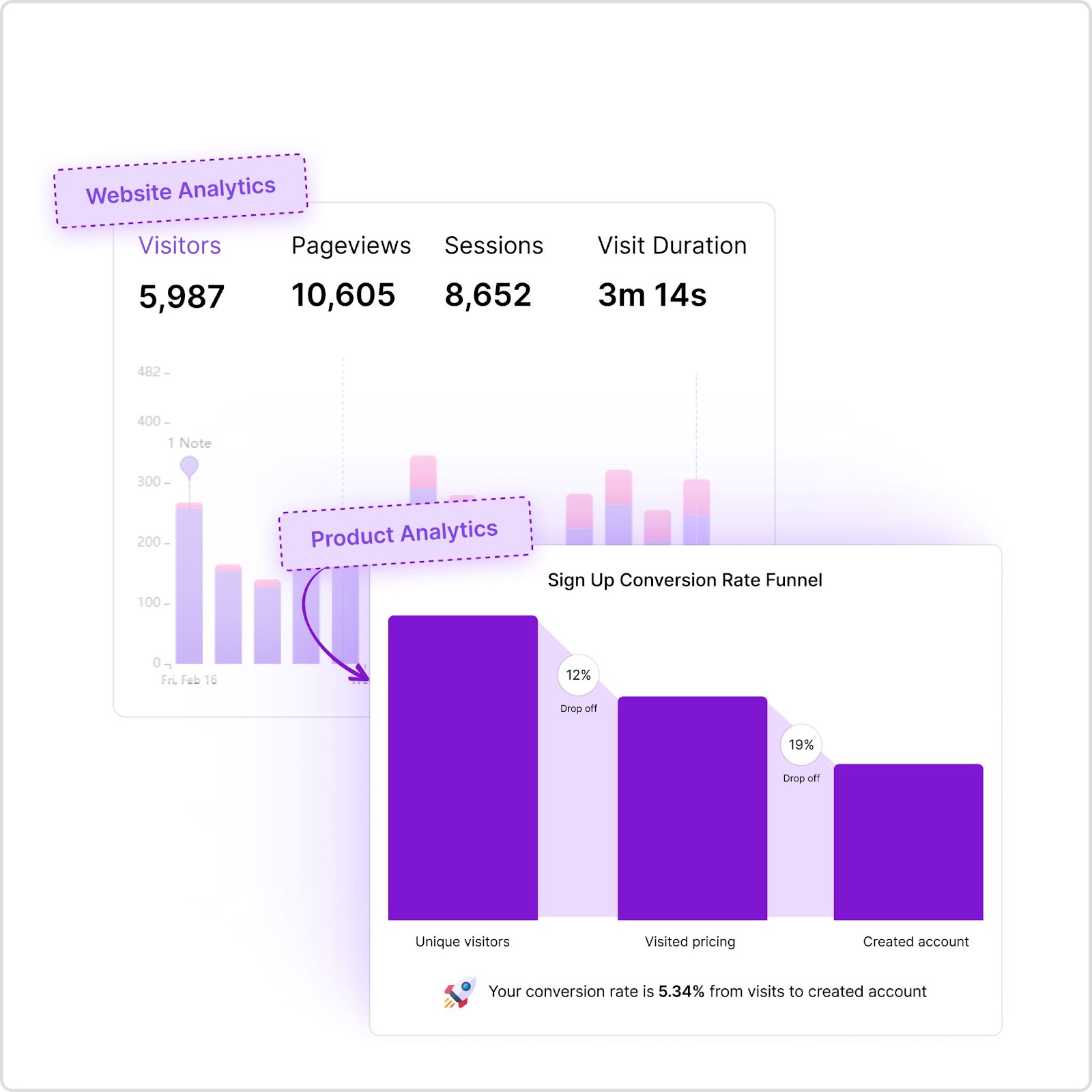
Usermaven is an AI marketing attribution platform for analyzing how acquisition activity becomes conversions, customer journeys, CRM pipeline, and revenue. It also includes website analytics, product behavior, funnels, and audience segments, so marketing and product performance can be investigated together rather than in disconnected reports.
Best for: B2B SaaS businesses, agencies, and growth organizations that need campaign-to-revenue visibility rather than a privacy-suite replacement.
Key capabilities
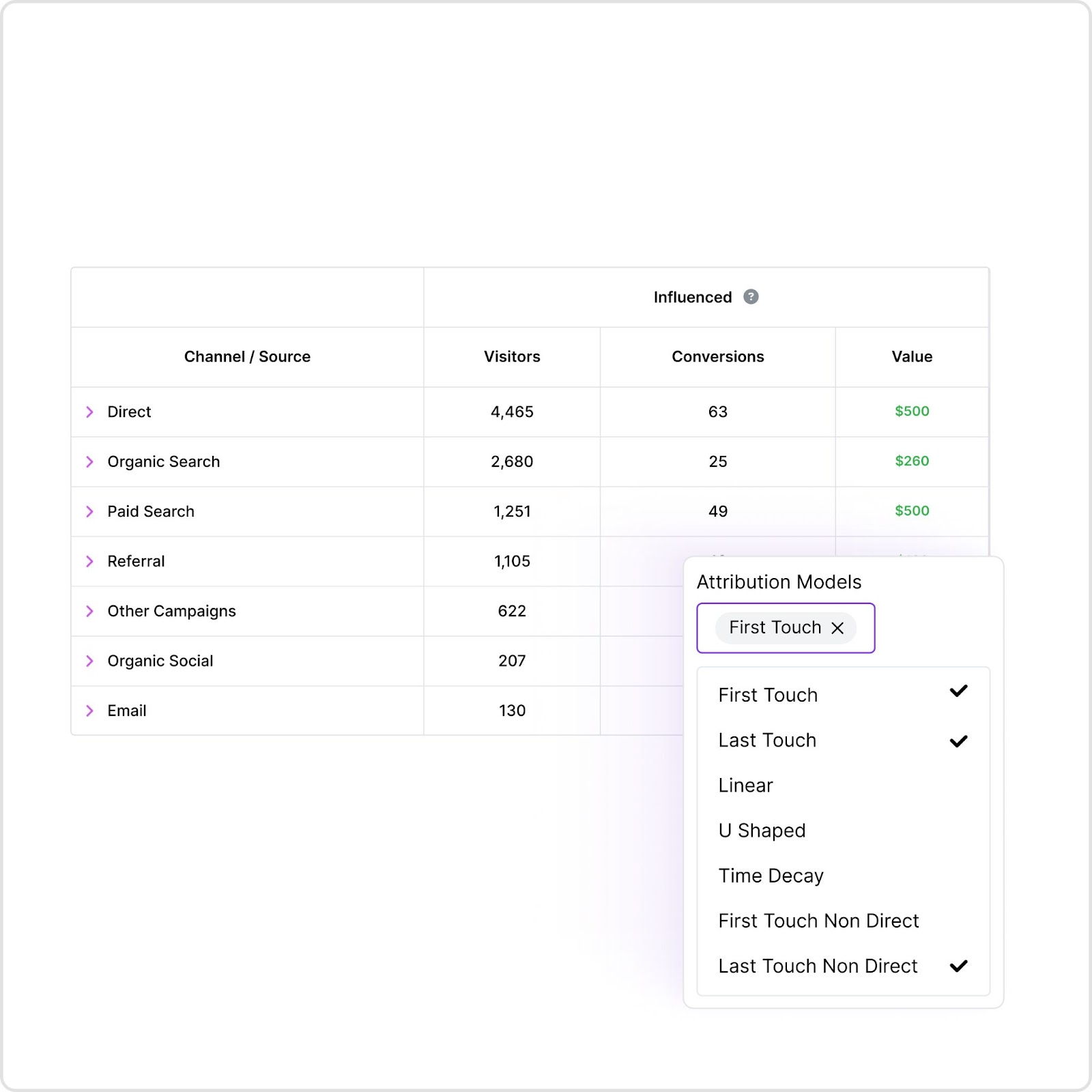
- Multi-touch revenue attribution: Compare first-touch, last-touch, linear, time-decay and other credit models across channels, content, and paid campaigns. Enterprise custom models allow tailored touchpoint weights.
- CRM and pipeline visibility: Integrate Salesforce records such as Leads, Opportunities and stage history; HubSpot workflows can receive selected attribution fields through Reverse ETL.
- Customer journeys and funnels: Investigate movement from visit to signup, activation, opportunity, and purchase through customer journeys and funnel analysis.
- Events and segments: Use automatic collection alongside custom events and segments to define meaningful milestones.
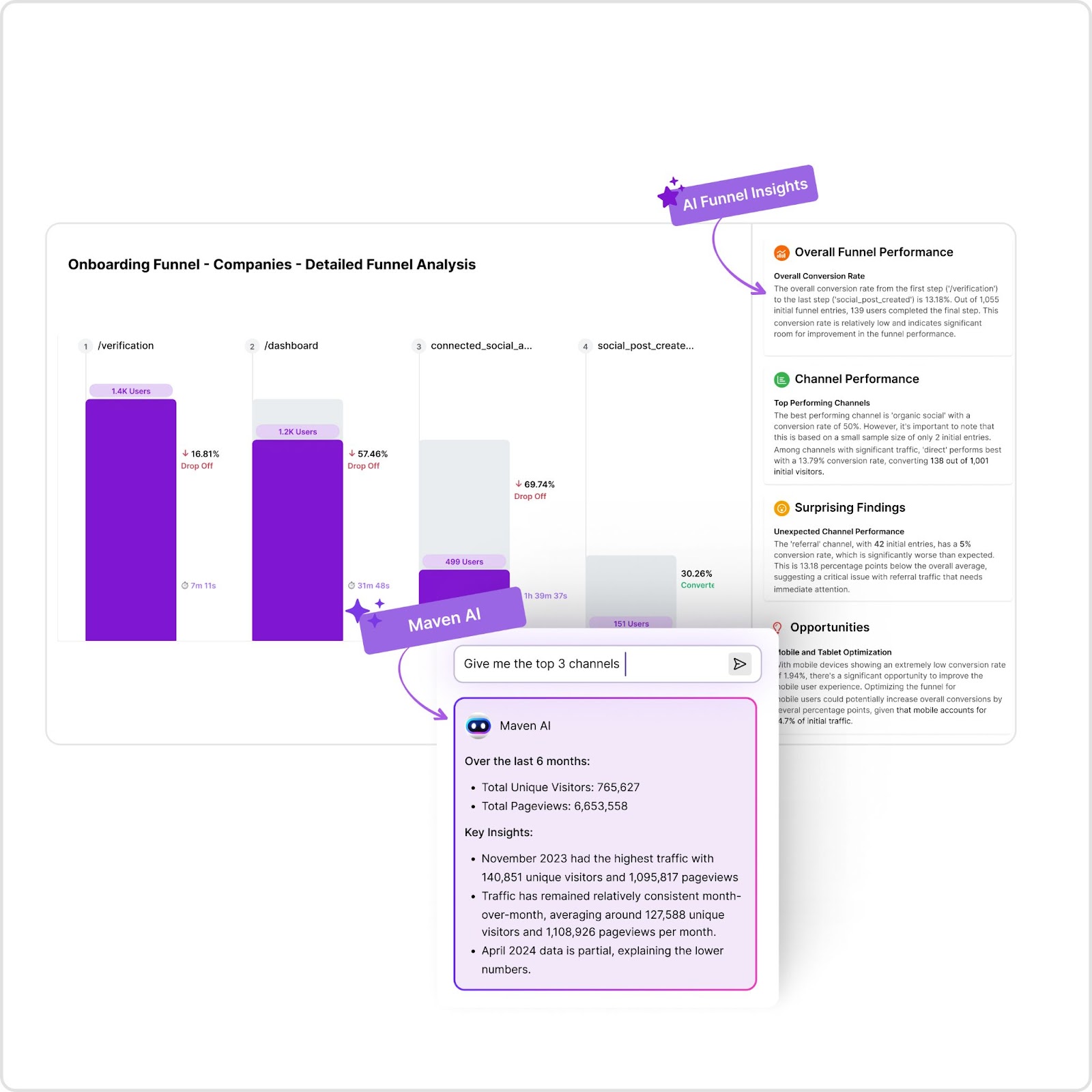
- AI and integrations: Maven AI answers questions, while scheduled AI Agents can surface adoption and retention changes. MCP connections support AI-enabled workflows.
- Agency and SaaS use cases: The agency solution supports client reporting, while B2B SaaS measurement links acquisition and downstream engagement.
Example: The same signup may appear under Google Ads in one attribution model and organic search in another. These are alternative credit allocations for one conversion, not two separate customers. Usermaven is most valuable when those touches can be connected to a CRM-defined outcome, not just to a pageview.
What to evaluate
Usermaven is not a one-for-one substitute for Piwik PRO’s consent management, tag management, and hosting requirements. Confirm the organization’s governance needs before migrating. For privacy-sensitive implementations, assess tracking configuration, consent requirements, and the available privacy controls individually rather than assuming that cookieless collection removes compliance obligations.

Pricing
Usermaven currently promotes custom-quoted Business and Enterprise plans on its pricing page. Business covers attribution, AI, product and website analytics, CRM/ad integrations, funnels and reporting. Enterprise adds deployment, governance, security and custom integration options. Check the required plan for a specific feature, including Enterprise custom attribution, during the demo discussion.
Bottom line: Choose Usermaven when campaign quality is defined by pipeline and revenue results. Keep or pair with Piwik PRO when consent and hosting governance remain the primary requirement.
Google Analytics 4

Google Analytics is the familiar choice for event-based web and app tracking within the Google marketing stack. Unlike a simple traffic counter, GA4 includes funnels, Explorations, Realtime, ecommerce reports, and data-driven attribution.
Best for: Organizations already using Google Ads and other Google products, especially when analysts can manage event definitions and reporting configuration.
- Strengths: Extensive Google integrations, event-based measurement, Realtime reports, free standard tier, and BigQuery export options.
- Trade-off: Consent configuration, identity settings, report processing and attribution definitions require care. GA4 is not a replacement for Piwik PRO’s consent suite by itself.
- Pricing: Standard GA4 is free. Analytics 360 pricing is contractual; avoid unverified “starts at $150,000” statements.
Verdict: A practical low-license-cost alternative if Google integration matters more than configurable hosting and an integrated consent suite.
Mixpanel

Mixpanel focuses on product intelligence across behavioral events, funnel conversion, retention, and experiments. Its platform also lists session replay, AI/MCP features and multi-touch attribution, so it is inaccurate to say Mixpanel cannot handle attribution at all.
Best for: Product and lifecycle analysts who primarily optimize activation, retention, and usage patterns.
- Strengths: Detailed cohorts, custom event analysis, funnels, session replay, experimentation and collaborative reports.
- Trade-off: Complex account-level CRM revenue questions may need additional data modeling and integrations; check how attribution is defined for the specific outcome.
- Pricing: Free up to 1 million events/month. Growth is usage-based after its included allowance; enterprise is quoted.
Verdict: Stronger than Piwik PRO for many product-specific analyses, but not necessarily a more complete consent or governance suite.
Amplitude
Amplitude is a digital analytics platform covering product behavior, experimentation, guides, session replay, and AI-assisted analysis. Its 2026 offerings also include AI Agents and MCP access.
Best for: Product-led businesses that want one environment for behavior analysis, experiments, feature iteration, and activation.
- Strengths: Event analytics, behavioral cohorts, AI-enabled workflows and experimentation.
- Trade-off: Data governance and pricing are tied to events and feature needs. Teams focused on enterprise consent infrastructure should verify coverage separately.
- Pricing: Free up to 2 million events/month; Plus begins with a free event allowance and scales with use; Growth and Enterprise are custom-priced.
Verdict: A closer fit to product experimentation than to Piwik PRO’s consent-centered analytics architecture.
Adobe Analytics

Adobe Analytics supports enterprise-grade digital experience analysis, flexible segmentation, customer journey investigation and advanced reporting across large properties.
Best for: Organizations with dedicated analysts, complex cross-channel measurement requirements, and existing Adobe ecosystem investments.
- Strengths: Deep analysis, segmentation, enterprise reporting and integration within Adobe Experience Cloud.
- Trade-off: Greater implementation, contracting, and analyst overhead than lighter alternatives.
- Pricing: Enterprise quote. Public fixed starting prices are not reliable for budgeting.
Verdict: A capable enterprise analytics option, not the simplest replacement for a mid-sized Piwik PRO deployment.
Fathom Analytics

Fathom Analytics prioritizes uncomplicated website reporting and cookieless traffic measurement. It also supports custom events, revenue tracking, UTM reporting and an analytics API, so “no conversion tracking” would be inaccurate.
Best for: Publishers, marketing sites, and agencies looking for clear website metrics without managing a large analytics suite.
- Strengths: Simple dashboard, events, revenue tracking, exports, and generous site allowances.
- Trade-off: Not designed for sophisticated product cohorts, CRM-stage attribution or enterprise consent/tag management.
- Pricing: Starts at $15/month for 100,000 monthly pageviews.
Verdict: Choose it when day-to-day site insight matters more than deep customer identity and governance.
Plausible Analytics

Plausible is a lightweight, open-source-oriented web analytics platform with simple dashboards, goals, custom events and privacy-oriented collection. Business-tier functionality includes funnels and user journeys, so it should not be described as lacking either capability categorically.
Best for: Website operators who value a compact dashboard, straightforward goals, and less ongoing maintenance.
- Strengths: Lightweight tracking, transparent reporting, open-source availability, traffic sources and event goals.
- Trade-off: Less native depth for individual customer lifecycle and marketing-to-CRM revenue compared with attribution-oriented systems.
- Pricing: Hosted plans begin around $9/month at a low pageview allowance; tier and monthly pageviews determine cost.
Verdict: Good for simpler websites, while business pipeline attribution calls for a different category of tool.
Clicky
Clicky provides real-time traffic activity, visitor-level browsing information, goal tracking and site monitoring in a comparatively simple interface.
Best for: Small business websites and publishers who want immediate traffic diagnostics.
- Strengths: Real-time visibility, straightforward visitor paths, goal monitoring and selected heatmap features.
- Trade-off: Less suited to structured product-event analysis, multi-touch revenue models and regulated enterprise governance.
- Pricing: Free tier available; paid plans begin around $9.99/month with limits based on sites and traffic.
Verdict: Useful for basic site operations, not a full replacement for every Piwik PRO module.
Open Web Analytics
Open-source web analytics gives technical operators a self-hosted route to web analytics and visitor interaction measurement. Its major attraction is infrastructure control rather than a turnkey modern marketing analytics workflow.
Best for: Developers and organizations prepared to maintain their own analytics deployment.
- Strengths: Open-source model, control over deployment, and basic visitor/event analysis.
- Trade-off: Evaluate release cadence, security maintenance, implementation work and available integrations before choosing it for a production environment.
- Pricing: No standard software subscription; hosting, maintenance, and engineering time create the real cost.
Verdict: Consider only when self-hosting is a priority and technical ownership is available.
Heap

Heap concentrates on autocapture and retroactive behavioral analysis. It helps product analysts define interaction events after collection and identify user paths, drop-offs, and conversion bottlenecks.
Best for: Digital product owners who want to explore user behavior without defining every event upfront.
- Strengths: Autocaptured interactions, funnels, session replay capabilities and AI-assisted interpretation on supported plans.
- Trade-off: Event hygiene, retroactive definitions and identity rules still matter; product behavior alone does not automatically show CRM-confirmed revenue.
- Pricing: Free plan available; higher tiers require a quote. Confirm the current session allowance in the purchase flow.
Verdict: Strong for product behavior exploration, while Piwik PRO remains more focused on governed analytics and consent.
Woopra

Woopra emphasizes customer journey analytics at the person and account level, including retention, segments, and integration of customer interactions across touchpoints.
Best for: Organizations with enough journey complexity and event volume to justify an established customer analytics platform.
- Strengths: Journey reporting, cohorts, customer profiles, automations and integrations.
- Trade-off: The current paid entry price is much higher than a lightweight traffic analytics subscription. Compare event allowances and contract scope carefully.
- Pricing: The published Pro entry price is $999/month for an allowance starting at 5 million events; Enterprise is custom.
Verdict: More appropriate for dedicated customer analytics programs than small-site reporting.
Piwik PRO vs. Usermaven: the decision
| Requirement | Piwik PRO | Usermaven |
| Built-in consent and tag suite | Core architectural strength | Evaluate separate CMP/tag requirements |
| Private hosting and regulated deployment | Enterprise hosting and security options | Enterprise private cloud/on-premise options |
| Website traffic and event analysis | Yes | Yes |
| Product cohorts, funnels and journeys | Available analysis features; confirm depth | Funnels, cohorts, journeys and user profiles |
| CRM-stage revenue attribution | Requires setup and data integration to fit the use case | Designed for attribution across acquisition and CRM outcomes |
| MCP and AI | Piwik PRO MCP beta announced in May 2026 | Maven AI Agents and external MCP connectors |
| Entry commercial model | Business from €36/month, action-based | Business and Enterprise quotes |
Why this matters: A company cannot treat Piwik PRO and Usermaven as feature-for-feature replacements. Piwik PRO is especially compelling for governance and consent operations. Usermaven is more directly oriented to marketing attribution and customer revenue outcomes. Evaluate the primary problem before weighing feature counts.
Avoid the attribution double-counting trap
Consider 20 paying customers who generated $40,000 in new revenue during a quarter. A first-touch report assigns $25,000 to organic search and $15,000 to paid search. A last-touch report might reverse that distribution. Both reports describe the same $40,000 of revenue under different credit rules.
Do not add the $40,000 shown under first-touch to the $40,000 shown under last-touch and report $80,000. Attribution models are alternative explanations of one underlying set of conversions. Validate CRM opportunity IDs, conversion windows, identity rules, and duplicate event handling before reconciling channel performance.
For account-led sales, also distinguish anonymous visits, identified contacts, leads, qualified opportunities, and won deals. If the business decision depends on lead quality and closed-won value, raw traffic and goal counts alone are incomplete measures.
Five checks before replacing Piwik PRO
- Audit data definitions. Document existing actions, goals, consent states, identifiers and source mappings. Establish which Piwik PRO reports must remain comparable.
- Rebuild goals and events. Define signup, activation, lead qualification, and purchase events in the candidate platform. Compare payloads and deduplicate conversions.
- Validate identity and privacy. Check cross-domain continuity, device changes, consent choices, retention policies, deletion rules, and tracking exclusions.
- Reconcile sessions and conversions. Run both tools in parallel for a representative reporting period. Explain differences in counting methodology instead of demanding identical totals.
- Test revenue and handoff. Confirm CRM stage mapping, source attribution windows, dashboards, exports and stakeholder access before switching the reporting source of truth.
Important: A migration may change historic comparability even when both tools work correctly. Record your measurement definitions, launch date, and expected differences in sessions, events, and attribution credit.
Which Piwik PRO alternative fits?
Start with the decision the analytics system must support. For a content site, Fathom or Plausible may answer the important questions at a fraction of the operational complexity. For product experiments and feature adoption, Mixpanel, Amplitude and Heap deserve closer evaluation. For enterprise analytics staffing and cross-channel reporting, Adobe Analytics is worth considering.
If privacy infrastructure, consent management and regulated hosting are essential, Piwik PRO may remain the better choice. When the larger problem is identifying which campaigns and touchpoints contribute to qualified opportunities and revenue, consider Usermaven’s attribution, customer journey and CRM-connected workflows instead.
For an agency handling multiple clients, compare the agency reporting requirements alongside workspace governance and contract costs, rather than choosing solely by the published monthly starting price.
Conclusion
The strongest Piwik PRO alternative depends on whether the organization needs simplified website metrics, product analytics, self-hosting, enterprise experience reporting, or marketing-to-revenue measurement. Piwik PRO remains a serious option for privacy governance, consent, and hosting control, so a switch should solve a clearly defined problem.
If the missing view is how acquisition turns into qualified pipeline and customers, book a demo to assess how Usermaven can connect marketing touchpoints, product engagement and CRM outcomes in one measurement workflow.
FAQs
What matters most when comparing Piwik PRO alternatives?
Start with the business question, then evaluate tracking units, consent and hosting requirements, event reporting, CRM integration, user experience, and true operating cost.
Is Usermaven a good alternative to Piwik PRO?
Usermaven is a strong fit when marketing attribution, revenue outcomes, and product analytics are priorities. It is not a like-for-like replacement for Piwik PRO consent and tag management.
Does Piwik PRO support AI and MCP?
Yes. Piwik PRO announced an MCP beta in May 2026 for querying analytics from compatible AI clients. Check access conditions and supported capabilities for a specific plan.
How do Usermaven and Piwik PRO pricing compare?
Piwik PRO lists a Business plan from €36 per month based on actions and domains. Usermaven currently lists custom-quoted Business and Enterprise plans. Compare required features and usage before estimating cost.
How can I evaluate Usermaven for revenue attribution?
Define conversion goals and CRM stages, confirm your source mappings and integration requirements, then book a demo to assess the workflow using your actual marketing questions.
Which alternative is better for product analytics?
Mixpanel, Amplitude and Heap focus heavily on product events, cohorts, funnels and behavior analysis. Evaluate their features and event governance against specific onboarding and retention questions.
Can I migrate historical Piwik PRO data to another tool?
Updated

Written by
Adeel Khan
Growth Marketing Expert
Adeel Khan is a full-stack SaaS marketer with 10+ years of experience in content marketing, paid advertising, analytics, and conversion rate optimization. He shares practical insights and strategies drawn from hands-on experience, helping B2B SaaS marketers improve performance and make better marketing decisions.
All articles by Adeel →