Factors.ai brings company identification, account intent, LinkedIn activation, and attribution into one B2B go-to-market platform. But a team replacing it may not need every part of that stack. Some want a clearer view of which campaigns generate revenue. Others need to identify anonymous business visitors or coordinate an enterprise account-based marketing program.
That is why comparing Factors.ai alternatives by feature count alone is misleading. For a team focused on measurement, marketing attribution software may be the right replacement for revenue reporting without replicating Factors.ai’s IP-to-company identification. Conversely, a visitor-identification tool can deliver actionable company signals without replacing full-funnel attribution.

This guide compares ten options using their current product positioning, published pricing, implementation scope, and practical trade-offs. The goal is to help you choose what actually fits your buying decision, not to imply that every product does the same job.
Shortlisted candidates
Start with the job your team needs to solve. These three options offer different approaches to replacing a Factors.ai workflow.
| Tool | Best for |
|---|---|
| Usermaven | Marketing and ads attribution connected to product behavior and revenue |
| Dreamdata | Account-level B2B journeys and revenue attribution |
| Snitcher | Identifying visiting companies and sending sales alerts |
Key takeaways
- Choose by the job being replaced: Account identification, ABM activation, paid-media attribution, and revenue reporting are distinct requirements.
- Usermaven fits attribution-led teams: It connects marketing channels with website and product behavior, conversion journeys, and CRM-linked business outcomes.
- Identification specialists are different: Snitcher, Leadfeeder, and RB2B focus on surfacing companies or people behind site visits, with important regional and plan limits.
- Enterprise ABM needs a broader stack: 6sense and Demandbase are stronger candidates when intent data, buying groups, and orchestrated campaigns are central.
- Pricing deserves careful interpretation: Compare usage limits, identification credits, eligible integrations, add-ons, and contract commitments, not just the entry price.
- A replacement should preserve evidence: Test coverage, identities, CRM stages, and attribution definitions before changing reporting or outbound workflows.
Factors.ai alternatives at a glance
| Platform | Best for | Why choose it? | Pricing access |
|---|---|---|---|
| Usermaven | SaaS growth and revenue measurement | Connect attribution with product usage and revenue | Business and Enterprise, custom quotes |
| Dreamdata | Account-level B2B revenue attribution | Focus on account-level journey and revenue measurement | Free entry plan; advanced custom quotes |
| HockeyStack | Enterprise revenue and GTM intelligence | Explore enterprise GTM journeys and revenue intelligence | Sales-led custom pricing |
| Snitcher | Identifying visiting companies | Focus on identifying visiting companies | From $49/month on displayed usage tier |
| Leadfeeder | Visitor identification and sales activation | Focus on visitor identification and sales workflows | Free Lite; Discover from $79/month billed annually |
| RB2B | US person-level website identification | Identify eligible US visitors at person level | Free; paid from $79/month |
| Fibbler | LinkedIn/Google Ads-focused B2B attribution | Focus on paid ad engagement and CRM pipeline | Public plan pricing; verify selected plan |
| Cometly | Paid-media-to-revenue measurement | Focus on paid-media attribution and conversion feedback | Usage-based; quote by volume |
| 6sense | Enterprise predictive ABM | Explore enterprise predictive ABM orchestration | Custom quote |
| Demandbase | Enterprise account-based GTM | Explore enterprise account-based GTM and buying groups | Custom quote |
The table groups tools by their primary buying purpose, not a supposed overall score. A platform can provide adjacent features without being a complete substitute for every Factors.ai module.
What does Factors.ai do, and why look for alternatives?
Factors.ai combines account identification, firmographic enrichment, intent signals, marketing journeys, ad activation, sales workflows, and attribution reporting. Its audience includes B2B demand generation, account-based marketing, and revenue teams that want to identify promising accounts and act on their behavior.
The platform publishes plan pricing, contrary to older comparisons that call it entirely quote-only. Its current FAQ lists Lite at $199/month, Basic at $6,000/year, Growth at $20,000/year, and Enterprise starting at $36,000/year. The actual commitment can change with account-identification volume, modules, CRM data, reporting limits, and add-ons.
Teams consider alternatives for different reasons. Choose based on the workflow and outcomes you need to preserve.
Connected measurement
Link marketing touchpoints with product activation, customer journeys, and revenue when post-signup outcomes matter.
Focused visitor identification
Compare identification coverage, geographic reach, and sales alerts if finding visiting companies is the primary job.
A different ABM workflow
Evaluate intent signals, buying groups, integrations, and campaign orchestration against the way your team operates.
The central question is: Which Factors.ai workflow are you replacing, and which outcomes must still be measured after migration?
How we evaluated these Factors.ai competitors
We compared the vendors using the product functions they publicly document, current plan pages where available, suitability for different B2B workflows, and the implementation or data limitations a buyer would need to verify. This is an editorial feature and pricing review, not a claim that we personally implemented and benchmarked all ten products.
The benchmark was Factors.ai pricing and features, rather than older listicle descriptions. We also checked vendor documentation and pricing, including the recent Leadfeeder branding change and Usermaven’s latest updates.
We did not award numerical scores or invent testing results. “Best for” means the tool’s published product scope is a reasonable match for a stated buyer need. Plan eligibility, geographic coverage, and total cost should be reconfirmed during procurement.
10 best Factors.ai alternatives in 2026
1. Usermaven
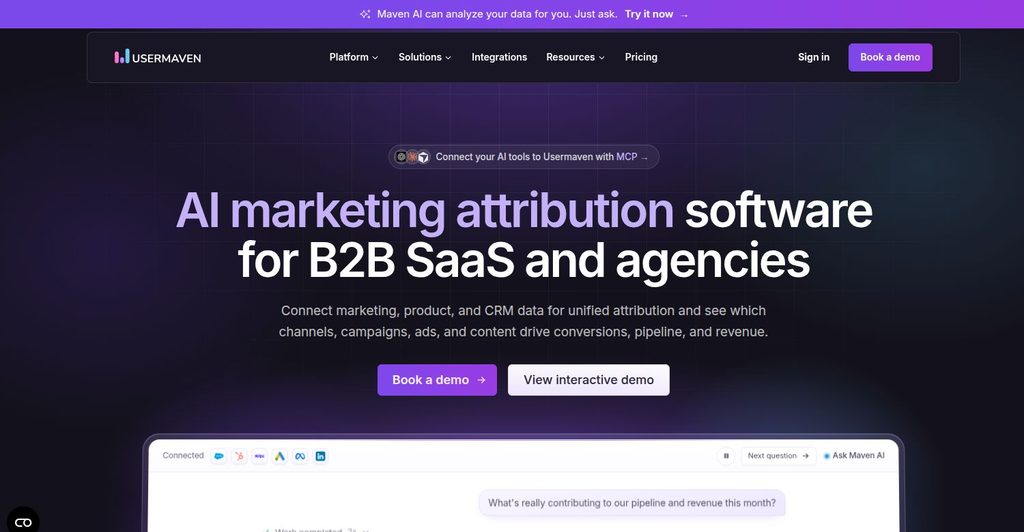
Best for: B2B SaaS and growth teams that need marketing attribution, product behavior, and revenue analysis together.
Usermaven is a marketing attribution platform that connects acquisition sources with website activity, product usage, customer journeys, conversions, and revenue outcomes. It helps teams understand which recorded marketing interactions contribute to signups, activation, pipeline, and revenue across the customer journey.
This makes Usermaven particularly relevant to product-led SaaS and hybrid sales-led teams. Its product analytics software complements attribution reporting, allowing teams to study activation and retention rather than stopping at lead creation. With CRM and event data connected, marketers can also inspect pipeline and revenue contribution.
Key features
- Multi-touch and custom attribution: Compare touchpoint credit using different models; custom modeling was announced for Enterprise workspaces.
- Paid ads attribution: Connect campaign activity with conversions, pipeline, and revenue to understand which ads contribute to business outcomes. Usermaven brings that analysis together with customer journeys and product behavior, helping teams evaluate what happens after a visitor clicks.
- Journeys, funnels, and retention: Analyze recorded user behavior and conversion drop-offs alongside marketing acquisition.
- Paid ads and CRM analysis: Evaluate campaigns using conversion value and downstream outcomes where integrations and event mapping support them.
- Maven AI and AI Agents: Ask analytics questions and schedule recurring monitoring of performance changes.
- Segments and dashboards: Investigate meaningful customer groups and share relevant reporting views.
Why choose Usermaven over Factors.ai?
Choose Usermaven when you need one connected view of campaign performance and customer behavior. Follow recorded interactions from an ad click through signup, product activation, and revenue; compare attribution models; and use Maven AI to investigate changes. The result depends on connected data and configured conversion goals.
What to consider: Teams that rely on anonymous company identification or predictive ABM should evaluate those workflows separately.
Pricing: Business and Enterprise plans use custom quotes. Custom attribution models are available for Enterprise workspaces. Official details: Usermaven pricing.
When it is best: SaaS growth, lifecycle, marketing operations, and RevOps teams evaluating whether acquired users become activated customers and whether campaigns contribute to qualified opportunities and revenue.
First-party evidence: ContentStudio’s attribution workflow
In a published ContentStudio customer story, the social media software company describes using Usermaven to connect paid campaign activity with signups, demo requests, plan upgrades, and revenue. The case study reports 128% growth in signups and 92% growth in plan upgrades during the covered engagement.
Those results are customer-reported outcomes from a broader marketing program, not controlled evidence that Usermaven alone caused them. The relevant takeaway for a software buyer is the measurement workflow: paid acquisition was evaluated against downstream customer behavior and revenue instead of isolated platform conversion reports.
2. Dreamdata
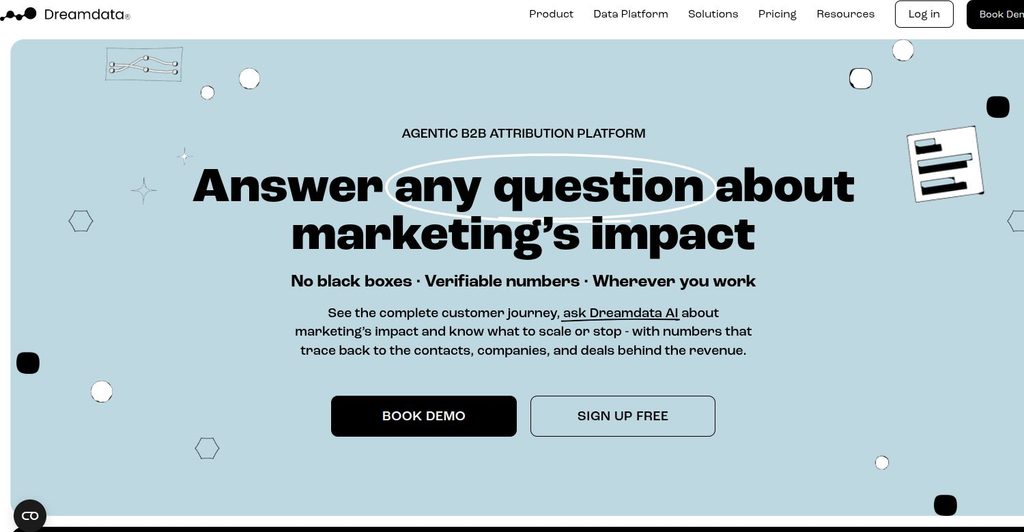
Best for: B2B revenue teams that prioritize account-level journeys and pipeline attribution.
Dreamdata focuses on B2B marketing attribution and GTM data, combining interactions across websites, ad platforms, CRM records, and other systems into account-level reporting. It is particularly relevant when buyers take months to close, multiple people interact before a sale, and marketing needs to report on opportunities and won revenue.
The company now advertises a free entry plan for foundational B2B analytics, with advanced attribution and activation offered through a customized commercial package. That is different from older listicles that still quote a fixed advanced starting price.
Key features
- Account and customer journey analysis for longer B2B sales cycles.
- B2B attribution models connected to CRM opportunities and revenue.
- Company identification, audience building, and alerts in its entry-level offering.
- Advanced activation and AI-assisted attribution in higher-level packages.
Why choose Dreamdata over Factors.ai? The stronger fit is a revenue team seeking an account-centric measurement environment as its primary system, especially when it wants marketing interaction data directly connected with pipeline and closed-won analysis.
What to consider: Dreamdata also offers identification and activation, so it is not merely a reporting dashboard. Evaluate exactly which features, event volumes, integrations, and histories are included in the proposed package before assuming its entry plan replaces Factors.ai Growth.
Pricing: Free plan listed at $0/month; advanced Attribution & Activation uses custom pricing. The Dreamdata and Usermaven comparison explains how their measurement approaches differ.
When it is best: Established B2B SaaS, demand generation, and RevOps teams accountable for multi-stakeholder pipeline and marketing-influenced revenue.
3. HockeyStack
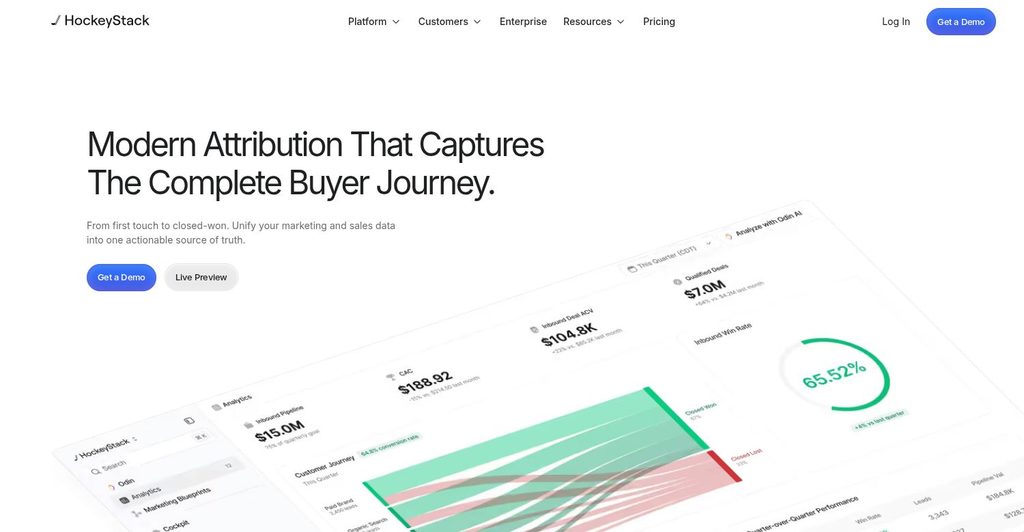
Best for: Enterprise GTM intelligence, complex buyer journeys, and revenue attribution.
HockeyStack brings marketing, sales, account, and revenue information together to examine B2B buying journeys. Its positioning has evolved beyond a conventional attribution dashboard toward a broader revenue intelligence and AI-assisted GTM environment.
The platform can help teams examine multiple conversion paths and compare attribution methods when sales cycles involve numerous recorded interactions and opportunity stages. Its breadth is especially relevant to organizations with established revenue operations teams.
Key features
- Multi-touch attribution and side-by-side model comparisons.
- Buyer journey and account-level analysis from early engagement to revenue.
- AI-assisted investigation of GTM activity and reporting.
- Advanced account and campaign measurement, including incrementality-related capabilities.
Why choose HockeyStack over Factors.ai? Prioritize HockeyStack if the core requirement is a comprehensive marketing-to-revenue intelligence environment rather than visitor identification and ad audience activation alone. The Usermaven and HockeyStack comparison examines how their attribution and analytics approaches differ.
What to consider: Its expanded GTM scope can introduce data integration, governance, and implementation requirements. Neither platform should be called automatically easier without testing the buyer’s actual CRM and tracking stack.
Pricing: Custom sales-led pricing without a universal public monthly figure. The HockeyStack pricing guide explains the factors that can affect a quote.
When it is best: Larger B2B revenue organizations with complex account journeys and a need for detailed measurement across marketing, sales, and closed-won activity.
4. Snitcher
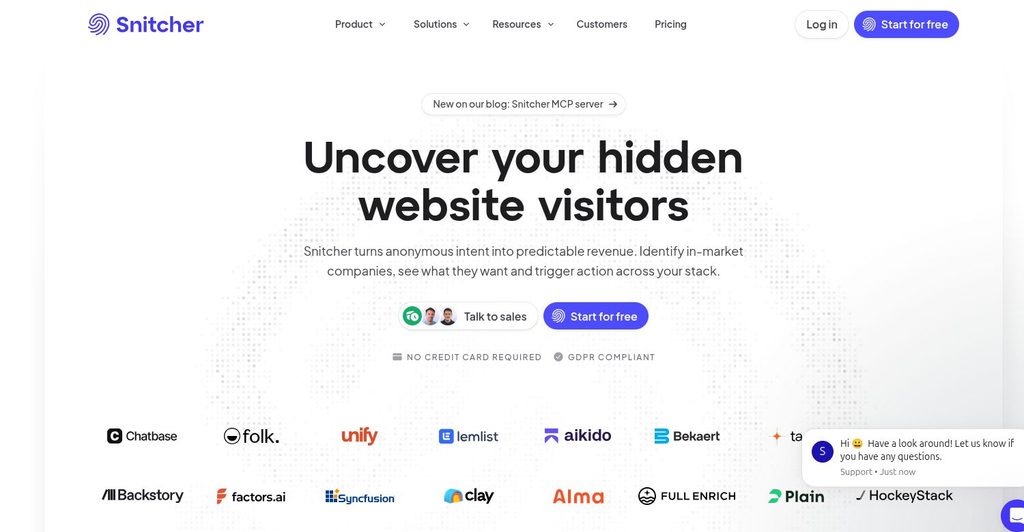
Best for: Identifying companies visiting your website and activating their interest signals.
Snitcher is a B2B website visitor intelligence platform built around matching site activity to companies. It helps sales and marketing teams discover businesses researching their services, understand the pages they engage with, and act on those signals through alerts, enrichment, and connected workflows.
Snitcher’s current product also offers attribution and broader GTM functions. It should not be described as identification-only. The main distinction is where the workflow begins: company discovery is the organizing use case.
Key features
- IP-to-company identification and visitor activity history.
- Account intent signals, scoring, and real-time alerts.
- CRM integrations, contact reveal options, and workflow automation.
- B2B analytics and API access for sales or marketing workflows.
Why choose Snitcher over Factors.ai? It can be a simpler buying choice if the main task is identifying site visitors and immediately routing account signals to a sales team, without buying a broad multi-module account-intelligence setup.
What to consider: Company resolution is not universal, and contact-level enrichment should not be assumed for every visit. Test match quality for your actual visitors and regions, plus the additional cost of contact credits.
Pricing: The vendor currently displays usage tiers beginning at $49/month for 0–50 identified companies, with annual discounts available. Pricing scales by monthly identified-company volume.
When it is best: Inbound-led B2B companies and sales teams that turn visiting-account signals into timely prospecting and follow-up.
5. Leadfeeder
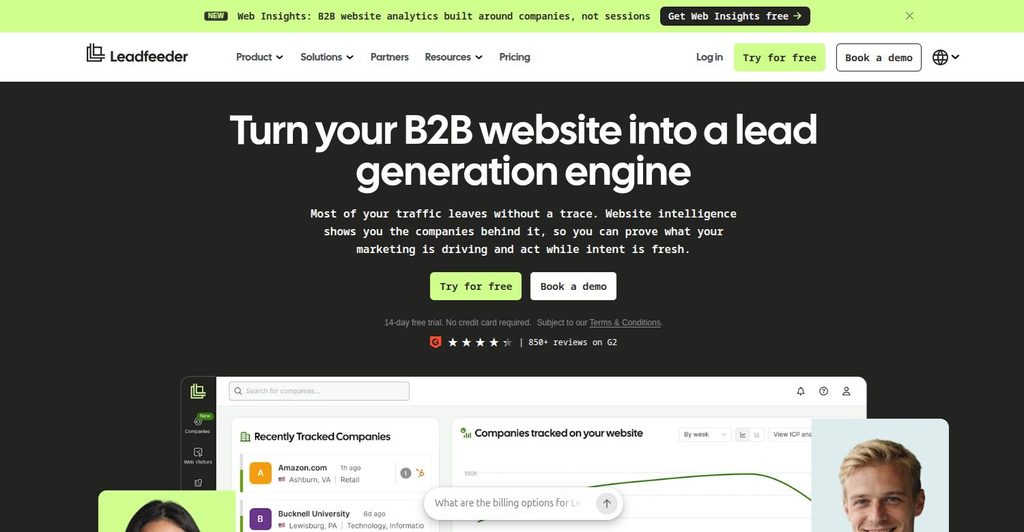
Best for: Company identification combined with contact enrichment and sales activation.
Leadfeeder identifies organizations visiting a business website and helps teams prioritize them for outreach. Its current offering combines anonymous-company discovery, enrichment, targeting lists, intent filters, sales workflows, and advertising activation at higher tiers.
If you remember the Dealfront brand, it has been consolidated under Leadfeeder’s name. These should not be treated as two separate competing products in a 2026 comparison.
Key features
- Website company identification and firmographic context.
- Visitor alerts, list building, and CRM synchronization.
- Contact enrichment and intent filtering on eligible plans.
- Sales activation, workflows, and B2B advertising features in higher tiers.
Why choose Leadfeeder over Factors.ai? Choose it when web visitor identification is the immediate source of prospecting opportunities and the team needs a defined path from company discovery to contact enrichment and sales engagement.
What to consider: Paid plans vary by identified-company volume and activation credits. The entry identification tier does not automatically include every enrichment and campaign feature, so a realistic cost comparison needs both volume and workflow requirements.
Pricing: Lite is free. Discover starts at $79/month billed annually, Activate at $369/month billed annually, and Scale at $599/month billed annually, with tiers and credits varying by package.
When it is best: Sales and demand-generation teams that need to surface high-fit visiting accounts and operationalize those signals in CRM workflows.
6. RB2B
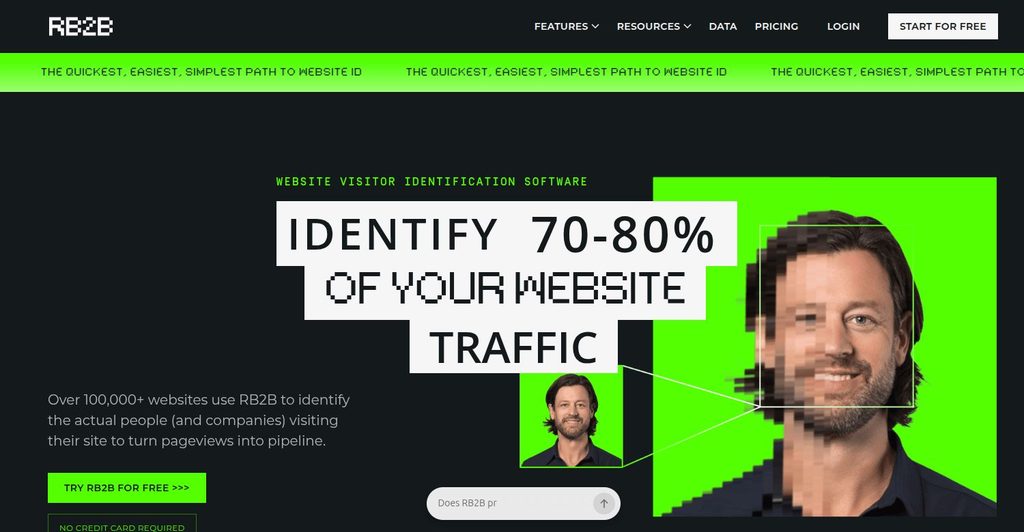
Best for: US-focused person-level website identification and lead routing.
RB2B specializes in identifying business visitors, especially person-level website identification for eligible US traffic. Its workflow routes identified information into Slack, Teams, or other sales tools so teams can act on visits associated with specific individuals.
This makes it a different category of alternative from full marketing attribution platforms. The central value proposition is knowing who may be visiting, rather than assigning fractional campaign credit to subscription revenue.
Key features
- Company-level visitor identification and US contact-level resolution.
- LinkedIn profile delivery and, on higher plans, business email enrichment.
- Slack and Teams notifications, with CRM integrations on eligible tiers.
- Filters for high-intent pages, visitor activity, and target accounts.
Why choose RB2B over Factors.ai? Consider it when the organization wants to route identified visitor signals to outbound sales quickly and does not require the broader Factors.ai ABM and attribution stack.
What to consider: RB2B says contact-level identification is limited to US traffic, while company identification has broader coverage. It also uses monthly resolution allowances, and different tiers have materially different identification and integration capabilities. Person-level identification cannot be guaranteed for all visits.
Pricing: Free plan; Starter $79/month, Pro from $149/month, and Pro+ from $199/month, with volume limits and potential overages.
When it is best: US-centric outbound teams and founders that need rapid visitor-to-sales workflows more than attribution modeling.
7. Fibbler
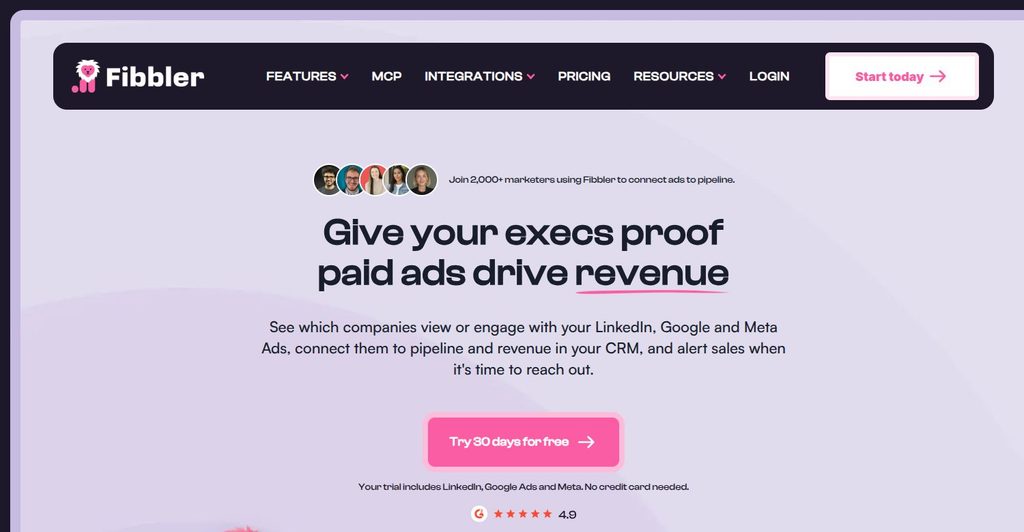
Best for: LinkedIn and Google Ads-focused B2B teams measuring paid engagement against CRM pipeline.
Fibbler focuses on B2B advertising attribution and connects paid-media engagement with CRM outcomes. It is deliberately narrower than a full ABM intelligence platform, making it relevant to teams whose main question is whether specific paid campaigns influence target accounts, opportunities, and pipeline.
This narrower positioning is a genuine advantage for some buyers. It is also why Fibbler should be evaluated against other paid-media attribution options rather than treated as a universal replacement for every Factors.ai workflow.
Key features
- LinkedIn advertising engagement and CRM-connected attribution.
- Account-level campaign influence and paid-media visibility.
- Google Ads attribution support through relevant plans or add-ons.
- Campaign optimization and audience-focused reporting tools.
Why choose Fibbler over Factors.ai? If most of the budget is concentrated in LinkedIn and Google Ads, a focused attribution workflow may provide a clearer decision path than deploying a wider account-intelligence system.
What to consider: A narrow paid-channel focus is not the same as full product analytics, website behavior measurement, or broad ABM intent coverage. Confirm the role of any Google Ads add-on and exactly which CRM integrations and attribution fields are supported.
Pricing: Fibbler’s published comparison material describes plans beginning at $89/month and a Google Ads add-on; pricing should be reconfirmed against the current quote before publication because plan packaging can change.
When it is best: LinkedIn-heavy B2B demand generation programs that want paid engagement tied directly to pipeline discussions.
8. Cometly
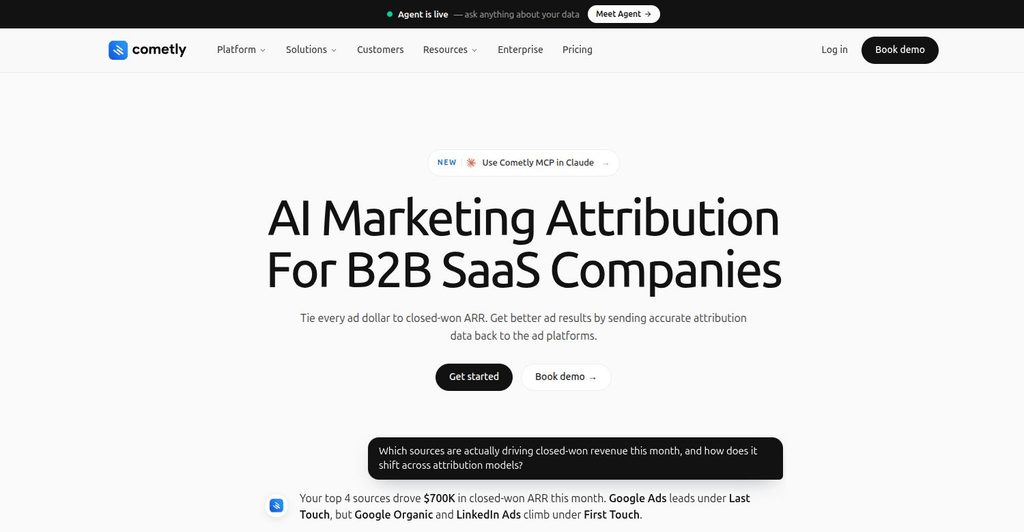
Best for: Paid advertising attribution, conversion feedback, and revenue tracking.
Cometly connects advertising interactions with conversions, revenue, and account journeys. It supports server-side event capture, marketing attribution, conversion syncing, and reporting across major paid channels. The platform now positions itself for B2B SaaS acquisition measurement as well as other paid-media use cases.
Its appeal is strongest where marketers manage spend across multiple ad networks and need to compare platform-reported conversions with downstream business outcomes.
Key features
- Multi-touch and paid-media attribution.
- Server-side tracking and Conversion API integrations.
- Account journeys, events, analytics, and dashboards.
- AI-assisted reporting and ad-management capabilities.
Why choose Cometly over Factors.ai? Prioritize it when campaign measurement and conversion feedback are the main jobs, particularly if the team wants a dedicated path from paid acquisition to opportunities and revenue. The Usermaven and Cometly comparison examines paid ads attribution alongside website and product analytics.
What to consider: Cometly also supports CRM and account reporting, but its buying proposition is not interchangeable with predictive account intelligence or third-party intent orchestration. Evaluate usage tiers, pageview limits, supported conversion connections, and the availability of advanced integrations.
Pricing: Core and Enterprise use usage-based quotes. The vendor says billing can be monthly or annually, with annual savings advertised. The Cometly pricing guide explains its quote-based model.
When it is best: Performance marketing, paid acquisition, and SaaS growth teams that need confidence in ads-to-revenue measurement.
9. 6sense
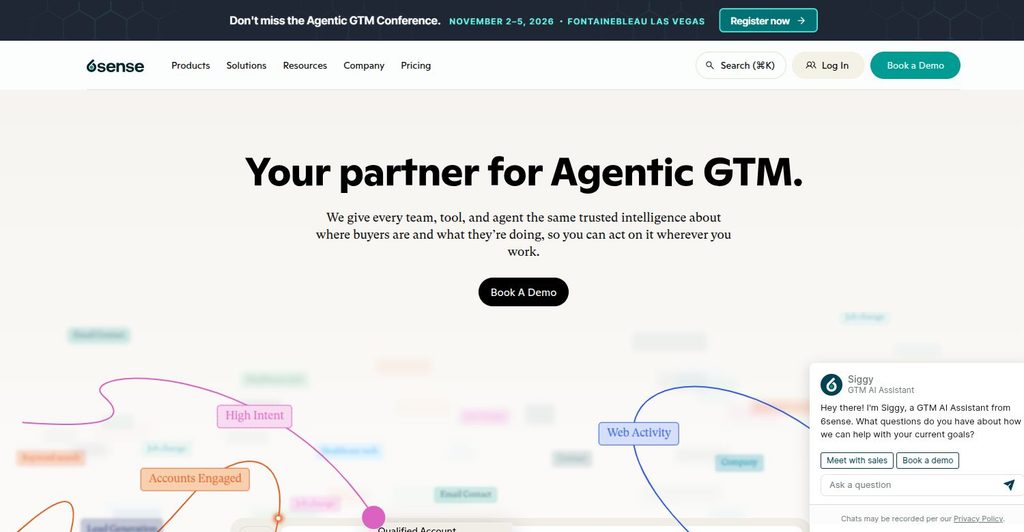
Best for: Enterprise predictive account intelligence and coordinated ABM programs.
6sense is an enterprise account-based go-to-market platform built around proprietary intent data, predicted buying stages, account prioritization, and multi-channel activation. It is most useful for teams coordinating marketing and sales against complex target-account lists.
Its focus is to help organizations identify which accounts may be in market, align campaigns to buying signals, and move those signals into sales and marketing workflows.
Key features
- Intent signals, company intelligence, and predictive account models.
- Dynamic audience segments and advertising activation.
- Marketing and sales workflows with AI assistance.
- Account and pipeline reporting linked to GTM activity.
Why choose 6sense over Factors.ai? It is a strong candidate when enterprise-scale account prioritization and orchestration are the principal requirements, including active buying-stage intelligence beyond observed website engagement.
What to consider: 6sense and Factors.ai both cover elements of account intelligence, intent, and activation. The difference should be established through dataset fit, integrations, regional performance, operating model, and procurement scope, not by claiming one platform always identifies more buyers.
Pricing: Customized quotes based on modules, users, data requirements, and other services.
When it is best: Enterprise marketing and sales organizations running established account-based programs with multiple channels and stakeholder teams.
10. Demandbase
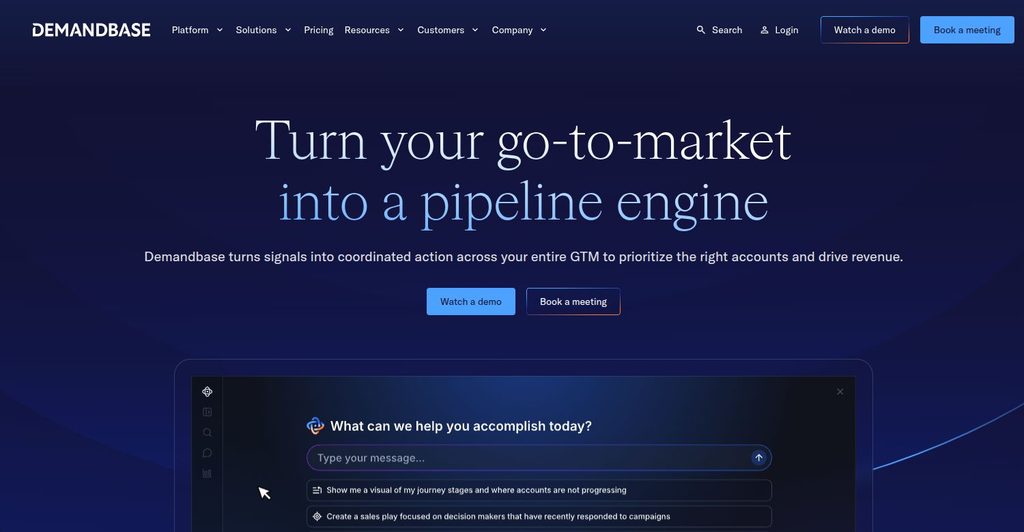
Best for: Enterprise ABM orchestration, account intelligence, and buying-group engagement.
Demandbase offers an account-based GTM platform connecting account and intent data with sales intelligence, buying-group engagement, advertising, and marketing workflows. It is designed for organizations that need to coordinate activity at both the account and buying-committee levels.
Compared with a narrower attribution tool, Demandbase is a broader operating environment for prioritizing and activating high-fit accounts across teams.
Key features
- Firmographic, technographic, contact, and intent data.
- Account and buying-group intelligence for sales prioritization.
- ABM advertising and campaign activation.
- CRM-connected sales and marketing workflows.
Why choose Demandbase over Factors.ai? Evaluate Demandbase when a large organization needs account-based orchestration across sales, advertising, and buying committees as a major GTM program, not merely as an add-on to analytics.
What to consider: Both vendors support account intelligence and activation, so the decision depends on the depth of your required data, buying-group workflows, campaign channels, and cost. Verify what Demandbase packages together and what must be separately licensed.
Pricing: Custom quotes. Demandbase describes a platform fee and per-user components for its combined sales and marketing offering.
When it is best: Enterprise B2B revenue teams investing heavily in account-based marketing and cross-functional GTM execution.
Factors.ai vs. Usermaven: Which is better for your team?
Factors.ai and Usermaven overlap in attribution and analytics, but their centers of gravity are different. Factors.ai emphasizes account discovery, intent signals, scoring, and action across ABM channels. Usermaven emphasizes connected marketing, website, product, funnel, and revenue analytics.
| Decision area | Factors.ai | Usermaven |
|---|---|---|
| Primary purpose | Account intelligence, ABM activation and attribution | Marketing attribution plus web and product analytics |
| Account discovery and intent | Company identification, intent and ABM scoring | Focuses on recorded customer interactions; evaluate dedicated identification separately |
| Marketing attribution | Supported | Multi-touch and model comparison; custom models on Enterprise |
| Product behavior and retention analytics | Available analytics, but not primary focus | Funnels, journeys and retention alongside attribution |
| CRM pipeline and revenue | Supported, configuration dependent | Supported through mapped goals and connected data |
| AI analysis and automation | Account and GTM intelligence workflows | Maven AI, Agents, dashboards and MCP |
| Published starting price | Lite $199/month, with annual tiers | Business and Enterprise custom quotes |
For a PLG SaaS company, the distinguishing question may be what users do after signup. Usermaven’s customer journey analytics and behavioral analysis help explain whether marketing attracts users who actually activate and continue using the product.
For a sales-led company, the challenge may be explaining which touchpoints contributed to a qualified opportunity. Connecting recorded interactions to pipeline attribution and closed-won outcomes matters more than counting unidentified visits alone.
But if the organization depends on revealing anonymous visiting accounts, enriching those accounts with intent data, prioritizing buying groups, and syncing audiences to ABM channels, Factors.ai may remain a better single-platform fit.
How to choose the right Factors.ai replacement
1. Define which capability must be replaced
Start by naming the operational problem. If your sales reps depend on daily lists of companies visiting pricing pages, identification is essential. If executives need accurate paid spend to revenue analysis, attribution may be the leading requirement. If marketing targets hundreds of named accounts, ABM activation and buying signals may be non-negotiable.
Avoid treating a tool with an attractive feature checklist as a replacement until it demonstrates your actual workflow.
2. Map the unit of analysis
Account, user, contact, opportunity, and campaign are different units. Company identification can be useful for outbound prospecting but may not connect to an individual user’s complete product journey. Conversely, product analytics can measure known user behavior without discovering the company behind every anonymous visit.
For B2B SaaS, b2b marketing attribution should reflect which customer and account relationships actually exist in the collected data.
3. Compare coverage, not advertised match rates alone
For identification tools, measure resolution on your own traffic and markets. Ask what happens to home networks, remote work, shared devices, VPNs, and privacy restrictions. If contact-level identity is limited to the US, do not assume identical coverage elsewhere.
For attribution platforms, audit UTM completeness, conversion events, CRM associations, lookback windows, and identity stitching. Missing touchpoints cannot be recovered simply by choosing a different model.
4. Calculate the total cost of the workflow
Compare monthly and annual commitments, identified-company volume, seats, activation credits, ad account connections, data histories, setup services, and additional modules. A nominal $79 identification plan may not support the same work as an enterprise ABM contract. Likewise, a custom-priced attribution platform may be justified when it replaces multiple fragmented reporting processes.
5. Test with real outcomes before switching
Use a controlled evaluation: track one high-intent visit, one CRM opportunity, and one closed-won or paid conversion through each candidate workflow. For the attribution option, evaluate campaign source, event quality, identity joins, and credited revenue. For an ABM option, validate company identification and whether the alert can reach a seller who can act on it.
Document what each candidate gets wrong as well as what it does well. Procurement decisions are stronger when they compare failures and trade-offs rather than only demo highlights.
Do you need one platform or a specialized stack?
There are two defensible approaches. A broader account-based platform may be simpler to govern when one team owns identification, intent, audiences, workflows, and account reporting. A specialized stack can be appropriate when the company already has mature outbound infrastructure but needs a better measurement layer.
For example, a team might pair visitor identification with revenue attribution tools to connect sales signals and marketing results. That does not automatically reduce total cost or eliminate data engineering. The tools still need consistent identifiers, CRM fields, and a shared definition of conversion.
The practical choice is to decide which platform becomes the source of truth for account identity, which platform records conversion and revenue outcomes, and how data moves between them. Without that agreement, adding another tool can create more dashboards but less confidence.
Final verdict: Which Factors.ai alternative should you choose?
For B2B SaaS teams that need acquisition-to-revenue measurement, Usermaven is a strong alternative. It is particularly relevant when marketing effectiveness should be evaluated alongside product behavior, funnels, customer journeys, retention, and connected CRM outcomes.
For specialized revenue attribution, evaluate Dreamdata and HockeyStack. For visitor identification, begin with Snitcher or Leadfeeder, and consider RB2B when US person-level identification is essential. For paid B2B attribution, evaluate Fibbler and Cometly. For enterprise ABM orchestration, shortlist 6sense and Demandbase.
No tool wins every category. If your buying process is centered on anonymous company discovery and intent-based activation, replacing Factors.ai with a pure attribution tool could mean losing functionality you actually rely on. If your priority is what happens after acquisition, a measurement-first platform may be more appropriate.
Businesses evaluating marketing, product, and revenue measurement together can book a Usermaven demo to review how the platform fits their campaign tracking, customer journey, and CRM data needs.
FAQs about Factors.ai alternatives
What is the best Factors.ai alternative?
There is no single best replacement for every use case. Usermaven is a strong choice for marketing attribution connected to website, product, and revenue outcomes. Dreamdata and HockeyStack emphasize B2B attribution; Snitcher and Leadfeeder emphasize visitor identification; 6sense and Demandbase emphasize enterprise ABM.
Is Usermaven a direct replacement for Factors.ai?
It can replace parts of an attribution and analytics workflow. It is not a like-for-like substitute for Factors.ai’s IP-to-company identification, third-party intent, or predictive ABM orchestration. Compare the capabilities your team actually uses before moving.
Which Factors.ai competitors identify anonymous website visitors?
Snitcher and Leadfeeder specialize in company identification. RB2B offers person-level identification for eligible US visitors, alongside global company-level identification. Coverage varies by geography, visit type, plan, and match eligibility.
Which Factors.ai alternatives are best for revenue attribution?
Usermaven, Dreamdata, HockeyStack, and Cometly are worth comparing, depending on whether the primary task is SaaS product-linked attribution, account-level B2B revenue attribution, enterprise GTM intelligence, or paid-media-to-revenue measurement.
Does Factors.ai publish its pricing?
Yes. Factors.ai publicly lists multiple entry and annual plans, though packages and add-ons affect the final cost. As of this review, its FAQ lists Lite at $199/month, Basic at $6,000/year, Growth at $20,000/year, and Enterprise starting at $36,000/year.
What is the most affordable Factors.ai alternative?
That depends on the required job. Dreamdata and RB2B publish free entry options, while Snitcher and Leadfeeder offer lower-cost identification tiers. These entry products do not necessarily include full attribution, contact enrichment, or enterprise ABM features.

Written by
Junaid Ahmed
Content Writer & Digital Marketer
Junaid Ahmed is a content and copywriter with 3+ years of experience creating research-driven content across SaaS, B2B, ecommerce, and digital marketing. He specializes in turning complex topics into clear, practical content that helps marketers better understand their challenges, evaluate solutions, and make informed decisions. His work spans educational content, industry insights, and actionable marketing guides.
All articles by Junaid →