A buyer clicks your LinkedIn ad, reads an article, returns through search, and signs up for a trial. Two weeks later, their company buys a subscription.
Your ad platform, website analytics, product database, and billing tool may each hold part of that story under a different identifier.
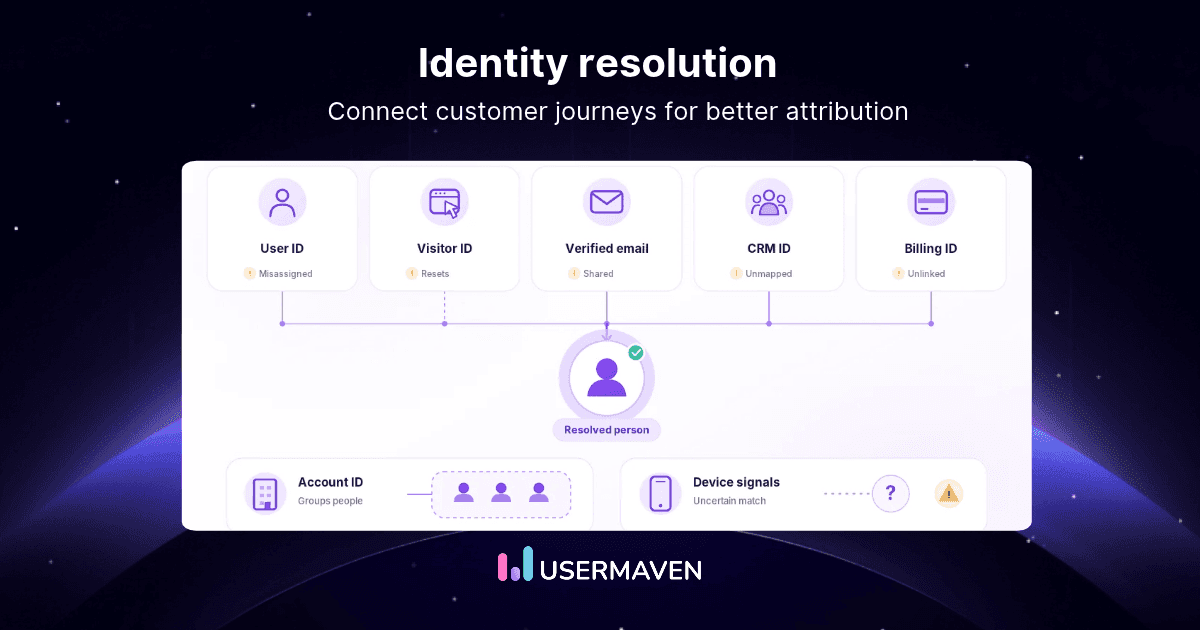
That is the problem identity resolution addresses.
By connecting records that reliably belong to the same person or account, businesses can understand more of the journey rather than treating every interaction as a separate customer.
This guide explains what identity resolution is, how its matching methods work, where mistakes happen, and how to check the quality of the resulting data.
It also shows why reliable identity connections matter when using marketing attribution software to understand which channels influence conversions and revenue.
Identity resolution at a glance
Identity resolution is the process of determining which identifiers, records, and interactions belong to the same person or account, then linking them into a consistent customer profile or identity record.
It can use known shared identifiers, statistical matching, or a combination of methods, depending on the system.
| Question | Short answer |
|---|---|
| What does it connect to? | Customer identifiers, records, events, and journeys |
| Main matching methods? | Deterministic and probabilistic matching |
| Common identifiers? | User IDs, anonymous IDs, email addresses, account IDs |
| Does it identify every anonymous visitor? | No; a trustworthy connection must exist or become available |
| Is it marketing attribution? | No; identity links interactions, while attribution distributes conversion credit |
| Main benefit? | More consistent journeys, customer analysis, and measurement inputs |
| Main risk? | Incorrectly merging people or failing to connect their records |
Key takeaways
- Identity resolution connects fragments: It associates records that genuinely refer to the same person or business entity.
- Matching methods have trade-offs: Deterministic matching uses shared identifiers; probabilistic matching estimates likely connections.
- A higher match rate is not automatically better: A false merge can be more damaging than leaving an uncertain record unresolved.
- Identity and attribution solve different problems: Identity tells a system which observed interactions belong together; attribution assigns credit to them.
- Measurement begins with captured data: No matching technique can reconstruct an interaction that was never recorded.
- Privacy still applies: Cookies, device signals, and customer identifiers need appropriate collection, access, and retention controls.
- Validation is essential: Test anonymous-to-known journeys, inspect duplicates, and measure unresolved events before relying on reports.
Unlock insights that drive growth
What is identity resolution?
The same customer can appear in several systems without a shared label.
A website may know someone as an anonymous visitor; an application may store an internal user ID; a CRM may hold an email and contact ID; and a payment platform may record a billing customer ID.
None of those records automatically proves that they belong to one person.
Identity resolution establishes trustworthy connections among those records so activity can be analyzed with fewer gaps or duplicates.
For example, when a visitor later signs in, a valid link between their anonymous browsing ID and authenticated account can preserve the earlier path to signup.
The objective is not to collect every possible identifier. It is to establish the right connections for a defined business purpose. A system can only unify the observations it receives, and a unified profile may still be incomplete.
What is the goal of identity resolution?
A well-designed approach reduces duplicate profiles, preserves continuity between anonymous and authenticated sessions, and helps teams connect customer behavior to outcomes.
That can improve reporting, audience analysis, and the ability to investigate why particular journeys converted.
It also requires choosing the entity carefully. A person, household, customer organization, and billing account are not interchangeable.
In B2B measurement, two employees can belong to one company without being the same person.
How does identity resolution work?
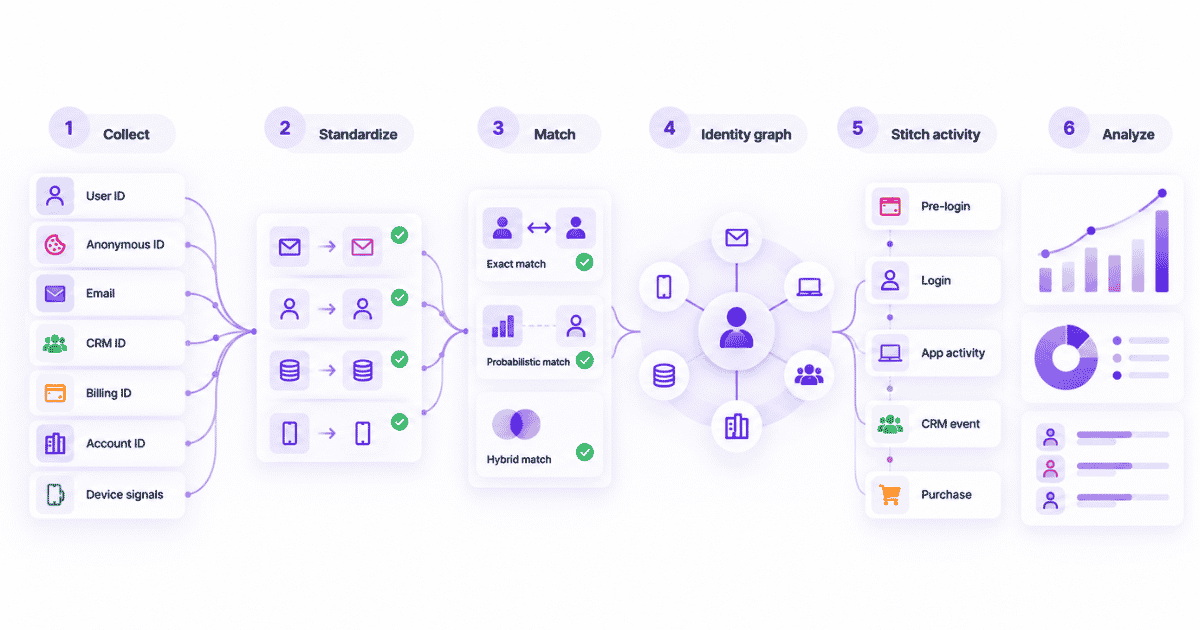
At a high level, the process runs from collecting identifiers to matching them and using the resulting associations.
Twilio Segment’s explanation of identity resolution describes a similar sequence, but the actual rules and data requirements vary by implementation.
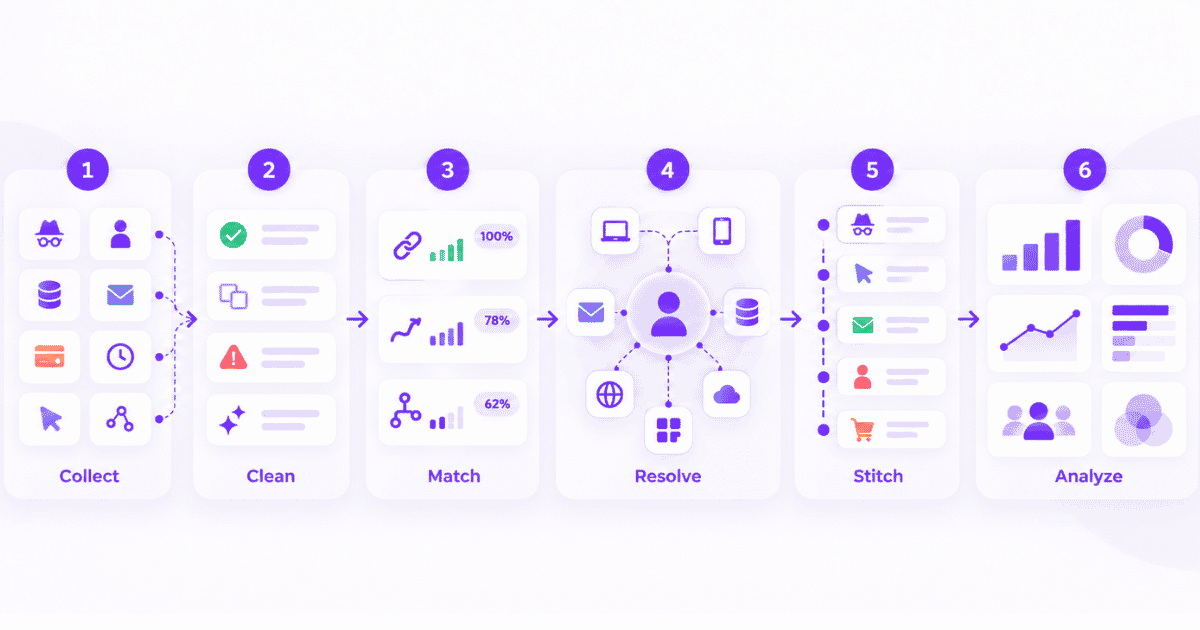
1. Collect customer identifiers
Capture the identifiers relevant to a legitimate measurement purpose: perhaps a website anonymous ID, authenticated user ID, CRM contact ID, billing ID, or verified email.
Keep the event timestamp and source as well, because identity is only one part of reconstructing a journey.
2. Standardize and assess input data
Normalize fields where appropriate, distinguish missing IDs from empty strings, and check for duplicate, reused, or unreliable identifiers.
A shared email address or misconfigured account ID should not automatically merge unrelated people.
3. Apply matching rules
An exact rule might connect records containing the same stable customer ID. A probabilistic system might instead score the likelihood of a connection using multiple allowed signals.
Some systems combine both. Every rule should have an explainable reason for accepting or declining a match.
4. Build or update the identity relationship
The matching layer associates records and identifiers with a resolved person or account.
Some platforms represent these relationships as an identity graph; others maintain linked profiles or mapping tables. The representation is less important than its consistency and auditability.
5. Connect earlier and later activity
When the right identification event occurs, a system can associate eligible pre-login interactions with an authenticated profile.
Later application, CRM, or billing events may join the same person when they carry compatible identifiers. This is commonly called identity stitching.
6. Use connected data in analysis
Resolved identities help analysts inspect conversion paths, funnels, user behavior, and customer-level outcomes.
They do not independently determine why a person purchased or prove that a campaign caused the purchase.
Identity resolution example: From anonymous visitor to paying customer
Consider a fictional B2B SaaS customer who discovers a product through a LinkedIn ad, reads an educational article, signs up, starts a trial, and purchases a subscription.
The journey exists, but the systems involved initially label the person differently.
| Event | Identifier in the system | What the team initially sees |
|---|---|---|
| LinkedIn landing-page visit | Anonymous ID A-104 | Unidentified website visitor |
| Blog and pricing-page views | Anonymous ID A-104 | Same browser’s earlier activity |
| Account signup and trial | User ID U-782 | Authenticated product user |
| Subscription payment | Customer ID C-501 | Billing transaction |
Suppose the website passes A-104 alongside U-782 during a valid identification step, and the billing system has a verified mapping between C-501 and U-782.
The company can now connect the captured marketing visit, signup, product activity, and payment to one known user.
Before resolution: The LinkedIn visit might look like an anonymous session, the trial like a new user, and the payment like an unrelated transaction. Acquisition-to-revenue analysis could be incomplete.
After resolution: The eligible activity can appear in one associated journey, making it possible to inspect which channel first introduced the customer and how their behavior developed before purchase.
But if the billing event contains no usable ID, the payment may remain separate.
And if two people share an email, merging them without stronger evidence can produce a false story. Linking fewer records correctly is preferable to linking more records carelessly.
Types of identity resolution
There are two principal matching approaches, plus hybrid implementations.
Deterministic identity resolution
Deterministic matching links records through a reliable shared identifier such as an internal user ID or a verified account reference.
For example, activity tied to the same authenticated application user can be associated even when collected by different services.
It is usually easier to explain and audit. However, exact matching can miss genuinely related records when a shared identifier is unavailable.
It can also be wrong if an ID was recycled, mapped incorrectly, or used by multiple people.
Probabilistic identity resolution
Probabilistic matching uses statistical methods to estimate whether records likely represent the same entity.
Depending on the provider and permitted data, signals might include device context, repeated patterns, or other characteristics.
It can help connect records that lack an exact common ID. In exchange, the system must manage uncertainty, confidence thresholds, and the possibility of false-positive matches.
A predicted relationship is not the same as a verified identity.
Hybrid identity resolution
A hybrid approach combines high-confidence deterministic connections with carefully governed probabilistic estimates.
It may be appropriate for complex enterprise customer datasets, but only if teams can inspect match decisions and control error rates.
| Dimension | Deterministic | Probabilistic | Hybrid |
|---|---|---|---|
| Match basis | Known shared identifiers | Estimated similarity or likelihood | Both approaches |
| Explainability | Usually straightforward | Depends on model design | Depends on rule hierarchy |
| Strength | High-confidence linking where IDs exist | Broader potential coverage | Balances coverage and certainty |
| Main risk | Missed matches or bad ID hygiene | Wrongly inferred matches | Complex governance |
| Best fit | Logins and first-party user tracking | Specialized identity systems | Large, multi-system datasets |
Not every marketing analytics platform offers all three methods.
For example, the public Usermaven guidance describes first-party anonymous-to-known identity stitching; it does not document an unrestricted third-party probabilistic identity graph.
Which identifiers are used in identity resolution?
An identifier is a piece of information a system uses to recognize a record or link it to another. Different identifiers offer different levels of persistence and certainty.
| Identifier | Typical role | Watch for |
|---|---|---|
| Internal user ID | Stable key for an authenticated person | Incorrect assignment across services |
| Anonymous visitor ID | Pre-login browser or visitor activity | Resets, blocked storage, changed context |
| Verified email | Match or contact detail | Shared addresses and account changes |
| CRM contact ID | Sales or lead record | Missing website-to-CRM mapping |
| Billing customer ID | Purchase and subscription events | No association with product user |
| Company or account ID | Grouping people under an organization | Mistaking one organization for one person |
| Device or contextual signals | Possible inputs to specialized matching | Instability, uncertainty, privacy restrictions |
For an analytics team, consistent first party data usually provides a more defensible starting point than trying to infer identity from weak signals. Strong identifiers still require good governance and correct implementation.
A company ID can connect multiple people to an account-level report, but must not silently combine their individual browsing histories.
This distinction is especially important in SaaS products with shared workspaces, agencies managing client accounts, and sales-led B2B journeys.
Identity resolution vs identity graph, verification, CDP, and attribution
Several adjacent concepts use similar language but answer different questions.
| Concept | Question it answers |
|---|---|
| Identity resolution | Do these records refer to the same person or account? |
| Identity graph | How are identifiers and their relationships represented? |
| Identity verification | Is someone who they claim to be? |
| Customer data platform (CDP) | How do we collect, organize, and activate customer data? |
| Marketing attribution | How do we allocate credit across observed marketing touchpoints? |
An identity graph is one way to store and navigate matching relationships. Identity verification, by contrast, may check documents or credentials to authenticate a person.
A CDP can include identity resolution as one of several capabilities, but the two terms are not synonymous.
The most important distinction for marketers is between identity and attribution. Identity resolution helps determine which events belong in a person’s observed journey.
Attribution then uses a selected model to distribute credit among eligible touchpoints.
Even multi touch attribution has limited value when earlier interactions are missing or associated with the wrong profile.
Why identity resolution matters in marketing
Connect anonymous and known customer journeys
Someone may read two educational pages while logged out, return from another source, and later register.
When a legitimate link between the anonymous ID and user ID exists, analysts can view the earlier activity alongside the signup.
This makes customer journey analytics more useful than a collection of isolated sessions.
Improve the inputs used for attribution
Imagine a first-touch campaign that attracts a visitor who later returns through branded search and converts.
If the earlier anonymous activity cannot be connected, branded search may appear to be the only measurable touchpoint.
Resolution can restore eligible observed context; the attribution model still determines how much credit each touch receives. It cannot assign credit to an interaction that was never captured.
Build more consistent segments
Duplicate records can cause the same customer to appear in different audience groups. Connected profiles help teams interpret past behavior and use customer segmentation software more consistently.
The benefits depend on profile correctness, current data, and appropriately defined segments.
Connect purchase and CRM outcomes
Marketing may be recorded on a website while a conversion happens in a billing platform or CRM.
If those events include compatible identifiers, teams can associate conversion value with an existing customer journey.
That can improve measurement of signup quality, opportunities, subscriptions, and revenue, not just raw leads.
Identity resolution use cases
B2B SaaS: Connect acquisition, trial, and revenue
A prospect discovers a software tool through LinkedIn, reads several articles, signs up, uses key features, and later helps their company purchase.
Person-level identity connects the original visitor to their product account; account-level associations help the team understand multiple stakeholders without combining them into one person.
These are distinct layers in a B2B SaaS measurement strategy.
Ecommerce: Connect product research to a purchase
A shopper discovers a product through a Meta campaign, revisits from search, checks out, and receives a transaction record in the ecommerce backend.
Matching an appropriate customer or visitor ID can associate the purchase with earlier observed research and improve the journey view for ecommerce brands.
Different devices or deleted browser identifiers can still create gaps.
Agencies: Follow a customer across a booking journey
A visitor lands on a campaign page, follows a link to an external booking domain, and submits an appointment.
Without suitable cross domain tracking, the booking may appear to belong to a different visitor.
The correct solution may involve preserving visitor context across configured domains, not purchasing a large identity graph.
How to implement identity resolution: Eight practical steps
1. Define the entity and business decision
Decide whether the goal is person-level journey continuity, account-level reporting, CRM matching, or connecting purchases to acquisition.
A model designed for individual users should not accidentally merge everyone who works at the same company.
2. Inventory the systems involved
List the website, app, analytics SDK, CRM, billing platform, booking tool, and other relevant systems. Record which identifier each one captures and whether that ID is available when a customer signs in or converts.
3. Choose stable identifiers
Use a permanent internal user ID for authenticated users wherever practical. Document how CRM or billing IDs map to it.
Do not treat an email as unique when your product allows shared addresses or multiple profiles associated with one email.
4. Write matching and exclusion rules
Specify when to join records and when to leave them separate.
Record what happens if an identity field is empty, multiple people match an email, or an ID conflicts with an existing profile.
Explicit uncertainty is better than an invisible guessed merge.
5. Stitch anonymous and known activity at identification
When the user signs up or logs in, pass the information required by your analytics implementation to associate the anonymous visitor with the authenticated profile.
Test the transition at the point it actually occurs, not only after a successful login.
6. Connect backend and external events
Ensure server side tracking sends compatible IDs. Include relevant timestamps and stable event identifiers to help with deduplication.
An invoice, CRM opportunity, or webinar attendance event should not be associated with an unrelated person simply because a field looks similar.
7. Apply privacy and access controls
Define a legitimate purpose for the identifiers, evaluate consent requirements where relevant, restrict sensitive profile access, and set appropriate retention policies.
Identity data should not become a general-purpose tracking asset without governance.
8. Test the complete journey and monitor errors
Create a test anonymous visit, navigate multiple pages, log in, generate an application event, and verify the timeline. Repeat with missing or ambiguous IDs.
Compare journey results and inspect whether events were matched, unresolved, or rejected.
| Implementation check | Evidence to look for |
|---|---|
| Tracking coverage | Expected pages and conversion events appear |
| Anonymous-to-known transition | Pre-login activity links to the correct identified user |
| CRM/billing connection | External event matches the intended record |
| Error handling | Ambiguous matches stay visible for review |
| Governance | Matching rules and changes are documented |
Common identity resolution challenges
A useful identity system must expose failures, not just successful matches.
| Symptom | Possible explanation | What to check |
|---|---|---|
| One person appears in two profiles | The identify event never connected the earlier ID | Tracking and identify order |
| Two people appear as one | Shared, recycled, or incorrect identifier | Match rules and ID assignment |
| Pre-login pages are missing | The browser event or context was not captured | Script load, storage settings, identification timing |
| Purchase has no associated customer | Billing event lacks compatible identity fields | User ID and billing mapping |
| Journey splits at checkout | Cross-domain context was not preserved | Domain configuration and consent controls |
| Email matches multiple contacts | Email is not a unique key in that dataset | Stable user or contact ID |
False positives vs. false negatives
A false positive means two records were linked even though they belong to different people. A false negative means records from the same person were left separate.
Both undermine analytics, but false positives can also mix one person’s activity into another person’s profile, creating privacy and reporting risks.
Avoid celebrating a rising match rate without checking why it rose. If coverage increases only because matching rules became much looser, the resulting profiles may be less trustworthy.
How to measure identity resolution quality
Identity resolution needs measurable checks that reflect both coverage and correctness. Some metrics require sampling or custom reporting; not every analytics tool exposes them as native dashboard tiles.
Match coverage
A practical definition is the proportion of eligible events that can be associated with the intended identity:
Match coverage = (Matched eligible events ÷ Total eligible events) × 100
For example, if 760 of 1,000 eligible events match the correct person, coverage is 76%.
The eligible-event definition must stay consistent; otherwise, the percentage can rise or fall just because the denominator changed. This is an illustrative calculation, not an industry benchmark.
Unresolved identity rate
Track events that have candidate identity information but cannot be assigned confidently.
An ambiguous email should not be counted the same way as a completely missing identifier or a rejected event. Those cases call for different fixes.
Duplicate and false-merge audits
Sample records that appear duplicated and profiles that combine several identifiers. Check whether they really belong together. A small manual review can reveal bad upstream IDs that an aggregate match-rate dashboard hides.
Journey continuity and revenue matching
Test whether expected pre-login and post-login interactions appear on the same timeline, and whether a purchase or CRM milestone belongs to the correct person.
Check a few real test paths before treating channel-level revenue changes as evidence of improvement.
| Quality check | Warning sign |
|---|---|
| Match coverage | A sudden drop after changing ID propagation |
| Unresolved events | Growing ambiguous-email matches |
| Duplicate profiles | One authenticated user appears under two IDs |
| False merges | Unrelated sessions share a profile |
| Journey continuity | Pre-signup activity disappears after login |
| Revenue association | Orders remain detached from known users |
The goal is confident matching, not a cosmetically perfect percentage.
Privacy and consent considerations
Identity resolution can involve personal data even when a field is pseudonymous or a person’s name is not visible.
A cookie ID, account ID, or device-related signal may still allow activity to be associated with an identifiable person when combined with other information.
Choose identifiers based on a defined purpose, minimize collection, control who can access linked profiles, and evaluate applicable rules for cookies, fingerprinting, consent, transparency, and retention.
Whether a specific practice is permitted depends on the jurisdiction and implementation; no tracking architecture is automatically compliant by virtue of being first-party or cookieless.
Cookieless tracking also comes with technical trade-offs. Removing persistent browser cookies can reduce continuity across visits or require a different identification sequence.
It does not mean an analytics system can reliably identify every visitor across unrelated devices.
Do you need identity resolution software or an API?
The answer depends on the scale and nature of the identity problem.
Existing analytics identity stitching may be enough when your goal is to connect a website’s anonymous visitor ID with a stable authenticated user ID, then analyze the same person’s captured activity and conversions.
A dedicated identity resolution platform may be justified when several business units need governed record matching across large datasets, complex entity relationships, identity graphs, or probabilistic approaches.
Evaluate how the vendor handles false merges, uncertain matches, deletions, and audit trails, not just its claimed match rate.
An identity resolution API or custom warehouse pipeline can suit engineering teams that need to programmatically submit records, maintain mapping logic, or control entity resolution centrally.
That offers flexibility but introduces monitoring, maintenance, and governance work. It should not be confused with a simple website identify call, which has a narrower purpose.
How identity resolution works in Usermaven
Usermaven supports first-party identity stitching that connects anonymous web activity to identified user profiles, alongside events, contact-level journeys, and attribution analysis.
The important product distinction is between merging an anonymous browser journey at identification and matching a later external event to a person who is already known.
Track anonymous website activity
With its default cookie-based setup, Usermaven’s tracking script assigns an anonymous visitor ID.
That ID allows eligible website interactions to be associated with the visitor’s browsing context before login.
It does not reveal a real name or guarantee continuity if storage is reset, blocked, or unavailable.
The Usermaven identity resolution documentation describes the anonymous ID cookie, the client-side identification process, and the testing steps for frontend and hybrid tracking.
Tracking must be installed and permitted for relevant activity to exist in the first place.
Connect the anonymous visitor to an identified user
When the visitor creates an account or logs in, the site can make a browser-side identification call using its permanent user ID.
In the documented workflow, Usermaven uses that identification step to connect eligible pre-login interactions to the known profile.
A simplified example looks like this:
usermaven(‘id’, {
id: ‘USER_12345’,
email: ‘customer@example.com’
});
The ID should refer to the actual user in the business’s own system. The email is additional context, not a reason to abandon a stable user ID.
In a hybrid browser-and-backend setup, the documented procedure passes the browser anonymous ID to the backend and includes it with the first server-side identify call when appropriate.
Match external conversions using Event Sources
A purchase, CRM deal, webinar registration, or offline transaction may occur outside the website. Usermaven’s Events capability includes Event Sources for bringing those actions into analytics.
Its July 2026 product update introduced Event Sources for payments, CRMs, webhooks, and CSV data, with identity resolution and attribution support.
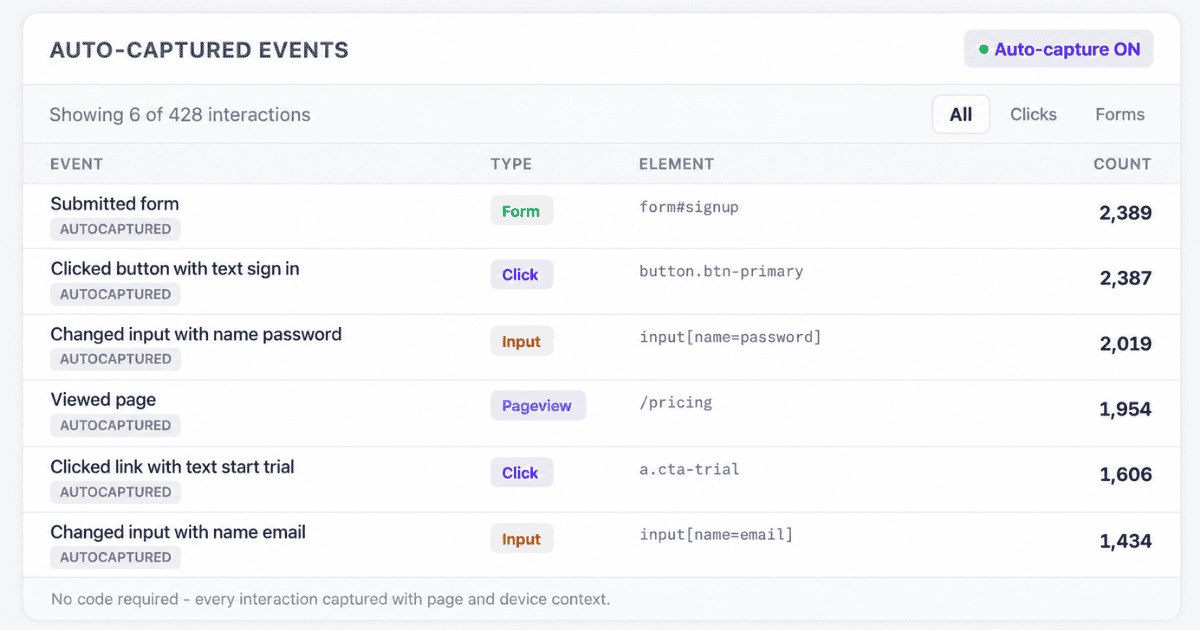
The Event Sources identity matching guide explains three important fields: user_id is the strongest way to link to an already identified person; anonymous_id preserves the relevant visitor lineage; and email is a fallback.
When an email matches multiple people, the event can remain counted but identity-unresolved rather than being assigned to someone arbitrarily.
Important distinction: Supplying identifiers in an imported Event Sources record does not, by itself, merge that visitor’s complete anonymous history into a user.
The website identification step performs that broader anonymous-to-known merge. This prevents a common misunderstanding about identity matching.
Explore the connected profile in Contacts Hub
After users are properly identified, Usermaven Contacts Hub helps teams inspect people and company activity rather than relying only on aggregate pageview counts.
The September 25, 2026 release added real-time updates to Contact Profiles and CSV exports for users, companies, and visitors, alongside richer profile analysis.
For a SaaS team, that creates a practical workflow: inspect the initial source, identify relevant content and product activity, and check what happened before the conversion.
A company-level view can supply context without pretending that every stakeholder is one person.
Validate the measurement foundation
Before changing budgets based on an attributed journey, inspect whether key events were captured and the user was correctly matched.
Usermaven’s Measurement Trust Center checks measurement setup, campaign tracking, customer matching, connected platforms, conversion feedback, and data confidence, then highlights corrective actions.
A useful test is to browse several pages in a fresh session, identify as a test user, and confirm that the earlier pageviews appear on the correct profile.
Then send a backend or imported event with the same stable user ID and inspect its outcome.
If expected activity is missing, check identification timing, cookies or privacy mode, and the IDs passed between systems.
Usermaven also supports cross-domain tracking for configured properties.
Between different registered domains, the documented cookie-based setup passes visitor context during navigation; simply adding independent sites to one workspace does not always make them one continuous journey.
Verify the actual domain configuration when testing multi-site funnels.
These steps give teams a way to connect identity work to trustworthy customer journeys, funnels, and attribution, not just a claim that all data is unified.
Customer story: Contentpen moved from traffic counts to customer journeys
Contentpen, an AI-powered publishing SaaS company, could see its organic traffic but struggled to understand how individual visitors behaved after landing or which content helped them convert.
According to its published Usermaven case study, the team used customer-level journeys, funnels, and Contacts Hub visibility to investigate activity and improve conversion-led content decisions.
The case study reports a 30–32% increase in conversions, 25–28% growth in engagement, and 50% less analysis time as part of the broader shift to Usermaven.
These are reported overall results, not a controlled measurement of identity resolution alone.
The useful lesson is narrower and more credible: viewing customer paths and meaningful actions together can help teams find points of friction that traffic totals alone cannot explain.
Identity resolution checklist
- Entity: Decide whether you are connecting individuals, accounts, or both.
- Inputs: Confirm that relevant events and identifiers are collected.
- Stable ID: Keep authenticated user IDs consistent across systems.
- Rules: Document when records should and should not merge.
- Stitching: Test the anonymous-to-known transition at signup or login.
- Cross-domain: Preserve visitor context across related properties when applicable.
- External events: Supply usable IDs for CRM, payments, and other conversions.
- Accuracy: Check duplicates, unresolved records, and false merges.
- Privacy: Apply relevant consent, access, and retention requirements.
- Validation: Inspect real journeys before relying on attribution results.
Final verdict
Identity resolution helps businesses connect fragments of a customer journey, but its usefulness depends on correct identifiers and defensible rules.
A profile that merges two unrelated people is not an improvement over an incomplete profile.
For marketers, the biggest benefit is more reliable context.
Connected journeys can make funnels, segmentation, and attribution more meaningful because the underlying interactions are associated with the right customer where the evidence supports that connection.
Start with first-party IDs, validate the login transition, audit unresolved events, and check downstream conversions. Improve match quality before chasing maximum coverage.
Want to connect your marketing touchpoints with customer journeys and revenue? Explore Usermaven to see how first-party identity stitching and connected analytics can support more confident growth decisions.
Frequently asked questions
What is identity resolution?
Identity resolution is the process of determining which records and interactions belong to the same person or account, then associating them in a consistent identity profile. It commonly uses shared identifiers, probabilistic methods, or both.
How does identity resolution work?
A system collects identifiers, prepares the data, applies matching rules, links related records, and uses those links to analyze customer activity. A reliable implementation also checks for missed matches and incorrect merges.
What are the types of identity resolution?
The main approaches are deterministic matching, probabilistic matching, and hybrid implementations. They differ in whether connections rely on known identifiers, statistical estimates, or a combination.
What is the difference between deterministic and probabilistic identity resolution?
Deterministic matching uses reliable shared identifiers, such as an internal user ID. Probabilistic matching estimates whether records belong together using multiple signals and a confidence threshold. The latter can extend coverage but also creates uncertainty.
What is identity resolution in marketing?
In marketing, identity resolution connects eligible customer interactions across visits, channels, and systems so teams can inspect more consistent journeys, segments, and conversion records. It is an input to attribution, not an attribution model itself.
What is an identity graph?
An identity graph is a representation of relationships among identifiers, records, and resolved entities. It can help systems determine which IDs belong together, although some tools implement identity linking through simpler profile mappings rather than a full graph.

Written by
Junaid Ahmed
Content Writer & Digital Marketer
Junaid Ahmed is a content and copywriter with 3+ years of experience creating research-driven content across SaaS, B2B, ecommerce, and digital marketing. He specializes in turning complex topics into clear, practical content that helps marketers better understand their challenges, evaluate solutions, and make informed decisions. His work spans educational content, industry insights, and actionable marketing guides.
All articles by Junaid →