A B2B purchase rarely depends on one person’s decision.
A marketing lead may discover a product, a technical evaluator may assess security, and a finance executive may approve the budget before someone else signs the agreement.
The final signer is not necessarily the person marketing reached first.
That is where account-based attribution becomes useful.
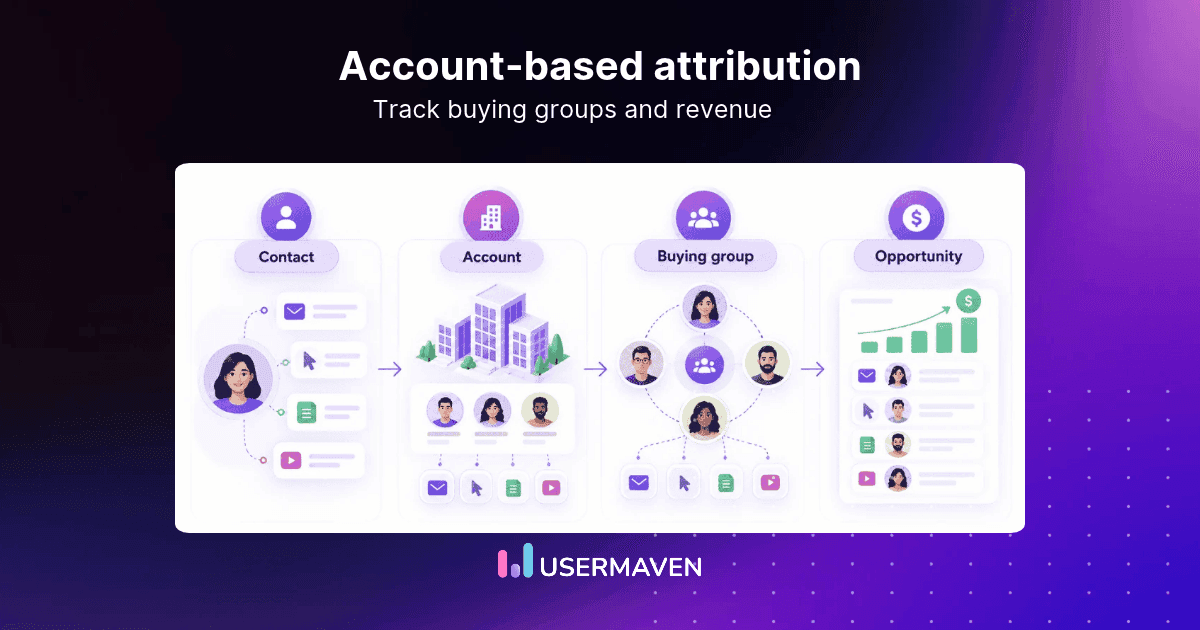
Instead of treating a single lead’s tracked journey as the whole story, teams connect eligible activity across contacts to the appropriate account and sales opportunity.
Good marketing attribution software can then put recorded marketing engagement alongside the pipeline and revenue outcomes that follow.
But an additional blind spot often appears at contract approval.
Signatures happen in a different system, deadlines change, and a deal may be marked Closed Won after the last document was executed.
This guide explains how to measure those milestones without mistaking administrative activity for marketing influence.
Key takeaways
- The opportunity is the outcome: Account-based attribution can connect interactions from multiple contacts to one defined deal, but one company can have several distinct opportunities.
- Signing authority is not marketing influence: A stakeholder may approve or sign an agreement without any eligible marketing interaction.
- Contract events provide context: Sent, viewed, signed, declined, and completed statuses explain deal progression, not automatic marketing credit.
- Identity and timing come first: Contact-to-account relationships, opportunity associations, event timestamps, and lookback windows determine what enters a report.
- Credit models are assumptions: First-touch, last-touch, and multi-touch models redistribute recorded credit; none proves causality.
- Validate before optimizing: Reconcile CRM outcomes and inspect actual buying-group activity before allocating budget based on an attribution report.
What is account-based attribution?
Account-based attribution is a marketing measurement approach that connects eligible interactions from people associated with a company to a selected account-level or opportunity-level outcome.
Rather than assuming a single lead represents the entire sale, it considers the recorded buying-group activity relevant to that deal.
The important word is relevant. A company can buy several products, renew a separate contract, or run multiple evaluations at once.
Marketing activity attached to an account should not be copied indiscriminately into every opportunity under that account.
Separating the account’s shared early touchpoints from the later touchpoints associated with individual opportunities helps preserve the correct relationship between activities and commercial outcomes.
Account-based measurement and multi-touch attribution are not alternatives.
The first defines which account, people, and opportunity are in scope; the second defines how credit is distributed among eligible touches.
Teams need both decisions to produce an interpretable report.
Unlock insights that drive growth
Contact vs. account vs. buying-group vs. opportunity attribution
B2B reporting becomes unreliable when the unit of analysis changes without anyone noticing.
A contact is a person; an account is an organization; a buying group is the set of people involved in a particular decision; and an opportunity represents one commercial transaction.
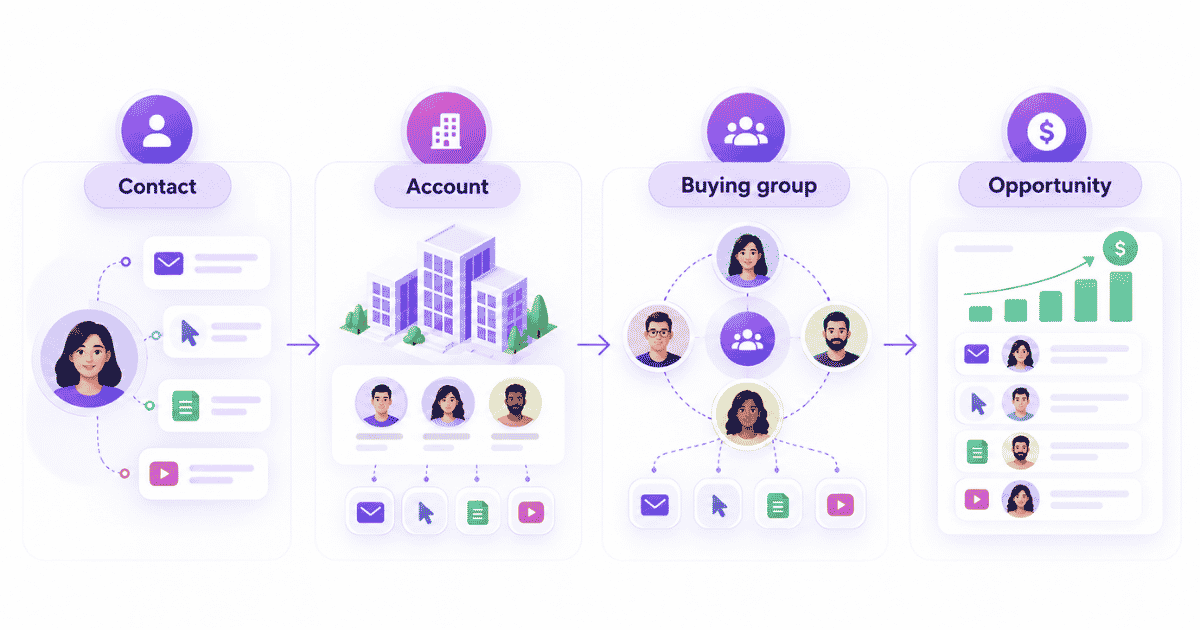
| Level | What it measures | Main reporting risk |
|---|---|---|
| Contact | Known individual’s captured interactions | One person’s activity stands in for the entire deal |
| Account | Combined activity associated with a company | Unrelated product evaluations are mixed together |
| Buying group | Activity of identified stakeholders for a specific decision | Important participants are missing or incorrectly included |
| Opportunity | Eligible interactions associated with a particular deal outcome | One touch is incorrectly credited across multiple deals |
These views can complement one another.
A content campaign may legitimately generate a known contact, while the revenue question requires that contact’s activity to be associated with the correct opportunity and its other participating stakeholders.
Adobe Marketo Measure’s account-based attribution documentation takes a similar view by separating the account’s shared early touchpoints from the later touchpoints tied to individual opportunities.
The existing B2B marketing attribution framework explains the larger connection between marketing and sales. This article focuses on the narrower problem of which people and contract milestones belong to which deal.
Why buying committees create attribution gaps
The researcher, champion, approver, and signer may be different people
A prospect may compare vendors, attend a webinar, and request a demo before introducing a procurement manager or executive approver. The procurement manager could negotiate terms by email, while the executive only receives the final agreement to sign.
That does not make the researcher’s journey unimportant, nor does it make the signature the decisive marketing touch.
It means the observable marketing journey and the organization’s approval workflow describe different types of activity.
Some stakeholders will have identifiable website or campaign histories; others will appear only in CRM notes, meetings, or agreement records.
An unrecorded marketing interaction must remain unrecorded rather than being reclassified as Direct traffic or retroactively assigned to someone else’s profile.
Identity and opportunity associations are incomplete
Contacts can use different email addresses, change employers, belong to subsidiaries, or participate in more than one buying group.
An account match based solely on a company domain may be enough for routing, but not enough to establish that an interaction influenced a specific opportunity.
Good identity resolution helps connect records where reliable identifiers support the relationship.
It cannot infer a missing decision-maker’s private discussion, and it should not merge several people into one user simply because they work for the same company.
The final agreement lives outside web analytics
Signature requests commonly take place in an external agreement tool.
Website analytics may capture a proposal-page visit but never observe that an agreement was sent, forwarded for approval, signed by another person, or allowed to expire.
That gap affects sales-cycle analysis, conversion timing, and the visibility of stalled opportunities. The remedy is not to create a marketing touch for each signature.
It is to preserve an accurate agreement event history and connect it to the correct CRM opportunity.
Contract timing changes the attribution window
A deal can spend substantial time in legal or procurement review after marketing has completed most of its work.
If the reporting outcome is defined at contract completion, a short lookback window may exclude earlier acquisition or nurturing activity.
The attribution window should reflect the defined conversion outcome and observed sales-cycle distribution.
Making every window longer without evaluating its consequences can also include weak or unrelated historical interactions.
Which contract-signing events should you track?
An agreement process produces useful operational evidence even when signers never become identifiable website visitors. Capture its status changes with the related opportunity ID and the best available event time.
| Event | What it establishes | Attribution treatment |
|---|---|---|
| Signature request created or sent | Approval workflow started | Sales process milestone, not marketing credit |
| Recipient opened or viewed | Document reached a recipient where the tool records it | Operational engagement, not assumed marketing influence |
| Individual signature completed | A named signer completed their step | Approval evidence, not automatic attribution touch |
| Request declined or expired | Agreement failed or stalled | Analyze conversion friction; not won revenue |
| All required signatures completed | Agreement execution milestone | May support a defined commercial conversion |
| CRM opportunity marked Closed Won | CRM’s final commercial status | Revenue outcome after reconciliation |
Some tools also support sequential signing, which shows when each role’s turn begins and ends.
When teams request signatures with Loio, they can set a signing order, monitor document status, and use a time-stamped audit trail to examine the agreement process. Those records can inform the CRM opportunity timeline if a business has a reliable way to transfer them.
This does not establish a native Loio-to-Usermaven integration, and a status notification should not be treated as a tracked advertising or content interaction.
Record the signer role when there is a legitimate business need, but do not convert job seniority into a credit multiplier.
A finance executive’s signature represents approval authority; it does not prove that executive encountered or responded to marketing.
How to connect buying-group activity to a signed opportunity
The goal is a defensible association chain: recorded interaction → known person → relevant company or account → specific opportunity → correctly timed outcome. Each connection needs an explicit rule and a way to check it.
1. Define the deal outcome before choosing a model
Choose whether the report measures demo requests, qualified opportunities, agreement completion, or Closed Won revenue.
These are separate outcomes, and a lead-generation conversion should not be silently replaced with the later value of a contract.
Set the opportunity type, currency, amount field, business unit, and exclusions. Decide whether renewals, expansions, partner-sourced deals, and new business belong in the same report.
Write down the rule that determines when an outcome is counted.
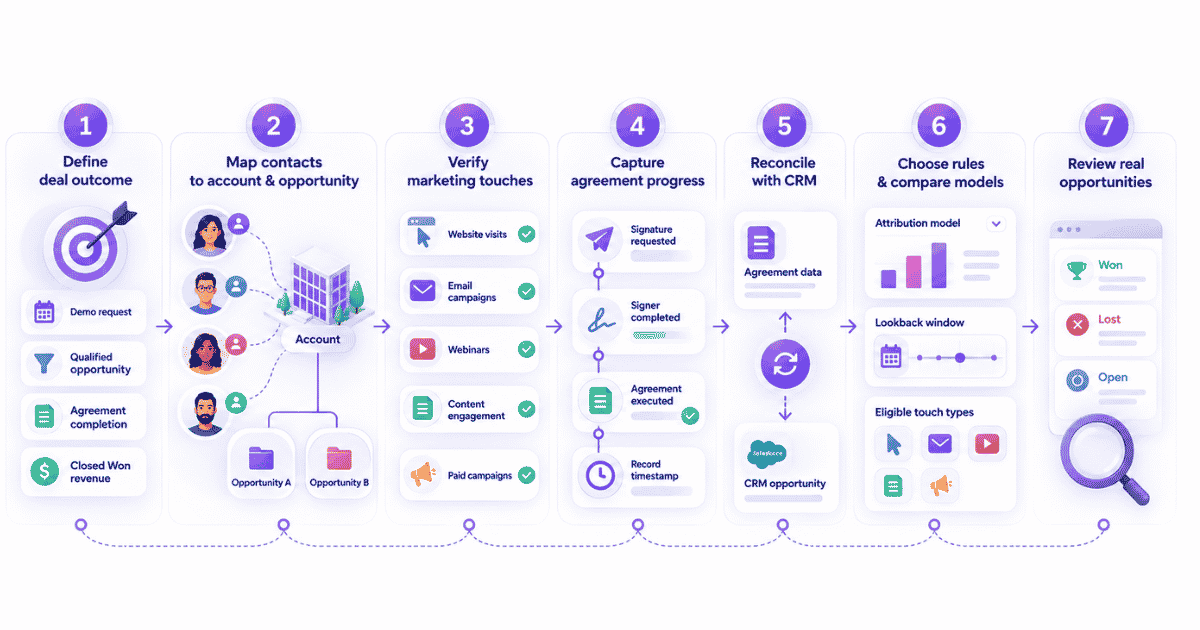
2. Map contacts to the right company and opportunity
Use stable CRM contact, account, and opportunity identifiers rather than names alone.
Confirm which stakeholders are actually associated with the opportunity, including known champions, evaluators, financial approvers, and signers.
Account-level inclusion should not erase deal-level scope. If one organization has two open opportunities, a webinar associated with the first should not automatically receive credit for the second.
Review opportunity-contact associations and account hierarchies before rolling up activity.
3. Verify eligible marketing touches
Check whether website visits, tagged campaigns, relevant emails, webinars, and other eligible interactions were actually recorded and tied to the correct contact.
Keep separate records for untracked activity rather than filling the gap with assumed Direct visits.
Consistent UTMs, tracking coverage, and identification timing make these associations easier to trust.
The goal is not to count every pageview as influence, but to have a defined set of eligible interactions that can be audited.
4. Capture agreement progress with accurate timestamps
Where available, save the date and status of the signature request, each completed signature, decline or expiration, and full agreement execution.
Store the document or request identifier alongside the opportunity identifier to prevent duplicate or mismatched events.
Be explicit about what each timestamp means. A signer-completed event, a fully executed contract, and a CRM Closed Won entry are not interchangeable.
If a sales representative updates the CRM later, preserve the original agreement event time rather than overwriting it.
5. Reconcile agreement and CRM outcomes
Compare contract completion with the CRM stage history, opportunity amount, and recorded close date.
Investigate discrepancies such as a contract amendment, a backdated deal, a partial execution, or a manually updated close date.
For a rigorous CRM attribution integration, the source record must remain identifiable after synchronization.
Agreement records help explain stage progression; CRM opportunities determine the reporting scope used for pipeline and won revenue.
6. Choose eligibility rules and compare models
Select a lookback window anchored to the reporting outcome. Decide which touch types qualify for credit, whether sales activities appear as contextual events, and whether contact histories must meet opportunity-specific rules.
Then compare models over the same opportunities, windows, filters, and outcome definitions.
A change in channel credit could be driven by a different formula, a different date, or a different set of eligible people. These differences should never be conflated.
7. Inspect real opportunities before publishing the numbers
Review a sample of won, lost, and open opportunities, including an account with multiple deals and one agreement that stalled. Compare the contact lists with tracked marketing activity, CRM stages, and signature-event history.
Document missing identities, incorrect opportunity associations, duplicate events, and unexpected date gaps. Only after those issues are understood should an attribution report guide a budget or campaign decision.
How attribution models handle buying-group activity
No standard model can compensate for missing identities or incorrect opportunity relationships. Models answer a narrower question: how does the chosen rule distribute credit among the eligible interactions you already have?
| Model | What it emphasizes | Buying-group limitation to check |
|---|---|---|
| First-touch | Earliest eligible interaction | Later committee engagement receives no credit |
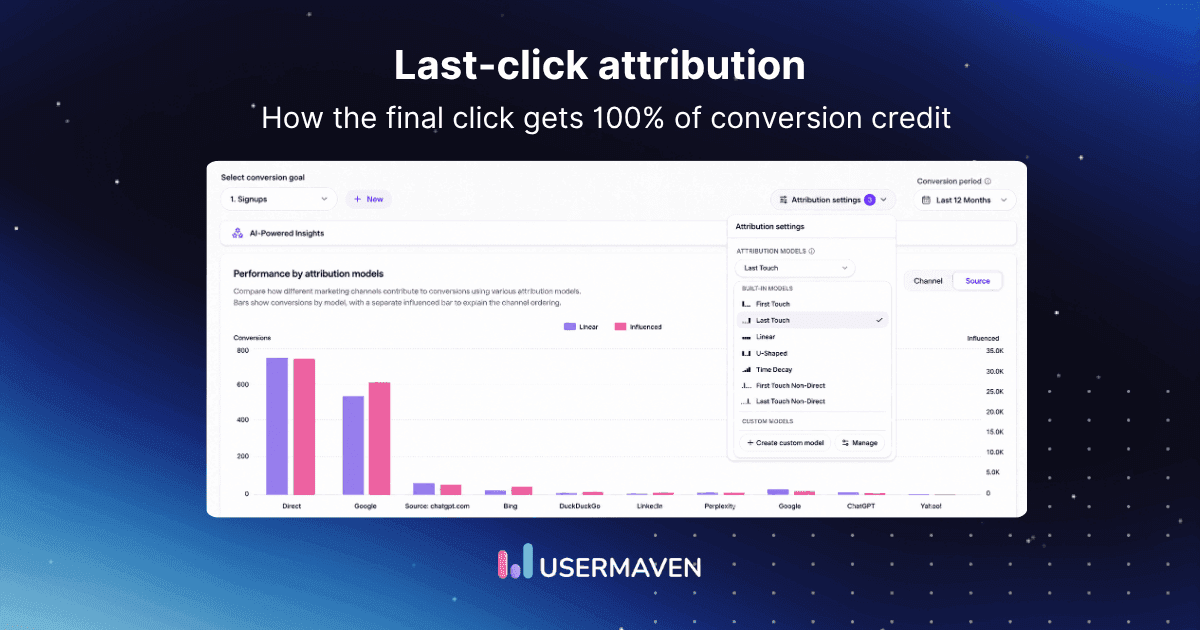
| Last-touch | Last eligible interaction before the outcome | Administrative or poorly tagged late activity may dominate if included |
| Linear | Equal share across eligible recorded touches | A brief visit and substantive session may receive equal credit |
| U-shaped or position-based | Two designated journey positions | Implementation-specific positions may not reflect buying milestones |
| Time decay | More recent eligible interactions | Early research may lose credit during long procurement cycles |
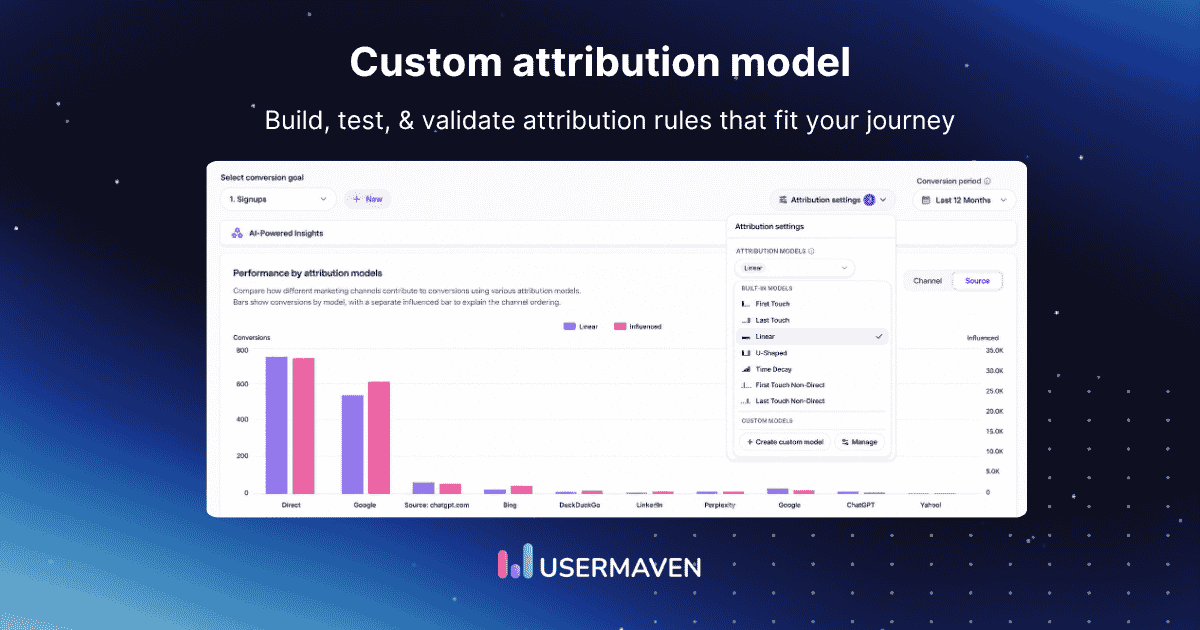
| Custom model | Business-defined position weights or channel adjustments | Chosen assumptions need transparent validation |
This comparison is only meaningful when the same contact/opportunity scope and conversion event are used.
The custom attribution model methodology becomes useful after teams can defend those inputs, not as a substitute for correcting them.
Credit allocation is not causal proof. A late-stage executive signature might be necessary for a sale without proving that any recorded channel would have lost the sale in that executive’s absence. Those are different questions.
What to check when the numbers look wrong
Several distinctive warning signs point to problems upstream of attribution weights. Treat them as investigation prompts rather than evidence that a particular model is defective.
| Warning sign | Possible explanation | First check |
|---|---|---|
| Only the original champion appears | Other contacts were never linked or tracked | CRM contact and opportunity associations |
| Direct receives an unusual share | Tagging or recorded return visits may differ by stage | Eligible touch sources and UTM coverage |
| Signed deals appear before their marketing touches | Timestamp or timezone mismatch | Event time, import time, CRM stage history |
| One account generates inflated attributed revenue | Multiple opportunity or duplicate outcome mapping | Opportunity ID and revenue deduplication |
| Declined agreements disappear from analysis | Only Closed Won outcomes are monitored | Agreement-stage reporting separate from attribution |
| Earlier campaigns lose all credit | Outcome date or lookback window changed | Same conversion event, window, and filters |
Two quality metrics are particularly useful here: buying-group coverage, meaning how many expected roles are connected to the opportunity, and opportunity association quality, meaning whether the recorded contact-to-deal links are correct.
These are proposed audit measures, not native Usermaven metrics.
You can also measure request-to-execution time and the share of agreements that expire or are declined. These operational measures may reveal procurement friction without inventing additional marketing credit.
How Usermaven connects marketing attribution with pipeline and revenue
Usermaven supports pipeline attribution by connecting acquisition channels and customer journeys with downstream conversion, opportunity, and revenue outcomes.
Its journey analytics and CRM integrations help teams inspect the recorded marketing context behind those outcomes.

Bring CRM opportunities into the marketing measurement workflow
The documented Salesforce integration imports contacts, accounts, opportunities, and deal-stage information into Usermaven.
Its purpose is to enrich tracked user and company activity with CRM context, not to invent unobserved stakeholder interactions.
Usermaven’s HubSpot integration similarly uses identified users and CRM contact associations to connect company, deal, and stage data.
The setup guide specifically notes that deals need appropriate contact associations and that website identify calls matter for linking marketing history.
Investigate contact activity and commercial outcomes
Contact Profiles provide visibility into identified people and associated activity, while conversion goals and attribution reports can connect eligible marketing sources with supported CRM events.
This is useful when sales and marketing disagree about where the known journey began or which stages are observable.
The result should not be described as a complete reconstruction of every committee member’s experience.
An executive who never generated a trackable interaction can remain a legitimate signer without a historical marketing journey in the analytics system.
Include external events without overstating what they mean
Usermaven Event Sources support imported events from configured webhooks and CSV data.
According to its event identity-matching documentation, stable user IDs and appropriate anonymous IDs or email can help associate external conversions with known people.
That capability can support a separately implemented contract milestone feed if the source system provides suitable records and identifiers.
The document-signing platform is not automatically connected just because a signed event exists elsewhere, and imported events do not replace browser-side anonymous-to-known identification.
Compare attribution views and validate pipeline results
Usermaven offers supported model comparisons and configurable lookback periods, so teams can see how channel credit changes when the rules change.
Its marketing attribution documentation describes the supported standard models and optional custom configurations.
For commercial decisions, relate that allocation back to actual opportunity scope and full-funnel revenue attribution.
A reliable report makes the tracked marketing-to-revenue connection explainable, while acknowledging incomplete committee coverage and events that never entered the measurement system.
Common mistakes in account-based attribution
Counting signers as marketing touches. Completing a document is usually an approval event.
If a genuine campaign interaction is recorded separately, evaluate it under the same eligibility rules as other marketing touches rather than assigning credit for the signature itself.
Assuming a company domain identifies the buying group. The account contains people with different responsibilities and potentially unrelated deals.
Review the relevant opportunity and contact associations instead of turning every account interaction into attributable activity.
Crediting one deal multiple times. Each opportunity has its own value and outcome timestamp. Check for duplicated stage events, amendments, and imports before summing attributed revenue across people or reports.
Changing the model before fixing the inputs. A custom weight may change the apparent channel winner, but it cannot connect a missing contact, recover an unrecorded interaction, or reconcile contradictory close dates.
Ignoring stalled approvals. Declined and expired requests should be analyzed as conversion-process outcomes even when they produce no Closed Won revenue.
Removing them from operational reporting hides useful information about contract friction.
Treating attribution as incrementality. A model allocates credit across observed activity.
Whether a campaign created additional sales requires a different evaluation approach, such as a suitable experiment or other causal methodology.
Account-based attribution checklist
- Outcome: Define whether the report measures qualified pipeline, executed agreements, or Closed Won revenue.
- Scope: Distinguish new business, renewals, expansions, and simultaneous opportunities.
- People: Confirm the relevant contacts, buying-group roles, and account relationships.
- Identity: Verify stable identifiers and keep unobserved activity unobserved.
- Marketing data: Check UTMs, campaign sources, event coverage, and eligibility rules.
- Agreement data: Preserve request, signature, decline, expiration, and completion timestamps where available.
- CRM alignment: Reconcile document completion, opportunity stage changes, and revenue amounts.
- Deduplication: Prevent one outcome or event from being counted several times.
- Model: Compare credit rules using the same people, outcomes, filters, and window.
- Validation: Audit representative won, lost, stalled, and multi-opportunity accounts.
- Governance: Record who owns the definitions and when they change.
Final verdict
A multi-signer agreement exposes a problem that broader B2B attribution guides can overlook: the people who discover and evaluate a product may be different from the people who approve and sign it.
The correct response is to connect reliable records around the opportunity, not to award credit to every signer.
Account-based attribution becomes more useful when buying-group associations, marketing interactions, signature milestones, and CRM outcomes are defined consistently.
Signature data explains how a deal progressed; attribution explains how eligible recorded marketing activity receives credit for the chosen outcome.
Start with a small audit of recent opportunities, then improve the identifiers, timestamps, and event definitions that cause the largest gaps.
Usermaven can help connect supported marketing and CRM outcomes so teams can make more defensible pipeline and revenue decisions.
Want to connect buying-group interactions with pipeline and revenue? Book a demo to see how Usermaven helps you track marketing touchpoints, analyze attribution, and understand which channels contribute to B2B deals.
Frequently asked questions
What is account-based attribution?
Account-based attribution links eligible marketing interactions from contacts associated with a company to a defined account or opportunity outcome. It helps B2B teams evaluate recorded buying-group engagement rather than reporting only one lead’s journey.
How is account-based attribution different from lead-based attribution?
Lead-based attribution typically focuses on the interactions of one person, while account-based attribution can combine relevant recorded activity across multiple associated contacts. The opportunity still needs clear rules to prevent unrelated account activity from receiving credit.
Does every member of a buying committee need a tracked web journey?
No. Some decision-makers participate through internal discussions, procurement, or contract signing without visiting tracked marketing properties. Their roles can still be documented in the CRM, but their missing interactions should not be fabricated for attribution.
Should contract signatures receive marketing attribution credit?
Not automatically. A signature is generally a legal or commercial process milestone, not evidence of a marketing touch. It may be useful as a conversion outcome or stage event when correctly defined and associated with the opportunity.
What if the same account has multiple opportunities?
Keep opportunity IDs, dates, contact relationships, and outcome values separate. An account-level report can provide context, but a touch should enter a given opportunity’s attribution only when it meets the documented association and eligibility rules.
Which date should an attribution report use for a signed deal?

Written by
Adeel Khan
Growth Marketing Expert
Adeel Khan is a full-stack SaaS marketer with 10+ years of experience in content marketing, paid advertising, analytics, and conversion rate optimization. He shares practical insights and strategies drawn from hands-on experience, helping B2B SaaS marketers improve performance and make better marketing decisions.
All articles by Adeel →